

A facelift should never look like surgery. The face should appear rested, balanced, and naturally refreshed — not tight, pulled, or frozen. In my experience an unnatural facelift is rarely caused by severe aging or poor skin quality; it is almost always the result of technical errors made during the operation. Patients seeking rejuvenation in Dubai consistently tell me the same thing: they want to look younger without looking done. Achieving that depends on a deep understanding of facial anatomy, precise planning, and, above all, restraint. When those principles are ignored, even a technically complex operation can produce an obviously operated result.
Key takeaways: natural results come from anatomy, not force
- An unnatural facelift is usually a technical error, not a consequence of aging or skin type.
- Over-tightening the skin is the most visible mistake — and a sign of insufficient deep correction.
- The SMAS must be repositioned with customized vectors, not pulled as one flat sheet.
- Releasing the retaining ligaments allows multi-directional repositioning without aggressive pulling.
- Over-correction ages the face, replacing soft contour transitions with a mask-like tightness.
- Facial balance across midface, jawline, and neck matters more than tightening any single area.
The evidence supports this emphasis on judgment over aggression. A 2016 review weighing the evidence behind the main facelift techniques concluded that, on the question of whether there is a best technique, the literature suggests the options are generally equal in efficacy — while adding, in the same breath, that this highlights the need for higher-quality research with standardized assessment before and after surgery. Read properly, that is a statement about how thin the comparative evidence is, not proof that every method performs identically. Either way it reframes the conversation away from how tight a face is pulled and toward how carefully anatomy is respected.
Why facelift results become unnatural
Facial aging does not happen because the skin loosens on its own. It happens because the deep tissues descend, the facial fat compartments shift, and the structural support weakens over time. When those changes are not properly addressed, a surgeon in Dubai is tempted to compensate by pulling harder on the skin. That may create a temporary improvement, but it inevitably leads to distortion as healing progresses.
A durable, natural result must be built on repositioning the deep structures rather than stretching the surface tissues — and most of the errors below are variations on the same underlying mistake of asking the skin to do the work the deep layers should be doing.
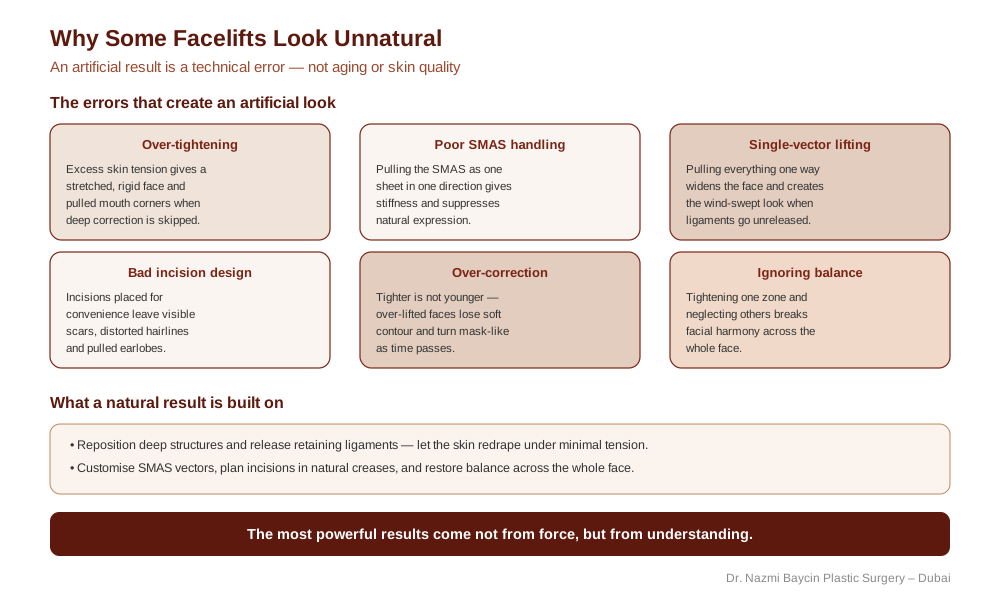
The technical errors that make a facelift look unnatural — and the anatomical principles that keep a result natural — by Dr. Nazmi Baycin, Dubai.
The common errors and how I avoid them
Most artificial results trace back to a handful of recurring technical errors, summarized in the table below.
| Error | How It Looks | How I Avoid It |
|---|---|---|
| Over-tightening the skin | Stretched, rigid face; pulled mouth corners | Lift through deep repositioning; let skin redrape |
| Poor SMAS handling | Stiffness, imbalance, suppressed expression | Customized vectors; reposition rather than over-tighten |
| Incorrect incision placement | Visible scars, distorted hairline, pulled earlobes | Incisions along natural creases and hairline transitions |
| Single-vector lifting | Widened face, wind-swept look | Release retaining ligaments; multi-directional lift |
Over-tightening is the most recognizable of these. Excessive skin tension produces a stretched appearance, restricts natural movement, and makes scars more visible; it usually happens when deep correction is insufficient and the skin is forced to bear the entire corrective load.
I avoid it in Dubai by deliberately minimizing skin tension, achieving the lift through deep structural repositioning so the skin can redrape naturally and scars heal discreetly. Mishandling the SMAS — the superficial musculoaponeurotic system that is the foundation of the lift — is just as damaging: treating it as a single sheet pulled in one direction creates rigidity and suppresses expression, because each region of the face ages differently and needs its own vector of correction.
I reposition rather than over-tighten this layer, securing it to maintain movement while providing durable support, an approach I describe in detail in my article on the high-SMAS technique and differential vector resuspension. Incisions, too, must be planned along natural creases and hairline transitions with an eye to how tissues heal over months, not how they look on the table. And single-vector lifting — pulling everything up or back — widens the face and produces the wind-swept look; this happens when the facial retaining ligaments are not adequately released, so I release them carefully to allow multi-directional repositioning without excessive force.
Why over-correction makes patients look older
There is a persistent belief that a tighter result looks younger, but in reality over-corrected facelifts often age the face. Youthfulness is associated with softness and balance, not tension: over-lifted faces lose their subtle contour transitions and develop a mask-like quality that becomes more obvious as time passes.
Skin quality cannot be forced, either — it is determined by biology, lifestyle, and how gently the tissues are handled, and pulling harder does not improve elasticity or texture. It compromises blood supply and delays healing. By preserving circulation and minimizing tension, healing is smoother, scars are finer, and long-term skin quality is protected.
Prioritizing anatomical restoration over maximum elevation is what allows the face to keep aging naturally after surgery rather than becoming rigid — the same restraint-first philosophy I set out in my piece on the art of the natural facelift and avoiding an overdone look.
Facial balance matters more than isolated tightening
Another common cause of an unnatural result is correcting one area while ignoring others. Tightening the jawline without supporting the midface, or lifting the neck without addressing cheek descent, creates visible imbalance. A facelift should restore harmony across the entire face, and in many cases lifting alone is not enough — strategic volume preservation or restoration may also be needed.
This is also why an isolated mid-face lift so often disappoints: the neck, chin, and jawline read as a single continuum, a relationship I explore in my article on the neck-chin-jawline continuum. Thinking in terms of the whole face is central to how I approach facelift surgery in Dubai, where combined techniques achieve balance rather than exaggeration. Because the right combination depends entirely on the individual face, both the plan and its cost are best worked out at a consultation.
Natural results come from anatomical respect
A natural facelift in Dubai restores facial structure without altering identity. By avoiding over-tightening, handling the SMAS with precision, releasing the retaining ligaments, and planning incisions carefully, the rejuvenation becomes invisible — the face simply looks rested rather than operated.
Facelift surgery leaves little margin for error, and consistent, natural outcomes require advanced anatomical knowledge, refined SMAS handling, precise incision placement, and the judgment to stop before over-correction occurs. That judgment, more than any single branded technique, is what defines careful plastic surgery in Dubai. In facelift surgery, the most powerful results are achieved not by force, but by understanding.
FAQs about unnatural facelift results in Dubai
-
What actually makes a facelift look unnatural?
An unnatural facelift is almost always the result of technical choices during surgery, not aging or poor skin. The usual culprits are over-tightening the skin, mishandling the SMAS layer, poorly planned incisions, single-vector lifting, and over-correction. Each of these forces the face into a stretched, rigid, or mask-like appearance rather than restoring its natural structure. When the deep tissues are repositioned properly and the skin is allowed to redrape under minimal tension, the face looks rested and refreshed instead of operated. The look of surgery is a sign of technique, not of the patient’s tissue.
-
Why does over-tightening the skin cause problems?
Over-tightening is the most visible facelift error. When the skin is placed under excessive tension, the face looks stretched, natural movement is restricted, the mouth corners can appear pulled, and scars become more noticeable. It usually happens because the deep correction was insufficient, so the skin is forced to carry the entire corrective load it was never meant to bear. The better approach is to achieve the lift through deep structural repositioning and to deliberately minimize skin tension. When the skin is not under strain, it redrapes naturally, scars heal more discreetly, and the face keeps its relaxed expression.
-
What is the SMAS and why does it matter so much?
The SMAS, or superficial musculoaponeurotic system, is the deep support layer of the face and the true foundation of a lasting facelift. A common mistake is to treat it as a single sheet that can be pulled in one direction, but the face does not work that way: each region ages differently and needs its own vector of correction. Over-tightening the SMAS creates rigidity and suppresses natural expression. Repositioning it with customized, region-specific vectors — rather than simply pulling it tight — is what maintains movement while providing durable, natural-looking support.
-
Why can a tighter facelift actually look older?
It seems counterintuitive, but over-corrected facelifts often age the face rather than rejuvenate it. Youthfulness is associated with softness, volume, and balance — not tension. When a face is over-lifted, it loses its subtle contour transitions and can take on a mask-like quality that becomes more obvious over time. Tightness reads as surgery, whereas a rested, balanced face reads as natural youth. By prioritizing anatomical restoration over maximum elevation, the face is able to continue aging naturally after surgery instead of becoming rigid, which is why restraint is such an important part of good technique.
-
Can pulling the skin tighter improve its quality?
No. Skin quality is determined by biology, lifestyle, and how gently the tissues are handled during surgery, not by how tightly the skin is pulled. In fact, excessive tension is counterproductive: it compromises the blood supply to the skin and delays healing, which can worsen scarring rather than improve texture. A well-executed facelift respects skin biology by preserving circulation and minimizing tension, so healing is smoother and scars are finer. Genuine improvements in skin texture come from careful handling and, where appropriate, adjunctive treatments — never from force.
-
Why is facial balance more important than tightening one area?
A face reads as natural when its regions are in harmony, so correcting one area in isolation often creates an imbalanced, operated look. Tightening the jawline while ignoring the midface, or lifting the neck without addressing cheek descent, throws the face out of proportion. The neck, chin, and jawline in particular behave as a single continuum, so an isolated mid-face lift frequently fails to deliver complete rejuvenation. A good plan restores harmony across the whole face, and in many cases combines lifting with volume preservation or restoration rather than relying on tightening alone.
-
How can I reduce my risk of an unnatural result?
The most important factor is the surgeon’s judgment and respect for anatomy, so choosing based on experience rather than price is the single best safeguard. Natural outcomes require advanced anatomical knowledge, refined SMAS handling, precise incision placement along natural creases, adequate release of the retaining ligaments, and the restraint to stop before over-correction. During a consultation, a careful surgeon assesses your individual facial structure and plans multi-directional correction tailored to it, rather than applying a single aggressive lift. Prioritizing subtlety and long-term balance over dramatic tightening is what protects against an artificial look.


GET APPOINTMENT
Get ready to look and feel best… You deserve…
