

Table of content
- What are the key takeaways about the neck-chin-jawline continuum in Dubai?
- Why do the neck, chin and jawline age as one unit?
- What does an isolated mid-face lift leave behind?
- How do I treat the whole continuum in one plan in Dubai?
- How does an isolated mid-face lift compare with an integrated facelift?
- When is a mid-face lift alone the right choice?
- Why does the integrated approach suit patients in Dubai?
- Where can you read about each part of a facelift in more depth?
- What do patients ask about neck and jawline rejuvenation in Dubai?
- Get appointment
This article covers why the neck, chin and jawline must be treated together and how I combine the three in one plan. The facelift techniques, candidacy, recovery, risks and cost are on facelift in Dubai; the methods for the neck and under the chin on double chin correction in Dubai; the deep-plane technique itself in deep plane versus SMAS facelift; the deep platysmal work itself, how the muscle is repaired beneath the skin during a facelift, in neck rejuvenation during facelift surgery; the signs of an overdone result in facelift errors and how they are avoided; and the complications of facelift surgery and the warning signs after it in facelift safety.
What are the key takeaways about the neck-chin-jawline continuum in Dubai?
The neck, jawline and chin share the same few structures, so a lift that treats only the cheeks leaves the rest behind and makes the mismatch visible.
- The neck, jaw and chin age together; the aging process ignores surgical boundaries.
- An isolated mid-face lift can accentuate a lax neck and an undefined jawline.
- The platysma muscle is the key driver of neck bands and jawline blurring.
- A corset platysmaplasty rebuilds the neck’s muscular sling for lasting support.
- A deep-plane lift repositions the SMAS-platysma as one unit, so the skin bears no tension.
- A recessed chin can undermine an otherwise excellent neck-and-jaw result.
Why do the neck, chin and jawline age as one unit?
Because they are tied together by the same few structures, and when those structures give way, every zone changes at once.
- The platysma muscle, a broad sheet running from the collarbone up into the lower face, separates with age into two vertical bands, the neck cords, and descends, pulling on the neck skin and obscuring the jawline.
- The mandibular ligament is the anchor that defines where the jawline ends and the neck begins. When soft tissue descends over it, the sharp angle of youth is lost.
- Fat under the chin adds a heaviness that persists even with a lifted mid-face.
- Chin projection matters: a mildly recessed chin makes normal fat under the chin look more prominent and leaves the neck muscles without adequate support.
A mid-face lift that ignores these connected elements is like tightening the center of a hammock while leaving the sides loose. It creates tension in one place and fails to resolve the overall sag.
| Structure | What it does in youth | What happens with age | What it needs |
|---|---|---|---|
| Platysma muscle | A continuous sheet supporting the neck and lower face | Separates into two bands and descends, pulling the neck skin | Repair of the sling in the midline |
| Mandibular ligament | Anchors the border between jaw and neck | Soft tissue descends over it; the angle of the jaw is lost | Redraping of the deep layer along the border |
| Fat under the chin | A thin layer under the chin | Accumulates and adds heaviness that a lifted mid-face makes more obvious | Removal, with the muscle and skin supported |
| Chin projection | Gives the neck-chin angle its foundation | A recessed chin makes fullness look worse and leaves the neck unsupported | Assessment, and augmentation where indicated |
How to read this table: read down the last column and notice that none of the four answers is delivered by lifting the cheeks; that is the whole argument of this article. Why fat removal without muscle and skin support lets a double chin return is the subject of my article on double chin recurrence after liposuction.
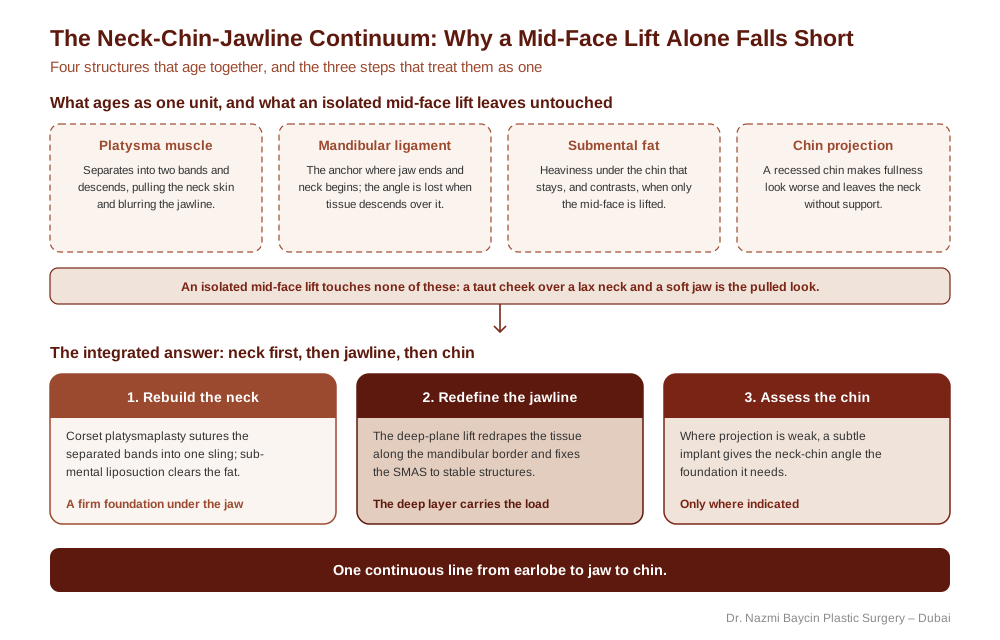
The neck-chin-jawline continuum: the platysma, mandibular ligament, submental fat and chin projection age as one connected system, so they are treated together, neck first, then jawline, then chin, by Dr. Nazmi Baycin, Dubai.
What does an isolated mid-face lift leave behind?
It leaves behind every part of the continuum it does not touch, and the contrast with the lifted cheek is what makes the result look operated. When surgery focuses solely on elevating the cheeks and the folds beside the nose, four disharmonies appear.
| Disharmony | What you see | Why it happens |
|---|---|---|
| The disconnect | Cheeks that look unnaturally full and high above a soft jawline and a lax neck | One zone lifted, the rest untouched; the classic sign of piecemeal surgery |
| Accentuated neck laxity | Looser skin and more visible bands below the jaw than before | Pulling the facial skin upward and backward increases the relative looseness of the neck |
| The persistent double chin | Heaviness under the chin that now contrasts starkly with a taut mid-face | The region under the chin was never treated directly |
| The lost transition | No continuous curve from the earlobe along the jaw to the chin | The deep layer was never redraped along the jawline border |
How to read this table: the middle column is what you would notice in the mirror; the right column is the reason a second operation is then needed. What each of these errors looks like, and how it is avoided, is set out in my article on facelift errors and how they are avoided.
How do I treat the whole continuum in one plan in Dubai?
With a composite deep-plane facelift that repositions the deeper structural tissues, the SMAS and the platysma, as one unified layer: the neck is addressed first, the jawline redefined second and the chin assessed last. This zonal thinking is well established in the literature. A 2022 technique article proposing five jawline zones and a five-step surgical approach sets out how the jaw-neck junction is evaluated and treated systematically rather than in isolation. It is a classification and operative description rather than an outcome study, so it supports the way of thinking, not a result. How the vectors of the lift are chosen so that your face moves naturally afterward is the subject of my article on the high-SMAS technique and differential vector resuspension.
Why is the neck treated first?
Because the neck is the foundation the jawline rests on, and a jawline redraped over an unrepaired neck has nothing firm beneath it. Through an incision of about three centimeters under the chin I perform a corset platysmaplasty: I suture the separated platysma muscles together in the midline, from the chin down to the Adam’s apple. This rebuilds a firm muscular sling, eliminates the bands and provides long-lasting support; why the repair has to be made in the muscle rather than the skin, and how the deep platysmal work is done, is the subject of my article on neck rejuvenation during facelift surgery. I often combine it with precise liposuction under the chin to remove excess fat, and the muscle repair is the support that makes the fat removal last. The individual methods for the neck and under the chin, and when each is used on its own, are on my page on double chin correction in Dubai.
How is the jawline redefined?
By redraping the deep tissues along the mandibular ligament with significant force, which recaptures the lost angle of the jaw. The deep-plane lift makes that possible. By securing the SMAS layer to stable facial structures, I create a sharp, natural jawline that appears effortless rather than tight, because the deeper layer bears the load and the skin carries no tension, which is also what keeps the face moving naturally afterward, as explained in my article on how a deep-plane facelift preserves expression. The marginal mandibular branch of the facial nerve runs along this border, so the redraping is done in a defined plane; the protocols that protect it, and the warning signs after surgery that need a call the same day, are in my article on facelift safety. What the deep plane is, and how it differs from a SMAS lift, is explained on my facelift page and in my article on deep plane versus SMAS facelift.
When does the chin need support?
When its projection is weak enough to undermine the neck-chin angle, because a recessed chin can spoil the result of even a perfectly executed neck lift. I assess chin projection at every facelift consultation. Where it is indicated, I incorporate a chin augmentation in Dubai, using a subtle implant to provide the structural foundation that completes the profile. Tightened neck muscles, a redefined jawline and proportional chin projection work together; each one makes the other two look better.
How does an isolated mid-face lift compare with an integrated facelift?
They differ in how much of the continuum they reach, and the table sets the two side by side.
| Feature | Isolated mid-face lift | Deep-plane facelift with neck recontouring |
|---|---|---|
| Cheek and nasolabial fold correction | Yes | Yes |
| Platysma muscle repair | No | Yes, corset platysmaplasty |
| Fat removal under the chin | No | Yes, liposuction where needed |
| Mandibular border redefinition | No | Yes |
| Neck band elimination | No | Yes |
| Chin assessment and augmentation | No | Yes, where indicated |
| Where the lift is carried | Largely by the skin | By the SMAS-platysma layer; the skin carries no tension |
| Incisions | Small, in the hairline | Around the ear and a short one under the chin |
| Risk of a pulled appearance | Higher when the neck is lax | Lower |
| The face it suits | Early cheek descent with a crisp jaw and neck | Cheeks, jawline and neck descended together |
How to read this table: each row is one element of the continuum; the left column is not a worse operation, it is a narrower one, and the section below says when narrow is right. How long each technique lasts, and its recovery, are on my page on facelift in Dubai.
When is a mid-face lift alone the right choice?
When the cheeks have descended but the neck and jawline have not, which is usually the younger patient with early mid-face sagging and a still-crisp jaw. In that face the endoscopic mid-facelift lifts the cheek through small incisions in the hairline without touching the neck, and it is the correct, honest answer rather than a compromise. The error this article is about is not the operation. It is applying it to a face in which the neck and jawline have already gone, and then expecting it to do what it was never designed to do. Which technique fits which face, and the health requirements for any of them, are on my page on facelift in Dubai.
Why does the integrated approach suit patients in Dubai?
Because the patients I see in Dubai represent a wide spectrum of skin types and genetic aging patterns, and the thicker, more sebaceous skin common across many ethnicities needs the strong, deep-layer support this technique provides to achieve a clean jawline. The desire for a polished appearance that withstands professional scrutiny and an active lifestyle makes a seamless, natural result from every angle non-negotiable. The outcome is not a face that looks done but one that looks revitalized and authentically your own, where the neck, jawline and chin exist in harmony with the lifted mid-face. The principles behind that natural look are the subject of my article on the art of the natural facelift. That harmony is the aim of all of my facial plastic surgery in Dubai.
Where can you read about each part of a facelift in more depth?
This article covers why the neck, chin and jawline are treated as one; the pages below cover each other part in depth.
- The techniques, candidacy, recovery, risks and cost: the facelift procedure page
- The neck and under the chin: double chin correction and why a double chin returns after liposuction alone
- Fat, muscle or both: how the neck is diagnosed: submental fat versus platysmal laxity
- The platysma repaired beneath the skin during a facelift: neck rejuvenation during facelift surgery
- The chin: chin augmentation and reduction
- The deep plane: deep plane versus SMAS facelift and the high-SMAS technique and differential vector resuspension
- Why the face keeps moving when the SMAS, not the skin, is lifted: how a deep-plane facelift preserves expression
- Complications, the protocols that prevent them and the warning signs: facelift safety
- The natural result: the art of the natural facelift and facelift errors and how they are avoided
What do patients ask about neck and jawline rejuvenation in Dubai?
Patients ask me why a mid-face lift alone fails, how I decide whether the neck needs treating, what a corset platysmaplasty is, whether they will need a chin implant and whether the neck can be treated on its own; the answers are below.
-
Why does a mid-face lift alone fail to rejuvenate the whole face?
Because it addresses the cheeks and the folds beside the nose and leaves the platysma muscle, the fat under the chin, the mandibular ligament and the jawline border entirely untouched. These structures age together as one continuous unit, so lifting one zone in isolation creates a visual mismatch: a taut mid-face against a lax neck and an undefined jaw. When the neck and jaw have not yet aged, a mid-face lift alone is the right operation; when they have, the whole continuum has to be treated.
-
How do you decide whether my neck needs treating with the facelift?
By examining the four structures rather than by your age or your request. I ask you to tense the neck and watch for the two vertical cords of a separated platysma; I run a finger along the jawline border to feel whether soft tissue has descended over it; I pinch under the chin to judge how much is fat and how much is loose skin; and I look at the profile to see whether the chin projects far enough to support the angle beneath it. If the cheeks have descended but those four are still sound, a mid-face lift alone is honest. If any of them has gone, it is treated in the same plan.
-
What is a corset platysmaplasty?
A technique in which the separated inner edges of the platysma muscle are sutured together in the midline, from the chin down to the Adam’s apple, recreating the muscular sling of the neck. Without that repair the platysma bands that cause a turkey neck persist however well the facial tissues are lifted. It is the foundational step that makes lasting neck rejuvenation possible, and in my integrated plan it is performed before the jawline is redraped.
-
Will I need a chin implant as part of my facelift?
Not necessarily, but I assess chin projection at every facelift consultation. A mildly recessed chin makes fullness under the chin look more prominent and blunts the neck-chin angle however well the neck and jaw are treated. So when augmentation is indicated, it is incorporated as a structural part of the plan rather than as an optional extra.
-
Can the neck be treated without a full facelift?
Yes, when the problem is confined to the neck and under the chin: fat can be removed, a loose platysma tightened or the neck skin lifted on their own, and those methods are described on my double chin correction page. The integrated plan in this article is for the face in which the cheeks, jawline and neck have all descended together, where treating one of them alone leaves the others behind.


Book a private consultation with Dr. Baycin in Dubai
Get ready to look and feel best… You deserve…
