

Key takeaways: the biomechanical approach
- A thigh lift balances three competing goals: contour, scar position, and functional mobility.
- The inner and outer thigh descend along different vectors, so they need different incisions and lift directions.
- The technique is an anatomical decision, not a preference — matched to where and how far the laxity extends.
- Three graduated levels: mini inner lift, vertical inner lift, and lateral/outer lift (often with a body lift).
- Durability depends on independent repair of the superficial fascial system (SFS), so the skin closes without strain.
- The groin’s lymph nodes must be respected to minimize the risk of long-term leg swelling.
This article is about matching the technique to the leg. Where a thigh lift sits within a wider plan after massive weight loss — which procedure comes first, and why the thigh is usually sequenced after the abdomen — is covered in my article on body contouring after massive weight loss.
The anatomical dynamics of thigh aging and weight loss
The thigh is a complex cylinder of skin, superficial fat, and deep structural fascia, suspended from the bony pelvis. Aging and weight loss destabilize this cylinder: the skin’s elastic recoil diminishes, the superficial fascial system weakens, and heavy, dependent tissue descends under gravity, producing the characteristic inner-thigh chafing zone, anterior knee bulk, and loss of a defined silhouette.
Crucially, the vectors of pull differ between the inner and outer thigh — inner-thigh descent is primarily vertical, toward the knee, while outer (lateral) descent follows an oblique vector, pulling down and backward. Treating these as the same problem with a single incision line is a fundamental error; each requires a distinct strategy to lift tissue along its natural path of descent, avoiding abnormal tension on sensitive structures like the labia majora in women or the scrotum in men.
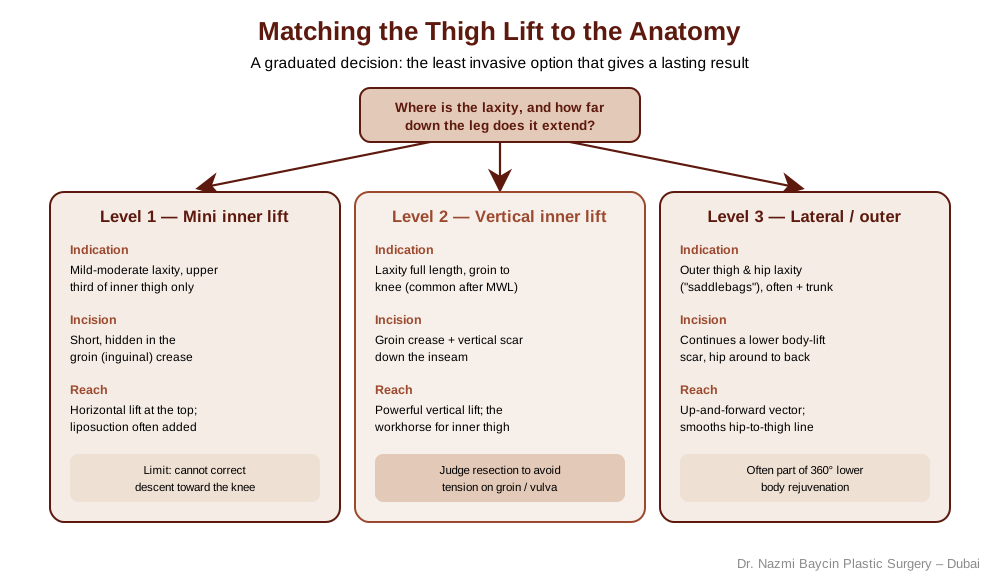
The graduated thigh-lift decision tree: technique matched to where the laxity sits and how far down the leg it extends, from a hidden mini lift to a full vertical or lateral lift — by Dr. Nazmi Baycin, Dubai.
The surgical decision tree: matching technique to anatomy
The choice of procedure is an anatomical mandate rather than a patient preference, following a graduated diagnostic system.
- A Level 1 mini inner thigh lift suits mild-to-moderate laxity confined to the upper third of the inner thigh with stable skin quality: a short incision is placed exclusively within the natural groin crease, the lift is minimal and horizontal, and liposuction is often integrated to refine adjacent contours — though it cannot correct descent extending toward the knee.
- A Level 2 traditional vertical inner thigh lift addresses significant laxity along the entire inner thigh from groin to knee, the most common presentation after massive weight loss; it requires a horizontal groin-crease incision plus a vertical incision down the inseam, removing a precise ellipse of tissue for a powerful vertical lift, with the artistry lying in judging resection to achieve tightness without harmful tension on the vulvar or groin structures.
- A Level 3 lateral or outer thigh lift addresses laxity predominating on the outer thigh and hip (the “saddlebag” area), often alongside back and abdominal laxity; the incision continues a lower-body-lift scar, circling from the front of the hip across the back and lifting tissue in an upward-and-forward vector — frequently the optimal choice for 360-degree lower-body rejuvenation.
| Level | Indication | Incision | Reach / limit |
|---|---|---|---|
| Mini inner lift | Mild-moderate laxity, upper third of inner thigh | Short, within the groin crease | Horizontal lift at the top; cannot correct descent toward the knee |
| Vertical inner lift | Full-length laxity, groin to knee (common after weight loss) | Groin crease plus vertical inseam scar | Powerful vertical lift; the workhorse for inner-thigh contouring |
| Lateral / outer lift | Outer thigh and hip (“saddlebag”), often with trunk laxity | Continuation of a lower-body-lift scar, hip to back | Up-and-forward vector; smooths hip-to-thigh transition |
The non-negotiable technical principles
Beyond incision choice, long-term success hinges on intraoperative discipline. The superficial fascial system (SFS) — the deep, durable layer of connective tissue — must be independently plicated with strong, permanent sutures, so it bears the long-term tension and allows the overlying skin to close without strain, which yields finer scars.
Conservative liposuction is a powerful adjunct to remove residual focal fat and feather transition zones around the knees and posterior thigh, but it is used with restraint, because the medial thigh does not forgive much. A pooled review of 447 medial thighplasty patients across sixteen published series found complications in 42.7 percent of them, most often wound dehiscence at 18.3 percent and seroma at 8.1 percent, with no major complications such as thromboembolism or sepsis. Its authors concluded that minor complications were common whatever technique was used — a finding about the operation as a whole rather than about any single manoeuvre, so my own restraint about aggressive liposuction in zones where skin will be excised is a practice principle rather than something that review tested.
The groin also houses critical lymph nodes, and meticulous, respectful dissection there is paramount to minimize the long-term risk of lower-leg swelling (lymphedema). Finally, the patient is positioned dynamically on the table — often in frog-leg or flexed positions — so the final closure sits under natural, functional tension rather than maximal stretch.
The goal: liberation, not constriction
A successful thigh lift is measured not in centimeters of skin removed, but in new-found freedom — from chafing, from clothing that never fits, from the burden of heavy, sagging tissue. The scars, while permanent, are the traded signature for that liberation, and my role is to engineer that trade to be as favorable as possible: placing scars in the most discreet locations while achieving the maximum functional and aesthetic benefit, so the leg looks and feels like a natural, lifted version of itself. Because the extent of surgery ranges from a mini lift to a circumferential lower-body lift, the surgical plan is always individualized to your anatomical diagnosis; the full details are set out on my main thigh lift surgery in Dubai page.
Why scar position is planned before the first incision
Patients often assume the scar is simply wherever the skin happens to be removed. In a well-planned thigh lift the opposite is true: the final scar position is decided first, and the resection is designed backward from it. The reason is that thigh tissue is mobile and heavy, and a scar that sits perfectly at the closing table can migrate over the following months if the deeper anchoring is inadequate.
The most common preventable complication of a medial thigh lift is scar descent — a scar planned discreetly within the groin crease that gradually drifts down onto the visible upper inner thigh, sometimes dragging the labia with it. This is precisely why the superficial fascial system is anchored independently to the stable, non-mobile tissue of the pubic ramus and Colles’ fascia at the groin. When that deep anchor holds, the skin closure carries no downward load, the scar stays where it was planned, and the surrounding structures are not distorted. The visible scar is therefore a direct readout of the invisible work done at the fascial level.
What recovery looks like after a thigh lift
Thigh lift recovery is more demanding than many patients expect, precisely because the thigh is a weight-bearing, constantly moving structure that cannot be fully immobilized. The first two weeks center on protecting the fresh suture line: I ask patients to walk gently to encourage circulation and reduce clot risk, but to avoid wide strides, deep squatting, and any movement that stretches the groin closure. Compression garments are worn continuously to control swelling and support the healing fascial repair. Wound dehiscence and seroma — a collection of fluid under the skin — are the most frequent minor setbacks, which is why drains and diligent garment use matter in the early phase. Most patients return to desk-based work within two to three weeks, resume light exercise around the six-week mark, and see swelling continue to settle over three to six months as the deeper tissues consolidate.
The scars mature more slowly still, typically softening and fading over a full year. I set out a specific, staged timeline for each patient at consultation, because the extent of the surgery — from a short mini lift to a circumferential lower-body procedure — changes the pathway considerably.
FAQs about the biomechanical approach to thigh lift surgery in Dubai
-
What’s the difference between an inner thigh lift and an outer (lateral) thigh lift?
They address tissue that descends along completely different paths. The inner thigh sags vertically, straight down toward the knee, while the outer thigh sags obliquely, pulling down and backward. Because the vectors of descent are different, each requires its own incision pattern and lift direction. Treating them as the same problem with a single approach is a common and avoidable error.
-
Will the scar be visible, and where exactly is it placed?
Scar placement depends on which level of correction you need. A mini lift confines the incision entirely within the natural groin crease, where it’s well hidden. A traditional vertical lift adds a second incision running down the inseam, and an outer thigh lift extends from the hip around to the back as part of a body lift pattern. In every case, I plan incisions along natural creases and tension lines to keep them as inconspicuous as possible.
-
How do you decide which level of thigh lift I need?
This is an anatomical decision, not a preference. I assess the location and severity of your laxity, whether it’s confined to the upper inner thigh, extends the full length toward the knee, or predominates on the outer thigh and hip, and match the technique to what your tissue actually requires. The goal is always the least invasive option that still achieves a lasting, functional result.
-
Is liposuction alone ever enough instead of a thigh lift?
Only when skin elasticity is still good and the primary issue is excess fat rather than loose skin. Once the superficial fascial system has weakened and skin is genuinely lax, liposuction alone won’t address that descent, and aggressive liposuction in areas that actually need skin excision can devitalize tissue and increase wound healing risk. I integrate liposuction conservatively, as a refinement alongside lift surgery, not a replacement for it.
-
What is lymphedema, and what’s my risk after this surgery?
Lymphedema is chronic swelling caused by disruption to the lymphatic vessels, and the groin contains an important concentration of lymph nodes that pass through the surgical field during a thigh lift. I take meticulous care during dissection in this area specifically to minimize this risk, since respectful handling of lymphatic tissue is one of the non-negotiable safety principles in this procedure.
-
How long is recovery, and when can I return to normal activity?
Recovery timelines vary by the extent of the procedure, but this is generally a major surgery with an extended recovery pathway rather than a quick turnaround. I’ll give you a specific timeline based on your surgical plan during consultation, including guidance on when walking, sitting, and exercise can safely resume as your incisions and the deeper SFS repair heal.


GET APPOINTMENT
Get ready to look and feel best… You deserve…
