

Key takeaways: treating the thigh and knee as one
- The bulge above the knee is a technique failure, not a necessary trade-off.
- It comes from a single vertical vector that gathers tissue instead of redistributing it.
- The fix is a multi-vector plan that blends the thigh smoothly into the knee.
- A high-suspension anchor to Colles’ fascia provides a fixed, durable foundation.
- Planning starts with a dynamic assessment of posture, gait, and seated position.
- All tension sits on the deep anchor, not the skin, protecting the scar.
Why standard thigh lifts often disappoint
Traditional thigh lifts use a reductionist strategy. They concentrate on the medial thigh and apply a single, mostly vertical vector of tension. This addresses medial laxity but rarely restores the leg’s true cylindrical contour. Two problems remain. The front of the thigh stays lax and undefined. And an abrupt, gathered ridge forms just above the knee — a visible demarcation that signals surgery rather than nature. The root cause is simple: a single vertical pull contradicts the limb’s three-dimensional reality. I see this most often in patients who come to me after surgery elsewhere. Their upper thigh is genuinely improved, yet they feel the result stops short of what they were promised. The disappointment is rarely about the amount of skin removed. It is about the transition — the eye is drawn straight to the ridge above the knee, and that single flaw undermines an otherwise sound operation.
Isolated lift versus the continuum approach
The two philosophies diverge at almost every step, as summarized below.
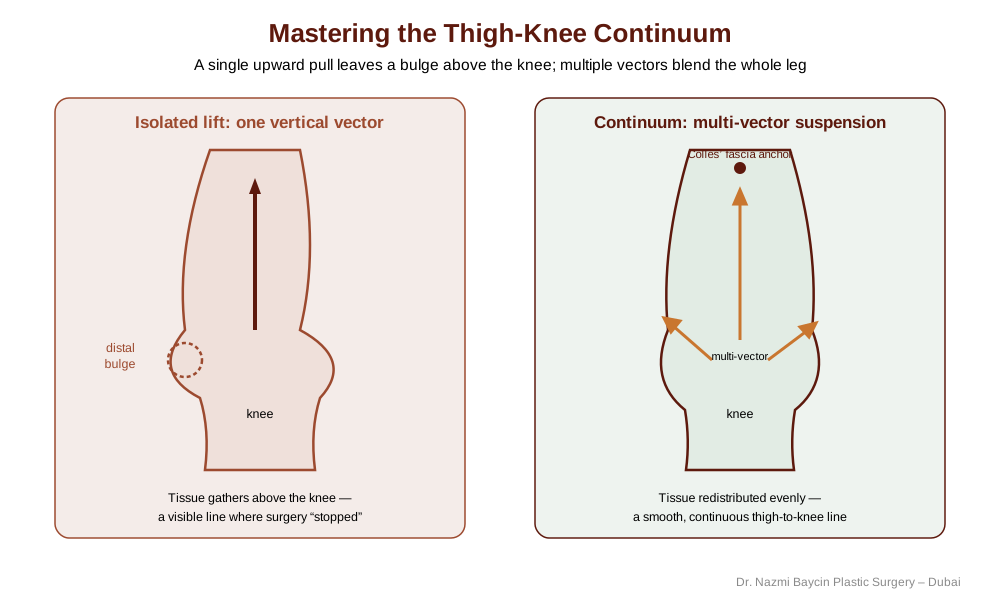
A single vertical vector gathers tissue into a bulge above the knee, while a multi-vector high-suspension approach anchored to Colles’ fascia blends the thigh smoothly into the knee — by Dr. Nazmi Baycin, Dubai.
| Element | Isolated thigh lift | Continuum approach |
|---|---|---|
| Zone treated | Medial thigh only | Medial, anterior, and the knee transition |
| Vectors | Single, vertical | Multiple — vertical, lateral, posterior |
| Knee result | Gathered bulge above the knee | Smooth, integrated drape |
| Anchor | Skin or shallow tissue | Deep high-suspension to Colles’ fascia |
| Scar behavior | Tension on skin → migration risk | Load on anchor → finer, stable scar |
Your personalized blueprint: a dynamic 360° assessment
Planning begins with movement, not static measurement. I assess posture, gait, and seated position to see how skin, fat, and fascia behave in motion. This reveals each patient’s anatomical signature: the patterns of laxity, the pockets of resistant fat, and the precise interaction between the distal thigh and the knee. That mapping drives a fully customized, composite plan. It may combine a vertical medial lift for core laxity, targeted fat removal to refine the anterior and lateral thigh, and a carefully designed knee blend so the lifted tissue meets the natural knee contour without a seam. To learn more about the fat-refinement component, visit liposuction surgery in Dubai.
The high-suspension technique: engineering a natural drape
To unify the thigh and knee into one flowing line, I use a high-suspension technique. It anchors the deep superficial fascial system to a fixed pelvic structure — Colles’ fascia. This concealed foundation delivers two advantages.
- First, it establishes a strong, enduring vector for vertical elevation.
- Second, it lets me modulate secondary vectors, pulling not only upward but laterally and posteriorly, which is the technical key to effacing the distal bulge and smoothing the drape over the knee.
Because the load spreads across a broad, deep anchor, tension on the incision line stays low, favoring a finer scar. The anchoring principle behind this is long established. A foundational 1988 single-surgeon series of eighteen patients introduced fascial anchoring to the medial thigh lift, and reported that suspending the flap from the tough, inelastic Colles’ fascia reduced the inferior scar migration, labial separation, and early recurrence of ptosis that had kept earlier techniques from wide acceptance. To learn more about the core operation, visit thigh lift surgery in Dubai.
Are you an ideal candidate?
This approach suits the patient with significant laxity across the whole thigh — medial, anterior, and extending toward the knee. Ideal candidates are at a stable weight, in sound health, and hold realistic expectations about scar placement and recovery. Because the thigh often changes alongside other areas, this work is frequently planned within a broader body-contouring strategy. To learn more about combining procedures, visit body contouring surgery in Dubai. During consultation, we confirm whether this or a modified technique fits your anatomy and goals, and the surgical plan is mapped out with you in detail at that stage.
Your recovery journey
Recovery extends the precision of the surgery. You are guided through a structured protocol: a custom-fitted compression garment for targeted support, gentle manual lymphatic drainage to manage swelling, and initial walking with a slight hip and knee flexion to protect the deep suspension. Most patients find discomfort well controlled. Within six to eight weeks, as swelling settles, the refined contour emerges — a leg where the transition from thigh to knee looks innate. The final result continues to refine over the following months as the deep tissues fully settle and the scars soften and fade into their creases. That commitment to anatomical truth runs through all of my plastic surgery practice in Dubai.
FAQs about the thigh-knee continuum in thigh lift surgery in Dubai
-
What exactly is the distal bulge above the knee and why does it happen?
This is a gathering or accumulation of tissue just above the kneecap that appears after thigh lift surgery performed with a single upward vector. When tension is applied purely vertically along the medial thigh, the skin and soft tissue above the knee is compressed rather than redistributed — creating a visible, often permanent bulge that demarcates exactly where the surgery stopped. This is the anatomical equivalent of sweeping a carpet to the edge of a room and leaving the pile at the skirting board. The multi-vector approach distributes this tissue evenly so no accumulation forms.
-
What is Colles’ fascia, and why is anchoring to it important?
Colles’ fascia is a dense, strong layer of connective tissue in the perineal region that attaches to the ischiopubic rami — a fixed, bony structure. Anchoring the superficial fascial system of the thigh to Colles’ fascia creates a suspension point that does not move, stretch, or fatigue over time. Unlike anchoring to skin or shallow subcutaneous tissue (which yields quickly), this deep fixation creates a foundation capable of bearing the mechanical load of the lifted tissue permanently. The durability of the result depends directly on the strength and stability of this anchor.
-
Why is a dynamic assessment necessary — why not just measure the thigh statically?
Because the behavior of the thigh during movement is not predictable from its static appearance. I need to understand how skin, fat, and fascia redistribute when you walk, sit, and change position — because the surgical result must look natural in all these states, not just when you are standing still. A purely static assessment misses the patterns of laxity that only appear in motion, and risks creating a result that looks acceptable in a photograph but reveals its flaws during ordinary activity.
-
Will there be visible scars, and where will they be placed?
The primary incision is placed in the groin crease — a natural skin fold that provides excellent concealment when the legs are together. Its length depends on the extent of correction required. Additional incisions may be placed in the inner thigh or posterior crease depending on which zones require direct treatment. All closures are performed under zero tension — the suspension anchor bears the load rather than the skin — which is the primary determinant of scar quality. Fine, well-healed scars in anatomical creases are achievable and expected; wide, hypertrophic scars are a function of poor closure technique, not the procedure itself.
-
Why do I need to keep a slightly flexed hip and knee position in early recovery?
Because the deep fascial anchor needs approximately six weeks to integrate and develop the fibrous ingrowth that makes the suspension permanent. During this period, sudden full extension at the hip or knee places direct traction on the anchor site. Walking with a slight protective flexion protects this attachment during the critical early healing window. Most patients find this adjustment natural within the first week and barely notice it by week three as their range of motion gradually returns.
-
Can a thigh lift be combined with other body contouring procedures?
Yes, and it frequently is — most commonly with liposuction of the lateral thigh, posterior thigh, and knee area to complement the lifting by addressing resistant fat deposits that the lift alone cannot treat. Combining VASER liposuction with the high-suspension lift produces a more complete 360° result than either technique alone. In appropriate candidates, it may also be combined with a tummy tuck or arm lift in a single operative session, with the usual caveats about operative time, blood loss assessment, and overall health status.


GET APPOINTMENT
Get ready to look and feel best… You deserve…
