

Key takeaways: reconstruction, not simple augmentation
- The post-weight-loss breast has a triad of deficiency: lost volume, a stretched inelastic skin envelope, and weakened internal support.
- A lift alone leaves a higher but still deflated breast; an implant alone overloads weakened tissue.
- The technique sequences platform, then implant, then skin drape — not three separate events.
- The implant is placed submuscularly for maximal soft-tissue coverage in thin patients.
- Multi-point internal fixation builds a cradle that offloads weight from the skin.
- Skin is closed under zero tension — the key to fine rather than wide scars.
The anatomical aftermath: a triad of deficiency
To plan effectively, one must first understand the compromised anatomy of the post-massive-weight-loss breast, summarized in the table below. The breast loses both fat and glandular tissue, leaving a thin, often atrophic layer that cannot be reshaped by auto-augmentation alone; it needs volume substitution. The skin has been stretched beyond its elastic recovery, acting as a loose, inelastic drape that cannot be relied on to shape or support an implant. And the internal support has failed — Cooper’s ligaments are irreversibly stretched and the inframammary fold is often malpositioned or indistinct. This triad dictates a philosophy opposed to standard augmentation-mastopexy: here the implant is not an accessory to the lift, but a structural component integrated into a newly engineered support system.
| Deficiency | What has happened | Surgical consequence |
|---|---|---|
| Volume depletion | Loss of fat and glandular tissue, leaving thin parenchyma | Volume must be substituted with an implant, not native tissue alone |
| Envelope damage | Skin stretched beyond elastic recovery, loose and inelastic | Skin cannot shape or support the implant |
| Support-system failure | Cooper’s ligaments stretched; inframammary fold malpositioned | Internal support must be rebuilt and anchored |
The surgical imperative: sequencing as strategy
The greatest technical error in these cases is treating implant placement and the mastopexy as separate events. They are a single, continuous reconstructive act, and my sequence is deliberate.
- First, I create a stable, vascularized pocket by performing the mastopexy parenchymal reshaping: using an inferior or central pedicle, I build a robust pillar of native tissue and suture it to the chest wall to establish a new, higher inframammary fold and a stable internal platform designed to bear weight.
- Second, I place the implant in a complete submuscular plane, beneath the pectoralis major and often the serratus fascia, which gives maximal soft-tissue coverage to camouflage the implant in thin skin and uses the muscle as a living sling to support its weight.
- Third, only after the implant is securely positioned do I tailor the skin, redraping it over the new mound and closing under zero tension — the tension borne by the deep parenchymal sutures and muscle, not the skin edges.
This is the single most important factor in preventing wide, hypertrophic scars.
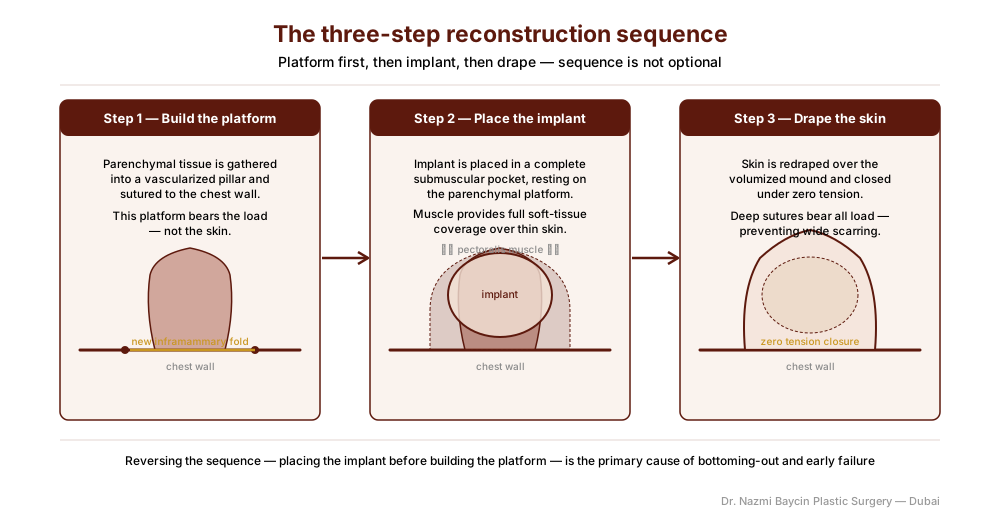
The reconstructive sequence — platform, then submuscular implant, then a zero-tension skin drape — by Dr. Nazmi Baycin, Dubai.
This sequence — platform, then implant, then drape — is the cornerstone of a stable outcome, and it reflects an established reconstructive principle. A fifteen-patient case series of mastoplasty with a submuscular autoprosthesis after massive weight loss stabilized the breast mound with an inferior-pedicle flap positioned under the pectoralis muscle, reporting that the new contour and nipple position stayed stable and the upper pole kept its fullness over at least six months of follow-up. That series restored volume with the patient’s own tissue rather than an implant, and its outcomes were assessed by the operating team rather than independently, but the structural logic is the same: build and anchor the support before relying on the skin. It is why patients seeking definitive post-weight-loss breast restoration must choose a surgeon proficient in reconstructive principles.
Implant selection: the principle of physiological load
The choice of implant is guided by the law of diminishing returns, because larger implants exert greater gravitational force on already weakened tissues. I typically select a moderate or high-profile implant to achieve the necessary projection with a narrower base width, reducing lateral stress on the skin envelope.
A cohesive gel implant is preferred for its stability and reduced risk of rippling in patients with thin soft-tissue coverage. The guiding “Goldilocks” principle is that the implant must be large enough to fill the skin envelope without stretching it, but small enough to be fully supported by the reconstructed internal platform and muscle — overfilling is a primary cause of early bottoming-out.
This adaptation to compromised anatomy is not unique to my practice: a Swedish registry study of 817 post-bariatric augmentations against 3,512 controls found that these patients more often receive larger and textured implants and more frequently have a mastopexy at the same time, while the subfascial and subglandular pockets common in standard augmentation are chosen less often — deep placement was already predominant in both groups. It reflects how routinely the technique must be adapted to this complex anatomy.
The non-negotiable elements of internal support
Beyond the muscle, additional reinforcement is mandatory, and I use a multi-point fixation system. The newly created parenchymal pillar is sutured to the periosteum of the underlying rib; the medial implant pocket is tightly closed to prevent symmastia; and the lateral breast tissue is sutured to the serratus fascia to prevent implant migration. Together these create a custom-made anatomical cradle for the implant — the internal architecture that a breast lift (mastopexy) in Dubai relies on to hold its shape over time. The same reconstructive judgment underpins how I approach breast augmentation in Dubai when volume restoration is the priority.
Repositioning the nipple without compromising its blood supply
One detail deserves particular emphasis in these patients, because it is where reconstruction and safety intersect: the nipple-areola complex often has to travel a long distance to reach its new, elevated position, and after massive weight loss the tissue carrying its blood supply is already thinned and fragile.
Moving it too aggressively, or on an unreliable pedicle, risks partial or complete loss of the nipple — an outcome far harder to correct than any contour issue. This is why the pedicle that carries the nipple is planned as carefully as the platform beneath it. I keep the nipple attached to a robust, well-vascularized column of tissue rather than detaching and grafting it wherever possible, preserving both sensation and viability.
In the rare cases where the travel distance is extreme, that trade-off is discussed openly beforehand, because protecting the living nipple always takes priority over shaving a few millimeters off an ideal position.
Candidacy and timing: the rules of engagement
This procedure is not for every post-weight-loss patient, and strict criteria apply. Weight must be stable for a minimum of 12 months, with a BMI ideally below 30 for optimal healing. Lab work must confirm no deficiencies in the protein, vitamins, or minerals critical for wound healing.
Expectations must be realistic — the goal is dramatic improvement and restoration, not perfection, and some skin-quality limitations are permanent. And the patient must be committed to a prolonged, structured scar-management protocol. Because this restoration is usually one part of a wider transformation, it is often planned alongside my broader approach to body contouring in Dubai, and the order in which the abdomen, breasts and limbs are addressed is set out in my article on post-bariatric body contouring for the massive weight loss patient, with staging decided case by case.
Recovery: protecting the reconstruction
The postoperative protocol is extended and vigilant. Patients wear a supportive bra 24/7 for 8–12 weeks, and any heavy lifting or strenuous activity is prohibited for a minimum of 6 weeks so the deep sutures can integrate fully. The reconstructed breast must be treated as a healing reconstruction, not a simple augmentation.
Given its reconstructive complexity and the surgical judgment required, the plan is individualized; I set this out in detail during consultation. This is the culmination of a patient’s journey — a final surgical step that provides not just shape, but a restored sense of integrity, and it reflects the wider philosophy behind my work as a plastic surgeon in Dubai.
FAQs about breast lift with implants after massive weight loss in Dubai
-
Why can’t I just have a breast lift without implants after massive weight loss?
After massive weight loss the breast has lost both its volume and its structural integrity at the same time. A lift alone reshapes and elevates what is there, but if the parenchymal layer is thin and atrophied, the result is a higher yet still deflated breast. The lift has nothing to fill — which is why the implant is not an aesthetic addition but a structural necessity, replacing volume the tissue itself can no longer provide.
-
Why is the submuscular pocket specifically necessary in these patients?
Post-weight-loss patients typically have very thin soft tissue over the breast. In a standard patient there may be enough native tissue to conceal an implant placed above or partly above the muscle; after massive weight loss that coverage is often absent, making rippling, edge visibility, and skin traction real risks. The pectoralis muscle provides a thick, durable living layer of coverage that compensates for what the thinned skin envelope can no longer provide.
-
What is bottoming-out, and why are these patients at higher risk?
Bottoming-out is when the implant gradually descends below the inframammary fold, making the nipple appear too high and the lower pole too full. It happens when the implant’s weight is not properly supported by the internal structure. Post-weight-loss patients are at higher risk because their Cooper’s ligaments are already stretched and the fold is often poorly defined — which is exactly why I build a stable parenchymal platform and anchor it to the chest wall before introducing the implant.
-
How is the scar pattern different from a standard breast lift?
The pattern depends on the degree of sagging and skin redundancy, but these patients commonly need a full anchor (inverted-T) pattern — a vertical scar from nipple to fold plus a horizontal scar along the fold — because the excess skin exists in multiple dimensions. The key difference is that the skin is closed under absolute zero tension, with the load borne by the deep sutures. That is the single most important factor in keeping scars fine rather than wide.
-
Can this be combined with other post-bariatric procedures?
Yes, though careful staging is required. Combining breast restoration with an abdominal or body-contouring procedure in one session is possible but demands careful assessment of total operative time and expected blood loss. In most cases I recommend staging — performing the abdominal procedure first and the breast restoration three to six months later — to minimize anesthetic exposure and let each area heal without competing demands on the body.
-
How long before I see the final result?
The breast looks dramatically improved immediately, but the final shape continues to develop for six to twelve months as swelling resolves, the implant settles, and the deep sutures integrate. Scars, initially pink and firm, mature over twelve to eighteen months. The first few months require patience — the breast is healing from a complex internal reconstruction, not a simple augmentation.


GET APPOINTMENT
Get ready to look and feel best… You deserve…
