

Key takeaways: breast lift scars and tension
- Scar quality after a breast lift depends far more on surgical technique than on skin type or genetics.
- Scar widening is a mechanical failure — the response of skin forced to bear weight it was never designed to carry.
- The shortest scar is often the wrong goal: a short, high-tension closure heals worse than a longer, tension-free one.
- Good technique transfers the load to a deep internal brassiere of reshaped breast tissue, leaving the skin to simply drape.
- For heavy breasts, reducing volume is often the most reliable way to protect long-term scar quality and shape.
- A multi-layered, tension-free closure is the final step that lets a scar mature into a fine line.
Why breast lift scars widen: a mechanical failure, not a genetic one
Scar widening is not random; it is a biomechanical response to unmanaged stress. The skin’s primary job is to serve as a covering — it is a terrible weight-bearing structure. When we ask a skin closure to support the weight and shape of the breast, it will inevitably stretch.
A 2025 mini review of the biomechanics of surgical wound tension describes exactly this cascade: high tension at a wound separates the edges, reduces local blood supply, and stimulates excessive fibroblast proliferation while inhibiting cell migration and collagen deposition. That review deals with surgical wounds in general rather than breast surgery specifically — the complications it names are dehiscence and incisional hernia — but the mechanism is the same wherever a closure is asked to carry load it was not built for. The primary causes of poor scar quality — excessive skin tension, inadequate internal support, and inappropriate pattern selection — are all surgical variables under my direct control. My philosophy is straightforward: if a scar heals poorly, we must first examine the forces acting upon it, not the patient’s biology.
The minimal-scar myth: why less can be more problematic
I frequently counsel patients who request the shortest possible scar, believing it guarantees a better cosmetic result. This is a dangerous oversimplification. Attempting a short-scar technique on anatomy that requires more comprehensive skin reshaping is one of the most common errors I correct in revision surgery.
A short, tight closure under high tension almost always heals worse than a strategically placed, longer scar under minimal to no tension. Forcing a vertical or periareolar lift onto a heavy, ptotic breast leads to predictable problems: scar widening, bottoming-out, areolar distortion, and early recurrence of sagging.
This is a long-standing position in the field, and I want to be clear about the strength of the evidence behind it. In a 2002 Aesthetic Surgery Journal article describing his own mastopexy and reduction technique, Claudio Cardoso de Castro argued that patients accept a longer scar when it delivers an improved breast appearance, and that scar quality matters more than scar length in achieving satisfaction. That is a considered contention drawn from one surgeon’s practice, not a controlled comparison — four pages, no cohort, no outcome data. I cite it because it states the principle plainly and because it matches what twenty years of my own operating has shown me, not because it settles the question. My primary goal, in any case, is never the shortest scar, but the most stable and beautiful long-term shape, which in turn allows for the finest scar.
My approach: engineering stability from the inside out
Scar quality is determined in the operating room, long before the incision is closed. My technique is founded on a core principle: transfer all supportive tension to deep, strong internal structures, leaving the skin to simply drape and heal.
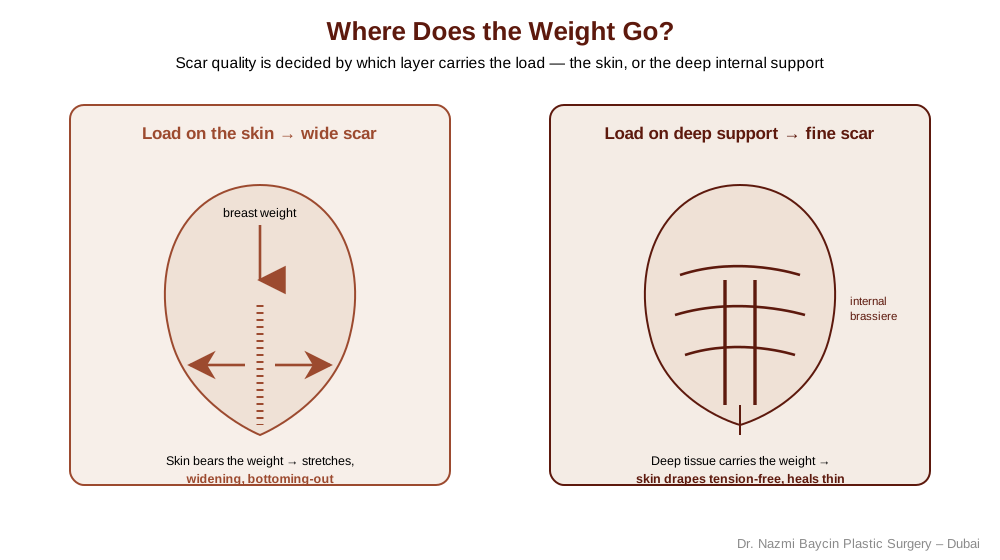
Where the weight goes: skin-borne load produces a wide scar, while a deep internal support lets the skin heal thin — by Dr. Nazmi Baycin, Dubai.
A full anchor (inverted-T) pattern is not a concession; it is a powerful tool that allows me to remove excess skin in three dimensions, eliminating the dog-ears and lateral tension points that would otherwise stress a shorter scar. With the deep support secured, the skin closure becomes a refined exercise in precision — a multi-layered, tension-free closure in which deep dermal sutures align the wound edges perfectly and meticulous eversion ensures the edges knit together smoothly, preventing depressed scars.
| Technical step | What I do | Why it protects the scar |
|---|---|---|
| Internal parenchymal reshaping | Suture the breast tissue itself into a new, uplifted position with strong, lasting sutures | Creates an internal brassiere that holds the weight, so the skin never has to |
| Deep pillar suturing | Construct reinforced vertical pillars of breast tissue in vertical lifts | The pillars bear the gravitational load, not the skin along the vertical incision |
| Precise pattern selection | Choose the scar pattern by mechanical need, not trend (e.g. a full anchor / inverted-T when required) | Removes excess skin in three dimensions, eliminating dog-ears and lateral tension points |
| Multi-layered tension-free closure | Deep dermal sutures align the edges; eversion technique; fine running skin suture | The skin edges knit smoothly with no load, letting the scar mature into a fine line |
The critical role of breast weight and volume
Heavy breasts exert constant downward force, and no suture technique can permanently defy physics. An integral part of my tension management is therefore an honest assessment of volume. For many of my patients, the most elegant and stable solution is a breast lift combined with reduction. Because unmanaged mechanical load is what drives scar widening in the first place, reducing the weight of the parenchyma is one of the most effective ways to ensure long-term scar quality and shape maintenance. If you are seeking a lifted, lighter silhouette, I encourage you to understand the integrated approach detailed on my page for breast reduction surgery in Dubai.
Postoperative care: protecting the surgical work
My responsibility extends beyond the operating room. I provide every patient with a clear, structured postoperative protocol to protect the delicate healing environment, including specific instructions on supportive garments, restrictions on upper-body activity, and a timeline for introducing scar-management therapies such as silicone gel or tape. Adherence to this plan is crucial: even a perfectly executed closure can be compromised by early strain, because reintroducing mechanical load during healing is exactly what reopens the door to widening.
When scars fail: the revision perspective
In my revision practice, I regularly see the consequences of poor tension management: widened vertical scars, distorted areolas, and recurrent ptosis. Correcting these issues requires even more advanced techniques, often involving complete re-release of tissues and re-establishment of support — sometimes with biologic mesh or advanced suture patterns. This complexity underscores why getting the mechanics right from the first operation is paramount. Patients exploring structural breast surgery may also review my breast lift surgery in Dubai page to understand how modern techniques emphasize internal support.
Scars as a signature of technique
Ultimately, fine breast lift scars are not a matter of hope — they are a measurable outcome of correct surgical engineering. They result from honoring the biomechanics of the breast, selecting the right architectural plan for your body, and executing that plan with patience and extreme technical care. When these foundational steps are rushed or omitted, the result is often a revision later; the discipline of this layered, structural approach is what protects a shape that lasts and scars that heal as discreetly as possible. If you are considering a breast lift and seek a result defined by lasting shape and refined scars, I invite you to consult with me as an experienced cosmetic surgeon in Dubai.
FAQs about breast lift scars in Dubai
-
Does my skin type determine how my breast lift scar will heal?
Skin type and genetics play a role, but they are not the main driver of scar quality — technique is. The most important factor is how much tension the skin closure has to bear. A scar closed under high tension will tend to widen regardless of skin type, whereas a scar closed tension-free, with the weight carried by deep internal support, has the best chance of healing into a fine line. This is why technique matters more than skin type.
-
Is a shorter scar always better?
Not necessarily — this is one of the most common misconceptions. Forcing a short-scar technique onto a breast that needs more skin reshaping puts the closure under high tension, which leads to widening, bottoming-out, and early sagging. A slightly longer scar placed under minimal tension usually heals finer and holds a better shape than a short scar under strain. That scar quality matters more than scar length has been argued in the surgical literature since at least 2002, though from clinical experience rather than from controlled trials.
-
Why do breast lift scars widen or thicken?
Widening is a mechanical response to unmanaged tension. Skin is a covering, not a weight-bearing structure, so when it is asked to support the breast’s weight it stretches, and the resulting tension disrupts healing — reducing blood supply, driving excessive fibroblast proliferation, and impairing orderly collagen deposition. Controlling that tension by transferring the load to deep tissue is the key to preventing it.
-
What is the internal brassiere technique?
It refers to reshaping and suturing the breast tissue itself into a new, uplifted position with strong, lasting sutures, so that the internal tissue — not the skin — carries the weight and holds the shape. In vertical lifts this includes building reinforced pillars of breast tissue. With the load supported internally, the skin can simply drape and close tension-free, which is what allows the scar to heal thin.
-
Will a breast reduction improve my scars compared with a lift alone?
For heavier breasts, often yes. Since scar widening is driven by mechanical load, reducing the weight of the breast tissue removes the very force that stresses the closure. That is why, for many patients with heavy or very ptotic breasts, a lift combined with reduction gives the most stable long-term shape and the best scar quality. Whether reduction is beneficial for you depends on your volume and goals, assessed at consultation.
-
How can I help my breast lift scars heal well?
The surgical technique does most of the work, but your aftercare protects it. Wearing the prescribed supportive garment, avoiding upper-body strain during early healing, and following the timeline for scar therapies such as silicone gel or tape all help. The common thread is avoiding mechanical load on the healing scar — even a perfectly closed incision can widen if it is strained too early.
-
How long do breast lift scars take to fade?
Scars mature gradually. In the first weeks to months they can look pink or firm, then they typically soften and fade over roughly a year to eighteen months as the tissue remodels. A scar that was closed tension-free tends to fade to a finer, paler line; one closed under tension tends to stay wider and more visible. Consistent scar care during this window supports the best final appearance.
-
Can a poor breast lift scar be revised?
Yes, though revision is more demanding than getting it right the first time. Correcting a widened scar, distorted areola, or recurrent sagging usually means re-releasing the tissues and re-establishing proper internal support — sometimes with additional suture techniques or biologic mesh. The goal is to fix the underlying mechanical problem, not just re-excise the scar, since simply re-cutting a scar under the same tension would reproduce the original result.


GET APPOINTMENT
Get ready to look and feel best… You deserve…
