

Key takeaways: reconstruction, not a routine lift
- Post-weight-loss breasts present a triad: deflation, overstretched skin, weakened internal support.
- A standard mastopexy is inadequate — it assumes good tissue quality and inherent fullness.
- Volume is restored with autologous auto-augmentation, using your own remaining tissue.
- An internal scaffold — the internal bra — bears the weight, taking tension off the skin.
- The anchor (inverted-T) pattern allows a tension-free closure — essential for durability.
- Candidacy requires 6–12 months of stable weight and careful tissue assessment.
The anatomical shift: why a “breast lift alone” is insufficient
Post-weight-loss breasts present a unique triad of issues: a deflated internal volume, a dramatically overstretched skin envelope with poor elasticity, and weakened internal ligaments. A standard mastopexy — designed for a breast with good tissue quality and some inherent fullness — is simply inadequate here. Unlike age-related sagging, post-weight-loss breast deformity involves loss of internal volume, stretched skin envelopes, and attenuated support structures.
After significant weight reduction, both fatty and glandular tissues diminish, leaving an empty, flattened envelope, particularly in the upper pole. The skin has been stretched beyond its elastic recoil, becoming thin and inelastic — functioning like a weathered sail, unable to shrink back or provide meaningful support. And the distance from nipple to inframammary fold becomes excessively long, with the natural supporting ligaments attenuated.
Attempting a traditional lift on this foundation is like trying to suspend a deflated balloon by its knot; it simply collapses again. The surgery must actively rebuild volume and create a new, robust internal structure.
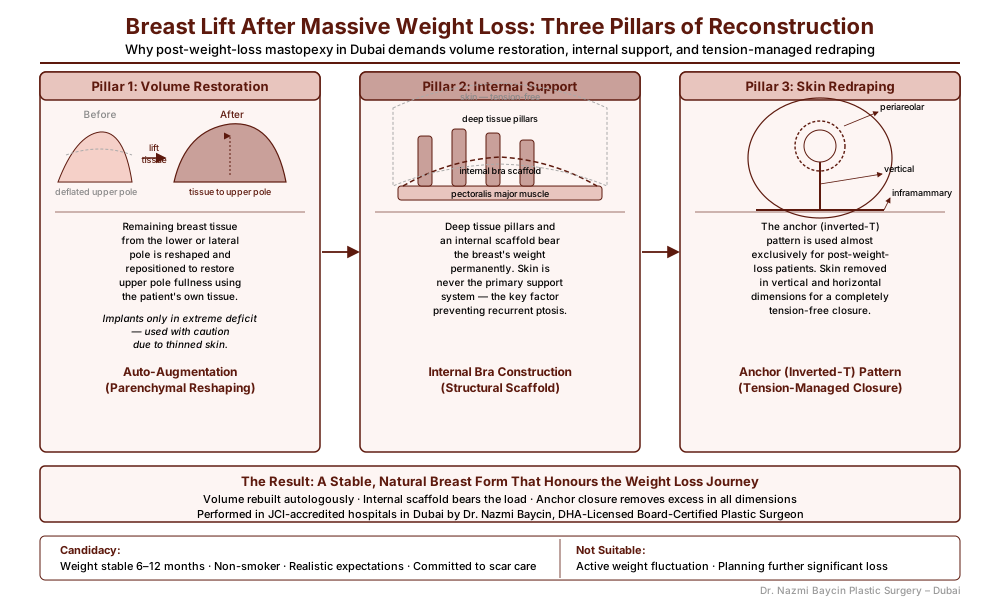
The three pillars of post-weight-loss breast reconstruction — autologous volume restoration, an internal support scaffold, and tension-free anchor redraping — by Dr. Nazmi Baycin, Dubai.
My reconstructive philosophy: the three pillars of restoration
To achieve a lasting, natural result, my technique rests on three interdependent principles. This structural, support-first approach reflects the established literature on post-bariatric breast surgery; a 2008 paper on mastopexy after massive weight loss using dermal suspension and selective auto-augmentation describes exactly this combination of internal support and autologous volume restoration.
Strategic volume restoration
First, we must address the deflation. Whenever possible, I use autologous tissue rearrangement — often called auto-augmentation. This repositions the remaining breast tissue itself (typically from the lower or lateral pole) to add volume and projection to the upper pole, restoring fullness with your own natural tissue and avoiding the added weight and potential complications of an implant in already compromised skin. In cases of extreme volume deficit, a carefully selected implant may be discussed, but this decision is made with particular caution given the thinness of the overlying skin.
Internal structural support
This is the non-negotiable foundation for durability. Skin should never be the primary support system. I employ advanced internal suturing to create a strong, supportive scaffold — constructing deep tissue pillars and reinforcing the lower pole with a mesh-like internal structure, often referred to as an “internal bra.” This framework bears the weight and maintains shape, taking all tension off the skin closure — the single most important factor in preventing recurrent sagging and poor scarring.
Tension-managed skin redraping
With volume and support established, the excess skin envelope is conservatively tailored. I almost exclusively use the anchor (inverted-T) pattern for post-weight-loss patients. While it leaves more scar, this pattern is essential: it allows me to remove skin in both vertical and horizontal dimensions, achieving a tension-free closure. A short-scar technique under high tension is a recipe for early failure in this patient population.
How post-weight-loss mastopexy differs from a standard lift
The table below sets the two approaches side by side, making clear why the post-weight-loss operation is a distinct, reconstructive procedure.
| Feature | Standard Mastopexy | Post-Weight-Loss Mastopexy |
|---|---|---|
| Addresses skin excess | ✓ | ✓ |
| Restores upper pole volume | Limited | ✓ (auto-augmentation) |
| Internal scaffold / internal bra | ✗ | ✓ |
| Skin-tension-free closure | Sometimes | Always (non-negotiable) |
| Incision pattern | Variable | Anchor (inverted-T) |
| Suitable for thin, inelastic skin | ✗ | ✓ (designed for it) |
| Operative time | 2–3 hours | 3–5 hours |
| Weight stability required | 3–6 months | 6–12 months minimum |
The critical consultation: assessing stability and tissue quality
Candidacy hinges on two factors I assess meticulously. First, weight stability: you must have maintained a stable weight for a minimum of six to twelve months, because further loss will undo the results and gain can stretch the reconstruction. Second, tissue evaluation: I examine the quality of your skin, the pattern of deflation, and the amount of usable residual breast tissue to determine the optimal plan for volume and support. This comprehensive assessment is what I detail for patients considering breast lift surgery in Dubai after major weight loss.
Recovery and realistic expectations
Healing is a deliberate process. The initial focus is on protecting the intricate internal reconstruction. Swelling resolves gradually over several weeks, and the final shape settles over six to twelve months as the internal scaffolds fully integrate. Scar care is paramount, and I provide a strict, evidence-based protocol. The payoff for this patience is a result engineered to last for decades, not just a few years. Where an implant is genuinely warranted by extreme volume loss, the considerations are covered in my related article on breast lift with implants after massive weight loss in Dubai.
Why specialized experience matters
Post-weight-loss breast surgery is a distinct subspecialty. It requires a surgeon who understands the biomechanics of stretched tissues, masters advanced parenchymal reshaping, and prioritizes long-term structural integrity over short-term minimal scarring. Patients in Dubai who have undergone transformative weight loss deserve this level of nuanced expertise. Because each reconstruction is individual, its plan — including cost — is discussed transparently at consultation. This restorative philosophy runs through all of my cosmetic surgery work in Dubai.
FAQs about post-weight-loss breast lift in Dubai
-
Is a breast lift after massive weight loss different from a regular breast lift?
Yes — fundamentally different, not just more complex. Post-weight-loss mastopexy must address a triad of simultaneous problems that standard mastopexy does not encounter: critical volume loss requiring autologous tissue redistribution, severely compromised skin that cannot bear tension, and attenuated internal support structures. My approach in Dubai addresses all three through auto-augmentation, internal scaffold construction, and anchor skin redraping — a reconstructive procedure, not an enhanced lift.
-
Do I need a breast implant after massive weight loss?
Not necessarily. My preferred approach is autologous volume restoration — repositioning the patient’s own remaining breast tissue to rebuild upper pole fullness without implants. This avoids the risks and complications of implants in already thinned skin. A breast implant is considered only when the volume deficit is extreme and autologous tissue is genuinely insufficient, and that decision is made with particular caution given the condition of post-weight-loss skin.
-
How long do I need to wait after weight loss before having breast lift surgery in Dubai?
A minimum of six to twelve months of stable weight is required. This allows the body’s tissue to reach its anatomical equilibrium after weight loss and gives me an accurate picture of the anatomy I will be working with. Operating before weight is stable risks having the reconstruction altered by further loss or gain.
-
Will I have significant scarring after post-weight-loss mastopexy?
Yes — and this is explained directly at consultation. Post-weight-loss mastopexy requires the anchor (inverted-T) incision pattern, which produces three scars: periareolar, vertical, and along the inframammary fold. This pattern is used because it is the only way to remove excess skin in both vertical and horizontal dimensions simultaneously, achieving a tension-free closure. Scars are managed with a structured protocol and fade significantly by twelve to eighteen months.
-
Can post-weight-loss breast lift be combined with other body contouring procedures?
Yes — and this is frequently appropriate. Many patients who have lost significant weight require contouring of the abdomen, thighs, or arms alongside breast reconstruction. I plan these procedures as a staged program, allowing adequate healing between sessions. Combining all procedures in a single operation is generally not advisable due to the extended operative time and recovery demands of each procedure individually.
-
What makes post-weight-loss mastopexy results last longer than standard breast lifts?
The internal scaffold. By constructing deep tissue pillars and a reinforced lower pole support framework — the internal bra — I remove all meaningful tension from the skin closure. The scaffold bears the breast’s weight permanently. Skin under tension stretches and scars poorly; skin that is tension-free heals well and maintains its position. This structural principle is what distinguishes a result that lasts decades from one that recurs within years.


GET APPOINTMENT
Get ready to look and feel best… You deserve…
