

Key takeaways: J-Plasma tightens, it does not remove
- J-Plasma contracts the existing skin envelope — it does not remove measurable skin.
- The primary contraindication is true skin excess, identified with a simple pinch test.
- Massive weight loss patients need excisional surgery, not energy-based tightening.
- High BMI or thick residual fat dampens the effect — the volume must be addressed first.
- It is a surgical adjunct, performed under anesthesia — not a non-surgical miracle.
- The ideal candidate needs refinement, not reduction — mild laxity with good elasticity.
Honest expectations here are backed by the evidence. A 2025 systematic review of helium-plasma radiofrequency found no evidence that the device tightens skin beyond what liposuction alone achieves. In March 2022 the FDA also warned against using it for skin tightening, at a time when the device held no clearance for any aesthetic use; since February 2023 it has held 510(k) clearance for coagulation of subcutaneous soft tissue following liposuction, which is the only way I use it.
The same review is blunt about safety. Across 135 adverse-event reports filed with the FDA it counted fifteen events classed as life-threatening and three deaths, most involving burns or helium tracking into a body cavity. Those reports are voluntary and carry no denominator, so they cannot establish a rate — but they are the reason I use this device only under anesthesia, in an accredited hospital, in the subcutaneous plane after liposuction, and never as a stand-alone skin treatment.
That is not a reason to dismiss the technology. It is a reason to use it precisely, for the narrow set of patients it genuinely helps.
The fundamental limit: it tightens, it does not remove
The principle that guides my candidacy assessment is simple. J-Plasma contracts collagen and tightens the soft-tissue envelope you already have — a focused-energy mechanism I contrast with older heat-based devices in my article on J-Plasma versus traditional skin tightening. It does not remove measurable amounts of skin, redistribute volume, or repair muscular diastasis.
So the primary contraindication, in my practice in Dubai, is true skin excess. I identify this with a pinch test. If I can grasp a substantial fold of skin that does not retract when released, the problem is excess, not laxity — and no amount of energy-induced contraction will meaningfully shorten that envelope. For those patients in Dubai, a formal excisional procedure such as an abdominoplasty or body lift is the correct, definitive solution.
The distinction is not academic. Choosing tightening when the true problem is excess wastes both money and recovery time, and it delays the operation that would actually have worked. This is why the initial diagnosis matters more than the choice of device. Using J-Plasma instead would be a fundamental mismatch, producing minimal improvement and near-certain dissatisfaction. It is a powerful adjunct in body contouring, but it is not a universal one.
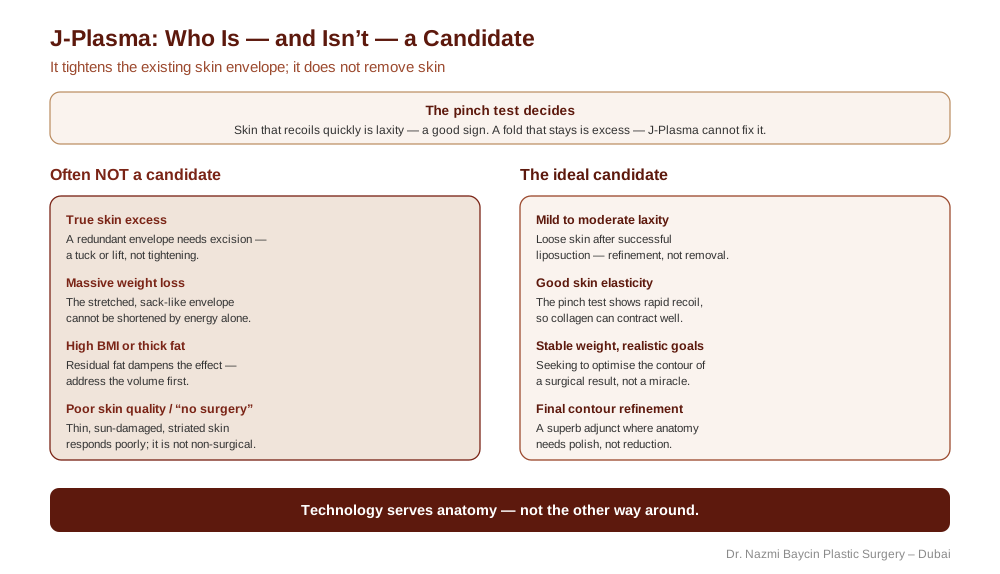
Who is and is not a candidate for J-Plasma — the pinch test, the profiles it cannot help, and the ones it can — by Dr. Nazmi Baycin, Dubai.
Who is, and is not, a good candidate
Over many consultations in Dubai I have come to recognize clear patterns. The table below contrasts the profiles for whom J-Plasma alone is the wrong choice with the ones who achieve outstanding results.
| Often NOT a candidate | Why | Better path |
|---|---|---|
| True skin excess | The envelope must be shortened, not tightened | Abdominoplasty or body lift |
| Massive weight loss | Stretched envelope beyond elastic capacity | Excisional body contouring |
| High BMI / residual fat | Fat volume dampens the tightening effect | Address fat first, e.g. liposuction |
| Poor skin quality | Diminished collagen response | Reassess suitability honestly |
A few of these profiles deserve a closer word. After significant weight loss, the skin is often stretched beyond its elastic capacity and resembles an empty, redundant sack; no energy-induced contraction can shorten it meaningfully, so these patients need formal excisional surgery, a topic I cover in my article on post-bariatric body contouring for the massive weight loss patient.
When a thick layer of subcutaneous fat persists, the tightening effect is mechanically dampened and visually negligible, so the fat component should be addressed first. And patients with severely sun-damaged, chronically thin, or extensively stretch-marked skin have a diminished collagen response, which limits what any contraction device can deliver. Perhaps the most common mismatch of all is the patient who wants a dramatic change but wishes to avoid surgery entirely. J-Plasma is a surgical adjunct — performed under anesthesia, requiring incisions for cannula access, and involving a recovery period. It is not a non-surgical treatment.
Why trying it first can be a setback
I sometimes meet patients who have been advised to try J-Plasma first and consider surgery later if it is not enough. In my view this is often a disservice. It incurs the cost and recovery of an ineffective procedure, and the internal fibrosis it creates can actually complicate a subsequent operation — making tissue dissection more challenging and potentially altering the blood supply. Scarred, fibrotic tissue does not dissect as cleanly, and a compromised blood supply raises the risk profile of the definitive surgery that eventually follows.
My philosophy is to perform the correct, definitive procedure first, based on an uncompromised anatomical assessment. This is really a question of judgment over marketing, the same principle I discuss in my article on why surgeon technique matters more than technology.
Where J-Plasma excels: the ideal candidate
For clarity, the patients who achieve outstanding results are those who need refinement, not reduction. They typically have mild to moderate skin laxity following successful liposuction, good skin elasticity with rapid recoil on the pinch test, a stable weight, and realistic expectations. Their goal is to optimize the final contour of a surgical result, not to avoid surgery altogether.
In these scenarios J-Plasma is a superb tool for final contour refinement — and this is exactly the context I describe in my piece on J-Plasma after liposuction and when it prevents secondary skin laxity. This precise, well-indicated use is central to how I approach J-Plasma in Dubai. Because candidacy is so individual, both suitability and cost are best assessed at a consultation — the investment is only worthwhile when the tool actually matches the problem.
Technology serves anatomy, not the other way around
J-Plasma is a refined instrument in my toolkit, but it is not a wand. Its appropriate application is a matter of surgical judgment, not technological marketing. The most valuable service I offer in Dubai is often the honest, sometimes firm, counsel that steers a patient away from a procedure that cannot help them and toward the one that will.
For anyone considering skin tightening, my advice is to seek a setting where the diagnosis is grounded in anatomy and the plan is brave enough to say no when that is in your best interest. That standard of candor is what you should expect from an experienced plastic surgeon in Dubai.
FAQs about J-Plasma candidacy in Dubai
-
What does J-Plasma actually do?
J-Plasma, also known as Renuvion, uses helium-based plasma energy to deliver controlled heat beneath the skin, which contracts collagen and tightens the existing soft-tissue envelope. The key word is tightens: it does not remove skin, redistribute volume, or repair separated abdominal muscles. It works at the tissue level under the skin to firm and retract what is already there. This makes it a useful adjunct for refining mild laxity, typically alongside liposuction, but it is not a stand-alone answer for loose or excess skin. Understanding this distinction is the foundation of deciding whether it suits you.
-
How do you decide if I am a candidate?
The most important tool is a simple pinch test. If the skin recoils quickly when released, that indicates laxity with good elasticity, which responds well to contraction. If I can grasp a substantial fold that stays put and does not spring back, the problem is true skin excess, which J-Plasma cannot correct. Alongside this I assess your skin quality, body fat, weight stability, and goals. The aim is to match the treatment to your actual anatomy rather than to a marketed promise, and sometimes that means recommending a different procedure entirely.
-
Why is J-Plasma not suitable after massive weight loss?
After significant weight loss, the skin envelope is often stretched far beyond its elastic capacity and resembles an empty, redundant sack. No amount of energy-induced contraction can meaningfully shorten that much excess tissue. These patients need formal excisional body contouring — procedures that physically remove the surplus skin and reshape the contour, such as a body lift or brachioplasty. Using J-Plasma in this situation would produce minimal, disappointing improvement. Recognizing when excision is required, rather than tightening, is one of the most important judgments in body contouring.
-
Can J-Plasma replace a tummy tuck?
No. A tummy tuck removes excess skin and, when needed, repairs separated abdominal muscles — two things J-Plasma cannot do. J-Plasma only tightens the existing skin envelope; it does not excise tissue or address muscular diastasis. If a pinch test reveals true skin excess or there is muscle separation after pregnancy, an abdominoplasty is the correct, definitive solution. Choosing J-Plasma in that scenario would be a fundamental mismatch, giving minimal improvement at real cost. The two are not interchangeable; they solve different problems.
-
Is J-Plasma a non-surgical treatment?
No, and this is a common misunderstanding. J-Plasma is a surgical adjunct. It is performed under anesthesia, requires small incisions for cannula access, and involves a genuine recovery period. Patients who want a dramatic transformation while avoiding surgery altogether are not good candidates, because the treatment simply does not fit that expectation. Managing this early in the conversation is an important part of an honest consultation. If avoiding surgery entirely is your priority, it is better to know from the outset that this is not the non-surgical shortcut it is sometimes marketed to be.
-
Should I try J-Plasma first and consider surgery later?
I generally advise against this sequential approach. Trying an under-powered treatment first means paying for, and recovering from, a procedure unlikely to solve the problem. More importantly, the internal fibrosis it creates can complicate a later operation, making tissue dissection harder and potentially affecting the blood supply. My philosophy is to perform the correct, definitive procedure first, based on a clear anatomical assessment, rather than stacking an ineffective step in front of it. Doing the right operation once protects both your result and your investment.
-
So who is the ideal J-Plasma candidate?
The ideal candidate needs refinement, not reduction. Typically that means mild to moderate skin laxity after successful liposuction, good skin elasticity with rapid recoil on the pinch test, a stable weight, and realistic expectations. Their aim is to optimize the final contour of a surgical result, not to avoid surgery or to correct major excess. For this specific group, J-Plasma is a superb tool for final contour refinement and can genuinely elevate the outcome. The art lies in identifying these patients accurately and steering everyone else toward the procedure that will actually help them.


GET APPOINTMENT
Get ready to look and feel best… You deserve…
