

Key takeaways: precision over diffuse heat
- Traditional RF and ultrasound rely on diffuse heat and a slow, variable collagen response.
- J-Plasma uses a focused, cool helium plasma field with minimal thermal spread.
- Its contraction is immediate and visible during surgery, not months later.
- Its greatest value is as a subdermal adjunct to liposuction, not a standalone.
- Ideal candidates have mild-to-moderate laxity with good skin quality.
- It tightens skin but cannot remove it — heavy excess still needs a body lift.
The choice is never about which device is best in the abstract. It is about which tool is right for a given anatomy and goal, and understanding how these technologies actually work is the first step to that decision.
The physics of precision: why heat alone falls short
The traditional radiofrequency and ultrasound devices offered across Dubai work by generating heat within the skin’s deeper layers. That heat aims to damage collagen fibers just enough to trigger a prolonged healing and tightening response over months. The difficulty is threefold. Heat spreads unpredictably through tissue, the required response varies greatly from patient to patient, and excess heat can risk burns or nerve damage. In effect, you are relying on the body’s variable biological reaction to an imprecise stimulus. J-Plasma works on a different physical principle.
The wand combines radiofrequency energy with helium gas to create a focused, cool plasma field, and when that field contacts tissue it delivers energy with exceptional precision and minimal thermal spread. The helium acts as a cooling buffer that protects surrounding structures.
The result is not simply heating; it is a direct, controlled collagen denaturation and contraction that I can watch happening in real time during the procedure. This subdermal mechanism is well described in the clinical literature, including a 2020 report on RF-helium plasma for subdermal skin tightening and contouring. For a fuller picture of how I use the technology, you can review my overview of J-Plasma skin tightening in Dubai.
J-Plasma versus traditional tightening at a glance
The two approaches are not simply strong and weak versions of the same thing. They differ in how energy reaches the tissue, how predictable the effect is, and where each one fits. The table below summarizes the practical differences.
| Feature | Traditional RF & Ultrasound | J-Plasma (Helium Plasma) |
|---|---|---|
| Energy delivery | Diffuse heat into the deeper layers | Focused plasma field with minimal thermal spread |
| Timing of effect | Gradual, over months of collagen remodeling | Immediate, visible contraction during surgery |
| Predictability | Varies widely with each patient’s biology | Controlled, real-time denaturation the surgeon sees |
| Typical use | Non-surgical maintenance and very mild laxity | Subdermal skin retraction alongside liposuction |
| Main limitation | Subtle, sometimes temporary results | Tightens skin but cannot remove excess skin |
My clinical application: J-Plasma as a surgical adjunct
In my practice in Dubai I almost never use J-Plasma as a standalone treatment. Its real strength is as a precision adjunct to liposuction. After fat is removed, the overlying skin can be left with reduced support, and in patients with mild to moderate laxity that can produce a less-than-ideal drape. This is where J-Plasma earns its place. By passing the wand beneath the skin after fat removal, I contract the entire soft-tissue envelope from the underside. It is much like tailoring a garment after taking it in: the aim is a smooth, tight fit over the new contour.
The areas where I find it most valuable in Dubai are the abdomen, neck, arms, and inner thighs, where skin retraction makes the difference between a good and a truly sculpted result. The way it prevents secondary laxity after fat removal is something I examine in detail in my article on J-Plasma after liposuction and secondary skin laxity.
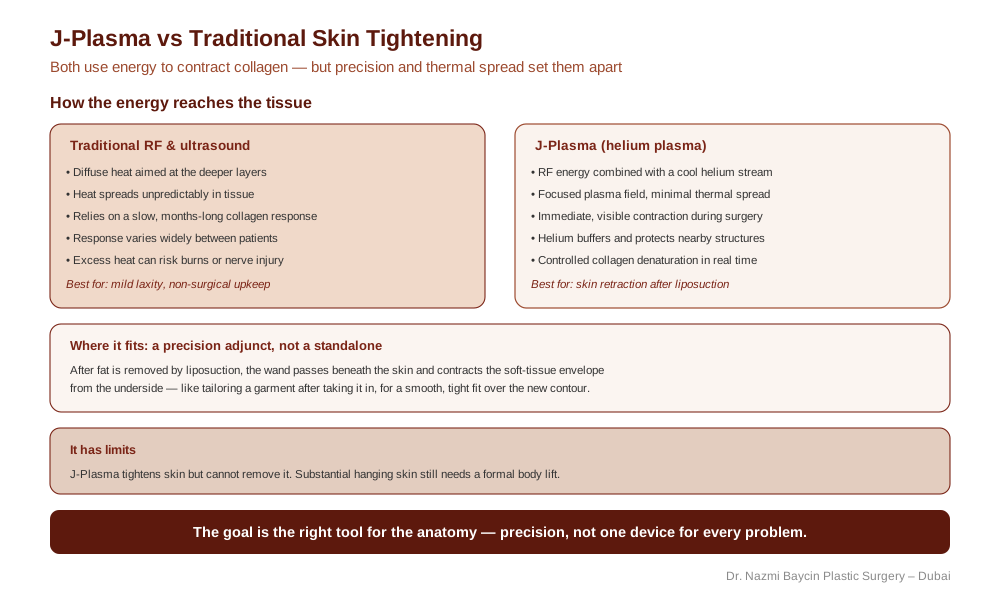
How J-Plasma helium plasma differs from traditional heat-based skin tightening, and where it fits as a precision adjunct to liposuction, by Dr. Nazmi Baycin, Dubai.
Because the quality of the fat removal underneath determines how well the skin can redrape, the liposuction technique itself matters enormously. Different fat characteristics call for different handling, a point I explore in my article on how fibrous versus soft fat changes liposuction technique. When contouring is circumferential, precision becomes even more important, as I discuss in my article on why 360-degree liposuction requires surgical precision.
Clear-cut candidates: who benefits
Patient selection in Dubai is everything, because J-Plasma is not a magic wand for severe laxity. The ideal candidate has good skin quality with mild-to-moderate looseness, is undergoing liposuction and needs enhanced skin retraction, wishes to improve contour without the long scars of a formal body lift, and holds realistic expectations about refinement rather than total transformation.
For patients with substantial hanging skin, a formal body lift remains the standard, because J-Plasma cannot remove skin; it only tightens what already exists. When a patient’s laxity is beyond what energy can address, I say so plainly, and I set out exactly who is not a candidate for J-Plasma and why in a dedicated article. That candor sits alongside the same philosophy I apply to combining energy with volume, which I discuss in my article on pairing fat transfer with J-Plasma for definitive rejuvenation.
Why traditional methods still have a role
None of this makes traditional radiofrequency or ultrasound obsolete. In my practice they serve an excellent purpose for non-surgical maintenance, early preventative treatment, or addressing very mild laxity in patients who are not surgical candidates. They are simply tools for a different set of goals. For the patient seeking a dramatic improvement in skin fit after liposuction, though, the immediate and potent contraction of J-Plasma sits in a different category of effectiveness. Matching the method to the goal is the whole point.
Choosing the right tool for your anatomy
The choice between J-Plasma and traditional tightening is not about which is better in a vacuum; it is about which is right for your anatomy and your goals. My responsibility as a surgeon is to reach for the most precise tool for the task in front of me. J-Plasma gives me a level of intraoperative control over skin contraction that was previously impossible, allowing finer refinements in body contouring. If you are looking for a laxity solution that uses the latest in precision energy, that assessment is best made in person with an experienced plastic surgeon in Dubai, where the plan is built around your anatomy rather than around a single device.
FAQs about J-Plasma skin tightening in Dubai
-
What is J-Plasma and how does it tighten skin?
J-Plasma, also known as helium plasma or by the brand Renuvion, is an energy device that combines radiofrequency with a stream of cool helium gas to create a focused plasma field. When that field contacts tissue beneath the skin, it produces a precise, controlled contraction of the collagen, tightening the soft-tissue envelope. Unlike treatments that rely on broad heat, the helium acts as a cooling buffer, so energy is delivered with minimal thermal spread to the surrounding tissue. The effect is immediate and visible during the procedure rather than developing slowly over months, which is part of why it is valued for precise surgical contouring.
-
How is J-Plasma different from radiofrequency or ultrasound tightening?
The main difference is precision and timing. Traditional radiofrequency and ultrasound devices heat the deeper layers of skin diffusely, aiming to injure collagen just enough to trigger a slow tightening response over months. That heat spreads unpredictably, the result varies a lot between patients, and excess heat carries some risk of burns or nerve irritation. J-Plasma instead delivers a focused plasma field with a cool helium buffer, producing immediate, controlled contraction that the surgeon can see in real time. In short, the traditional devices rely on your body’s gradual reaction, while J-Plasma gives direct, visible tightening at the time of surgery.
-
Is J-Plasma used on its own or with surgery?
In my practice it is almost always used as an adjunct to surgery rather than on its own. Its greatest strength is tightening the skin after liposuction: once the fat is removed, the wand is passed beneath the skin to contract the soft-tissue envelope from the underside, helping the skin redrape smoothly over the new contour. This is particularly useful on the abdomen, neck, arms, and inner thighs. It can be thought of like tailoring a garment after taking it in. Used as a standalone surface treatment it does far less, which is why I reserve it for the situations where it genuinely improves the surgical result.
-
Who is a good candidate for J-Plasma?
The best candidate has good skin quality with mild-to-moderate looseness, is undergoing liposuction and would benefit from extra skin retraction, wants to improve contour without the long scars of a body lift, and has realistic expectations about refinement rather than a total transformation. It suits people whose skin simply needs help redraping after fat removal. It is not designed for severe laxity or large amounts of hanging skin, and part of a responsible consultation is being honest about when your anatomy falls outside what this technology can achieve, so you are not steered toward a treatment that will underdeliver.
-
Can J-Plasma replace a tummy tuck or body lift?
No. This is one of the most important distinctions to understand. J-Plasma tightens the skin you have, but it cannot remove excess skin. If you have substantial loose or hanging skin, for example after major weight loss or pregnancy, a formal procedure such as a tummy tuck or body lift that excises the extra skin remains the appropriate option. J-Plasma is best thought of as a refinement tool for mild-to-moderate laxity, often alongside liposuction, rather than a replacement for skin-removing surgery. An in-person assessment is the only reliable way to determine which category your skin laxity falls into.
-
Is J-Plasma safe, and what protects the surrounding tissue?
When performed by a trained surgeon on an appropriate candidate, J-Plasma has a strong safety profile, and much of that comes from its design. Because the helium gas cools the plasma and the energy is focused with minimal thermal spread, the surrounding tissue is better protected than with devices that rely on broad, diffuse heat. That said, it is still an energy-based surgical tool that must be applied with correct technique, appropriate settings, and proper patient selection. Safety depends heavily on the training and experience of the surgeon using it, which is why it should only be performed in a properly equipped surgical setting by someone experienced with the device.
-
When will I see results, and how long do they last?
Part of the contraction is visible immediately during the procedure, which is one of the distinguishing features of the technology. After surgery there is a period of swelling, and as that settles over the following weeks and months the tightened, smoother contour becomes clearer. Because the effect comes from genuinely contracting and remodeling the tissue rather than temporarily plumping it, the results are durable, particularly when the skin was of good quality and the laxity was mild-to-moderate to begin with. As with any body-contouring result, maintaining a stable weight and healthy lifestyle helps preserve the improvement over the long term.


GET APPOINTMENT
Get ready to look and feel best… You deserve…
