

Key takeaways: the fat transfer and J-Plasma synergy
- Aging creates a dual deficit: lost volume and a lax skin envelope — treating only one gives incomplete results.
- Fat transfer rebuilds foundational volume with the body’s own living tissue, integrating permanently when grafted correctly.
- J-Plasma/Renuvion tightens the skin from the inside out, contracting the deep layer and stimulating new collagen.
- The sequence is critical: volume is restored first, then the envelope is tightened over the newly filled space.
- Applying energy first would compromise the blood supply the fat grafts need to survive.
- Outcomes depend on technique, not just technology — atraumatic harvesting, micro-placement, and feathered energy delivery.
The dual deficit of aging: volume loss and skin laxity
Aging is not a one-dimensional process, and effective treatment requires a dual diagnosis.
- The first axis is structural volume loss: over time the face and body lose subcutaneous fat, and because this depletion is not uniform it produces hollowed temples, flattened cheeks, etched nasolabial folds, and deflated body contours.
- The second axis is envelope degradation: the skin’s collagen and elastin networks break down, so the envelope becomes lax and loses its ability to snap back, leading to draping and wrinkling.
Addressing only one half of this equation yields incomplete results. Adding volume to loose skin can appear bloated; tightening skin over a volume-deficient frame can look stretched and gaunt. The technical failure lies in treating these as separate problems — the masterstroke is treating them as interconnected components of a single system.
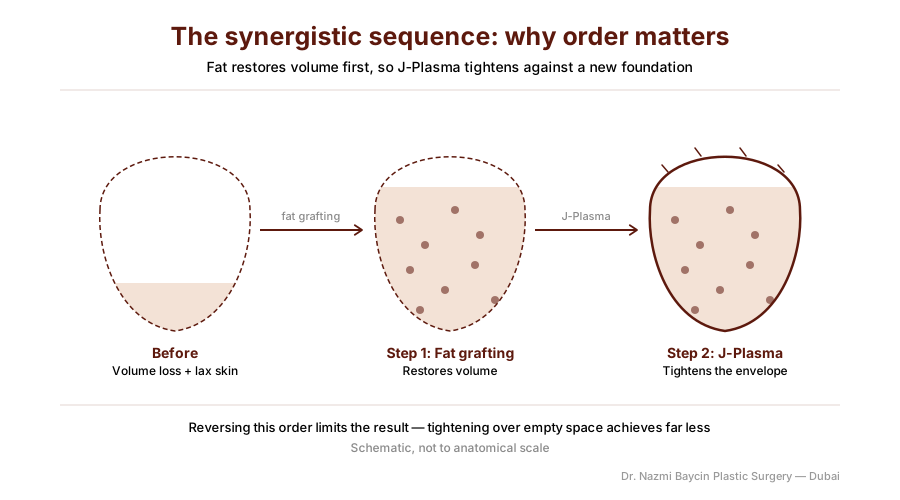
The dual-axis sequence: living fat grafts rebuild volume first, then J-Plasma contracts the skin envelope over the restored foundation — by Dr. Nazmi Baycin, Dubai.
Autologous fat transfer: the art of structural grafting
Fat transfer is the gold standard for volumetric restoration because it uses the patient’s own living tissue — but “fat injection” is a gross oversimplification of a meticulous, multi-stage grafting procedure. It begins with harvesting with biologic intent: I use low-pressure, micro-cannula harvesting to preserve the viability of fat cells (adipocytes) and their crucial stromal vascular fraction.
A comparative study of harvest and transfer methods in five patients shows where the real risk lies. Across the cannulas, needles and processing settings tested, histology found 98 to 100 per cent of fat cells intact — with two exceptions. Collection at minus 700 mmHg vacuum damaged more than 10 per cent of cells, and preoperative massage damaged around 30 per cent. The lesson is narrower than it is usually reported to be: it is high suction pressure and aggressive handling that cost you cells, not the choice of instrument. The graft is then refined to remove oil, blood, and lysed cells, concentrating pristine living tissue that will predictably survive. That stromal vascular fraction matters beyond volume: it carries regenerative cells that improve the quality and vascularity of the tissue the graft integrates with, which is part of why a well-taken graft looks and behaves like living tissue rather than an inert filler.
The final stage is strategic micro-placement, where artistry meets science. Fat is not injected in large boluses, which are prone to necrosis and irregularity; using specialized micro-cannulas, I deposit minuscule amounts in a layered, three-dimensional network across multiple tissue planes.
Coleman’s 2006 case-report paper on structural fat grafting sets out this principle — placing fat in small aliquots keeps each graft fragment in close contact with a blood supply, which maximizes how much survives, whereas a bolus leaves inner cells clumped away from vascularity and prone to death. It is indexed as case reports and written by the originator of the method, so it illustrates the technique rather than testing it against an alternative, and Coleman is explicit that the mechanism of graft survival is not fully understood. What it does document is the broader observation that grafted fat improves the tissue it is placed into, not merely its volume. This is what differentiates a natural, lasting outcome from a lumpy, temporary fix.
J-Plasma / Renuvion: the science of subdermal contraction
J-Plasma delivers precisely controlled cold helium plasma energy to the underside of the skin, where it directly stimulates the deep collagen framework. The device emits an energized beam of helium gas (plasma) at a low temperature; applied to the subcutaneous tissue, it produces immediate tissue contraction and, more importantly, triggers a powerful, sustained neocollagenesis — the production of new collagen.
Because the energy is delivered beneath the skin, it acts on the foundational layer that supports the envelope — the comparison with surface-based devices, and where each belongs, I cover in my article on how J-Plasma differs from traditional heat-based tightening. That makes it the ideal partner to fat transfer, because it addresses the laxity of the very envelope the fat is filling. And because neocollagenesis unfolds gradually, the tightening continues to develop for months after surgery, maturing in step with the settling fat graft rather than peaking and fading.
The synergistic sequence: volume and contraction in concert
The true innovation is not in using these technologies, but in their specific sequence and application. My protocol is deliberate, and the table below sets out why each step must happen in order.
| Stage | What happens | Why the order matters |
|---|---|---|
| 1 — Fat grafting first | Living fat grafts are meticulously placed to rebuild lost structural volume, creating a new youthful topography | Establishes the filled foundation the skin will later be tightened against |
| 2 — J-Plasma second | Energy is applied to the underside of the overlying skin, contracting the envelope directly against the newly placed volume | Tightening over an optimally filled space maximizes smoothing and firming; tightening an empty envelope achieves little |
| Never reversed | Energy is never applied before grafting | Applying energy first can damage the microvasculature that the fat grafts depend on to survive |
This synergy is particularly transformative for areas like the abdomen, arms, and thighs after liposuction, where skin laxity is a concern. It allows for thorough fat removal with the confidence that the skin will contract rather than hang. This J-Plasma skin tightening in Dubai represents a paradigm shift in body contouring — moving beyond mere fat extraction to true silhouette refinement.
Avoiding the pitfalls: why technique dictates outcome
The combination of fat transfer and energy-based tightening is fraught with potential complications if executed without rigour. Poor or traumatic harvesting leads to fat necrosis — oil cysts, calcifications, and irregular contours. Excessive J-Plasma energy can cause over-contraction, adhesions, or irregularities, especially in hands without deep anatomical knowledge. And a misplaced sequence, applying energy before grafting, can damage the microvasculature and compromise the blood supply the grafts need.
My methodology is designed to avoid each of these: the fat grafting is atraumatic and precise, and the J-Plasma is delivered with a painterly meticulousness, feathering the energy at the edges for seamless transitions. The goal is a potent biologic effect, not a simple thermal burn.
Regeneration versus reduction
This approach represents the pinnacle of regenerative aesthetics. We are not just removing or pulling; we are rebuilding with living tissue and stimulating the body’s own contractile and collagen-producing machinery. The result is improvement that continues to evolve and settle over months, appearing increasingly natural — the texture, warmth, and dynamic movement of restored fat under tightened, revitalized skin is something implants or thread lifts can never replicate.
Because this is two advanced, surgical-grade procedures performed in one strategic operation, choosing a surgeon requires verifying documented expertise in both complex fat grafting and subcutaneous energy delivery. To discuss how this synergy applies to your anatomy, I welcome you to a consultation as an experienced cosmetic surgeon in Dubai.
FAQs about fat transfer with J-Plasma in Dubai
-
Why combine fat transfer with J-Plasma instead of doing one alone?
Because aging has two components: lost volume and lax skin. Fat transfer alone can restore fullness but does nothing for a loose envelope, so the result can look bloated; tightening alone over a deflated frame can look stretched and gaunt. Combining them treats both problems as one system — volume is rebuilt and the skin is contracted over it — which is why the combined result looks more natural and complete than either procedure on its own.
-
Why is the fat placed first and the J-Plasma applied second?
The sequence is deliberate and important. Placing the fat first rebuilds the volume, so that when J-Plasma tightens the skin it is contracting over an optimally filled foundation — which maximizes the smoothing and firming effect. Reversing the order would be counterproductive and unsafe: applying energy first can damage the small blood vessels that the fat grafts rely on to survive, reducing the proportion of the graft that lasts.
-
How much of the transferred fat survives permanently?
A proportion of every fat graft is naturally reabsorbed in the first few months, after which the surviving fat is considered permanent because it establishes its own blood supply. The key to maximizing survival is technique: gentle, low-pressure harvesting to keep the fat cells viable, and placing the fat in tiny aliquots so each fragment sits close to a blood supply. Grafting in large clumps causes more of the fat to die, so meticulous placement directly improves how much lasts.
-
Is J-Plasma / Renuvion safe under the skin?
In trained hands, yes. J-Plasma delivers helium plasma energy at a comparatively low temperature to the underside of the skin, producing controlled contraction and new collagen while avoiding the external burns associated with some surface devices. The main risks — over-contraction, adhesions, or irregularity — come from excessive energy or inadequate anatomical knowledge, which is why the energy is feathered carefully and delivered by a surgeon experienced in subcutaneous energy work.
-
What areas can be treated with this combination?
On the face, it restores hollowed temples, flattened cheeks, and etched folds while firming lax skin. On the body, it is especially valuable for the abdomen, arms, and thighs — often after liposuction — where removing fat can leave the skin loose. There, J-Plasma gives the confidence to contour thoroughly knowing the skin will contract rather than hang. Suitability depends on your anatomy and goals, assessed at consultation.
-
Is the result immediate, or does it take time?
You will see a change quickly, but the final result develops over months. There is immediate tissue contraction from the J-Plasma and instant volume from the fat, but swelling must settle, a portion of the graft resorbs, and the collagen-building response continues over time. Because this is regenerative, the outcome tends to keep refining and settling, looking increasingly natural over the following months rather than peaking on day one.
-
How is this different from dermal fillers or a thread lift?
Fillers add temporary volume with a foreign material and do not tighten skin; thread lifts reposition tissue mechanically but add no volume and do not rebuild the envelope. This combination uses your own living tissue for permanent, natural volume and actively stimulates new collagen to firm the skin from within. The texture, warmth, and natural movement of restored fat under tightened skin is something synthetic fillers and threads cannot replicate.
-
What is the recovery like?
Recovery is generally more involved than an injectable but far less than an excisional lift. Expect swelling and bruising at both the donor and treated sites, managed with supportive garments and activity restrictions during early healing. J-Plasma’s inside-out approach avoids external skin burns, which helps keep downtime shorter than some surface treatments. Your specific timeline depends on the areas treated and is reviewed in detail before surgery.


GET APPOINTMENT
Get ready to look and feel best… You deserve…
