

Key takeaways: rebuild the architecture, don’t flatten it
- The pinned-back look is a technical failure, not a limit of the patient’s anatomy.
- Recreating the antihelical fold is what restores the ear’s three-dimensional curve.
- Balanced conchal setback reduces prominence while preserving natural depth behind the ear.
- The shadow line behind the helix is what makes a correction read as unoperated.
- The target is an anatomical correction (helix ~17–21 mm from the scalp), not an overzealous one.
- An ear can look correct from one angle and wrong from another — all three views are checked.
This article is about the aesthetics of the result: what makes a correction look natural rather than operated. Which structures cause the prominence is covered in my article on the three subunits of the auricular framework, and the operative sequence in my article on the four-step surgical sequence.
Otoplasty is a safe and well-studied procedure, but its results depend heavily on technique — and that dependence is measurable. A 2026 systematic review of 21 otoplasty studies, eighteen of them retrospective, compared six families of technique and found that hybrid approaches combining sutures with cartilage-scoring were associated with lower rates of recurrence and reoperation than methods relying on sutures alone. The review measured recurrence and complications rather than aesthetic quality, so it does not tell us which technique looks most natural — but it does establish that the choice of method has consequences, which is the premise of everything below.
The central flaw: neglecting the antihelical fold
The most critical error behind an unnatural ear is failing to properly reconstruct the antihelical fold. When a surgeon focuses only on suturing the ear closer to the head without sculpting this fold, the ear loses its depth. The upper pole straightens abruptly, and the result is the flat, sharp, stuck-on appearance that immediately signals surgery.
My technique treats the operation as a process of cartilage sculpting rather than simple repositioning. Through precise cartilage scoring and the placement of form-defining sutures, I rebuild a soft, rounded antihelical fold. That rebuilt fold provides an internal spring: it holds the ear in a natural, gentle projection away from the head instead of forcing it flat under suture tension alone. The difference is visible from every angle. An ear with a properly reconstructed fold keeps its curves and shadows; an ear without one looks pressed and lifeless.
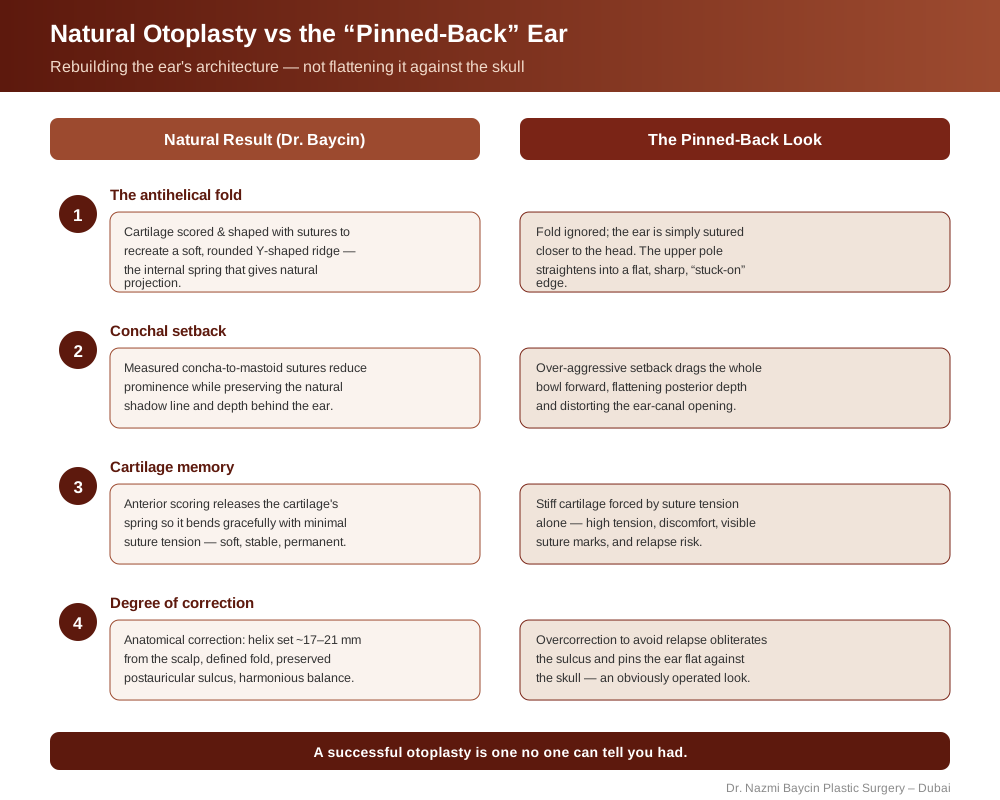
Natural otoplasty versus the pinned-back look across four technical decisions — antihelical fold reconstruction, balanced conchal setback, respecting cartilage memory, and an anatomical rather than overzealous degree of correction — by Dr. Nazmi Baycin, Dubai.
Balanced conchal setback: respecting natural projection
The second pillar of a natural result is managing the conchal bowl. Over-aggressive conchal setback is a primary driver of the pinned look. Pulling the entire conchal complex too far forward flattens the ear’s natural posterior depth and can even distort the opening of the ear canal.
My approach is measured. I assess each patient’s conchal depth and how much the concha contributes to the overall prominence, then place sutures from the concha to the mastoid fascia behind the ear with calculated tension — enough to reduce prominence meaningfully, but never so much that it erases the natural space behind the ear. That preserved space keeps a gentle shadow line behind the helix, which is one of the quiet details that makes a result believable. When the shadow behind the ear disappears, the eye reads the ear as flat, no matter how well the front looks.
Suture tension as an aesthetic decision
Suture strategy is usually discussed as a question of durability. It is also an aesthetic one. My sutures are not merely anchors; they are architectural supports. I use permanent, braided sutures placed in specific, strong zones of the cartilage to build the new antihelical fold, and I distribute the tension evenly along the fold to prevent sharp angles or kinking.
For the conchal setback, each suture is tensioned precisely, allowing a millimeter-level reduction in projection without creating a tight, flattened look. High, concentrated tension does not only risk relapse and visible suture marks — it produces a visibly strained contour, with the ear held rather than shaped. Releasing the cartilage’s own spring through scoring is what allows the sutures to sit at low tension, and low tension is what allows the fold to look soft. Why that spring exists and what it does over time is covered in my article on cartilage memory and otoplasty relapse.
Natural technique vs. the pinned-back look
The table below sets my approach against the shortcuts that create an operated appearance, across the decisions that matter most to how the result reads.
| Technical Decision | Natural Result (Dr. Baycin) | The Pinned-Back Look |
|---|---|---|
| Antihelical fold | Rebuilt with scoring & sutures | Ignored; upper pole flattened |
| Three-dimensionality | Preserved curves and depth | Flat, sharp, stuck-on |
| Conchal setback | Measured, balanced tension | Over-aggressive, bowl dragged forward |
| Depth behind the ear | Shadow line preserved | Posterior depth flattened |
| Suture tension | Even, low, distributed | High, prone to marks & strained contour |
| Degree of correction | Anatomical (~17–21 mm) | Overcorrected, sulcus obliterated |
| Postauricular sulcus | Preserved | Erased |
| Overall impression | Subtle, natural, unnoticed | Obviously operated |
Avoiding overcorrection and ensuring symmetry
The fear of relapse can tempt a surgeon to overcorrect, and that is a fundamental mistake. I aim for anatomical correction, not an overzealous one. During surgery I continually assess the ear’s position relative to the scalp, checking from the front, the side, and behind, because an ear that looks corrected from one angle can look wrong from another. The target is a subtle reduction in prominence — typically bringing the helix to about 17 to 21 millimeters from the scalp — combined with a well-defined antihelical fold and a preserved postauricular sulcus. I pursue symmetry diligently, but with the understanding that perfect symmetry does not exist in nature. The aim is harmonious balance, where both ears read as relaxed, natural mirror images rather than identical manufactured copies.
A patient-specific plan
No two ears are alike, and neither is the surgical plan. Cartilage stiffness in particular changes what is possible: soft, pliable cartilage tolerates a gentler approach, while rigid cartilage needs releasing before it will hold a soft fold at all. Those differences are largely a function of age, and I cover them in my article on how cartilage behaves differently in children and adults.
Matching the technique to the individual in Dubai — their cartilage stiffness, degree of prominence, and any prior surgery — is what separates a durable, natural correction from a one-size-fits-all one. It also draws on the same principles of contour and balance that guide all of my otoplasty surgery in Dubai.
The hallmark of success is invisibility
A successful otoplasty is one that goes unnoticed. The hallmark of the work is an ear that looks well-proportioned and naturally set, with nothing pointing to surgery. That is achieved by respecting and rebuilding the ear’s own delicate architecture — the antihelical fold and the conchal depth — rather than fighting it with forceful suturing.
The reward is not just a less prominent ear, but a confident, harmonious appearance free of both the original prominence and the stigma of an obvious operation. Because every ear and every cartilage type is different, the surgical plan and its cost are discussed openly at consultation, and this same respect for natural contour runs through all of my facial aesthetic surgery in Dubai.
FAQs about natural-looking otoplasty in Dubai
-
What causes the pinned-back look after otoplasty?
The pinned-back look comes from technique, not anatomy. It happens when a surgeon simply sutures the ear closer to the head without rebuilding the antihelical fold, or when the conchal bowl is set back too aggressively. The upper ear straightens into a flat, sharp edge, the natural depth behind the ear disappears, and the ear looks pressed against the skull. I avoid this by reconstructing the fold, using balanced conchal setback, and preserving the natural shadow line behind the ear, so the correction looks natural from every angle.
-
Will my ears look too flat or overcorrected?
Not with a measured, anatomical approach. Overcorrection — often done out of fear of relapse — flattens the ear against the skull and erases the natural groove behind it, producing an obviously operated look. I instead aim for a subtle, balanced reduction in prominence, typically bringing the helix to about 17 to 21 millimeters from the scalp, while preserving the postauricular sulcus and a defined fold. The goal is a natural degree of setback that looks relaxed, not a maximal one that looks artificial.
-
Why does the groove behind the ear matter to the result?
Because it is what the eye actually reads. The postauricular sulcus is the natural space between the back of the ear and the side of the head, and it casts a soft shadow along the rim. When a correction preserves it, the ear still looks like it is sitting away from the skull in a relaxed way. When an aggressive setback erases it, the ear reads as pressed flat even if the front view looks acceptable, because the shadow that gave it depth has gone. Preserving that groove is one of the quietest and most decisive differences between a natural result and an operated one.
-
How do you decide how far back the ears should sit?
Not by pushing them as far as they will go. I work toward an anatomical position rather than a maximal one, typically bringing the helix to roughly 17 to 21 millimeters from the scalp, and I judge that against the head it belongs to rather than against a number alone. A broad head carries a slightly greater set-off comfortably; a narrow one does not. The other constraint is that the ear is not equidistant from the skull along its length, so the upper pole, the mid rim, and the lobe each need their own judgment rather than a single uniform reduction.
-
Do the ears look different from the front than from the side?
They can, and that is exactly why an otoplasty has to be judged from all three views during surgery. An ear can look well corrected from the front while showing a sharp, unnatural crease in profile, or look elegant in profile while still protruding when seen head-on. Overcorrection in particular tends to reveal itself from behind, where the lost groove is most obvious. I check the front, the side, and the posterior view repeatedly before finalizing anything, because the people who see your ears every day will see them from all of them.
-
Can an over-corrected otoplasty be softened later?
Often, though it is more demanding than getting it right the first time. Releasing an over-tightened correction means dividing the sutures that are holding the ear flat and, where the cartilage has been creased rather than curved, addressing that crease directly — which is harder than creating a fold in untouched cartilage. Restoring a lost postauricular sulcus is the most difficult part, because it depends on soft tissue that has already healed in its flattened position. An honest assessment of how much of the original contour can be recovered is the starting point, and it has to be made in person.


GET APPOINTMENT
Get ready to look and feel best… You deserve…
