

Key takeaways: match the technique to the cartilage
- The ear looks similar at every age, but its cartilage biomechanics change markedly over time.
- Children’s cartilage is soft and plastic — it accepts and holds a new shape readily.
- Adult cartilage calcifies, becoming stiff and developing a strong memory that springs back.
- Children often do well with a suture-based technique; adults usually need cartilage scoring too.
- Adults heal more slowly and fibrotically, so the cartilage must be reshaped before scarring sets in.
- The right plan is chosen for the tissue, not the age on the chart.
This article is about how age changes the tissue and therefore the operation. The procedure itself — candidacy, anesthesia, recovery and cost — is covered on my main page for otoplasty and ear surgery in Dubai.
The core difference: plasticity vs. memory
The most critical factor I assess is the quality of the ear cartilage itself. The external ear is made primarily of elastic cartilage, and while it looks visually similar throughout life, its mechanical properties shift significantly with age. In children — typically between about five and twelve — the cartilage is soft, pliable, and remarkably malleable. It has high plasticity, meaning it can be gently bent and reshaped with sutures and will readily adopt and maintain that new form, because its internal recoil forces are minimal.
In adolescents and adults, by contrast, the cartilage undergoes progressive calcification, becoming thicker, stiffer, and more brittle. It develops a powerful memory — a strong tendency to spring back to its original shape. Suturing alone in that setting sets up a constant battle between the suture strength and the cartilage’s innate desire to return to its pre-operative state, which is a primary cause of late relapse. Recognizing this distinction is the first step in my consultation in Dubai, because it dictates whether a suture-only technique will suffice or whether a more robust, cartilage-modifying approach is needed.
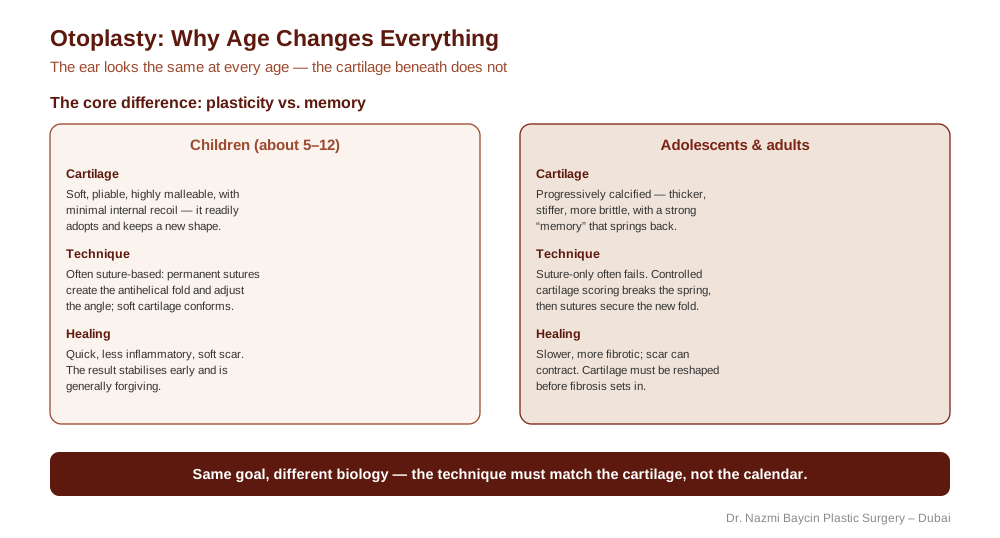
Why otoplasty differs between children and adults — cartilage plasticity gives way to stiffness and memory with age, changing both technique and healing — by Dr. Nazmi Baycin, Dubai.
How technique changes with age
Because of this, my surgical toolkit varies significantly with the assessment. The table below summarizes the main differences.
| Factor | Children (about 5–12) | Adolescents & Adults |
|---|---|---|
| Cartilage | Soft, pliable, high plasticity | Calcified, stiff, strong memory |
| Main technique | Suture-based reshaping | Cartilage scoring plus sutures |
| Healing | Quick, soft scar, stabilizes early | Slower, more fibrotic, scar can contract |
| Main risk | Generally forgiving | Late relapse if memory not addressed |
In children I often use a suture-based technique: through a small incision behind the ear, permanent, non-absorbable sutures create the missing antihelical fold and adjust the conchal-mastoid angle. The soft cartilage conforms beautifully, and those sutures provide a lasting internal scaffold as the child grows, with the focus on precision and subtlety to preserve the ear’s natural contours. In adults a suture-only approach is frequently inadequate.
My standard in that setting involves cartilage scoring — carefully etching or abrading the anterior surface of the cartilage where the new fold is wanted. That controlled weakening breaks the cartilage’s spring, allowing it to bend gracefully and permanently toward the scored side, and I then reinforce the new shape with sutures. Modifying the cartilage’s intrinsic properties and then securing it is what overcomes the strong memory and delivers a permanent correction.
The published comparison supports the combined approach, though with an important qualification. A 2026 systematic review of 22 otoplasty studies found that hybrid methods combining sutures with cartilage-scoring were associated with lower rates of recurrence and reoperation than techniques relying on sutures alone. The qualification is that the review compared techniques, not age groups — it does not stratify its findings by patient age, and nineteen of its twenty-two studies were retrospective. So it establishes that the hybrid approach performs better overall; the reason I apply it selectively by cartilage stiffness rather than universally is a clinical judgment about the tissue in front of me, not something that review demonstrates.
The order in which those steps are carried out matters as much as the choice, and I set out the full four-step sequence in my article on the surgical sequence of otoplasty.
Healing dynamics and the risk of fibrosis
The healing process presents another major divergence. Children heal quickly, with a milder inflammatory response and softer, more pliable scar tissue; the result stabilizes early and is generally very forgiving. Adults, however, have a slower, more fibrotic response. The scar tissue that forms behind the ear is thicker and can contract, and if the cartilage has not been adequately reshaped, that fibrosis can actually work against the result, contributing to late asymmetry or irregular contours.
My technique in Dubai accounts for this by ensuring the cartilage is in its ideal position before the fibrotic phase sets in, so that the scar tissue forms to support the new shape rather than distort it. Getting a natural, un-operated contour in the first place is closely tied to avoiding the over-corrected look, which I discuss in my article on natural-looking otoplasty and avoiding the pinned-back appearance.
Why an age-appropriate first operation matters
Adults presenting for surgery often include those with a prior, failed otoplasty — and those cases are markedly harder than a primary correction, because the cartilage is scarred as well as stiff. That is the strongest practical argument for choosing an age-appropriate technique at the outset: a stable primary result is always preferable to a difficult secondary correction. How a revision is assessed and planned, and how early and late relapse differ, is covered in my article on why ear pinning relapses and how cartilage memory is controlled.
Because the right plan depends entirely on the individual’s cartilage and healing characteristics, both the surgical approach and its cost are best worked out at a consultation, whether the patient is eight or forty-eight.
Success is defined by respecting biology
The ultimate success of an otoplasty — a natural appearance, symmetry, and permanence — hinges on the surgeon’s respect for the biology of cartilage. I do not simply perform an operation; I engineer a solution that works in harmony with the patient’s tissue properties. For children, that means gentle, guiding techniques; for adults, it requires more decisive, structural modification to reach the same beautiful outcome.
My counsel to patients in Dubai is always to seek a surgeon who does not just see prominent ears, but who understands and can expertly manage the living cartilage within them at every stage of life. That is the standard you should expect from a considered cosmetic surgery clinic in Dubai, where the technique is chosen for the tissue in front of the surgeon rather than for the age on the chart.
FAQs about otoplasty in adults and children in Dubai
-
Is otoplasty different for adults compared with children?
Yes, meaningfully so. Although the aesthetic goal is the same, the operation differs because the ear cartilage behaves differently with age. In children the cartilage is soft and plastic, so it can be reshaped and held with sutures alone. In adults the cartilage has calcified and become stiff, with a strong tendency to spring back, so suture-only techniques often relapse. Adult otoplasty therefore usually adds controlled cartilage scoring to break that spring before securing the new shape. The healing response also differs, so the whole plan is tailored to the patient’s age and tissue quality.
-
Why does adult ear cartilage resist reshaping?
With age, auricular cartilage undergoes progressive calcification and its matrix accumulates, making it thicker, stiffer, and more brittle. This gives it a strong memory — a powerful tendency to return to its original shape. If a surgeon relies on sutures alone to hold a new fold, they are working against that constant recoil, which is a common cause of late relapse. To achieve a permanent result in adults, the cartilage’s intrinsic springiness has to be reduced directly, usually through careful scoring, before sutures reinforce the corrected shape. This is why technique selection matters so much in older patients.
-
At what age does ear cartilage start to stiffen?
There is no single birthday at which it changes. Stiffening is gradual and continuous, beginning in adolescence and progressing through adult life, which is why the teenage years are the least predictable period — two sixteen-year-olds can present with quite differently behaving cartilage. That is also why I assess stiffness directly at consultation rather than inferring it from age. In practice the useful distinction is between cartilage soft enough to hold a suture-created fold and cartilage that will fight one, and that assessment is made by handling the ear, not by reading a date of birth.
-
Do a child’s ears keep growing after otoplasty?
The auricle reaches most of its adult size early, which is precisely why surgery becomes reasonable from around five or six rather than waiting until adolescence. Some further growth does occur, but it is proportionate and small, and because the correction is built into the cartilage and held by permanent internal sutures, the shape scales with the ear rather than being outgrown. This is a common and reasonable parental worry, and the short answer is that a well-executed childhood otoplasty does not need repeating at maturity for growth reasons alone.
-
How does healing differ between adults and children?
Children generally heal quickly, with a milder inflammatory response and soft, pliable scar tissue, so their results stabilize early and tend to be forgiving. Adults heal more slowly and with a more fibrotic response; the scar tissue behind the ear is thicker and can contract over time. If the cartilage has not been adequately reshaped, that contracting fibrosis can pull on the result and contribute to late asymmetry or irregular contours. Good adult technique therefore places the cartilage in its ideal position before the fibrotic phase, so the scar supports the new shape rather than distorting it.
-
Is the recovery harder for a child or an adult?
The timeline is broadly similar, but the difficulties sit in different places. Children heal faster and complain less, yet the practical challenge is compliance — keeping a young child from knocking or rubbing the ears during the protective phase takes real supervision, and that is where most early setbacks in children come from. Adults manage the aftercare easily but heal more slowly, with a firmer scar and a longer settling period before the final shape declares itself. Neither is harder overall; they simply need different things from the people around the patient.
-
Does the technique really need to change with age?
It genuinely does, because the same visible ear can contain very different cartilage. Applying a child’s suture-based method to a stiff adult ear invites relapse, while using aggressive adult scoring on a child’s soft cartilage would be unnecessary and could compromise a naturally forgiving result. The right approach is chosen for the tissue itself — its stiffness, its memory, and its healing tendencies — rather than for the age on paper. This is why a thorough assessment of the cartilage at consultation, not a fixed template, is what guides the surgical plan at any age.


GET APPOINTMENT
Get ready to look and feel best… You deserve…
