

Key takeaways: reshape the cartilage, then secure it
- Otoplasty is cartilage reshaping followed by fixation, not repositioning by stitch.
- Suture-only techniques can relapse, because the cartilage’s memory pulls against the stitches.
- Controlled scoring releases that spring, so the fold forms willingly rather than under strain.
- Sutures then stabilize a shape the cartilage already accepts, instead of forcing one.
- The sequence is deliberate: scoring, conchal setback, stabilizing sutures, then symmetry.
- Hybrid scoring-plus-suture methods are associated with lower recurrence than sutures alone.
This article is about how the correction is executed, in what order, and why. Which structures are actually causing the prominence in the first place — the antihelical fold, the conchal bowl, or the lobule — is a separate diagnostic question, covered in my article on the three subunits of the auricular framework. For the procedure as a whole, see my main page on otoplasty surgery in Dubai.
The philosophy of refinement: reshape properly, then secure
My surgical philosophy is built on a simple mechanical truth: cartilage has memory. If you bend it into a new position with a stitch alone, without altering the cartilage itself, it strains to return to where it started — and over months, it often does. The most reliable, natural, and lasting results come from actually reshaping the cartilage so it wants to sit in its new form, and then reinforcing that shape with permanent sutures. Reshaping without fixation risks a sharp or irregular contour; fixation without reshaping risks relapse. The combination is what delivers a fold that is both soft and durable.
The hybrid technique: why scoring plus sutures is more reliable
Broadly, there are two families of otoplasty technique: cartilage-scoring and cutting methods that reshape the cartilage directly, and suture-only methods that bend it without altering it. Each alone has a weakness. Pure suture techniques are elegant and minimally invasive, but because they leave the cartilage’s spring intact, they carry a well-recognized risk of gradual recurrence. Pure aggressive cutting, at the other extreme, can create sharp edges if done without restraint.
My practice deliberately combines the strengths of both: controlled anterior scoring weakens the cartilage’s resistance along the line of the new antihelical fold, so it curves smoothly and willingly, and permanent sutures then stabilize that reshaped fold against any residual memory.
The published evidence points the same way, with a caveat about how strong that evidence is. A 2026 PRISMA systematic review of 22 otoplasty studies, 19 of them retrospective, compared six technique families and found that hybrid approaches combining sutures with cartilage-scoring, and cartilage-scoring with flaps, were associated with lower rates of recurrence and reoperation than methods relying exclusively on sutures, on scoring alone, on incisionless technique, or on sutures with a flap. Its authors are careful about what that means: there are no randomised controlled trials in this literature, outcome reporting is inconsistent between studies, and the comparative groups are unequal in size, so this is the best available evidence rather than a settled answer. Safety points in the same direction. A 2024 systematic review and meta-analysis of cartilage-sparing otoplasty reported a low overall complication profile and found no significant difference between scoring and sparing techniques on recurrence, hematoma, or wound infection. Read together, the two say that judicious scoring adds durability without adding measurable risk.
Comparison: hybrid scoring-plus-suture versus suture-only
| Feature | Hybrid: scoring + sutures (Dr. Baycin) | Suture-only |
|---|---|---|
| How the fold is made | Cartilage reshaped, then secured | Cartilage bent by sutures alone |
| Antihelical fold | Soft, rounded, willingly held | Can look tight or strained |
| Relapse risk | Lower — memory is reduced by scoring | Higher — cartilage spring intact |
| Conchal excess | Directly reduced or repositioned | Harder to fully address |
| Contour control | Precise when scoring is controlled | Limited by underlying cartilage |
| Durability | Designed for a lasting result | Depends on suture holding memory |
| Scarring | Minimal, hidden behind the ear | Minimal, hidden behind the ear |
Critical technical mistakes I consistently avoid
Reliable results depend as much on avoiding errors as on executing the technique.
- First, over-excision of skin: removing too much skin behind the ear creates tension that distorts the cartilage work and leads to stretched, migrated scars — the skin envelope should be respected.
- Second, uncontrolled scoring: scoring is powerful, but it must be measured and even; over-scoring in one spot weakens the cartilage unevenly and risks an edge, so it is done gradually and symmetrically.
- Third, relying on sutures to do a job scoring should do: forcing un-prepared cartilage into a fold with tension alone is the classic route to both a strained look and later relapse.
- Fourth, ignoring the lobule: the soft earlobe is part of the aesthetic unit and must be repositioned as a final step, or a bottom-heavy result leaves the upper ear neatly back while the lobe still sticks out. To learn more about refining the lobe itself, visit earlobe surgery in Dubai.
The surgical sequence: a stepwise architectural plan
The procedure is a meticulous sequence of corrections, each performed with magnified precision and in a deliberate order, because each step sets up the next.
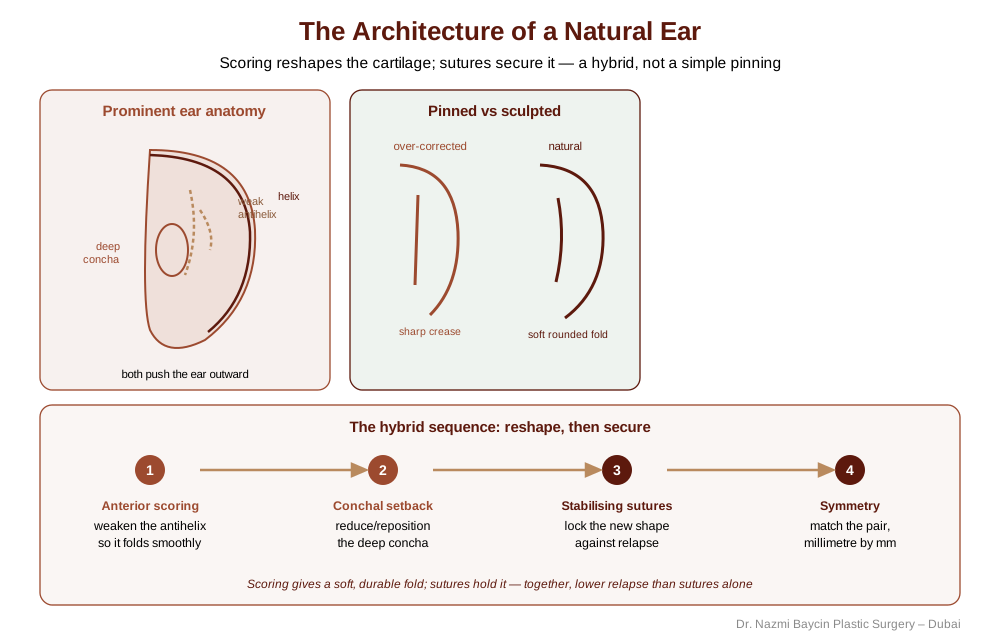
The architecture of otoplasty: prominent-ear anatomy, the difference between a pinned crease and a soft sculpted fold, and the hybrid sequence — scoring to reshape, sutures to secure — by Dr. Nazmi Baycin, Dubai.
Step 1 — Anterior scoring: preparing the fold
Where the new antihelical fold should sit, I gently score the anterior surface of the cartilage along a controlled line. This releases the cartilage’s tension on that side, so it naturally curves into a smooth, rounded fold rather than resisting. The scoring is even and conservative — enough to reshape, never so much as to create an edge. This is the step that makes the fold genuinely soft and, importantly, durable. It comes first because scoring cartilage that is already under suture tension is both harder to control and less effective.
Step 2 — Conchal setback: reducing the spacer
If the conchal bowl is deep, I address it directly, reducing or repositioning the conchal cartilage and setting it back toward the mastoid bone. This removes the structural spacer that pushes the ear outward and often resolves a large part of the projection before the fold is finalized — which in turn changes how much correction the fold still has to provide.
Step 3 — Stabilizing sutures: locking the new shape
With the cartilage reshaped, permanent mattress sutures are placed to secure the new antihelical fold and the conchal position. Because the cartilage has already been prepared to hold this shape, the sutures are stabilizing the result rather than forcing it — which is precisely why the correction resists relapse. The tension on each suture is adjusted independently to match the opposite ear.
Step 4 — The pursuit of symmetry: the surgeon’s ultimate test
Throughout, I am never operating on one ear in isolation — I am operating on a pair. Symmetry is judged last, once both ears are structurally complete, because a millimeter adjusted early moves everything downstream of it. I measure projection angles intraoperatively and make fine, millimeter-level adjustments until the balance feels innate. This relentless focus on proportion, more than any single maneuver, defines a refined otoplasty result.
Long-term stability and natural feel: the two tests of success
A successful otoplasty must pass two tests over time, and both matter equally: it must stay stable, and it must feel natural. Stability comes from the combination of reshaped cartilage and permanent sutures — the scoring reduces the cartilage’s urge to spring back, and the sutures hold the prepared shape, so the two work together rather than against each other. But stability alone is not enough.
The result must also be soft and pliable. Patients should be able to sleep on their ears, wear headphones, and live active lives without stiffness. This union of durability and suppleness is the hallmark of a technically refined procedure, and it is exactly what the hybrid approach is designed to deliver.
The unspoken goal: invisible intervention
The highest compliment an otoplasty can receive is not that the ears look perfect. It is that the person looks well and nobody can quite say why. The goal is for the ears simply to look right: naturally positioned, harmoniously folded, in graceful proportion to the head, and staying that way. They should never be the first thing someone notices, but a quiet, settled element of overall facial balance. Achieving this requires a surgeon who is equal parts anatomist, sculptor, and artist.
When choosing a surgeon, review their results closely — and, ideally, their long-term results: look for soft contours rather than sharp creases, natural projection rather than a flattened look, and seamless symmetry that has held over time. This architectural approach runs through all of my facial plastic surgery work in Dubai.
FAQs about the cartilage-reshaping otoplasty technique
-
Why do you combine cartilage scoring with sutures instead of using sutures alone?
Because cartilage has memory, and a stitch alone does not change that. If I bend the cartilage into a new fold with sutures but leave the cartilage itself unaltered, it strains to return to where it began — and over months it often does, drifting the ears back toward prominence. So I first score the cartilage gently along the line of the new fold to relax its spring, so it curves willingly, and only then place permanent sutures to secure the reshaped fold. That combination is what gives me a fold that is both soft and durable, and it is why I rely on it in every case. The published reviews point the same way: combining scoring with sutures is associated with lower recurrence than suture-only methods.
-
Why does the order of the four steps matter?
Because each step changes what the next one is working with. Scoring comes first, since it relaxes the cartilage so the fold forms willingly, and scoring cartilage that is already under suture tension is harder to control. The conchal setback comes second, because reducing the bowl often resolves a large part of the projection and therefore changes how much correction the fold still needs to provide. Sutures come third, stabilizing a shape that already exists rather than creating one. Symmetry is judged last, once both ears are structurally complete, because a millimeter adjusted early moves everything downstream of it. Reordering the sequence is one of the quieter ways a technically sound operation produces a disappointing result.
-
Does cartilage scoring make the result look or feel unnatural?
No — done in a controlled, measured way, the opposite is true. Careful scoring is exactly what lets me coax the antihelical fold into a smooth, soft curve, rather than pinching it into a sharp crease with an overtightened suture. The risk of an unnatural edge comes from uncontrolled, excessive scoring, which I avoid by working gradually and evenly, a little at a time. Done well, the reshaped cartilage feels supple and natural under the fingers, and the fold looks as though it was always there.
-
Does scoring the cartilage weaken the ear or make it fragile?
No — controlled scoring does not make the ear fragile; it makes it cooperative. Cartilage resists being folded because of its natural spring, and scoring simply relaxes that spring along the precise line where I want the new fold to sit, so the cartilage curves willingly rather than fighting the correction. The essential word is controlled: I score gradually and evenly, never aggressively in one place, so the cartilage is reshaped without being thinned to weakness or left with an edge. Once the reshaped fold is secured with permanent sutures and the tissue heals over the following months, the ear is every bit as robust as before — you can sleep on it, wear headphones, and live normally. A scored, reshaped fold is in fact more stable over time than one held only by a stitch.
-
Two ears are never identical — how do you make them match?
Symmetry is the hardest part of otoplasty, and it is where I concentrate a great deal of my attention. I never operate on one ear in isolation; I work on the pair together, measuring projection angles and comparing the fold, the height, and the position of each ear against the other throughout the operation. Because I perform the surgery under local anesthesia, I can sit the patient up and view both ears from the front — the angle from which everyone actually sees them — before I finalize anything. I adjust the tension on each suture independently, in millimeter increments, until the two ears agree. The aim is not two mathematically identical ears, which no natural face has, but two ears that read as a balanced, harmonious pair.
-
Why is removing too much skin behind the ear a mistake?
It is one of the most common causes of a poor otoplasty result, and I deliberately avoid it. When a surgeon removes too much skin behind the ear and relies on that tension to hold the ear back, the closure is fighting a constant pull — which stretches and widens the scar and can distort the very cartilage work underneath. In my technique the correction is carried by the reshaped cartilage and the internal sutures, not by pulling the skin tight, so I remove only a conservative amount of skin and close the incision without tension. That is precisely why the scar behind the ear stays fine and hidden, and why the shape holds without being forced.


GET APPOINTMENT
Get ready to look and feel best… You deserve…
