


Table of content
- Key takeaways: designed around your anatomy
- Jawline implant surgery in Dubai quick facts
- What is jawline implant surgery?
- How does a jawline implant compare with fillers and other options?
- Are you a good candidate for a jawline implant?
- The role of 3D facial imaging in jawline implant surgery
- 3D simulation of a jawline implant: before & after comparison
- 3D bespoke jawline implant printing technology
- Where does Dr. Baycin perform jawline implant surgery in Dubai?
- What is recovery after jawline implant surgery like?
- What are the risks and complications of jawline implant surgery?
- Safety and long-term outcomes
- Checklist before having jawline implant surgery in Dubai
- What are the steps of jawline implant surgery in Dubai from consultation to surgery?
- How much does jawline implant surgery cost in Dubai, UAE?
- What makes Dr. Baycin an exceptional jawline implant surgeon in Dubai?
- About Dr. Nazmi Baycin
- FAQs about jawline implant surgery in Dubai
- What is jawline implant surgery?
- How much does jawline implant surgery cost in Dubai?
- Who is a good candidate for jawline implant surgery in Dubai?
- How is 3D facial imaging used in jawline implant surgery?
- What makes a bespoke jawline implant different from a standard implant?
- Is a jawline implant better than jawline filler?
- Are jawline implants permanent?
- Will there be visible scars after jawline implant surgery?
- Is jawline implant surgery safe, and what are the risks?
- How long is the recovery after jawline implant surgery in Dubai?
- Can jawline implant surgery be combined with other procedures?
- Why does the process take 6 to 8 weeks?
- When will I see the final results?
- Get appointment
The jawline is the frame of the lower face. It carries the line from the chin back to the angle beneath the ear, separates the face from the neck, and decides, more than any single feature, whether a face reads as soft or structured. I am Dr. Nazmi Baycin, and my jawline implant surgery in Dubai is built on one principle: the implant is designed around your mandible, never your face adapted to a stock shape. From a high-resolution CT scan I build a three-dimensional model of your jaw, design an implant that follows its every curve, and have it printed for you alone — a method I currently offer as the only surgeon in Dubai providing it.
Performing jawline implant surgery in Dubai within JCI-accredited hospitals, I plan the jaw angles, the jaw body, and the chin as a single unit, because that is how the eye reads them. The aim is structure and proportion, never exaggeration: a jawline that looks as though it was always yours. The principle is the one that guides all my work: to restore form is to restore function.
Key takeaways: designed around your anatomy
- A defined jawline frames the lower face and supports the neck profile.
- 3D facial imaging maps the jaw in detail before any surgical step.
- A bespoke implant is designed millimeter by millimeter to your mandible.
- A close fit reduces dead space, improving stability and predictability.
- The goal is structure and proportion, never exaggeration.
- Results emerge naturally over four to six weeks as swelling resolves.
Jawline implant surgery in Dubai quick facts
| Procedure detail | Bespoke jawline implant in Dubai |
|---|---|
| Technique | 3D CT-designed, patient-specific implant fixed to the mandible |
| Implant | Bespoke, 3D-printed in biocompatible medical-grade material (USA) |
| Coverage | Jaw angles, jaw body, or the full jawline; chin often included |
| Anesthesia | General |
| Procedure time | About 1.5–2 hours |
| Hospital stay | Day case or one night |
| Incision | Inside the mouth (no external scar) |
| Sutures | Dissolvable (none to remove) |
| Downtime | 1–2 weeks |
| Swelling | Peaks in week 1; largely settles by 2 weeks |
| Final result | Fully apparent at 4–6 weeks |
| Lead time | 6–8 weeks from CT scan to surgery (design, printing, shipping, approval) |
A well-defined jawline is a cornerstone of facial balance. It frames the lower face, supports the neck profile, and contributes significantly to how strong, youthful, or refined a face appears. When the jawline lacks definition or structural support, even an otherwise attractive face can appear unbalanced. For patients seeking a permanent and precise solution, jawline implant surgery in Dubai using 3D facial imaging and bespoke implant printing technology offers a modern, highly predictable approach. In my practice, jawline implant surgery is not about exaggeration. It is about structure, proportion, and harmony. With today’s technology, we no longer adapt the patient to a standard implant. Instead, we design the implant around your unique anatomy.
What is jawline implant surgery?
Jawline implant surgery is a facial contouring procedure designed to enhance the shape, width, projection, and continuity of the mandibular region. Depending on your anatomy and goals, the implant may be focused on the jaw angles, the jaw body, or extend along the entire jawline to create a continuous and natural contour. You may consider jawline implant surgery if your jawline appears weak, narrow, asymmetrical, or poorly defined.
Many patients choose this procedure to achieve a stronger lower face, improve facial symmetry, or create better balance between the jawline, chin, and midface. Because the jaw and chin function as a single aesthetic unit, jawline enhancement is often planned alongside chin augmentation in Dubai, and the reasoning behind treating them together is something I explore in my article on the structural philosophy of chin augmentation and total jawline harmony. The table below summarizes the most common jawline concerns and how a bespoke implant is used to address each one.
| Jawline concern | Typical presentation | How a bespoke implant helps |
|---|---|---|
| Weak jaw angles | A soft, rounded lower face lacking definition at the back of the jaw | Adds projection and width at the angles for a stronger frame |
| Poor jaw-body continuity | Gaps or steps between the chin and jaw angle | Restores a smooth, continuous line along the mandible |
| Facial asymmetry | One side of the jaw more developed than the other | Designed side-specifically to balance the two sides |
| Weak chin-jaw relationship | A recessed or narrow lower face overall | Planned with chin balance for harmonious lower-face proportions |
| Over-resected jaw angle | A hollow or notch where bone was removed in a previous jaw-reduction operation | Fills the defect exactly, because the implant is designed on the CT scan of the deficit itself |
| Age-related loss of jaw definition | Jowling and a blurred jaw-neck border as bone volume recedes with age | Restores skeletal support beneath the soft tissue, often alongside neck or lower-face rejuvenation |

This 3D facial bone imaging demonstrates how jawline implant surgery is planned before any surgical step is taken. By analyzing the jawbone in three dimensions, the implant is designed to follow your natural anatomy, ensuring precise fit, balance, and long-term stability — by Dr. Nazmi Baycin, Dubai.
How does a jawline implant compare with fillers and other options?
Most patients who come to me for a jawline have already tried, or been offered, something else. Each option has a place, and the table is meant to show where that place is rather than to dismiss any of them.
| Factor | Bespoke jawline implant | Dermal fillers | Fat grafting | Bone surgery (angle osteotomy / genioplasty) |
|---|---|---|---|---|
| What it changes | Skeletal contour: width, angle, projection, continuity | Soft-tissue volume over the bone | Soft-tissue volume, using your own fat | The position of the bone itself |
| Best for | Bone deficits; asymmetry; permanent definition | Mild softening; trying a look before committing | Diffuse hollowing in a patient with fat to spare | Large skeletal movements, vertical changes, bite-related discrepancies |
| Durability | Permanent | 12–18 months, then repeated | Partly permanent; 30–50% of grafted fat is typically resorbed | Permanent |
| Precision | Designed to the millimeter on a CT model | Judged by eye at each session | Unpredictable retention, side to side | Surgeon-judged during the operation |
| Definition achievable | Sharp, structural; reads as bone | Soft; filler cannot create a crisp angle and tends to blur it with volume | Soft; adds fullness rather than edge | Structural, but limited to what the existing bone allows |
| Reversibility | Removable or exchangeable | Dissolvable (hyaluronic acid) | Not reversible | Not reversible |
| Downtime | 1–2 weeks | Hours to a few days | 1–2 weeks | 2–4 weeks |
| Cost over 10 years | One procedure | Repeated 6–10 times; often exceeds surgery | One to two sessions | One procedure |
A jawline implant is often combined with adjacent procedures where they serve the same result: chin augmentation in the same implant, submental fat removal to sharpen the jaw-neck border, or buccal fat reduction where cheek fullness softens the line of the jaw.
Are you a good candidate for a jawline implant?
You are likely a good candidate if your jawline is weak, narrow, asymmetric, or poorly defined, you want a permanent structural correction rather than a filler that fades, you are in good general health, and your expectations are for balance rather than exaggeration. A clean medical history matters, because patient safety governs every decision I make before surgery. The 3D CT assessment is what settles the question: it shows us together whether the shortfall is in the bone, where it is, and what a given implant will do to the profile before anything is committed.
It is equally important to be clear about what a jawline implant does not treat. Where the jaw-neck border is blurred by fullness under the chin rather than a lack of bone, the answer is removing submental fullness, not adding structure beneath it. Where the skin and soft tissue of the lower face have descended with age, an implant alone cannot lift them, and the jawline is better restored as part of a facelift plan, with the implant providing the skeletal support beneath. And where the jaw discrepancy is functional, affecting the bite, the underlying skeletal relationship belongs to orthognathic surgery rather than to an onlay implant. The CT model separates these cases because it shows the skeleton beneath the soft tissue.
The role of 3D facial imaging in jawline implant surgery
Precision begins with planning. Jawline implant surgery in Dubai relies heavily on 3D facial imaging, which allows me to analyze your facial skeleton in detail before any surgical step is taken. A high-resolution CT scan is used to create a three-dimensional digital model of your facial bones and soft tissues. This model allows precise evaluation of jaw width, angles, projection, asymmetry, and overall facial proportions.
By working in three dimensions, I can plan the implant size, shape, and position with a level of accuracy that is simply not possible with traditional methods. The depth of analysis this imaging allows is something I detail further in my article on using 3D CT imaging for precision facial bone analysis and surgical planning. For you as a patient, this means fewer uncertainties, clearer expectations, and more predictable results.
What the CT model measures
| Measurement | What it tells me | How it shapes the implant |
|---|---|---|
| Bigonial width | The distance between the two jaw angles, and how it relates to the width of the cheekbones | Decides how much lateral projection each angle needs, and whether the two sides need different amounts |
| Gonial angle | The angle at the corner of the jaw; an obtuse angle reads as a sloping, undefined jawline | Sets the posterior and inferior extension of the implant to sharpen the corner |
| Mandibular border continuity | Whether the lower border runs as one clean line from chin to angle, or steps and dips | Defines where the implant must thicken or thin to produce a continuous edge |
| Chin projection and width | How the chin sits relative to the lips and the jaw body | Determines whether the chin is included in the same implant or treated separately |
| Left-right asymmetry | Differences in angle height, flare, and border position between the sides | Each side is designed independently; the implant is never a mirrored pair |
| Soft-tissue thickness | How much skin and muscle overlies the bone at each point | Governs how much bone change is needed to produce a given change at the surface |
| Mental nerve position | Where the nerve exits the jaw below the premolars | The implant and its screw positions are designed to stay clear of it |

This 3D facial bone analysis is part of the planning process for jawline implant surgery. By visualizing the jawline in three dimensions, I can design a bespoke implant that integrates naturally with the facial structure and delivers predictable results — by Dr. Nazmi Baycin, Dubai.
3D simulation of a jawline implant: before & after comparison
The simulation below is a real patient model. You can select the visualization mode using the button on the left, which allows you to view the model with or without soft tissue and compare before-and-after states. You can also change the viewing angle by clicking and dragging inside the frame.
3D bespoke jawline implant printing technology
Once your 3D facial model is created, a custom jawline implant is digitally designed to match your exact mandibular anatomy. Every curve, thickness, and extension is adjusted millimeter by millimeter to complement your face rather than overpower it. The final design is then produced using advanced 3D printing technology and biocompatible medical-grade materials intended for long-term implantation. How such an implant performs depends heavily on how it is manufactured: a materials study of 3D-printed PEEK bone implants found that controlling the printing environment during manufacture improved the material’s crystallinity and the bond between its printed layers, and with them its mechanical strength. Because the implant is bespoke, it fits closely against the bone, reducing dead space and improving stability.
This precise fit is one of the key reasons bespoke jawline implants feel more natural and behave more predictably over time. The full design-and-manufacturing pathway behind these devices is something I describe in my article on the workflow of 3D-printed custom facial bone implants.
Stock jawline implant vs. bespoke jawline implant
The jaw is the one facial site where a stock implant is most exposed, because it must fit two angles that are rarely symmetric and a border that curves in three planes at once. The table sets out where the difference lies.
| Factor | Stock (off-the-shelf) implant | Bespoke CT-designed implant |
|---|---|---|
| Design basis | A manufacturer’s average jaw, in a few sizes | Your own CT scan; the inner surface is a negative of your mandible |
| Symmetry | Sold as mirrored pairs; cannot correct a jaw that differs side to side | Each side designed independently, so an asymmetric jaw can be balanced |
| Fit at the angle | Approximate; the implant often rocks or lifts where the bone curves | Flush across the whole footprint; no gap to shift within |
| Continuity with the chin | Separate angle and chin pieces leave a step between them | One continuous design from angle to chin where needed |
| Adjustment in surgery | Trimmed by hand to approximate the fit | None needed; fit decided before the incision |
| Fixation | Screws through an implant that may sit on an uneven bed | Screw positions planned on the model, clear of the mental nerve |
| Predictability | Estimated from a size chart | Previewed in soft-tissue simulation; the design you approve is the specification |
| Lead time | Immediate | 6–8 weeks for design, printing, shipping, and regulatory approval |
| Cost | Lower | Higher, reflecting imaging, design, manufacture, and import |
| What the evidence shows | A comparison of 21 mandibular angle augmentations, 12 with stock implants and 9 with patient-specific implants, found the custom implants gave greater facial symmetry, though the difference did not reach statistical significance in a series that small, and reported a low complication rate for the custom group. No larger head-to-head trial exists; the advantages above are reasoning about fit, presented as such. | |

Advanced 3D facial imaging allows precise analysis of the jawbone and accurate planning of bespoke jawline implants. Each implant is designed millimeter by millimeter to match the patient’s anatomy and enhance facial harmony — by Dr. Nazmi Baycin, Dubai.
How the implant is placed
The operation is performed under general anesthesia and takes about one and a half to two hours. I reach the jaw through incisions inside the mouth, along the lower gum line, so there is no external scar. A pocket is lifted directly on the bone, kept to exactly the footprint the implant was designed for, and the implant is seated against the mandible in the position planned on the model. Because the inner surface already matches the bone, it sits in only one place; I then fix it with small titanium screws at the positions designed for it, clear of the mental nerve. The incisions are closed with dissolvable sutures and a supportive dressing is applied.
Where does Dr. Baycin perform jawline implant surgery in Dubai?
I perform every jawline implant surgery in a premium, JCI-accredited hospital in Dubai that meets the highest international standards for safety and hygiene. Your surgery takes place in a fully equipped, advanced medical environment — because outstanding results and uncompromising safety are inseparable.
What is recovery after jawline implant surgery like?
The implant is precisely positioned according to the preoperative 3D plan. Postoperative care focuses on swelling control, comfort, and optimal healing. After jawline implant surgery in Dubai, some swelling and tightness are expected, particularly during the first week. Most patients are able to return to daily activities within one to two weeks, although strenuous exercise should be avoided initially. As swelling gradually subsides, the jawline becomes more defined and structured.
The final result is not abrupt or artificial. It emerges naturally as healing progresses, typically becoming fully apparent within four to six weeks. Because bespoke implants fit precisely, recovery is often smoother and long-term stability is improved. To understand the full science behind how I support your healing after surgery, see my advanced recovery protocol in Dubai article.
| Stage | What is happening | What you do |
|---|---|---|
| Day 0–1 | Home the same day or after one night; the lower face feels tight and full; antibiotics and pain relief prescribed | Head elevated, cold compresses, soft or liquid diet, antiseptic mouthwash after every meal |
| Days 2–7 | Swelling peaks around day 3 and begins to settle; mild numbness of the lower lip or chin is common and temporary | Soft foods, no vigorous chewing, supportive jaw garment as instructed, no exercise |
| Week 2 | Most swelling gone; jawline visibly stronger; sutures dissolving | Back at work and social life; normal diet returning; light walking |
| Weeks 3–4 | Residual swelling at the angles resolving; sensation returning where it was altered | Sport and strenuous activity from about week 3–4 with my clearance |
| Weeks 4–6 | Tissues seated onto the implant; the contour you approved on the model is now visible in the mirror | Follow-up review; no restrictions |
| Months 3–6 | Final refinement of the angles and jaw-neck border as the last deep swelling clears | Nothing further; the result is stable and permanent |
Plan your jawline implant recovery
Enter the surgery date you planned and view your own recovery calendar; then add it to your phone calendar or print it.
Your timeline appears here once you choose a date.
These are typical timings. Your own plan depends on your health, the technique used, and how you heal; always follow the instructions Dr. Baycin gives you after surgery. Nothing you enter here is sent or stored.
What are the risks and complications of jawline implant surgery?
Jawline implant surgery is safe in experienced hands, but no operation is without risk, and I would rather you read the list here than hear it for the first time at consultation. The recognized risks are infection, hematoma, temporary numbness of the lower lip or chin from irritation of the mental nerve, asymmetry, visible or palpable implant edges, and, specific to implants, malposition or shifting that can require revision. Because the incisions are inside the mouth, the bacterial environment carries a slightly higher infection risk than an external route would, which is why antibiotics and meticulous oral hygiene matter in the first week.
The published evidence is reassuring, and it is worth describing accurately. A 2025 systematic review of 117 studies and 4,273 patients receiving facial implants of all kinds found an overall complication rate of 4.4%, with nerve disturbance at 2.1%, infection at 1.0%, hematoma at 1.4%, displacement at 0.59%, and bone resorption at 0.68%, and noted that patient-specific implants showed promise in reducing complications such as infection. A meta-analysis of 29 studies and 543 patient-specific implants for facial contouring and augmentation reported pooled rates for PEEK implants of 6.94% for any complication, 1.51% for infection, and 0.73% for implant removal, with no significant difference between PEEK and titanium. And in the largest published series of computer-designed mandible implants, 123 patients over fifteen years, infection requiring removal occurred in 2.4% and revision for dissatisfaction in 4.1%.
Three things follow from those figures. First, the complication that matters most, infection, sits at one to two in a hundred with modern custom implants. Second, the mechanism behind most implant-specific problems, a gap between implant and bone, is exactly what the CT-designed fit closes off before the operation; I should be plain that this is reasoning about mechanism rather than a result proven head to head, since no trial has compared custom and stock jawline implants directly. Third, nerve disturbance is the most frequent complication in every series, which is why the mental nerve is mapped on the model and the implant and screws are designed to stay clear of it.
Safety and long-term outcomes
When performed by an experienced board-certified surgeon, jawline implant surgery is a safe and reliable procedure. The use of 3D planning and custom implant manufacturing significantly reduces surgical guesswork and improves long-term outcomes. The materials used for bespoke jawline implants are designed to remain stable and durable over time. With proper placement and care, jawline implant surgery offers a permanent solution for structural facial enhancement.
This structural, whole-face approach reflects the same philosophy I apply across the lower face, which I discuss in my article on the neck-chin-jawline continuum. For patients weighing this against other structural options, both the surgical plan and its cost are best worked out at a consultation, once your anatomy and goals are clearly defined — an approach in keeping with what you should expect from a board-certified plastic surgeon in Dubai.
Checklist before having jawline implant surgery in Dubai
Jawline implant in Dubai: suitability and safety checklist
Important: This checklist helps you prepare for your consultation. It cannot decide whether surgery is safe or suitable for you. Please disclose your full medical history, medicines, and supplements when we meet — everything you share stays confidential.
- Discuss at consultation We plan around it together. Usually not a barrier on its own.
- Medical review The anesthesia team or a specialist reviews it, sometimes with tests or a clearance letter, before a date is confirmed.
- Postpone Surgery waits until this has changed or settled.
- Alternative advised This procedure is not the right fit; another option may suit you better.
| # | Question | Why it matters | If the answer is “NO” |
|---|---|---|---|
| 1 | Are you 18 or older, with facial growth complete? | The implant is fixed to the jaw bone, which must have finished growing. | Not offered |
| 2 | Is your concern the bone itself — a jawline that looks weak, narrow, uneven or poorly defined — rather than fullness under the chin or sagging skin? | An implant adds skeletal structure. It cannot remove fullness under the chin or lift skin that has descended with age. | Alternative advised Fullness under the chin: double chin correction; loose lower-face skin: a facelift, with or without an implant. |
| 3 | Do your upper and lower teeth meet normally, without a significant jaw misalignment? | An onlay implant adds to the bone but cannot correct the bite; a jaw discrepancy that affects the bite needs jaw (orthognathic) surgery. | Alternative advised Orthognathic surgery may be assessed instead. |
| 4 | Are you looking for a permanent structural change, rather than trying a fuller look first? | An implant is permanent, though removable. Filler adds soft volume for 12–18 months and is a fair way to try a look before committing. | Alternative advised Filler may be a sensible first step. |
| 5 | Are you comfortable with the implant being designed from a 3D CT scan of your face, and with a result aimed at balance rather than exaggeration? | The CT model shows where the bone falls short and previews the result; you review and approve the design before it is made. | Discuss at consultation We look at the design together. |
| 6 | Can you allow 6–8 weeks from your CT scan to surgery? | Your implant is designed, approved, 3D-printed in the USA, shipped to Dubai and approved by the health authority before it can be used. | Discuss at consultation If you travel from abroad, only one trip may be needed for the surgery itself. |
| 7 | Can you follow a soft diet, use an antiseptic mouthwash after every meal, and avoid sport for about 3–4 weeks? | The incisions are inside the mouth, so oral hygiene protects the implant from infection while it heals. | Postpone Choose a date that allows 1–2 weeks off work and social life. |
| # | Does this apply to you? | Why it matters | Usual next step |
|---|---|---|---|
| Medical history | |||
| 8 | Heart disease, high blood pressure, or an irregular heartbeat | General anesthesia and surgery add strain on the heart. | Medical review |
| 9 | A previous blood clot (DVT or PE), a clotting disorder, or a close relative with clots | Surgery raises clot risk; prevention is planned around your personal risk. | Medical review |
| 10 | Diabetes | Blood-sugar control affects healing and infection risk around the implant. | Medical review |
| 11 | Asthma, other lung disease, or sleep apnea | These affect breathing during and after anesthesia. | Medical review |
| 12 | Liver or kidney disease, anemia, or a bleeding disorder | These affect how medicines are cleared, bleeding, and recovery. | Medical review |
| 13 | HIV, hepatitis B or C, or another blood-borne infection | Well-controlled infection does not automatically rule surgery out; your team plans around it. | Discuss at consultation In confidence. |
| 14 | Past problems with anesthesia, or allergy to local anesthetics, antibiotics, or latex | Jawline implant surgery is performed under general anesthesia. | Medical review |
| 15 | Previous jaw or chin surgery — including jaw-angle reduction — an existing implant, or fillers in the jaw or chin | Earlier work changes the bone and soft tissue the implant is designed against. | Medical review The 3D CT scan maps it. |
| 16 | Numbness of the lower lip or chin, or a previous nerve injury in the jaw | The nerve that gives the lip and chin feeling exits close to the implant area; your baseline is recorded before surgery. | Medical review |
| 17 | Medicines for bone thinning (such as bisphosphonates or denosumab), or past radiation to the jaw | These affect how the jaw bone heals around the fixation screws. | Medical review |
| 18 | A dental infection, gum disease, loose teeth, or dental work planned in the coming months | The implant is placed through the mouth, which must be healthy to keep the implant free of infection. | Postpone Until treated; dental work is planned around surgery. |
| 19 | Braces or orthodontic treatment planned or under way | Moving the teeth changes the jaw and chin relationship the implant is designed for. | Discuss at consultation |
| 20 | Jaw joint pain, clicking, or limited mouth opening | Recovery involves a soft diet and a jaw garment, and the operation is done through the mouth. | Discuss at consultation |
| 21 | Pregnant, breastfeeding, or possibly pregnant | Planning needs a CT scan, and elective surgery is deferred until after pregnancy and breastfeeding. | Postpone |
| Medicines and supplements | |||
| 22 | Blood thinners, aspirin, or anti-inflammatories such as ibuprofen | These increase bleeding; some are paused before surgery under medical guidance. | Medical review Never stop a prescribed medicine on your own. |
| 23 | Supplements such as fish oil, vitamin E, ginkgo, garlic, or turmeric | Several raise bleeding risk and are usually paused before surgery. | Discuss at consultation |
| 24 | Weight-loss injections such as semaglutide or tirzepatide | They slow stomach emptying, which matters for general anesthesia. | Medical review |
| 25 | The contraceptive pill, hormone therapy, or prescribed testosterone | Estrogen raises clot risk; testosterone can thicken the blood. | Medical review |
| 26 | Anabolic steroids or other performance-enhancing drugs | These affect the heart, liver, blood count, and anesthesia. | Medical review Please be open with us — it stays confidential. |
| 27 | Antidepressants or other psychiatric medication | Some interact with anesthesia or pain medicines. | Medical review Keep taking them unless your prescriber advises otherwise. |
| Lifestyle and travel | |||
| 28 | Smoking, vaping, or any nicotine — including pouches, gum, or patches | Nicotine slows healing and raises the risk of infection around the implant, which is placed through the mouth. | Discontinue Until nicotine-free for the recovery period we advise. |
| 29 | Recreational drug use or regular heavy drinking | These interact with anesthesia and slow healing. | Medical review |
| 30 | Flying long-haul to Dubai for surgery, or planning to fly home soon after | Long flights add to clot risk around surgery. | Discuss at consultation We plan your travel dates with you. |
| Expectations and wellbeing | |||
| 31 | Do you spend a lot of time worrying about how your face or jawline looks, or feel no change would be enough even when others disagree? | This can be a sign of body-image distress that surgery rarely relieves. | Discuss at consultation A supportive, private conversation. |
Medical note: A medical condition, infection, or medicine does not automatically rule out jawline implant surgery. The decision depends on the diagnosis, how well it is controlled, the planned procedure, and assessment by the surgeon and anesthesia team. Never stop or change prescribed medication without advice from your treating clinician.
Aesthetic note: A jawline implant adds permanent skeletal definition to the jaw angles, the jaw body or the whole jawline, designed on a 3D CT model of your own jaw. It does not remove fullness under the chin, lift loose skin, or correct the bite, and this checklist cannot guarantee a particular result.
Jawline implant risks: Infection — slightly more likely because the incisions are inside the mouth — hematoma, temporary numbness of the lower lip or chin, asymmetry, visible or palpable implant edges, and shifting of the implant that may need revision. Your surgeon explains how each is reduced.
Medically reviewed by Dr. Nazmi Baycin, DHA-licensed plastic surgeon · Last reviewed: 24.10.2026
What are the steps of jawline implant surgery in Dubai from consultation to surgery?
Because jawline implant surgery is performed under general anesthesia, and because your implant is designed and made for you alone, the path from your first visit to your procedure follows six steps. Each one is there to confirm that surgery is both safe and right for you.
- Consultation and 3D CT scan: I assess your jawline, chin and lower-face proportions, and establish whether the shortfall is in the bone. Consultations are paid, and this is where your exact pricing is confirmed once your CT model has been reviewed.
- 3D facial imaging (CT scan): A high-resolution CT scan is performed to capture detailed images of the facial skeleton. This scan forms the foundation for accurate jawline analysis and implant planning.
- Digital facial analysis and surgical planning: The CT data is converted into a three-dimensional facial model. Jaw width, angles, projection, and symmetry are evaluated, allowing me to determine the optimal implant design and placement.
- Implant design and manufacturing: Your implant is designed, approved and manufactured for you alone, in four stages.
- Bespoke jawline implant design: Based on the 3D analysis, a custom jawline implant is digitally designed to match your unique mandibular anatomy. The implant may enhance the jaw angles, jaw body, or the entire jawline, depending on the desired outcome.
- Review and design approval: You will review the proposed implant design. Any refinements are made before final approval to ensure expectations and surgical goals are aligned.
- 3D printing of the custom implant: Once approved, the jawline implant will be manufactured using advanced 3D printing technology and biocompatible medical-grade materials in the USA.
- International shipment and regulatory approval: The bespoke implant will be shipped from the USA to Dubai and submitted for local health authority approval. This step is essential for ensuring compliance with medical safety regulations.
- Booking the procedure (scheduling of jawline implant surgery): After approval, the surgery date will be scheduled. Procedures are scheduled within 2–10 days, depending on the hospital’s operating theater (OT) availability.
- Preoperative blood tests: Routine blood tests are carried out before surgery to confirm that you are in good general health for general anesthesia.
- Preoperative anesthesia consultation for clearance: The anesthesiologist reviews your test results and medical history and gives clearance for general anesthesia.
- Procedure: I place your bespoke implant through incisions inside the mouth and fix it with small titanium screws at the positions planned on the model, in a JCI-accredited hospital in Dubai. The operation takes about 1.5–2 hours, and the hospital stay is a day case or one night.
The overall process may take 6 to 8 weeks.
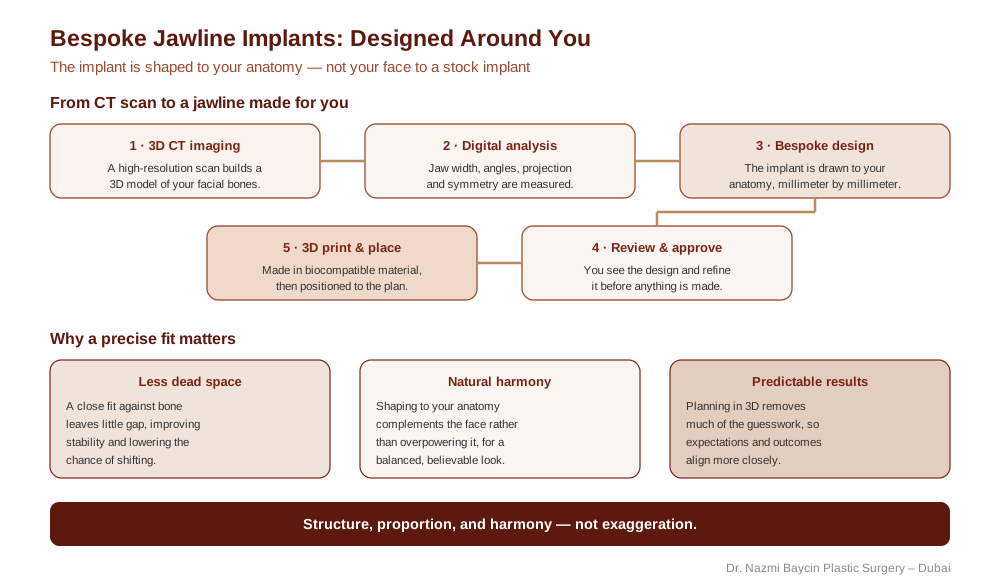
The bespoke jawline implant workflow — from 3D CT imaging to a custom implant designed around your anatomy — by Dr. Nazmi Baycin, Dubai.
How much does jawline implant surgery cost in Dubai, UAE?
The total cost of bespoke jawline implant surgery in Dubai is AED 90,000 to AED 100,000 (about $24,500 to $27,200). Unlike a stock-implant procedure, this figure covers the whole pathway: the CT scan and 3D analysis, the digital design and your review, 3D printing in the USA, shipment and local regulatory approval, the hospital and anesthesia fees, and the surgery itself. The exact figure within that range depends on whether the implant covers the angles alone or the full jawline with the chin, and is confirmed at your consultation once your CT model has been reviewed.
For a complete overview of treatment fees, please refer to full price list of the procedures.
Schedule your private consultation with Dr. BaycinWhat makes Dr. Baycin an exceptional jawline implant surgeon in Dubai?
Patients seeking a jawline want structure that looks like their own bone — and the reason they travel to Dr. Baycin is simple: the implant is designed for their jaw, not adapted to it.
- 25+ years of surgical expertise: a DHA-licensed, board-certified plastic surgeon and member of the American Society of Plastic Surgeons (ASPS), bringing decades of facial and skeletal experience to every procedure.
- The only surgeon in Dubai offering CT-designed, 3D-printed facial bone implants: every jawline implant is designed on the patient’s own CT model and printed for that patient alone.
- Whole-lower-face planning: jaw angles, jaw body, chin, and neckline assessed as one unit, so the result is proportion rather than a stronger jaw in isolation.
- Side-specific design: asymmetric jaws are corrected by designing each side independently, something no mirrored stock pair can do.
- Preview before commitment: soft-tissue simulation lets you see and approve the result before the implant is manufactured.
- Nerve-aware engineering: the mental nerve is mapped on the model and the implant and screw positions are designed around it.
- Safety beyond compromise: thousands of aesthetic procedures in JCI-accredited hospitals with zero major complications.
- Honest, transparent consultations: every option explained, including when a filler, a neck procedure, or a facelift would serve you better than an implant.
- Exceptional post-operative care: personalized aftercare and direct surgeon access throughout recovery.
- A global destination for facial bone implants: patients from Europe, the GCC, and beyond choose Dubai for his results.
About Dr. Nazmi Baycin
Surgery, to me, is precision applied in service of restoration — a conviction that has guided every one of the more than 7,000 procedures I have performed over 25 years in practice. I am a DHA-licensed, board-certified plastic surgeon, trained in Turkey and based in Dubai since 2016. I operate exclusively within JCI-accredited hospitals, and hold international membership in the American Society of Plastic Surgeons (ASPS). Three techniques, in particular, have become signatures of my practice. Scarless breast augmentation, performed through a transaxillary approach that leaves no incision on the breast itself. Labiaplasty designed individually around each patient’s own anatomy, never to a standard template. And 3D customized facial bone implants, engineered through CT-based bespoke printing — a technique I currently offer as the only surgeon in Dubai providing it. My practice today spans facial rejuvenation, breast surgery, body contouring, and cosmetic genital procedures, drawing patients from across the UAE, Europe, and the wider GCC. Yet the principle guiding each of these specialties has never changed: to restore form is to restore function.
FAQs about jawline implant surgery in Dubai
-
What is jawline implant surgery?
Jawline implant surgery is a facial contouring procedure designed to improve the shape, definition, and structural support of the jawline. The goal is to enhance facial balance by strengthening the lower face in a natural, proportionate way. Depending on your anatomy, the implant can focus on the jaw angles, the jaw body, or run along the entire jawline to create a continuous contour. Rather than adapting your face to a stock implant, the modern approach designs a bespoke implant around your own mandibular anatomy, which is what allows the result to look structured yet natural.
-
How much does jawline implant surgery cost in Dubai?
The total cost of bespoke jawline implant surgery in Dubai is AED 90,000 to AED 100,000. That figure covers the whole pathway, from the CT scan and 3D design through 3D printing in the USA, shipment and regulatory approval, to the hospital fees and the surgery itself. Where you fall within the range depends on whether the implant covers the jaw angles alone or the full jawline including the chin, and is confirmed at consultation once your CT model has been reviewed.
-
Who is a good candidate for jawline implant surgery in Dubai?
You may be a good candidate if you have a weak, narrow, or poorly defined jawline and are seeking a permanent solution rather than temporary fillers. Good general health and realistic expectations focused on facial harmony are important. Ideal candidates want structural balance between the jawline, chin, and midface rather than an exaggerated look. During the consultation, your facial proportions are assessed in three dimensions to confirm whether an implant is the right approach for your goals, and whether combining it with chin enhancement would produce a more harmonious lower face.
-
How is 3D facial imaging used in jawline implant surgery?
3D facial imaging allows your jawline to be analyzed in three dimensions using a high-resolution CT scan. That scan is converted into a detailed digital model of your facial bones, so jaw width, angles, projection, and any asymmetry can be measured precisely. Planning the implant on this actual bone structure — rather than estimating during surgery — improves both accuracy and predictability. It also lets you see and understand the plan in advance, which reduces uncertainty. This imaging-led planning is the foundation of the whole bespoke process and a major reason the results are so consistent.
-
What makes a bespoke jawline implant different from a standard implant?
A bespoke jawline implant is designed specifically for your anatomy rather than selected from a range of pre-made shapes. Because it is drawn millimeter by millimeter to your mandible, it fits closely against the bone, which improves symmetry, stability, and the naturalness of the result. A standard, off-the-shelf implant cannot match the individual contours of your jaw as precisely, so it may leave gaps, sit less securely, or look less integrated. The custom fit reduces dead space beneath the implant, and this closer bone contact is a key reason bespoke implants behave more predictably over time.
-
Is a jawline implant better than jawline filler?
They do different jobs. Filler adds soft volume over the bone and lasts twelve to eighteen months; it is a reasonable way to try a fuller lower face, but it cannot create a crisp angle, and repeated sessions tend to blur the jawline with volume rather than define it. An implant changes the skeleton itself, produces a sharp, structural edge, and is permanent. If your concern is a real bone deficit or asymmetry, an implant is the right tool; if it is mild softening you are unsure about, filler is a fair first step, and over ten years it usually costs more than the surgery it postpones.
-
Are jawline implants permanent?
Yes. Jawline implants are designed to be permanent. The medical-grade materials used are stable and durable and do not degrade over time, so they provide long-lasting structural support to the lower face. Once healed, the implant becomes a settled part of your facial framework. Because a bespoke implant fits so precisely against the bone, it also tends to remain stable in position, which supports the longevity of the result. Should circumstances ever change, implants of this type can be adjusted or removed, but they are intended and designed as a lasting solution.
-
Will there be visible scars after jawline implant surgery?
No. I place the incisions inside the mouth, along the lower gum line, so there is no external scar on the jawline or neck. The incisions are closed with dissolvable sutures and heal within the mouth, where they are not visible once recovery is complete. The trade-off of the intraoral route is a slightly higher infection risk from the mouth’s bacterial environment, which is why antibiotics, an antiseptic mouthwash, and a soft diet are part of the first week’s care.
-
Is jawline implant surgery safe, and what are the risks?
In experienced hands it is safe, though no operation is without risk. The recognized risks are infection, hematoma, temporary numbness of the lower lip or chin, asymmetry, palpable edges, and, specific to implants, malposition or shifting. Across the published literature on facial implants, the overall complication rate is around 4 to 7 percent, with infection at one to two percent and nerve disturbance the most frequent issue. The 3D plan addresses the mechanism behind most implant-specific problems, a gap between implant and bone, and maps the mental nerve so the implant and screws stay clear of it. Where any issue does arise, it is almost always correctable.
-
How long is the recovery after jawline implant surgery in Dubai?
Initial swelling usually improves within the first one to two weeks, and most patients return to their normal daily activities during this period. Strenuous exercise should be avoided early on while the tissues settle. The final result becomes more apparent as the swelling fully resolves over four to six weeks, at which point the refined, structured jawline is clearly visible. Because bespoke implants fit precisely, recovery tends to be smoother than with less exact methods. Following the aftercare guidance — including activity limits and a soft diet after the intraoral incisions — helps healing proceed as predictably as possible.
-
Can jawline implant surgery be combined with other procedures?
Yes. Jawline implant surgery in Dubai is often combined with chin enhancement or other facial procedures to achieve balanced lower facial proportions. Because the jaw, chin, and neck form a single visual continuum, addressing them together frequently produces a more harmonious result than treating any one area in isolation. The 3D planning process makes it straightforward to design complementary changes that work together, whether that is a chin included in the same implant, submental fat removal to sharpen the jaw-neck border, or buccal fat reduction where cheek fullness softens the line of the jaw.
-
Why does the process take 6 to 8 weeks?
Because the implant does not exist until it is designed for you. After the CT scan, the 3D model is built and the implant is designed, which you review and approve; it is then 3D-printed in the USA, shipped to Dubai, and submitted to the local health authority for approval before it can be used. Each step protects the result or your safety, and none can be skipped. If you are traveling from abroad, the scan and the design review can be arranged so that only one trip to Dubai is needed for the surgery itself.
-
When will I see the final results?
You will notice an immediate structural improvement in the jawline right after surgery, but the final aesthetic result becomes clearer as the swelling subsides. This typically occurs within four to six weeks, as the tissues settle and the definition of the new contour emerges. The change is designed to look natural rather than abrupt, so it reveals itself gradually as healing progresses. Because the implant was planned and fitted to your specific anatomy, the settled result closely reflects the design you reviewed and approved before surgery, which is part of what makes the outcome so predictable.


GET APPOINTMENT
Get ready to look and feel best… You deserve…
