

A chin implant either arrives at the result you agreed on, or it approximates it. There is no third outcome. When a patient and I settle on a plan — this much projection, this vertical proportion, this correction of a chin that sits slightly to one side — the entire value of a 3D-designed implant lies in whether the object placed on the bone reproduces that plan faithfully, or merely resembles it. A stock implant, chosen from a drawer and adjusted by feel during surgery, leaves that fidelity to chance and to the surgeon’s hands on the day. A precisely designed implant removes the guesswork: the target is fixed in the plan, the device is built to hit it, and what you previewed is what you receive. This article is about that accuracy — what it is, how it is achieved, and why it is the difference between a predictable result and a hopeful one.
Key takeaways: accuracy is the whole point
- A 3D-designed implant is built to reproduce an agreed plan, not to approximate one.
- What you preview, you receive — the simulation is the specification, not a sales image.
- Sub-millimetric design plus screw fixation converts an accurate plan into an accurate result.
- Precision is what makes the outcome predictable, and predictability is what patients actually want.
- An implant that fits exactly is less likely to be revised, because most revisions correct a poor fit.
- Accuracy is a chain: plan, design, placement. A break in any link loses the result.
The promise of a precisely designed chin implant is not that it is fancier than a standard one. It is that it is accountable to a plan. That accountability is the whole subject of this article. For the procedure itself — candidacy, technique options, risks, recovery, and cost — see my main page on chin augmentation in Dubai; for the geometry a chin correction has to satisfy, see my article on which of the four axes your surgeon measured.
Here I focus on one question only: how a designed implant hits the result you were shown. The approach is documented in the surgical literature. In a 2018 study on computer-assisted planning and 3D-printing for chin augmentation, patients viewed three-dimensional images of their own face to choose the contour they wanted; a replica of the mandible was then printed from their CT data, the inner surface of the implant was shaped to match that bone, and the outer surface was shaped to reproduce the contour the patient had chosen. The preview and the device came from the same model. That is the mechanism this article is about.
Predictability is the result patients are really asking for
When a patient tells me they want a stronger chin, they are not asking for a larger object under their skin. They are asking to look a particular way — and to know, before they commit, that they will. The unspoken fear in every aesthetic consultation is the gap between what was discussed and what was delivered. Precision is how that gap is closed. A designed implant makes the outcome a decision rather than a hope.
The projection is set to a number rather than discovered afterwards. The vertical dimension is set to your facial proportions. Because every dimension is fixed in advance and the implant is built to those dimensions, the result is defined before you are anesthetized — and defined by you and me together, not discovered on review. That is what accuracy delivers first: not a better chin in the abstract, but the specific chin you agreed to.
What you preview is what you receive
The most direct expression of this accuracy is the preview. Because the implant is designed on a digital model of your own facial bones, the projected result can be shown to you before any decision is made — and because the manufactured device reproduces that design faithfully, the preview is not a marketing picture. It is the specification. What you approve on the screen is what is built, and what is built is what is placed.
This turns the consultation into something closer to engineering than persuasion. You are not being sold a hoped-for improvement; you are approving a defined one. If the projection looks a fraction too strong on the model, it is reduced on the model, and the implant is built to the reduced figure. The decision is made where it can still be changed cheaply — in the design — rather than on the operating table, where it cannot.
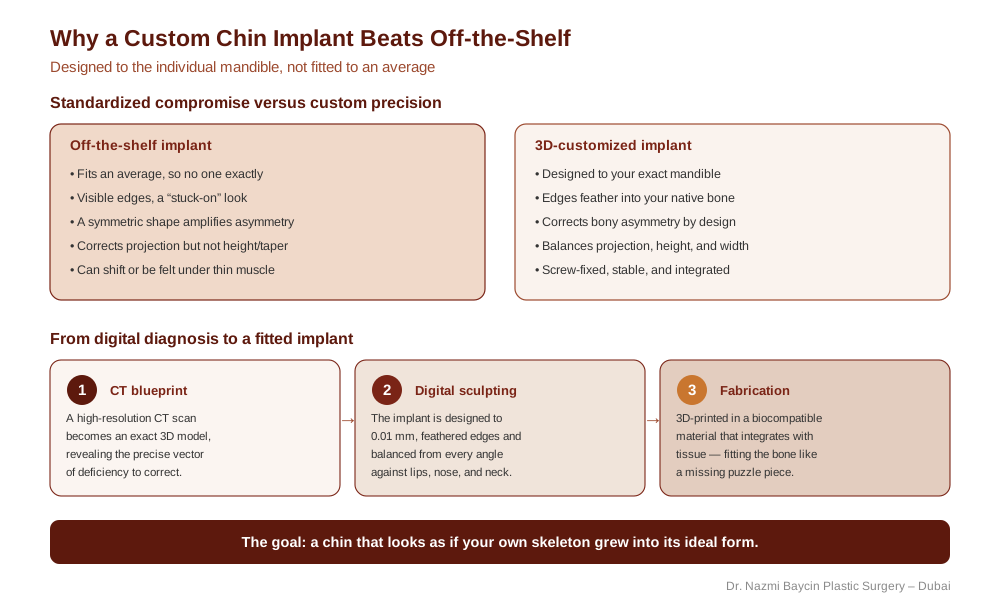
Accuracy is a chain from an agreed plan to a fitted implant: the design sets the target, the fabrication reproduces it, and the fit on the bone preserves it — by Dr. Nazmi Baycin, Dubai.
The value of the imaging that underpins this preview is something I explore in my article on 3D CT imaging for precision facial bone analysis, and the manufacturing that reproduces it in my article on the workflow of 3D-printed custom facial bone implants.
Fit is what carries accuracy from the plan onto the bone
An accurate plan is worthless if the implant does not sit exactly where the plan intended. This is where a designed device earns its accuracy in the flesh. Because it is built to the contour of your bone, it seats in one position and one only — flush, with no dead space beneath it, indexed to the surface it was designed from. A stock implant can sit slightly high, slightly low, or slightly rotated, and each of those small errors is a departure from the plan that no one intended and no one may notice until the swelling settles. The table below sets the points at which accuracy is lost in a standard approach against the points at which a designed implant holds it.
| Where a standard implant loses the target | How a precisely designed implant holds it |
|---|---|
| Position judged by feel during surgery | One seated position, indexed to your bone |
| Changes made with a scalpel in theatre | Changes made on the screen before fabrication |
| Result assessed only after healing | Result approved on the model beforehand |
Placement: the last link in the accuracy chain
The accuracy of a designed implant is preserved or lost at placement, and two steps of the operation exist specifically to preserve it. The first is the pocket: I dissect it directly on the bone and size it to the implant rather than to a generic shape, so the device can seat only in the position it was designed for. The second is fixation: the implant is anchored to the bone with a micro-screw, so it cannot migrate, rotate, or settle out of position over the months that follow. Those two steps are what convert an accurate plan into a permanent result — the geometry you approved is the geometry that endures.
The wider surgical decisions that surround those steps — which access route suits your anatomy, what the trade-offs are between an intraoral and a submental incision, and what recovery involves — belong to the operation as a whole rather than to its accuracy, and I set them out on my chin augmentation in Dubai page. The same structural thinking runs through my article on the structural philosophy of chin augmentation.
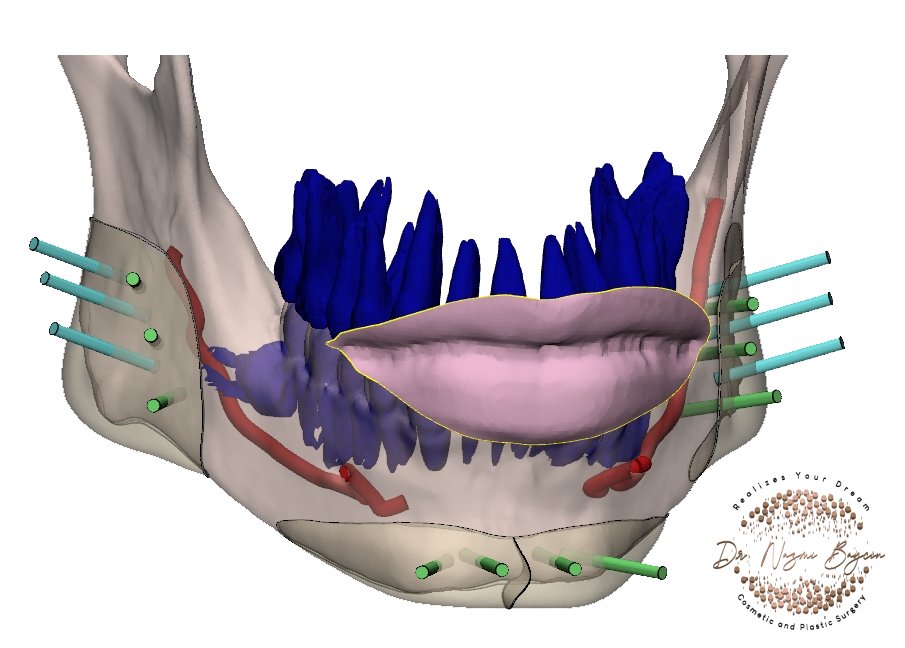
A precision-engineered, 3D-customized implant set visualized on the mandible. The three integrated components — central chin implant and bilateral jaw angle implants — are designed to work as a single anatomical unit, ensuring seamless bone contact and long-term stability, by Dr. Nazmi Baycin, Dubai.
Accuracy and the revision you never have
The most persuasive argument for precision is the operation it prevents. Most chin-implant revisions are not undertaken because a patient wanted a different look; they are undertaken because the first implant fitted poorly — it shifted, it sat asymmetrically, its edge became palpable, or it never quite matched the plan to begin with. Each of those is a failure of accuracy, and each is precisely what a designed implant is built to avoid.
An implant indexed to your bone and fixed with a screw does not develop the malpositions that send patients back to theater. This is not a claim that a custom device is categorically safer in every respect; the published complication and revision figures, and what they say about implant fit, are set out with the rest of the risk picture on my chin augmentation page. What matters for accuracy is narrower and simpler: a well-fitted implant removes the commonest reason a chin augmentation has to be redone. The most accurate operation is frequently the one that needs doing only once.
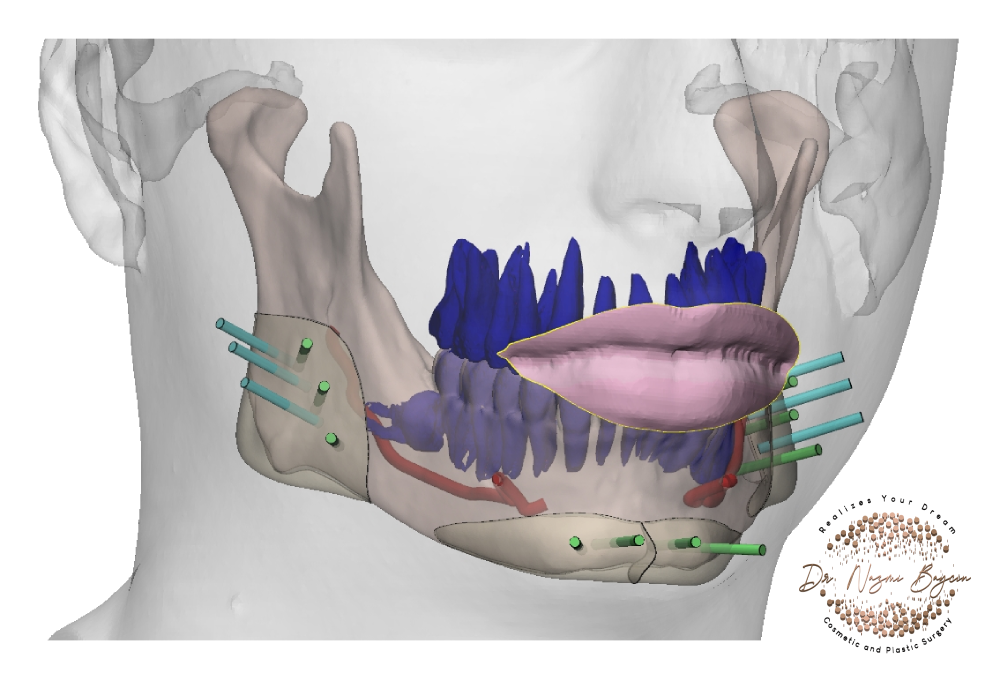
The same 3D implant design shown beneath semi-transparent soft tissue. This simulation demonstrates how the customized implant rebalances the lower face by supporting the chin, defining the jawline, and creating natural facial harmony without a stuck-on appearance, by Dr. Nazmi Baycin, Dubai.
Accuracy is a chain, and every link must hold
It is worth being precise about what precision requires, because a designed implant is not a machine that removes the surgeon. Accuracy is a chain with three links: the plan must be correct, the device must reproduce the plan, and the placement must preserve it. A flawless design placed in the wrong pocket is inaccurate. A perfect placement of an implant designed to the wrong target is inaccurate. The technology guarantees the middle link — that the manufactured device matches the design — but the judgment that sets the right target, and the surgical discipline that seats the device where it belongs, remain human.
This is why the accuracy of the implant does not replace the accuracy of the surgeon; it depends on it. The scan and the software remove my ability to guess at the dimensions, which is a great deal. They do not decide what the dimensions should be, or dissect the pocket, or fix the screw. A precisely designed implant is the reward for planning precisely and placing precisely — not a substitute for either.
3D simulation of chin implant surgery in Dubai
The chin implant simulation below is a real patient model. You can select the visualization mode using the button on the left, which allows you to view the implant model with or without soft tissue and compare before-and-after states. You can also change the viewing angle by moving the mouse by clicking and dragging inside the frame.
The surgeon’s role: setting the target that accuracy serves
All of this precision serves a target, and setting that target is the part of the work no software performs. It requires translating what a patient wants — often expressed only as a feeling that something is out of balance — into specific, defensible dimensions that respect their anatomy, and then the surgical skill to realize those dimensions exactly. Accuracy toward the wrong target is merely a reliable way to reach the wrong result.
Choosing a surgeon for this procedure therefore means verifying genuine command of 3D planning and a portfolio of natural, accurate results — the standard you should expect from an experienced cosmetic surgeon in Dubai. Because every plan is built around one specific skeleton and one agreed outcome, the target and its precision are best defined together at a consultation with a full facial analysis, where you can see the result before you decide to pursue it.
FAQs about the accuracy of 3D-designed chin implants in Dubai
-
What does accuracy actually mean for a chin implant?
It means the implant reproduces an agreed plan rather than approximating it. With a designed implant, the projection, the vertical height, and the fit against your bone are all fixed in the plan and built into the device, so the result is defined before surgery rather than discovered after it. A standard implant is chosen from a small range of shapes and adjusted by feel in the operating room, which leaves the final result partly to chance. Accuracy is simply the degree to which the chin you receive matches the chin you approved.
-
Does the preview really predict my result?
To a meaningful degree, yes, because the preview and the implant come from the same digital design. The projected outcome is generated on a model of your own facial bones, and the manufactured implant reproduces that model faithfully, so what you approve on the screen is the specification the device is built to. Swelling means the very early weeks are not representative, and no simulation is a photographic guarantee. But the underlying geometry you approve is the geometry that is placed, which is why the preview is a plan rather than a marketing image.
-
Can I change my mind about the design before surgery?
Yes, and that is one of the practical advantages of designing rather than selecting. Because the plan exists as a digital model before anything is manufactured, adjustments are made on the screen, where they cost nothing but a revision of the file. If the projection looks a fraction strong, we reduce it and look again; if the vertical proportion reads long, we shorten it. The point at which the design is locked is the point at which fabrication begins, so the decision happens while it is still cheap to change. With a stock implant the equivalent decision is made in the operating room with a scalpel, where it is neither cheap nor reversible.
-
Is the accuracy in the implant or in the surgeon?
Both, and they depend on each other. Accuracy is a chain: the plan must set the right target, the manufactured implant must reproduce the plan, and the placement must preserve it. The technology guarantees the middle link, that the device matches its design. It does not decide what the target should be or seat the implant in the correct pocket, which remain matters of surgical judgment. A precisely made implant placed toward the wrong target, or in the wrong position, is precisely inaccurate. The device makes an accurate result possible; the surgeon makes it happen.
-
How is the implant kept in exactly the planned position?
By designing it to the bone and then fixing it to the bone. Because the implant is built to the contour of your mandible, it indexes to a single seated position rather than sitting anywhere along the bone, so there is only one place it fits. It is then anchored with a micro-screw, which prevents the migration, rotation, or gradual settling that can move a loose implant out of position over the months after surgery. The pocket is dissected precisely on the bone to receive it. Together these steps preserve, at placement, the accuracy that was built into the design.
-
How long does the design process take before surgery?
Longer than selecting an implant from a tray, which is the honest trade-off for precision. The sequence runs from the CT scan to the digital design, then to your review and approval of the projected result, then to fabrication of the implant itself, and each stage has to finish before the next begins. This is why a designed implant cannot be arranged at short notice in the way a stock implant can, and why I raise the timeline early rather than late in the consultation. For patients travelling to Dubai for surgery, the planning is done in advance of the trip so that the design is approved and the implant made before you arrive.
-
Does accuracy come at the cost of a natural result?
It is what makes the result natural. A chin looks unnatural precisely when it departs from the plan — too much projection, an edge that is felt, a shape that does not match the face. Accuracy means the implant delivers the measured, proportionate change that was designed against your own features, with edges that feather into your bone rather than standing off it. Precision is not the opposite of subtlety; it is how subtlety is achieved reliably. The most natural-looking results are the accurate ones, because they are the ones that reproduce a plan built to suit your face.


GET APPOINTMENT
Get ready to look and feel best… You deserve…
