

Key takeaways: a structural approach to jawline harmony and definition
- Correct projection alone does not produce a balanced lower face — the jaw angles and the neckline decide the result.
- The submental-cervical angle is the element a chin plan most often ignores.
- An implant alone cannot correct a soft neckline, and a poorly planned one can make it more obvious.
- A four-piece system engineers the central chin and each parasymphyseal and jaw-angle zone separately.
- An intraoral incision leaves no external scar; the implant sits in a subperiosteal pocket directly on the bone for stability.
- Targeted liposuction under the chin and jawline often refines the neck contour and accentuates the new definition.
The art of jawline balance and proportion
To achieve a truly natural outcome, we must look beyond the chin point and instead analyze how the lower face reads as a whole. My aim is to restore your inherent anatomical relationships for a result that looks and feels authentically yours — the enhancement should look born, not built.
A 2019 review of optimizing the chin and jawline (Chin & Sykes) makes the relevant point directly: optimizing a deficient chin requires an understanding of the bony anatomy together with the chin’s relationship to the adjacent structures — the lips, the teeth, and the nose. It is that relational half of the assessment I am concerned with here. The measurement of the chin itself, and the four independent axes any correction has to satisfy, I set out separately in my article on which of the four axes your surgeon measured.
The error that shows in the neckline
Perhaps the most consequential error in chin augmentation is ignoring the submental-cervical angle — the junction between chin and neck. It is the part of the plan that is hardest to see in a consultation and the easiest to notice afterwards.
An implant alone cannot correct a soft or poorly defined neckline; indeed, an improperly planned implant can make these issues more noticeable, because a stronger chin above an undefined neck draws the eye to the transition between them. True harmony demands a comprehensive plan that integrates the chin with the entire jawline and neck, rather than treating the chin as a feature that can be improved on its own.
Designing for the whole lower jaw
Because the correction has to satisfy the jaw angles and the neckline as well as the chin, it cannot sensibly be built from a single component. My planning is done on a cone-beam CT map of the facial skeleton, and the implant is designed against that map rather than selected and adapted at the table — a process you can read about in my page on custom 3D-printed facial implants in Dubai.
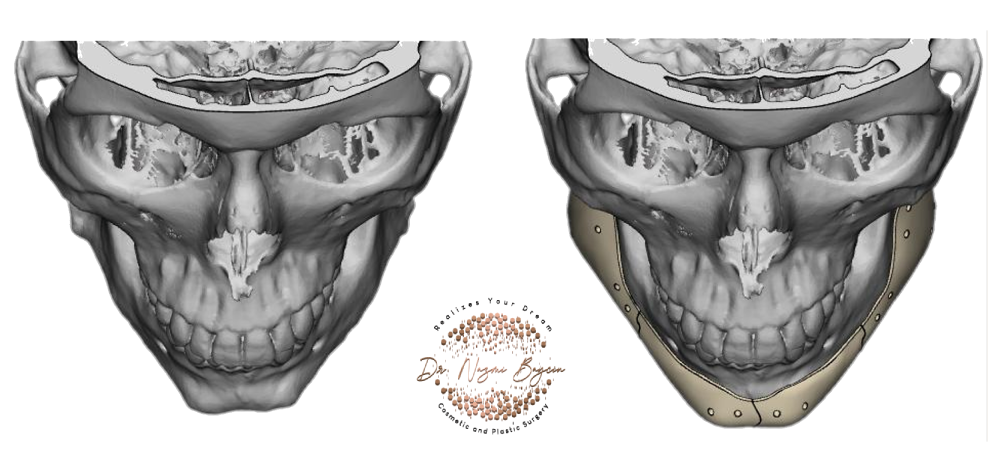
Top-down 3D skull comparison: native anatomy (left) transitions to the planned result after virtual custom implant placement (right), showing precise volumetric expansion and bilateral symmetry — by Dr. Nazmi Baycin, Dubai.
Where the whole lower jaw is being addressed, I use a four-piece system: the central chin, the left and right parasymphyseal zones, and the jaw angles, each engineered to its own specification. That separation is the point. A single component that spans the mandible has to compromise somewhere, whereas four components can each answer to the segment of bone they sit on, so the chin and the angles arrive at the same line from opposite directions.
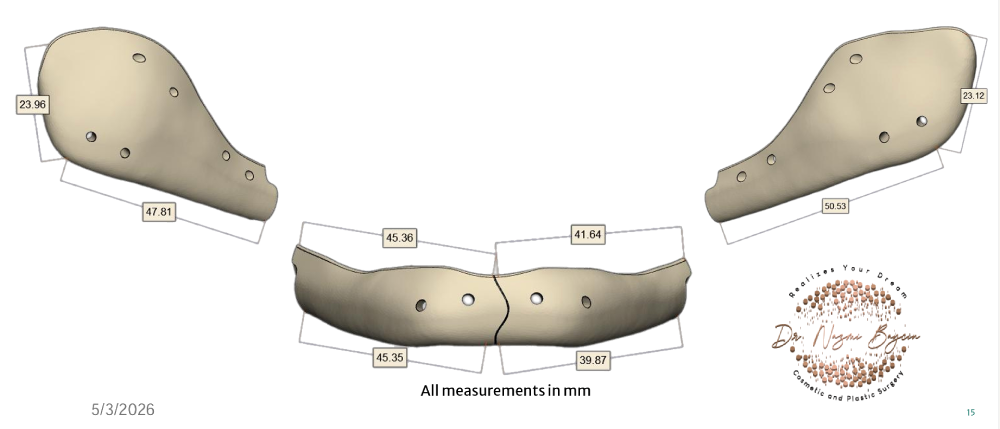
Four individually designed, 3D-printed PEEK implants, each engineered to sub-millimeter precision for a specific zone of the mandible — central chin, left and right parasymphyseal areas, and jaw angles — for total jawline harmony — by Dr. Nazmi Baycin, Dubai.
One caveat belongs here rather than in a footnote. Designing an implant against the bone rather than fitting it to the bone at the table is the whole of what a custom approach claims, and it does not make the operation risk-free. The route of placement carries a trade-off of its own. I prefer the intraoral approach because it leaves no external scar, but access through the mouth is a choice with consequences rather than a free advantage, and it is one I discuss openly before any decision is made. The full risk picture, and how it bears on choosing a route, belongs on my chin augmentation in Dubai page.
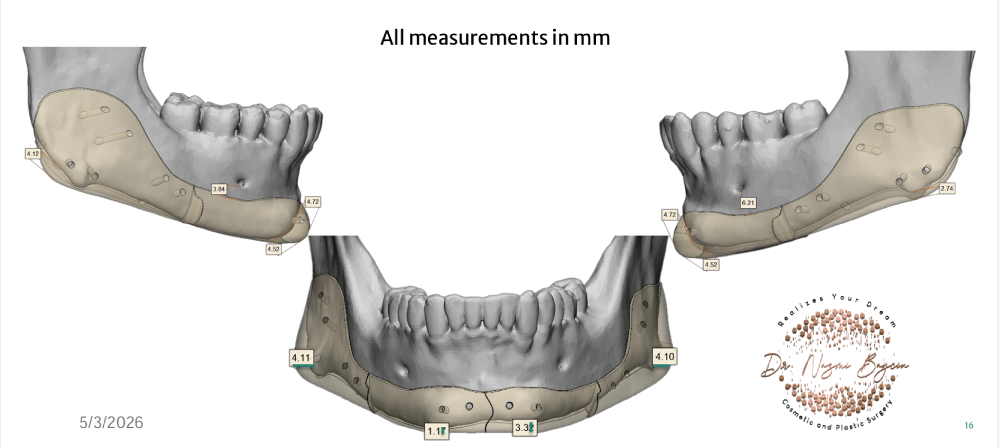
Three-panel surgical simulation showing the final lower-jaw contour from left lateral, right lateral, and frontal views — the custom implants integrate seamlessly with the native bone to restore balanced proportions — by Dr. Nazmi Baycin, Dubai.
Surgical artistry: anatomical integration and refinement
Surgical execution is where planning becomes reality. I use a precise intraoral incision inside the mouth, which leaves no visible external scar, and place the implant into a precisely dissected subperiosteal pocket directly on the bone — crucial for stability, preventing movement, and ensuring the implant heals as a unified part of your anatomy.
My goal is flawless anatomical integration, where the implant becomes a natural extension of your jaw. For many patients, I enhance this with gentle, targeted liposuction under the chin and along the jawline to refine the neck contour and accentuate the new, stronger jawline.
This combined approach — structural augmentation plus refined contouring — is a signature element of my work in jawline implants in Dubai and is key to a truly harmonious, athletic profile.
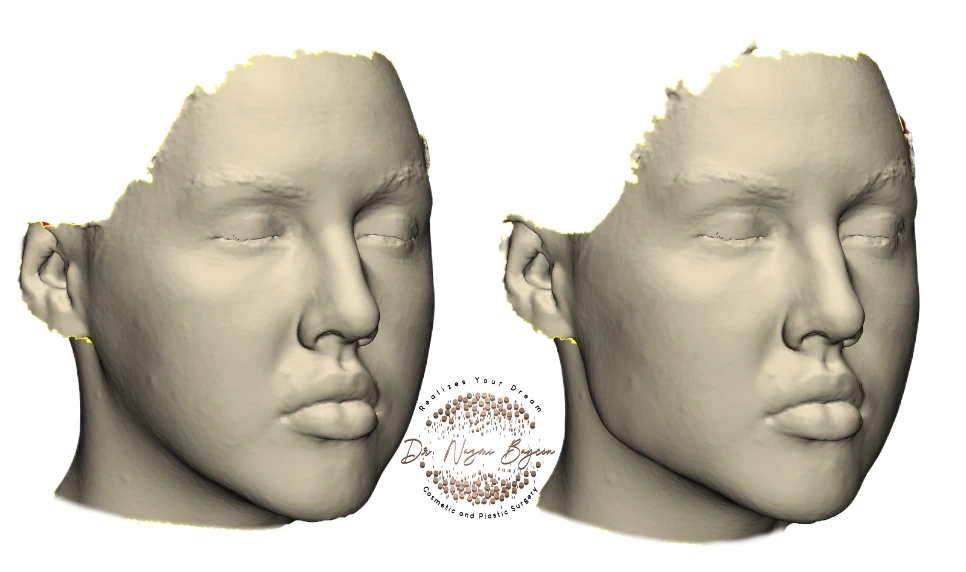
A comparative 3D facial scan demonstrating the precision of digital surgical planning. The left panel depicts the patient’s current baseline facial contour, while the right panel reveals the simulated jawline definition achieved through patient‑specific, 3D‑planned implant augmentation. This pre‑operative blueprint, generated from high‑resolution volumetric data, allows to predict soft‑tissue support, ensure bilateral symmetry, and engineer a naturally harmonious lower facial profile prior to the actual procedure. By translating this digital simulation into a precisely milled implant, the workflow eliminates guesswork, reduces surgical time, and delivers reproducible, anatomically accurate results for patients seeking custom jawline contouring — Dr. Nazmi Baycin, Dubai.
The simulation below is the 3D model of the image above. You can select the visualization mode using the button on the left, which allows you to compare before-and-after states. You can also change the viewing angle by moving the mouse by clicking and dragging inside the frame.
You may select the visualization mode with the button on the left to see with/without soft tissue, and also change the view angle with mouse movement.
Your recovery journey: from surgery to defined contour
Recovery from this meticulous technique is typically smooth. Swelling and tightness are normal and subside significantly within the first two weeks, and you will be given a specialized compression garment to minimize swelling and support the new contour. Most patients feel comfortable returning to desk work and social activities within 7–10 days. The final result unfolds gracefully over the following months as residual swelling dissipates, revealing a stronger, more balanced profile and a sharper, more defined jawline that integrates perfectly with your natural facial expressions. The outcome is not just a changed chin but a harmoniously enhanced lower face that projects confidence and balance.
A philosophical commitment to anatomical truth
Ultimately, exceptional facial enhancement is an exercise in respecting and restoring anatomical truth — seeking balance and proportion rather than isolated change. My role is to use precise tools and deep expertise to reveal the most harmonious version of your inherent structure. This patient-specific, engineering-based philosophy is what defines my practice and establishes my approach as a leading cosmetic surgeon in Dubai, transforming chin augmentation from a generic commodity into a bespoke art form focused on structural elegance — ensuring the result is unmistakably and authentically you.
FAQs about jawline definition in Dubai
-
Why can a chin implant alone leave the neckline looking unchanged?
Because the neckline is not made by the chin bone. The submental-cervical angle is drawn by the soft tissue beneath the jaw, so adding projection in front of it does not necessarily open it. A stronger chin above an undefined neck can even draw attention to the transition between them. This is why I plan the chin, the jaw angles and the neckline together, and why targeted contouring under the chin is often part of the same operation rather than a separate one.
-
What does it mean to treat the chin and the jaw angles as one unit?
It means the correction is designed across the whole mandibular border rather than at the chin point alone. The eye reads a continuous line from the angle of the jaw to the chin, so a chin brought forward without regard to the angles behind it can look disconnected from the rest of the face. Designing the segments together lets the chin and the angles arrive at the same line, which is what makes the lower face read as one structure rather than as a corrected feature.
-
Will the implant be visible or feel like a foreign object?
No. The implant is placed through a small incision inside the mouth, leaving no external scar, and positioned directly on the bone in a precisely dissected pocket. Because it is custom-fabricated to match your own bone contours, it integrates as a seamless extension of your jaw rather than sitting on top of it.
-
Is liposuction always combined with jawline surgery?
Not always, but it is common. For many patients, gentle, targeted liposuction under the chin and along the jawline is added to refine the neck contour and accentuate the newly defined jawline created by the implant. Whether this is recommended depends on your specific anatomy.
-
How long until I see the final result?
Initial swelling and tightness subside significantly within the first two weeks, and most patients return to desk work and social activities within 7–10 days. The fully refined result, with a sharper and more defined jawline, emerges gradually over the following months as residual swelling resolves.
-
What makes the four-piece implant system different from a single implant?
Rather than addressing only the central chin, the four-piece system separately engineers the central chin and the left and right parasymphyseal and jaw angle zones. This allows each region of the lower jaw to be corrected to its own precise specification, achieving total jawline harmony rather than an isolated change to chin projection alone.


GET APPOINTMENT
Get ready to look and feel best… You deserve…
