

Key takeaways: custom implants vs off-the-shelf
- Custom implants are digitally designed from the patient’s own CT scan, not selected from a menu of shapes.
- The posterior surface is contoured to lock onto the unique bone topography like a key in a lock.
- Feathered, undetectable edges give a seamless transition to native bone, with no palpable step.
- The implant seats perfectly on first contact — no intraoperative bending, trimming, or guesswork.
- Incisions are hidden (intraoral or within the scalp) for a scar-free facial result.
- The approach spans congenital, post-traumatic, and aesthetic needs.
The digital blueprint: where surgical vision becomes virtual reality
The journey begins not in the operating room but within a sophisticated digital workspace. Following a high-resolution 3D CT scan, I collaborate with specialized biomedical engineers in a virtual design environment — the point where the art of surgery meets the science of engineering. Here I am not selecting from a menu of shapes; I am digitally sculpting the patient’s future anatomy. I specify the precise volumetric design, determining the exact augmentation — measured in cubic millimeters — needed for the desired projection while maintaining perfect symmetry.
I ensure anatomic conformity, contouring the implant’s posterior surface to lock seamlessly onto the patient’s unique bone topography. I design feathered, undetectable margins with vanishingly thin edges for an imperceptible transition to native bone. And I build in an integrated fixation strategy, with strategic flanges and pre-determined screw locations for absolute stability. This design session is where the surgical plan is irrevocably perfected; the surgery that follows is its precise execution.
Quality gates: how the design is verified before it reaches the operating room
Between the design session and the operation, the plan passes through a series of deliberate checkpoints. The proposed implant is checked against a mirrored model of the patient’s own anatomy, so that symmetry is judged not against a textbook ideal but against the individual’s unaffected side. I review the design in successive iterations with the engineering team, and I do not approve a file until the on-screen fit is flawless from every angle — margins, thickness transitions, and each planned screw position over safe, solid bone. Only the approved, frozen file goes to manufacturing. When the finished implant arrives, it is verified against that same file, sterilized, and labeled for its one intended patient. Nothing generic enters the workflow at any point, which is precisely why nothing needs to be improvised at the table.
From scan to surgery: what the timeline looks like
Patients are often surprised that most of this procedure happens before the operating room is ever booked. The CT scan itself takes minutes. The collaborative design phase typically unfolds over one to two weeks, depending on how many refinement rounds the anatomy demands. Manufacturing and sterile preparation of the implant then require a few additional weeks at the certified laboratory.
In practice, the journey from first scan to surgery usually spans about four to six weeks — a schedule dictated by precision, not by convenience, and one I never compress at the expense of a design iteration the anatomy still needs. I consider this interval one of the workflow’s quiet strengths. It gives the patient unhurried time to review the virtual plan, ask questions, and arrive at surgery with a clear, shared picture of the intended result.
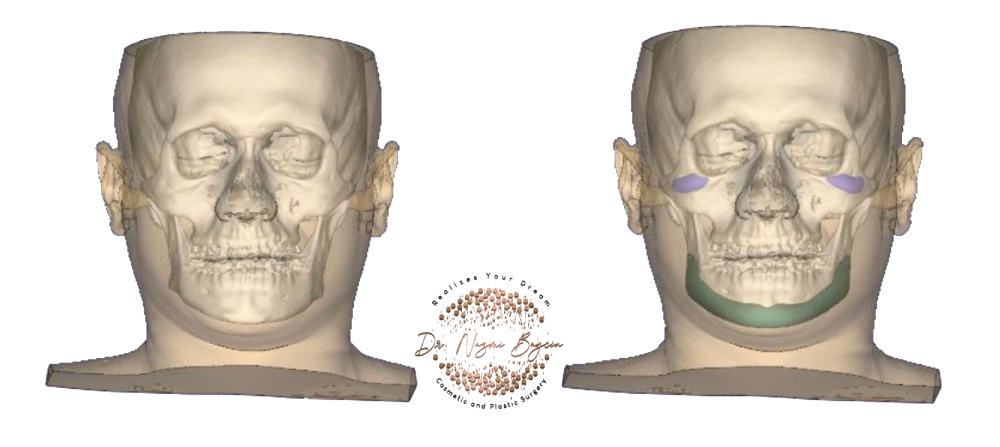
A 3D visualization contrasting native facial bone with custom-designed jawline and malar implants, digitally matched to the patient’s own skeletal anatomy — by Dr. Nazmi Baycin, Dubai.
From digital file to biocompatible reality
Once the design is finalized, the approved digital file is transmitted to a certified medical laboratory, where the virtual model is transformed into a physical object through advanced additive manufacturing — 3D printing. The implant is fabricated layer by layer from PEEK, or polyetheretherketone, a high-strength, medical-grade polymer approved for permanent skeletal implantation and chosen for its ability to integrate favorably with human bone and tissue. The manufacturing process guarantees that the physical implant is a 1:1 anatomic replica of the digital design, with no loss of detail — transforming a collaborative vision into a sterile, patient-ready medical device.
The surgical placement: the culmination of precision
The arrival of the custom implant in the operating room marks the transition from planning to artistry, and my technique honors the precision of the implant while ensuring a scar-free result. Access is discreet: for chin or jawline augmentation I use an intraoral (inside the mouth) or external approach, and for broader frontal bone augmentation a coronal incision within the scalp — so there are no visible scars on the face. The facial bone is exposed with extreme care to preserve vital nerves, vessels, and muscle attachments.
The hallmark of success is the definitive trial fit: the sterile custom implant seats perfectly upon first contact, with no need for intraoperative bending, trimming, or modification. Using micro-screws through the pre-designed flanges, I then fix the implant firmly to the underlying bone, preventing micromovement, promoting integration, and forming the stable foundation for the final aesthetic.
Contrasting paradigms: the advantage of a custom fit
The limitations of stock, pre-formed implants are significant, and the custom workflow addresses each directly, as the table below sets out.
| Dimension | Stock (off-the-shelf) implant | 3D-printed custom implant |
|---|---|---|
| Fit | Bent and carved during surgery to a rough approximation | Seats perfectly on first contact; no modification needed |
| Symmetry & gaps | Gaps common; perfect symmetry is difficult | Gap-free; designed for precise anatomic symmetry |
| Edges | Often thicker and more palpable | Feathered, imperceptible transition to bone |
| Predictability | Outcome varies with intraoperative shaping | The virtual plan is the outcome achieved |
| Stability | Suboptimal fit can allow micromovement | Rigid fixation minimizes displacement risk |
This move toward personalized, patient-matched design reflects a broader direction in the field, and it is worth reporting the evidence with its caveats attached. A 2025 expert consensus on patient-specific craniofacial reconstruction sets out the case for CAD/CAM implants — enhanced surgical accuracy, improved aesthetic results, reduced operative times, and the possibility of single-stage resection and reconstruction — while being equally clear about the costs: the approach demands specialized expertise, depends entirely on accurate imaging data, and is expensive. A 2024 outcomes study of 44 PEEK patient-specific implants placed in 37 patients, followed for a mean of 78.6 months, recorded significant improvement in both patient and surgeon assessments and no dislocation, rupture, or long-term infection, though it is retrospective and has no comparison group. Both are drawn from reconstructive craniofacial surgery rather than aesthetic augmentation, much of it reconstruction after tumor resection, and the consensus paper specifically counsels autogenous tissue over alloplastic implants for long-term midface reconstruction. What carries across to aesthetic work is the principle of precise fit and stable fixation, not the outcome figures themselves.
Applications: from reconstruction to refined aesthetics
This technology is transformative across a spectrum of needs. In congenital deficiency, it symmetrically builds underdeveloped cheekbones (malar hypoplasia) or a recessed chin (retrogenia). In post-traumatic reconstruction, it precisely restores the contour of a fractured zygoma or mandible to its pre-injury state. And in aesthetic enhancement, it artfully augments the jawline, chin, or malar eminence to create balance and definition — and because the implant is designed from the patient’s own anatomy, the result appears inherent rather than grafted. For a recessed or weak chin specifically, this custom approach refines the principles of chin augmentation in Dubai, and as part of a wider skeletal plan it can anchor a comprehensive face transformation in Dubai.
The same workflow produces a frontal implant for the upper third, where the design tolerances are tighter still, since the forehead is a broad and evenly lit surface on which a fraction of a millimeter of unintended projection will show. That application — the analysis of forehead slope and brow ridge prominence, and the tapering of the implant into the hairline and temples — is set out in my article on forehead bone augmentation in Dubai. The full method across all zones is detailed on my dedicated page for 3D facial bone implant technology in Dubai.
The attainment of inherent balance
The highest goal of facial augmentation is not to impose a new shape but to reveal an ideal version of the patient’s own inherent structure. The workflow for 3D-printed custom facial implants embodies this: corrections and enhancements that are profound in impact yet perfectly congruent in origin, so the result looks and feels like it was always meant to be. Because each implant is engineered from an individual’s unique CT geometry, no two designs in my practice have ever been identical — every plan begins and ends with the patient’s own anatomy. This commitment to personalized, structural solutions reflects the wider philosophy behind my work as a board-certified plastic surgeon in Dubai.
FAQs about 3D-printed custom facial implants in Dubai
-
How is a custom 3D-printed implant different from a standard facial implant?
A standard implant comes in pre-set shapes and sizes, so the surgeon bends and carves it during surgery to approximate a fit — which can weaken it, leave gaps, and make perfect symmetry hard. A custom implant is designed digitally from your own CT scan to match your exact bone topography, with feathered edges and built-in fixation points. It seats perfectly on the first try, with no intraoperative modification.
-
What is the design process like?
It starts with a high-resolution 3D CT scan of your facial skeleton. I then work with biomedical engineers in a virtual environment to sculpt the implant — setting the exact volume in cubic millimeters, contouring the underside to lock onto your bone, feathering the edges, and placing fixation points. You are effectively seeing and approving your result before surgery, because the virtual plan is what gets manufactured and placed.
-
Which parts of the facial skeleton can this workflow be applied to?
The chin, the mandible and jaw angle, the cheekbone and submalar region, and the frontal bone of the upper third. The design and manufacturing steps are identical in each case; what changes is the access route and how tight the tolerances need to be, since a broad surface such as the forehead shows a small error far more readily than a region hidden under thicker soft tissue. Where more than one zone is treated, the implants are designed together so they meet without a step between them.
-
Will there be visible scars?
No visible facial scars. For chin and jawline implants I use an incision inside the mouth or a discreet external approach, and for frontal bone augmentation an incision hidden within the scalp. The access is planned so the healed incision is concealed, keeping the focus on the natural-looking skeletal enhancement rather than any sign of surgery.
-
What material are the implants made from, and are they permanent?
They are fabricated from PEEK, or polyetheretherketone, a high-strength, medical-grade polymer approved for permanent skeletal implantation and chosen for how favorably it integrates with bone and tissue. Once fixed rigidly to the underlying bone with micro-screws, the implant is designed to be a permanent, stable part of your facial framework, not something that needs periodic replacement.
-
Who is a good candidate for custom facial bone implants?
Candidates include people with underdeveloped cheekbones or a recessed chin, those restoring facial contour after trauma, and those seeking aesthetic definition of the jawline, chin, or cheekbones. Because the implant is built from your own anatomy, it suits patients who want a precise, natural-looking result rather than an approximate one. The right approach is confirmed after a CT scan and consultation.
-
Why does a custom implant give a more natural result?
Because it is designed as an extension of your own skeleton rather than an object placed on top of it. The gap-free fit prevents movement and soft-tissue irritation, and the feathered edges mean there is no palpable or visible step under the skin. The augmentation reads as part of your natural bone structure, which is what makes the result feel inherent rather than added.


GET APPOINTMENT
Get ready to look and feel best… You deserve…
