

Table of content
- What is forehead bone augmentation?
- The role of 3D skull imaging in forehead bone augmentation in Dubai
- 3D bespoke forehead implant printing technology
- Steps to getting forehead bone augmentation in Dubai
- Postoperative care after forehead bone augmentation
- Safety and long-term outcomes
- FAQs about forehead bone augmentation in Dubai
Key takeaways: contour built on bone, not filler
- The forehead frames the upper third of the face and sets its overall slope.
- 3D CT imaging maps the frontal bone, brow ridges, and temples before surgery.
- A bespoke implant is drawn millimeter by millimeter onto your own skull model.
- Tapered margins allow the implant to disappear into the hairline and temples.
- The aim is a smooth, continuous curve, never an added bulge.
- The contour settles over roughly six weeks as swelling resolves.
The upper third of the face is often overlooked in facial planning, yet it carries a great deal of visual weight. A forehead with gentle, continuous convexity reads as balanced and youthful. A forehead that is flat, that slopes sharply backwards, or that dips unevenly between the brow and the hairline can make the whole face appear harsh or top-heavy, regardless of how well proportioned the features beneath it are. For patients who want a permanent correction of that underlying shape, forehead augmentation in Dubai using 3D skull imaging and bespoke implant printing technology offers a precise and highly predictable route. In my practice, forehead bone augmentation is a question of contour, not volume. The purpose is not to add bulk to the forehead, but to establish the curve the face was structurally missing — and to do it with an implant designed around your bone rather than a shape chosen from a catalogue.
What is forehead bone augmentation?
Forehead bone augmentation is a skeletal contouring procedure that reshapes the frontal bone region using a solid, custom-designed implant placed directly on the bone. Depending on your anatomy, the implant may address the central forehead alone, extend across the supraorbital ridges to soften a heavy or uneven brow line, or continue laterally into the temporal region where hollowing is common. The result is a continuous curve from the brow to the hairline rather than a series of separate corrections.
You may consider forehead augmentation if your forehead appears flat or backward-sloping in profile, if there is a visible step or depression between the brow ridge and the upper forehead, if one side is more prominent than the other, or if temporal hollowing has narrowed the upper face. Because the frontal bone, the brow ridges, and the temples are read together as a single surface, they are almost always planned as one unit.
A retrospective study of 75 forehead augmentation patients concluded that augmenting the forehead and temples, using an implant prefabricated with 3D printing, may be the best option currently available, since the contour can be built to what the patient actually asked for. The table below summarizes the most common concerns in the upper third and how a bespoke implant is used to address each.
| Forehead Concern | Typical Presentation | How a Bespoke Implant Helps |
|---|---|---|
| Flat or receding forehead | A forehead that slopes backwards sharply in profile, with little convexity | Restores gentle, continuous projection from brow to hairline |
| Step above the brow ridge | A visible groove or shelf between the brow and the upper forehead | Smooths the transition so the surface reads as one curve |
| Frontal asymmetry | One side of the forehead flatter or more prominent than the other | Designed side-specifically to even out the two halves |
| Temporal hollowing | Narrow, sunken temples that pinch the upper face | Extended laterally to widen and fill the temporal region |
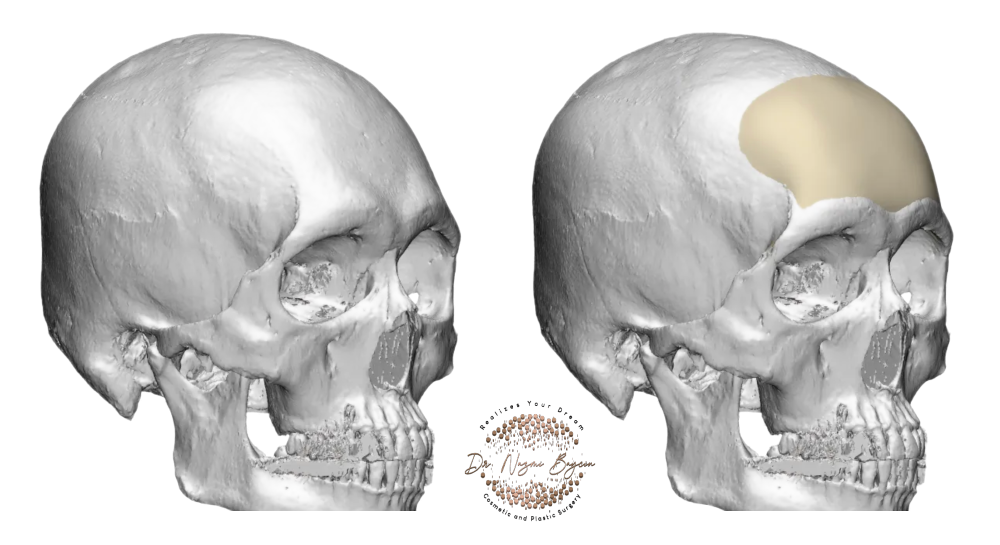
This 3D skull imaging shows how forehead augmentation is planned before any surgical step is taken. By analyzing the frontal bone in three dimensions, the implant is designed to follow the natural curve of the skull, ensuring accurate projection, symmetry, and a smooth transition into the temples — by Dr. Nazmi Baycin, Dubai.
The role of 3D skull imaging in forehead bone augmentation in Dubai
The forehead is unusually unforgiving. It is a broad, smooth, well-lit surface, which means that even a one or two millimeter irregularity in projection can be visible in ordinary light. This is precisely why the planning stage matters so much. Forehead bone augmentation in Dubai begins with a high-resolution CT scan, which is converted into a three-dimensional digital model of your skull and overlying soft tissue. On that model, I can measure frontal projection, the angle of the forehead in profile, the height and prominence of each brow ridge, the depth of the temporal hollows, and any side-to-side difference between the two halves of the frontal bone.
Working from an accurate three-dimensional model means the shape of the forehead is decided in advance, not estimated through the incision. The depth of analysis this imaging allows is something I detail further in my article on using 3D CT imaging for precision facial bone analysis and surgical planning. For you, it means seeing the intended contour before surgery, understanding exactly what will change, and being able to refine it while it is still a design.
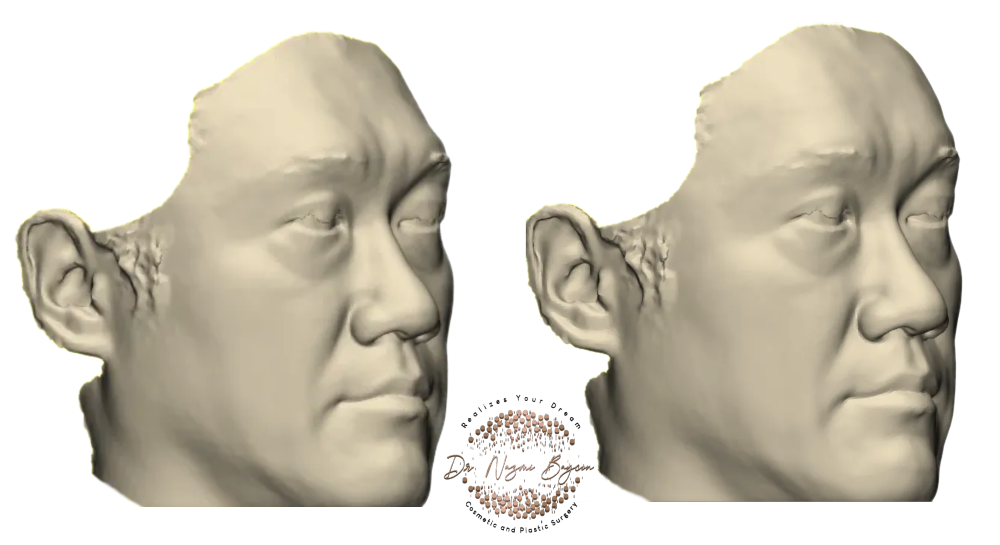
The profile view is where forehead augmentation is judged. Planning the implant in three dimensions allows the slope of the forehead and the transition over the brow ridge to be set precisely before surgery — by Dr. Nazmi Baycin, Dubai.
3D Simulation of forehead implant
The simulation below is a real patient model. You can select the visualization mode using the button on the left, which allows you to view the model with or without soft tissue and compare before-and-after states. You can also change the viewing angle by moving the mouse by clicking and dragging inside the frame.
3D bespoke forehead implant printing technology
Once the 3D skull model is complete, a custom forehead implant is designed digitally against your actual bone surface. Thickness is varied across the implant so that projection is greatest where it is needed and tapers to almost nothing at the borders, which is what allows the edges to disappear beneath the skin at the hairline and along the temporal line. The design is then manufactured by 3D printing in a biocompatible, medical-grade material intended for permanent implantation.
Accuracy at this stage is measurable rather than theoretical. In a design and validation study of a custom frontal implant, the thickness ran from 3 mm at the center to 0.1 mm at the borders so the edges stayed tangent to the surrounding skull, and the finished design came within a mean of 0.65 mm of the model the surgeon had shaped by hand.
Because the implant is made for one skull, it sits flush against the bone rather than bridging across it. That eliminates the gaps, or dead space, that a pre-formed implant leaves behind, and dead space is what leads to movement, fluid collection, and edges that eventually become visible. The full design-and-manufacturing pathway behind these devices is something I describe in my article on the workflow of 3D-printed custom facial bone implants.
Steps to getting forehead bone augmentation in Dubai
The pathway for forehead augmentation in Dubai using 3D skull imaging and bespoke implant printing is structured so that every decision about shape is made, reviewed, and agreed before the day of surgery.
- 3D skull imaging (CT scan): A high-resolution CT scan captures the frontal bone, brow ridges, and temporal regions in detail. This scan is the foundation of the entire plan.
- Digital analysis and surgical planning: The CT data is converted into a three-dimensional model. Frontal projection, forehead slope, brow ridge prominence, temporal depth, and symmetry are assessed, and the ideal implant footprint is determined.
- Bespoke forehead implant design: A custom implant is designed against your own skull surface, with thickness varied across the design and margins tapered so the borders blend into surrounding bone.
- Review and design approval: You review the proposed contour in profile and from the front. Refinements are made until the design matches the agreed goals, and nothing is manufactured before approval.
- 3D printing of the custom implant: Once approved, the forehead implant is manufactured using advanced 3D printing technology and biocompatible medical-grade materials in the USA.
- International shipment and regulatory approval: The bespoke implant is shipped from the USA to Dubai and submitted for local health authority approval, which is required for compliance with medical device safety regulations.
- Scheduling of forehead augmentation surgery: Once approval is granted, the surgery date is scheduled.
The overall process may take 4 to 6 weeks. The total cost of the procedure is AED 80,000 to AED 90,000.
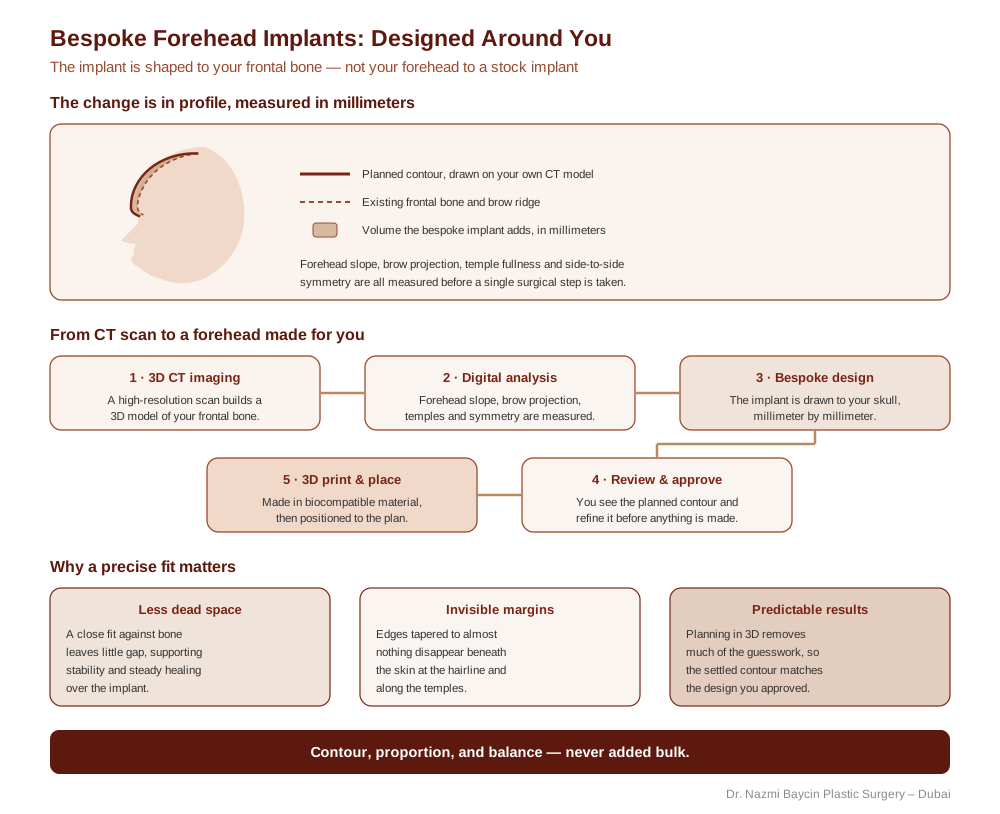
The bespoke forehead implant workflow — from 3D CT imaging to a custom implant designed around your frontal bone — by Dr. Nazmi Baycin, Dubai.
Postoperative care after forehead bone augmentation
The implant is positioned and fixed according to the preoperative 3D plan. Postoperative care in the upper face focuses on swelling control, protection of the surgical site, and comfort. Swelling after forehead augmentation tends to be most noticeable in the first week and often settles downward toward the eyelids before it resolves, which is expected and temporary. Sleeping with the head elevated in the early days makes a considerable difference.
Most patients return to daily activities within one to two weeks. Strenuous exercise, heavy lifting, and anything that risks impact to the forehead should be avoided in the early recovery period while the implant settles against the bone. As swelling subsides, the new contour becomes progressively clearer, and the final shape is typically apparent within four to six weeks. The change should never appear abrupt: the intended result is a forehead that simply looks better proportioned, not a forehead that looks operated on.
Safety and long-term outcomes
Performed by an experienced board-certified surgeon, forehead augmentation with a custom implant is a safe and reliable procedure. Planning the shape in three dimensions and manufacturing the implant in advance removes most of the intraoperative guesswork, which is where variability in skeletal contouring usually comes from. The materials used for bespoke forehead implants are stable and durable, do not resorb, and are intended to remain in place permanently.
Long-term stability depends heavily on fit. An implant that matches the underlying bone contour has broad, even contact, which supports both its position and the quality of healing over it. This structural, whole-face approach reflects the same philosophy I apply throughout facial contouring: the upper third is planned in relation to the midface and the lower third, so that correcting one region does not create a new imbalance elsewhere. Both the surgical plan and its cost are best worked out at a consultation, once your anatomy and goals are clearly defined — an approach in keeping with what you should expect from a board-certified plastic surgeon in Dubai.
FAQs about forehead bone augmentation in Dubai
-
What is forehead bone augmentation?
Forehead bone augmentation is a skeletal contouring procedure that reshapes the frontal bone region using a solid implant placed directly on the bone. The goal is to establish a smooth, continuous curve across the upper third of the face rather than to add bulk. Depending on your anatomy, the implant may cover the central forehead, extend across the brow ridges, or carry laterally into hollow temples. Rather than selecting a pre-formed shape, the modern approach designs a bespoke implant against your own skull, which is what allows the correction to read as your natural bone structure.
-
Who is a good candidate for forehead bone augmentation in Dubai?
You may be a good candidate if your forehead is flat or slopes backwards in profile, if there is a visible step between your brow ridge and upper forehead, if the two sides are uneven, or if your temples appear hollow and narrow. Good general health and expectations focused on proportion rather than dramatic change are important. Candidates who do best are those looking for structural balance across the upper face, not maximum projection. At consultation your skull is assessed in three dimensions to confirm whether an implant is the right approach and how far the design should extend.
-
How is 3D skull imaging used in forehead bone augmentation in Dubai?
A high-resolution CT scan is converted into a detailed three-dimensional model of your frontal bone and soft tissue. On that model, forehead slope, projection, brow ridge prominence, temporal depth, and any asymmetry can be measured directly rather than estimated. This matters more on the forehead than almost anywhere else in the face, because it is a broad, evenly lit surface where small irregularities show. Planning on the actual bone means the shape is decided in advance, and it lets you see and understand the intended contour before committing to it.
-
What makes a bespoke forehead implant different from a standard implant?
A bespoke forehead implant is designed for one skull and no other. Thickness is varied across the design so projection sits exactly where it is needed, and the borders are tapered to almost nothing so they blend into the surrounding bone. A pre-formed implant cannot follow the individual curvature of your frontal bone, so it tends to bridge across the surface, leaving gaps beneath it. Those gaps are what allow movement, fluid collection, and eventually visible edges. Broad, even bone contact is the single biggest reason custom implants behave more predictably over time.
-
Should the temples be treated at the same time as the forehead?
Very often, yes. The forehead and the temples are read as one continuous surface, so building the forehead forward while leaving hollow temples behind can make the upper face look narrower rather than better balanced. In a retrospective comparison of 75 patients, treating both regions together with an implant made before surgery was associated with far fewer implants needing removal and with higher aesthetic scores from blinded assessors than treating the forehead alone. Whether your temples need including is decided on the 3D model, where their depth can be measured rather than judged by eye.
-
Can forehead bone augmentation correct a heavy or uneven brow ridge?
Often, yes — but by contouring rather than by removal alone. A brow ridge frequently looks heavy because the forehead above it is flat, which exaggerates the step between the two. Building the upper forehead forward softens that step and can make the brow appear less prominent without touching it. Where there is genuine asymmetry between the two ridges, the implant is designed side-specifically to even them out. Which approach suits you depends on what the 3D analysis shows about the relationship between your brow and the frontal bone above it.
-
Where is the incision, and will there be a visible scar?
Access for forehead augmentation is normally gained through an incision placed within the hair or along the hairline, so that healing occurs in a concealed area rather than on the forehead itself. The exact placement is chosen according to your hairline position, hair density, and the extent of the planned implant. Careful, tension-aware closure supports fine healing, and the scar becomes progressively less noticeable as it matures. The intention throughout is to change the visible contour of the upper face while keeping any evidence of the surgery out of sight.
-
Is forehead bone augmentation in Dubai safe?
Forehead bone augmentation is considered safe when carried out by an experienced, board-certified surgeon. Custom implants and 3D planning improve safety by mapping the operation in advance: the size, shape, thickness, and position of the implant are determined on a model rather than judged during surgery. Your general health and anatomy are assessed thoroughly beforehand, and the surgical plan accounts for the anatomy of the region, including the position of the supraorbital nerves. As with any procedure there are risks, but the personalized planning is precisely what makes the process more controlled.
-
How long is the recovery after forehead augmentation in Dubai?
Swelling is most pronounced in the first week and commonly drifts downward toward the eyelids before resolving, which is normal. Most patients return to normal daily activities within one to two weeks. Strenuous exercise and any risk of impact to the forehead should be avoided in the early phase while the implant settles. The final contour becomes clearly visible over four to six weeks as the tissues settle. Keeping the head elevated in the first few nights and following the aftercare guidance helps recovery proceed as predictably as possible.
-
Are forehead implants permanent, and can they be removed?
Yes, forehead implants are designed to be permanent. The medical-grade materials used are stable, do not resorb, and provide lasting structural support to the upper face. Once healing is complete, the implant behaves as part of your facial framework. Because a bespoke implant sits flush against the bone with broad contact, it also tends to stay exactly where it was placed, which supports the longevity of the result. Should circumstances ever change, implants of this type can be adjusted or removed, but they are designed and intended as a lasting solution.
-
Can forehead bone augmentation be combined with other procedures?
Yes. Forehead bone augmentation is often planned alongside temporal contouring, brow positioning, or hairline procedures, since these all affect how the upper third of the face reads. It can also be planned in the same 3D workflow as contouring in the midface or lower face when overall facial proportion is the goal. Whether combining procedures is right for you depends on your anatomy, your priorities, and your recovery preferences, and it is assessed individually so the overall plan improves your proportions rather than any single feature in isolation.
Forehead bone augmentation has become a precise, patient-specific procedure rather than a matter of surgical judgement at the table. By combining 3D skull imaging with bespoke implant printing technology, the shape of the upper face is designed, reviewed, and agreed before surgery begins. Shaping the implant around your frontal bone, rather than adapting your forehead to an implant, is what makes the result look like structure you were always meant to have.


GET APPOINTMENT
Get ready to look and feel best… You deserve…
