

Key takeaways: building the face from the foundation
- The facial skeleton, not the skin, sets the underlying proportions of the face.
- Bone resorbs with age, removing support and causing sagging, folds, and flattening.
- Fillers add diffuse volume; a skeletal implant restores a permanent, load-bearing foundation.
- 3D CT planning converts a scan into a digital model for millimeter-precise implant design.
- Custom implants fit the bone like a key in a lock, with feathered edges and no step-offs.
- The result is designed to be lasting: rigid screw fixation holds the implant stable against the bone.
The blueprint of the face: why the skeleton matters more than the skin
The face is a structure where soft tissues — muscle, fat, and skin — drape over a bony scaffold. When that scaffold is strong and well-proportioned, the drape is smooth and supported. When it is deficient, from genetics or age-related atrophy, the overlying tissues lose support and the face sags, folds, and flattens early.
Three zones of structural deficiency matter most. A weak chin or receding jaw diminishes profile definition and can make the nose look larger. Decline of the zygoma (cheekbone) drops the cheek fat pad, deepens the nasolabial fold, and hollows the under-eye. And loss of mandibular volume in front of the masseter creates early jowling, even before the skin becomes lax.
Correcting these with filler alone is a common error: filler adds diffuse volume to mobile soft tissue and needs constant maintenance, while a skeletal implant restores the permanent, load-bearing base. The difference is that between hanging a painting on a sturdy hook and trying to support it with putty.
The 3D revolution: from estimation to exactitude
The old limitation of facial implants was their off-the-shelf nature. Surgeons had to adapt standard shapes to unique anatomy, risking asymmetry, poor fit, and palpability. My practice uses 3D virtual surgical planning instead. A high-resolution CT scan of the skull becomes a 3D digital model, and I analyze it to diagnose the exact location and millimeter degree of bony deficiency. I then design the implant myself in a virtual workspace, adjusting dimensions, curvature, thickness, and surface texture to match the patient’s anatomy and goals. The final design is 3D-printed in medical-grade material, so it fits the bone like a key in a lock, with feathered edges that prevent step-offs and promote seamless integration.
This planning approach is well described in the literature. A 2020 PRISMA systematic review of 3D-printed bone models in oral and cranio-maxillofacial surgery documents how converting CT data into accurate physical and digital models supports precise preoperative planning and a clear visual preview of the reconstruction. It is worth naming its scope precisely: that review examined printed models used for training, simulation and planning, not the implants themselves, so it supports the planning stage of this work rather than the device. To understand how 3D CT imaging guides that planning, visit my 3D CT imaging for facial surgical planning in Dubai article.
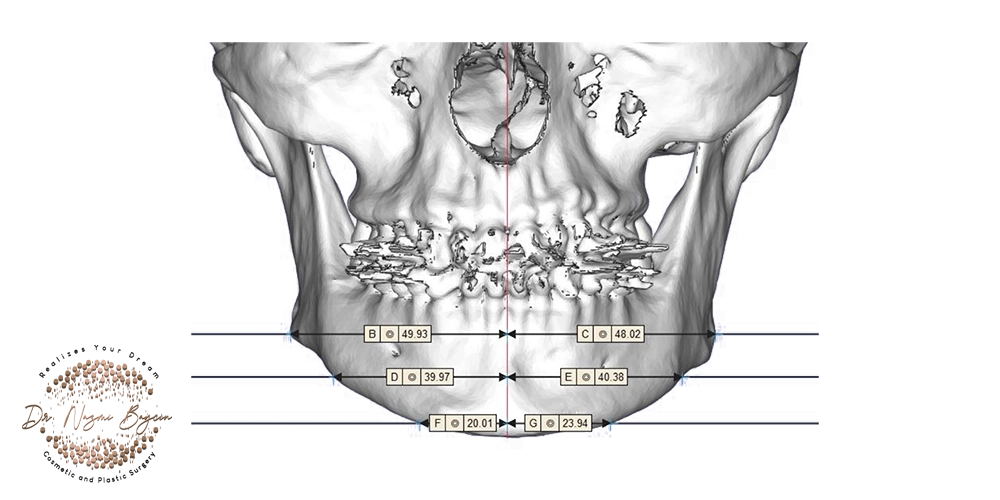
A 3D facial bone scan with anatomical measurements used to plan facial bone implant surgery, allowing accurate evaluation of skeletal proportions, asymmetries, and bone volume before implant design — by Dr. Nazmi Baycin, Dubai.
Architectural augmentation by facial zone
The chin and jawline are where profile harmony is won or lost. My approach uses an extended anatomic implant that augments not just the central chin point but the whole mental region, avoiding the “stuck-on” look. Custom wrap-around angle implants restore definition from the chin back to the mandibular angle — a strong contour in men or an elegant oval in women. All are placed through a discreet intraoral incision, leaving no visible scar. To learn more about the core procedure, visit chin augmentation surgery in Dubai, and for the bespoke-printing workflow specifically, visit custom 3D chin implant surgery in Dubai.
In the midface, implants restore anterior projection to the cheekbone. Building up the zygomatic and submalar regions creates a solid platform that re-suspends the descended mid-fat pad, softening the nasolabial fold and tear trough from beneath — a more durable lift than any suture-based cheek lift. The most transformative outcomes often harmonize several zones at once, and 3D planning lets me design and coordinate multiple implants as a single architectural plan. To learn more about jaw-specific work, visit 3D jawline implant surgery in Dubai.
The upper third follows the same logic. A forehead that is flat or slopes backwards, an uneven brow ridge, or temples that have hollowed are skeletal findings rather than soft-tissue ones, and they are addressed by restoring frontal projection rather than by lifting the brow. Because the frontal bone is a broad, evenly lit surface, it is also the zone least forgiving of an approximate fit, which is why the design tolerances there are tighter than anywhere else in the face. That work is set out in full in my article on forehead bone augmentation in Dubai.
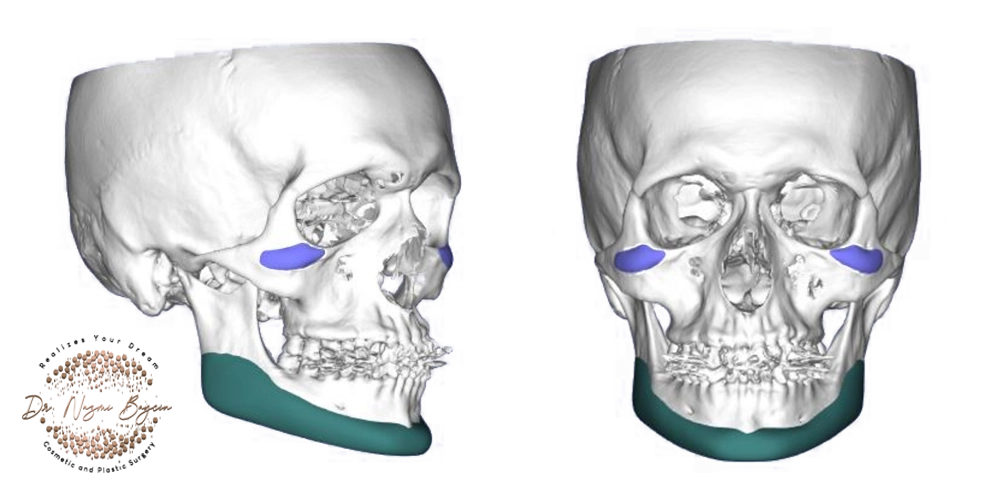
A custom facial bone implant designed on a 3D CT scan, with shape, thickness, and position digitally planned for natural contours and balanced proportions — by Dr. Nazmi Baycin, Dubai.
The pivotal distinction: structure versus volume
This philosophy draws a clear line in aesthetic practice, summarized below.
| Factor | Large-volume filler | Custom skeletal implant |
|---|---|---|
| What it targets | Mobile soft-tissue space | The underlying bone framework |
| Support | Diffuse volume, no load-bearing base | Permanent, load-bearing foundation |
| Over time | Bloating, migration, over-filled look | Rigidly fixed to bone; stable |
| Maintenance | Repeated top-ups | One-time, definitive |
| Result | Mimics projection | Restores true structural projection |
A skeletal implant is fixed rigidly to the native bone and provides stable support, so the overlying soft tissue looks taut and youthful naturally. It is a one-time, definitive structural correction rather than a recurring cosmetic fix.
The merit of structural aesthetics
Facial bone augmentation is best understood as a permanent, technology-driven structural change rather than a temporary cosmetic touch-up. It brings together advanced CT imaging and 3D planning, the design and manufacture of a patient-specific implant, the surgical expertise for precise subperiosteal dissection and fixation, and an accredited operating environment. Because each implant is bespoke, it is engineered uniquely for your anatomy and cannot be substituted with a standard, off-the-shelf part. The outcome is not a “done” look but a better-proportioned face — a sense of strength, balance, and definition that reads as inherently natural. This foundational philosophy runs through all of my facial plastic surgery work in Dubai.
FAQs about facial bone augmentation with 3D implants in Dubai
-
Why does filler not achieve what a skeletal implant achieves?
Because filler sits in soft tissue — not on bone. When the underlying skeleton is deficient, the overlying soft tissue has no support structure to rest against, and filler simply adds diffuse volume to an unsupported envelope. The result is often a bloated, puffy appearance rather than defined projection. A skeletal implant provides what the bone itself would have provided: a firm, stable platform that allows the overlying muscles, fat, and skin to drape naturally. The difference is structural versus cosmetic — one corrects the cause, the other temporarily masks it.
-
What does the 3D planning process actually involve – how is my implant designed?
It starts with a high-resolution CT scan that is converted into a detailed 3D digital model of your facial skeleton. I analyze this model to identify the precise location and degree of bony deficiency — often finding asymmetries not visible to the naked eye. I then design the implant digitally, sculpting its dimensions, curvature, thickness, and surface texture to match your anatomy and aesthetic goals exactly. You can see a virtual representation of the planned result before anything enters an operating room. The finalized design is then manufactured in medical-grade biocompatible material. The implant fits your bone like a key in its lock.
-
Which parts of the face can be augmented this way?
The chin and mandible, including the jaw angle, the cheekbone and submalar region in the midface, and the frontal bone, brow ridges and temples in the upper third. Each zone is diagnosed on the same three-dimensional model, and where more than one is treated the implants are designed and coordinated as a single architectural plan rather than as separate operations. Which zones are appropriate for you depends on where the skeletal deficiency actually lies, which is frequently not where the surface appearance suggests.
-
Are custom 3D-printed implants safer than standard off-the-shelf implants?
The safety profile of the implant material itself is equivalent — both use approved biocompatible materials with long clinical track records. The advantage of custom implants is anatomical precision: an implant designed to conform exactly to your bone surface is less likely to shift, be palpable through skin, or create pressure point irregularities over time. Off-the-shelf implants require intraoperative modification to fit, a process that can compromise edge feathering and symmetry. I should be plain that no trial has compared custom against stock implants directly, so this is a reasoned argument from fit rather than a proven difference in outcome. In my own practice the variable I treat as most important is the surgical plane, dissecting strictly beneath the periosteum, directly on bone.
-
Where are the incisions placed, and will there be visible scars?
For chin and jawline augmentation, all incisions are placed entirely inside the mouth — along the lower gum line — leaving no external scar whatsoever. For cheekbone augmentation, the access is most commonly through a small intraoral incision in the upper gum, again with no visible external scar. The implants are fixed with micro-screws through pre-designed fixation flanges that are part of the implant design, eliminating the need for additional external approaches. The combination of intraoral access and precise custom fit means the procedure leaves no visible trace.
-
How permanent is the result, and what is the long-term maintenance?
The result is designed to be permanent. A custom implant is anchored to the bone with micro-screws and becomes a fixed, load-bearing part of your facial architecture, held in position by that fixation and by the tissue capsule that forms around it over the following months. It is not absorbed by the body and does not require top-ups, unlike injectable fillers that metabolize and shift. One thing I raise rather than leave unsaid: an implant pressed against bone can leave a shallow impression in the bone beneath it. Radiographic studies of chin implants show this is common, usually a matter of a millimeter or two, and typically without symptoms or consequence — which is a further reason to care about a fit that spreads load evenly rather than concentrating it. The only other maintenance consideration is the same as for any surgical result: protecting the face from significant trauma and informing future surgeons or dentists about the presence of the implant during imaging or intervention planning.
-
Can facial bone augmentation be combined with soft tissue procedures such as a facelift?
Yes — and this combination often produces the most complete, lasting result. A facelift repositions descended soft tissue; skeletal augmentation provides the structural foundation that gives the lifted tissue something to rest against. Many patients seeking midface rejuvenation benefit from both cheekbone augmentation to restore anterior projection and a facelift to reposition the descended soft tissue over that newly created platform. The 3D planning process allows me to design the skeletal component with the planned soft tissue repositioning already taken into account, ensuring the two procedures work in concert rather than independently.


GET APPOINTMENT
Get ready to look and feel best… You deserve…
