

Key takeaways: reposition to restore, don’t remove and hollow
- Under-eye aging is about volume distribution, not too much fat.
- Simple fat removal often creates the very hollow, skeletonized look patients fear.
- The orbital fat pads are a finite resource — once removed, they are gone permanently.
- Fat repositioning mobilizes the patient’s own fat to fill the trough from beneath.
- Releasing the tear trough ligament is what allows the groove to be smoothed.
- Because it preserves volume, repositioning ages gracefully alongside the face.
Understanding why removal fails begins with the anatomy. A sound grasp of lower-eyelid structure is what guides technique; a systematic review of 54 anatomic studies of the lower eyelid maps the ligaments, fat compartments, and support structures that determine how this region ages, undertaken precisely because the lower lid is less well defined anatomically than the upper and carries a less favorable complication profile. It is an anatomic review rather than a comparison of techniques, so it tells the surgeon what must be known, not which operation to choose. The under-eye is not a simple bag to be emptied — it is an interplay of several components that have to be addressed together.
The anatomical truth: why bags are only half the story
To understand why fat removal disappoints, you first have to understand the midface. Several structures shape how the under-eye ages. The orbital fat pads are not bags to be discarded but essential volume compartments; with age, the thin orbital septum restraining them weakens and lets them protrude forward.
The tear trough ligament is a firm fibrous band tethering the skin to the bone along the rim of the eye socket, and as the cheek fat descends with age, a depression forms below it — the tear trough itself. The palpebromalar groove is the continuation of that trough laterally, separating the eyelid from the cheek prominence. The aged eye is not caused by too much fat; it is caused by a volume disparity — bulging fat above a tight ligament, and a descended, volume-deficient cheek below it.
Removing fat only deepens that disparity, creating a hollowed V-shaped deformity that no filler can perfectly correct. My job in Dubai is to diagnose and treat the entire anatomical relationship, not just the one part that bulges.
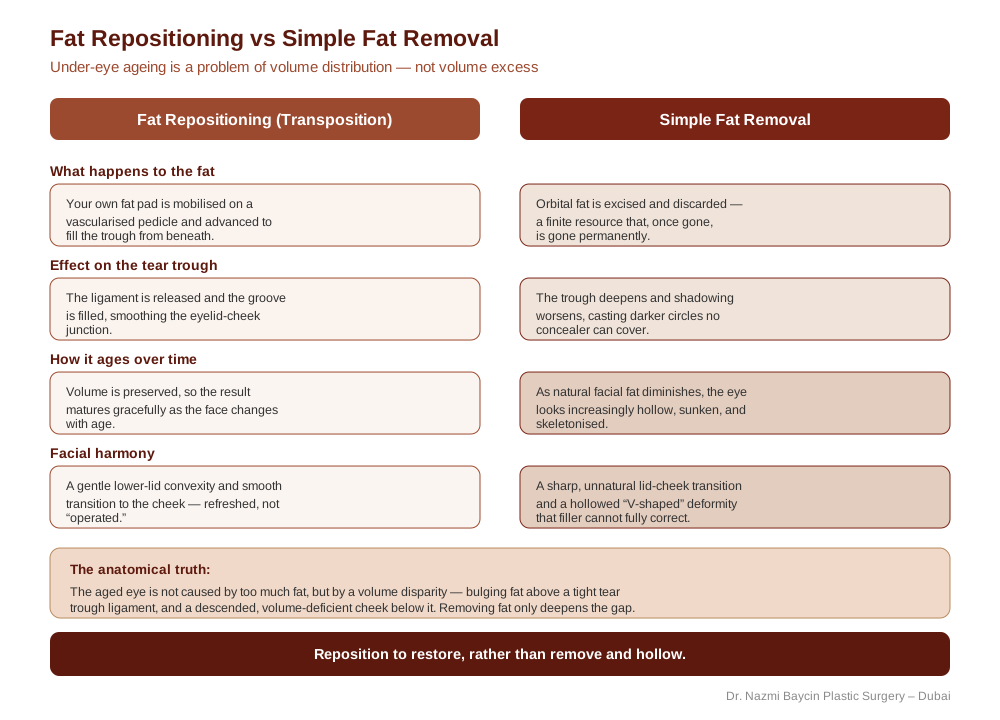
Fat repositioning versus simple fat removal for tear troughs — repositioning preserves the patient’s own volume and ages gracefully, while removal deepens the trough and hollows the eye over time — by Dr. Nazmi Baycin, Dubai.
What removal costs, in one paragraph
Patients are often wary of surgery because they have seen the signs of over-resection: eyes that look hollow, tired, and artificially deepened. Orbital fat is finite, so once it is gone the eye is left vulnerable as natural facial fat diminishes; the trough deepens and casts shadows no concealer covers; and the lid loses its gentle convexity, producing a sharp transition to the cheek. I set out those failure modes in full, and the philosophy behind avoiding them, in why preserving volume protects your natural eye shape. What follows here is the technique that replaces removal.
My technique: precision repositioning to restore youthful topography
I perform the procedure through a subciliary incision below the lower lash line whenever possible, which leaves no visible scar and minimizes disruption to the eyelid muscles — the same muscle-respecting principle behind supporting the orbicularis muscle to preserve the gaze — and I assess the three fat compartments — medial, central, and lateral — for quality and volume. The critical step is the meticulous release of the tear trough ligament, which frees the tethering point that creates the deep groove. Rather than cutting the fat away, I mobilize it on a vascularized pedicle and gently advance and suture that living fat pad over the released trough and orbital rim, filling the depression from beneath the muscle. It is a permanent, integrated solution, because it uses your own tissue placed exactly where volume is needed. The table below outlines the sequence.
| Step | What Is Done | Why It Matters |
|---|---|---|
| 1. Access & assessment | A subciliary incision below the lash line; the three fat compartments are assessed | Leaves no visible scar; protects the delicate eyelid muscles |
| 2. Ligament release | Meticulous release of the tear trough ligament | Frees the tethering point that creates the deep groove |
| 3. Fat pedicle transposition | Fat mobilized on a vascularized pedicle and sutured over the rim | Fills the depression with living tissue — a permanent, integrated fix |
| 4. Midface integration & support | Optional minimal midface blending; lateral canthopexy | Blends lid to cheek; maintains eyelid shape, preventing rounding or scleral show |
For a seamless blend between the rejuvenated eyelid and the cheek, I sometimes integrate a minimal-incision midface lift, and I frequently add a lateral canthopexy — a small supportive suture at the outer corner — to maintain eyelid tone and prevent any postoperative rounding or scleral show, the same safeguard I detail in how canthal support prevents lower-lid retraction. My protocol is designed to work with the anatomy rather than against it, and it is the same disciplined approach I bring to all of my lower eyelid surgery in Dubai.
Identifying the ideal candidate
The best candidates for fat repositioning tend to share a clear profile: moderate to significant under-eye puffiness from protruding fat pads, a visible and deep tear trough or palpebromalar groove, good skin elasticity with minimal excess skin, and a desire for a natural, long-lasting improvement rather than a dramatic, operated look.
It is also my preferred solution in Dubai for correcting hollowing after a previous blepharoplasty, where the challenge is to work with limited remaining fat to rebuild a more youthful contour. Because the technique depends so heavily on the specific balance of protruding fat, ligament tightness, and cheek position, candidacy is best confirmed through a careful in-person assessment rather than assumed from symptoms alone.
A smarter, more conservative philosophy
Lower-eyelid rejuvenation has progressed from an era of removal to an era of restoration, and my commitment is firmly to that more conservative philosophy. By repositioning rather than removing, I preserve your facial architecture and create a result that is refreshed, harmonious, and free of the dreaded hollowed look. The goal is not merely to look less tired, but to restore the gentle, youthful topography that light reflects off so beautifully — the real art of periorbital rejuvenation.
This restraint-first, anatomy-led approach is exactly what you should expect from a board-certified plastic surgeon in Dubai. Because every under-eye is different, the right technique and its cost are best determined at a detailed consultation, where your specific anatomy and goals guide the plan.
FAQs about lower-eyelid fat repositioning in Dubai
-
What is lower-eyelid fat repositioning?
Lower-eyelid fat repositioning, or fat transposition, is a technique that moves the eye’s own protruding fat pads rather than removing them. Instead of excising the fat that causes under-eye puffiness, the surgeon mobilizes it on a vascularized pedicle and advances it downward to fill the tear trough from beneath, after releasing the ligament that creates the groove. The result is a smooth transition from eyelid to cheek that uses your own living tissue. Because the volume is preserved and redistributed rather than discarded, the correction tends to look natural and to age gracefully.
-
What does releasing the tear trough ligament actually do?
It removes the tether that creates the groove. The tear trough ligament is a firm fibrous band binding the skin to the bone along the rim of the eye socket, and while it remains tight the depression cannot be smoothed no matter how the fat is handled — filling above a tethered band simply creates a ridge. Releasing it frees the soft tissue so the transposed fat can lie flat across the rim and the lid-to-cheek line becomes continuous. This is why the release, rather than the fat itself, is the step that decides the result.
-
Who is an ideal candidate for fat repositioning?
The best candidates have moderate to significant under-eye puffiness from protruding fat pads, a visible and deep tear trough or palpebromalar groove, good skin elasticity with minimal excess skin, and a preference for a natural, long-lasting result over a dramatic change. It is also an excellent option for correcting hollowing after a previous eyelid surgery, where the goal is to rebuild contour with limited remaining fat. Because the right approach depends on the balance of protruding fat, ligament tightness, and cheek position, candidacy is confirmed through an individual assessment rather than symptoms alone.
-
Is fat repositioning a permanent solution?
It is designed to be a permanent, integrated solution. Because the fat is kept alive on its own blood supply and secured where volume is needed, it becomes part of the region’s natural architecture rather than a temporary addition. Unlike fillers, which are gradually absorbed and need repeating, repositioned fat is your own living tissue placed precisely to fill the trough. As long as the underlying support is respected, the correction endures and continues to age in harmony with the rest of the face.
-
How does fat repositioning compare with under-eye fillers?
Fillers can be a reasonable non-surgical option for milder tear troughs, but they address the depression from above rather than correcting the underlying anatomy, and they are temporary and require ongoing maintenance. In cases with genuine fat protrusion and a deep, ligament-driven trough, filler alone often cannot produce a smooth result and can even look worse if overdone. Fat repositioning corrects the actual cause — releasing the ligament and redistributing your own fat — in a single, lasting procedure. Which option suits you depends on the severity of the deformity and your goals, and is best decided at consultation.
-
Can fat repositioning fix hollows from a previous eyelid surgery?
Often, yes. Hollowing after an earlier blepharoplasty is one of the situations where repositioning is especially valuable. When too much fat has been removed previously, the challenge is to restore contour using whatever fat remains, redistributing it carefully to soften the hollow and rebuild a more youthful curve. In some cases additional volume strategies are considered alongside repositioning. Because revision work in this delicate area demands precision, a thorough assessment of the existing anatomy and prior surgery is essential before planning the correction.
-
Will the results look natural, and will there be a visible scar?
Yes to natural, and generally no visible scar. The procedure is performed through a subciliary incision just below the lash line whenever possible, which is well concealed and minimizes disruption to the eyelid muscles. Because the correction redistributes your own fat and restores the gentle lower-lid convexity, the outcome looks refreshed rather than operated, avoiding the sharp lid-cheek transition seen after aggressive removal. The aim is to restore youthful under-eye topography so that light falls on it naturally, not to produce an obviously surgical change.


GET APPOINTMENT
Get ready to look and feel best… You deserve…
