

Key takeaways: the triad approach to eye rejuvenation
- Rejuvenation combines three components, not a single “eye lift”: conservative blepharoplasty, canthopexy, and fat grafting.
- Blepharoplasty is preservative — measured skin and fat adjustment, not aggressive removal.
- Canthopexy re-suspends the outer-corner tendon for support and a subtle youthful tilt.
- Micro-fat grafting replaces lost volume to efface the tear trough and restore light-reflecting contours.
- The goal is the “rested, not resected” look — avoiding the hollow stare and rounded eye shape.
- It is a two-to-three-hour micro-surgical procedure, not a quick lid trim.
Component one: precision blepharoplasty — the discipline of conservative refinement
The first step is often what patients initially seek: addressing excess skin and protruding fat pads. In my hands, though, blepharoplasty is an exercise in measured restraint, not maximal removal.
- For the upper lids, the incision is placed within the natural supratarsal crease, and I remove only the skin that hinders the natural fold, often preserving a portion of the orbicularis oculi muscle to maintain softness and texture.
- For the lower lids, the approach is even more conservative: the incision is hidden immediately below the lash line, and any adjustment of the so-called “fat bags” is measured in milligrams, not grams.
The common surgical error is aggressive fat removal from the lower lids, which creates an irreversibly hollowed orbit — a skeletonized look that accentuates aging and casts dark shadows. My technique is preservative by design: I often reposition or gently trim fat pads rather than remove them entirely, maintaining the youthful fullness that prevents a gaunt appearance.
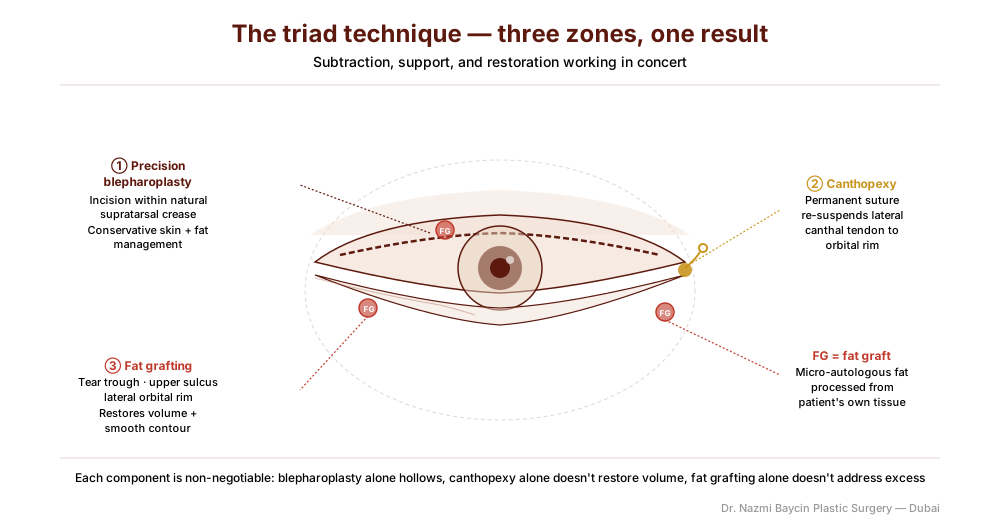
The triad technique — conservative blepharoplasty, structural canthopexy, and micro-fat grafting working together for a rested, natural result — by Dr. Nazmi Baycin, Dubai.
Component two: canthopexy — the hidden architecture of youthful expression
If blepharoplasty addresses the “what” of aging, canthopexy addresses the “why.” A frequently overlooked reality is that the eyelid’s position is not static: with age, the lateral canthal tendon — the structural anchor at the eye’s outer corner — loosens and descends, contributing to a sad, tired appearance and to lower-lid instability. A canthopexy is a precise, internal procedure in which a permanent suture subtly re-suspends this tendon to the firm orbital bone.
This provides two benefits at once. It gives structural support, reinforcing the lower eyelid against the globe — a critical prophylactic step during lower blepharoplasty that greatly reduces the risk of complications such as lid retraction (visible white below the iris) or ectropion.
And it provides aesthetic restoration, returning a faint, youthful upward tilt to the outer corner that lifts the whole periorbital area and conveys alertness without altering your fundamental expression. Neglecting this step is like tightening a flag on a sagging pole — the problem soon returns.
Component three: micro-autologous fat grafting — the restoration of light and volume
The final and perhaps most transformative component addresses the root cause of aged eyes: volume loss. As we age we do not just gain loose skin; we lose the foundational fat pads that create smooth, light-reflective contours around the eyes, and simply tightening skin over a hollowed structure only accentuates the problem.
My solution is micro-autologous fat grafting. I harvest a small amount of living fat from an inconspicuous donor site — such as the inner knee or abdomen — process it into pure, viable micro-grafts, and use specialized cannulas to place tiny droplets in the deep tissue planes of the tear trough, the upper lid sulcus, and the lateral orbital rim. This is adding volume, not moving it. Where the orbital fat has herniated forward rather than disappeared, it can be repositioned over the rim instead of grafted, and I set out that alternative in my article on how orbital fat is repositioned rather than added. This is selective structural replenishment rather than indiscriminate volume: by replacing what time has taken, I efface the tear trough and its dark shadow, restore a gentle convexity to the upper lid, and recreate a smooth cheek-to-lower-lid transition that catches light youthfully.
The result is a restoration of the eye’s natural topography that no amount of skin tightening can achieve. A 2021 review article in Facial Plastic Surgery Clinics of North America sets out this shift from an excision-based approach toward restoring lost periorbital volume, presenting it as a new paradigm for rejuvenation of the eyelids. It is a technique review by two surgeons describing their own practice rather than a comparative study, so it is best read as an expert account of why the approach changed, not as evidence that one method outperforms another.
The surgical symphony: why the triad is non-negotiable
Performed in isolation, each component offers limited improvement; performed in symphony, they create a holistic rejuvenation. The sequence is logical: the canthopexy establishes a stable, youthful platform, the blepharoplasty conservatively refines the draping over that platform, and the fat grafting then fills and smooths the surrounding architecture so the new contours integrate seamlessly. The table below summarizes how the three work together.
| Component | What it addresses | Its role in the result |
|---|---|---|
| Precision blepharoplasty | Excess skin and protruding fat pads | Conservative refinement — removes only what is needed, preserving fullness |
| Canthopexy | Descent and laxity of the outer-corner tendon | Structural support and a subtle youthful upward tilt |
| Micro-fat grafting | Volume loss and the tear-trough hollow | Replenishes contour and light, effacing dark shadows |
This integrated approach is what delivers the “rested, not resected” look. It avoids the telltale signs of a poor eye lift — the hollow stare, the rounded eye shape, the pulled-tight skin — so patients gain eyes that look refreshed, open, and authentically their own. These conservative principles underpin all of my eyelid surgery in Dubai, and every operative plan is drawn individually around the anatomy in front of me.
Who is a candidate for the triad approach?
The patients who benefit most from the triad are usually in their forties to sixties and describe the same frustration: they feel energetic, yet colleagues and family keep telling them they look tired. On examination I typically find three converging changes — a fold of redundant upper-lid skin, a lax lower lid whose outer corner has drifted downward, and a tear trough that has deepened into a permanent shadow.
When all three are present, addressing only one of them produces an incomplete and sometimes unbalanced result, which is precisely why I plan the components together. The assessment itself is methodical. I test lateral canthal laxity with a gentle snap-back maneuver, distinguish true fat-pad herniation from simple volume deficiency, and map the depth of the tear trough in animated and resting expression. I also review dry-eye history, contact lens use, and prior procedures around the eyes, because each of these shapes how conservative the excision must be.
Not every patient needs all three components in equal measure. A younger patient with early hollowing but firm lid support may need micro-fat grafting alone, while a patient with pronounced laxity may need the canthopexy to carry most of the structural work. The triad is a framework, not a fixed recipe — the operation is composed for the individual orbit.
Recovery: what the first weeks and months look like
The procedure is performed under sedation or general anesthesia and takes two to three hours, and patients typically return home the same day. For the first seventy-two hours I ask patients to keep the head elevated and apply cool compresses in short intervals, which markedly limits swelling around the grafted areas. Fine sutures are removed within about a week.
Most bruising fades over ten to fourteen days, and patients are usually comfortable in social settings by the end of the second week, often sooner with camouflage makeup once incisions have sealed. I ask patients to postpone strenuous training for about three weeks and to avoid rubbing the lids while the canthopexy matures — a mild sense of outer-corner tightness in the early weeks is expected and reassuring, as it reflects the support the suture is providing. The grafted fat follows its own quieter timeline.
A portion of the transferred micro-grafts is resorbed in the first months, which I anticipate in my placement, and the surviving fat integrates as living tissue. The contour you see at around three to six months is, for practical purposes, the durable result — a tear trough that stays effaced and a lid-cheek junction that continues to catch light naturally.
Preserving the poetry of the gaze
The eyes are not just features; they are narratives, and my triad approach is designed to honor that narrative. It is a technically demanding methodology that requires not just surgical skill but an artistic understanding of facial harmony and light. Because the periorbital area does not exist in isolation, this approach is often planned alongside other facial procedures — brow position strongly affects the upper lids, and midface descent contributes to the lower-lid hollowing that fat grafting addresses.
Where the brow has dropped, the triad may be combined with a brow lift in Dubai, and where there is broader midface and jawline descent, with a facelift in Dubai, each step sequenced so it informs the next. For the patient who seeks rejuvenation that respects — and even enhances — their unique expression, this is the difference between looking like you have had surgery and looking like you have rediscovered your best self. That philosophy is at the heart of my work as a plastic surgeon in Dubai.
FAQs about the triad technique for eye rejuvenation in Dubai
-
What is the most common mistake in lower eyelid surgery, and how do you avoid it?
Aggressive fat removal from the lower lids — the instinct to simply empty out the lower-lid bags. This creates an irreversibly hollowed orbit that accentuates aging rather than reversing it and produces the dark shadows that patients dread. My technique involves repositioning or gently trimming fat pads rather than removing them entirely, and supplementing any deficiency with micro-fat grafting to maintain the youthful fullness of the lower lid.
-
What is canthopexy, and why is it done at the same time as blepharoplasty?
Canthopexy uses a permanent internal suture to re-suspend the lateral canthal tendon — the structural anchor at the outer corner of the eye — to the firm orbital rim. Within the triad it comes first, because it establishes the stable platform on which the conservative blepharoplasty and the fat grafting are then built, and a supported lid tolerates lower-lid work far better than an unsupported one. It also restores a subtle upward tilt to the outer corner that conveys alertness rather than fatigue. How lid laxity is tested for beforehand, and what follows when it is missed, I cover in my article on preventing lower-lid malposition.
-
What is the tear trough, and can fat grafting fix it?
Yes, and filling it is one of the three components. The tear trough is the hollow groove running from the inner corner of the eye down along the nose-cheek junction. Micro-fat grafting placed in the precise deep tissue plane here effaces the hollow, eliminating the shadow it creates and smoothing the transition between the eyelid and the cheek. It is one of the most visually significant things I can do for a tired-looking face.
-
Will I look surprised or pulled after this surgery?
Not with the triad approach. The hollowed stare and startled look come specifically from aggressive skin and fat removal that depletes volume and over-tightens the lid margin. By keeping excision conservative, restoring the lateral canthal angle to its natural position rather than over-elevating it, and replenishing lost volume with fat grafting, the result is a rested version of your own eyes — not a different shape.
-
Where does the fat for grafting come from, and is it permanent?
I harvest a small amount of living fat from an inconspicuous site — usually the inner knee or abdomen — process it into pure micro-grafts, and place it with specialized fine cannulas. Because it is your own living tissue, the portion that survives integrates permanently and does not need to be repeated. Some absorption is expected in the first few months, so the final volume settles at around three to six months after surgery.
-
Can this be combined with a brow lift or facelift?
Yes, and often this is the most complete approach. The periorbital area does not exist in isolation — brow position affects upper lid appearance significantly, and midface descent creates the lower lid hollowing that fat grafting addresses. When combining the triad technique with a brow lift and midface or full facelift, I sequence the procedures so each step informs the next, which is the same philosophy I apply to all combined facial rejuvenation planning.


GET APPOINTMENT
Get ready to look and feel best… You deserve…
