

Key takeaways: support the canthus, prevent the retraction
- Retraction is rarely about removing too much skin — it is a failure of horizontal lid support.
- The lateral canthal tendon is the true anchor of the lower lid; its laxity is the biggest predictor of retraction.
- A structured preoperative assessment (laxity, vector, midface, skin quality) identifies the at-risk eye.
- Canthopexy vs canthoplasty is an anatomical choice, not a preference — matching support to risk.
- Conservative skin excision plus lateral tension redistribution replaces the old cut-more-skin model.
- Prevention adds minimal time and risk; correcting established retraction is complex and unpredictable.
For patients in Dubai seeking refined eyelid rejuvenation, understanding why canthal support is non-negotiable — and how it prevents retraction — matters before surgery. I believe education is the first step to prevention, and it shapes every eyelid consultation I hold in Dubai. Anyone exploring advanced eyelid techniques should be informed not only about fat preservation or skin tightening, but about the structural engineering that produces a stable, beautiful result.
What is lower eyelid retraction?
Lower eyelid retraction occurs when the lid margin is pulled downward after surgery, exposing the white sclera below the iris. The result is a tired, startled, or unnatural look — and one I am often asked to correct in Dubai. Functionally, it can cause dry eye, excessive tearing, irritation, and even corneal exposure. I stress one point to my patients: retraction is rarely about removing too much skin.
It is almost always a biomechanical failure of horizontal lid support. Once the suspensory ligaments are compromised during surgery, the lid cannot resist the downward pull of gravity and scar contracture. That is my reading of the cases I am asked to revise, and it is worth being precise about what the published record does and does not settle. A 2017 review of the causes and surgical outcomes of lower eyelid retraction covers retraction from every cause — most frequently thyroid-associated orbitopathy, and otherwise muscle surgery, injury, orbicularis weakening, or cicatricial change after blepharoplasty — and reports on correcting it rather than on why it happens after cosmetic surgery. The case I make below therefore rests on the pattern in my own revision practice, with that paper cited for what it genuinely establishes: how demanding the correction is once retraction has set in.
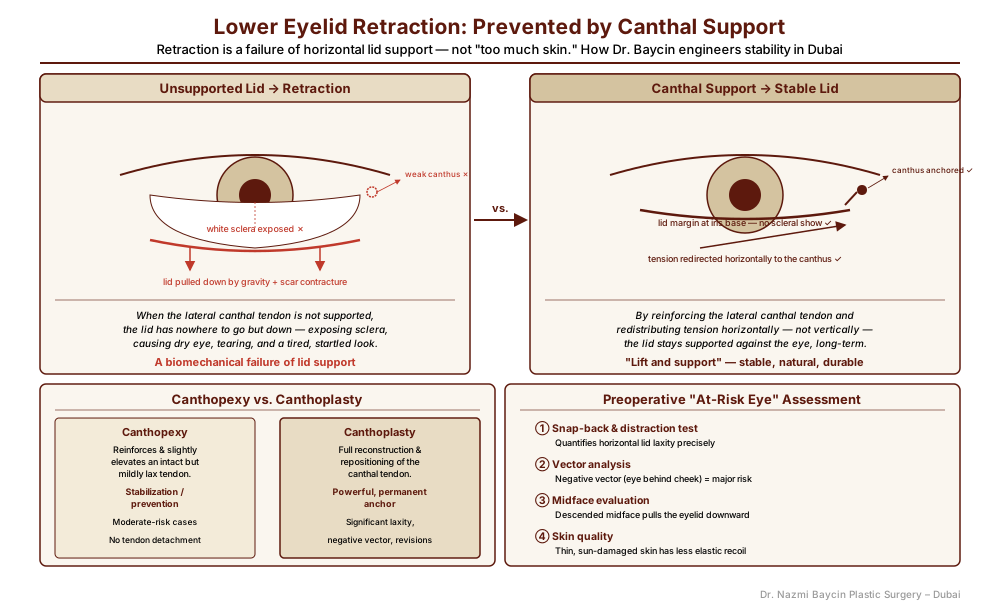
Lower eyelid retraction and its prevention — a weak, unsupported lateral canthus lets the lid margin fall and expose scleral show, while a canthopexy or canthoplasty re-anchors the canthus and redistributes tension horizontally so the lid sits correctly against the eye — by Dr. Nazmi Baycin, Dubai.
Why the lower eyelid is uniquely vulnerable
The lower eyelid is a delicate, three-layered structure suspended between the eyeball and the cheek. Its position depends on a precise balance of ligamentous support — particularly the lateral canthal tendon — together with muscle tone and skin elasticity. Traditional blepharoplasty that only subtracts tissue, whether skin, fat, or muscle, without re-establishing that balance invites trouble. The lid has nowhere to go but down. So my planning always begins with one question: what is holding this lid up, and how do I protect it?
The lateral canthus: the cornerstone of the technique
The lateral canthus is the true anchor of the eyelid, and its strength and position dictate everything. A weak, lax, or malpositioned canthal tendon is the single greatest predictor of postoperative retraction. In my preoperative assessment, I treat canthal integrity with the same importance as the amount of herniated fat. I will not proceed with an isolated lower blepharoplasty if significant laxity is present without a plan to correct it. That firm rule is why the retraction cases I revise almost always come from surgery performed elsewhere. This structural principle runs through my whole approach to eyelid surgery in Dubai.
Identifying the at-risk eye
Prevention is everything, so my consultation involves a dynamic assessment designed to uncover hidden risks. The snap-back and distraction tests quantify horizontal laxity precisely: a lid that returns slowly when drawn from the globe and released, or that can be distracted more than 6–8 mm, has laxity that will progress after surgery unless it is supported. Vector analysis determines whether the eye is prominent, sitting ahead of the cheekbone, or recessed behind it — the negative vector that places the greatest mechanical demand on the lid. A midface evaluation assesses cheek support, since a descended midface pulls on the lid. And skin quality matters, because thin, sun-damaged skin has less elastic recoil.
Any scleral show already visible before surgery predicts more of it afterward. Patients with prominent eyes, demonstrable laxity, or a weak midface are never turned away — they are simply offered the appropriately stabilized procedure from the start. The same consultation also asks a separate question about the muscle itself: whether the orbicularis has descended far enough to need elevating, which is the subject of orbicularis suspension and how the muscle is supported.
Canthopexy vs. canthoplasty: a strategic choice
These are not interchangeable, and misapplying them is a common source of failure. I use a canthopexy to reinforce and slightly elevate an intact but mildly lax tendon; it is a stabilization procedure, often performed through the upper blepharoplasty incision, ideal for preventative support in moderate-risk cases. A canthoplasty is a full reconstruction and repositioning of the canthal tendon, which I employ for significant laxity, negative-vector anatomy, or in all revision cases; it lets me directly control the vertical and horizontal position of the lid and create a powerful, permanent anchor. The table below sets the two side by side. The choice is anatomical, never a matter of preference.
| Feature | Canthopexy | Canthoplasty |
|---|---|---|
| What it does | Reinforces & slightly elevates the tendon | Fully reconstructs & repositions the tendon |
| Tendon detachment | No — tendon left intact | Yes — tendon detached and re-anchored |
| Strength of support | Moderate, preventative | Powerful, permanent |
| Lid position control | Limited elevation | Full vertical & horizontal control |
| Best for | Mild laxity, moderate-risk prevention | Significant laxity, negative vector, revisions |
| Typical access | Often via upper blepharoplasty incision | Lateral canthal incision |
| Primary role | Stabilization / prevention | Reconstruction / correction |
| Used in revision cases | Rarely sufficient alone | Standard |
The skin-removal fallacy and a philosophy of tension
A generation of surgeons was taught that retraction is caused by excessive skin removal. That is true only in extreme cases; the deeper problem is excessive tension on an unsupported margin. My technique uses extremely conservative skin excision — often just a few millimeters — with any redundancy addressed through lateral recruitment via the canthal procedure. Lifting and supporting the lid in this way redistributes tension horizontally, where it can be managed, rather than relying on a tight vertical closure that drags the lid down.
Integrating the midface and orbit
I never view the lower eyelid in isolation. In many patients, especially those with early midface descent, I combine a minimal, fat-preserving lower blepharoplasty with a percutaneous midface suspension. This subtle lift of the cheek, via a hidden suture through the same lower-lid incision, provides a foundational platform for the eyelid and further reduces downward pull. This integrated approach is a hallmark of how I achieve natural, long-lasting harmony.
Prevention over revision
Correcting established retraction is a complex, unpredictable challenge, and the published experience bears that out. In the 2017 series referred to above, correction typically demanded a lateral tarsal strip to address horizontal laxity together with a SOOF lift to raise and hold the midfacial tissues supporting the lid — two substantial operations layered on one that has already been performed once. Spacer grafts to lengthen the posterior lamella are frequently needed as well, and outcomes are improved rather than perfect.
The preventative canthal support I build in adds minimal time or risk to the initial surgery, yet it is the most powerful insurance against exactly that. This proactive mindset is non-negotiable for me. The lower blepharoplasty that looks simple is often the most technically demanding, because it asks the surgeon to anticipate and counter invisible biomechanical forces.
My commitment is a safe, elegant, durable result — sometimes more complex beneath the surface precisely so the outcome looks beautifully simple on it. Because every case is individual, its plan and cost are discussed transparently at consultation, and this preventative philosophy shapes all of my plastic surgery in Dubai.
FAQs about lower eyelid retraction after blepharoplasty in Dubai
-
What is lower eyelid retraction after blepharoplasty?
Lower eyelid retraction is a complication where the lower lid margin is pulled downward after surgery, exposing the white sclera below the iris — a sign known as scleral show. It produces a tired, startled, or rounded appearance and can cause functional problems including dry eye, excessive tearing, irritation, and in severe cases corneal exposure. I emphasize that it is rarely caused by removing too much skin; it is almost always a biomechanical failure of the horizontal support that holds the lid against the eye.
-
What is scleral show and is it always a problem?
Scleral show is the visibility of the white sclera between the iris and the lower lid margin, caused by the lid sitting lower than it should. A small amount can be a normal anatomical variant in some people, but scleral show that appears or worsens after blepharoplasty is a sign of lower eyelid retraction and warrants attention. It is both an aesthetic concern, giving a tired and rounded look to the eye, and a potential functional one, as it can lead to dry eye and irritation.
-
How is lower eyelid retraction prevented?
Prevention rests on supporting the lateral canthal tendon — the anchor of the lower lid — rather than relying on skin removal. I assess every patient preoperatively for risk factors (lid laxity, negative-vector anatomy, midface descent, skin quality) and, where indicated, reinforce the canthus with a canthopexy or canthoplasty. I use conservative skin excision and redistribute tension horizontally toward the supported canthus rather than vertically, where it would pull the lid down. This structural approach is what prevents retraction.
-
What is the difference between canthopexy and canthoplasty?
Both support the lateral canthal tendon, but to different degrees. Canthopexy reinforces and slightly elevates an intact but mildly lax tendon without detaching it — a stabilization and prevention procedure for moderate-risk cases. Canthoplasty is a full reconstruction that detaches, repositions, and re-anchors the tendon, giving complete control over lid position — used for significant laxity, negative-vector anatomy, and revision cases. I select between them based on each individual’s anatomy, never as a default preference.
-
Which preoperative findings tell you a lid needs support?
Five, and I check all of them at consultation. A lid that returns slowly on the snap-back test, or that can be distracted more than 6 to 8 mm from the globe, has demonstrable horizontal laxity. A negative vector, where the globe projects ahead of the cheekbone, places greater mechanical demand on the lid. A descended midface pulls on it from below. Thin, sun-damaged skin has less elastic recoil. And any scleral show already present before surgery predicts more of it afterward. None of these rules a patient out; each raises the level of support the operation needs.
-
Can lower eyelid retraction be corrected if it has already happened?
Yes, but correction is considerably more complex and less predictable than prevention. Established retraction often requires spacer grafts to lengthen the lid, major canthal reconstruction, and frequently midface lifting — and even then the outcome, while improved, is rarely perfect. This large gap between the difficulty of correction and the ease of prevention is exactly why I build canthal support into the primary surgery, where it adds minimal time and risk.
-
Does adding canthal support make lower blepharoplasty riskier or longer?
No — and this is central to my philosophy. Preventative canthal support adds only minimal time and minimal additional risk to the primary operation, while providing the single most powerful protection against retraction. The trade-off is overwhelmingly favorable: a small addition to the initial procedure prevents a major, unpredictable revision later. The lower blepharoplasty that looks simplest on the surface is often the most carefully engineered beneath it.
-
Am I at higher risk of retraction after lower blepharoplasty?
You may be at higher risk if you have prominent eyes with a recessed cheekbone (negative vector), demonstrable lower lid laxity, a descended or weak midface, thin sun-damaged skin, or any previous lower eyelid surgery. Importantly, being higher-risk does not mean you cannot have surgery — it means you need a stabilized procedure that includes appropriate canthal support and, where indicated, midface suspension. I identify these risk factors during a dynamic preoperative assessment and plan the procedure accordingly.


GET APPOINTMENT
Get ready to look and feel best… You deserve…
