

Key takeaways: restoring the periorbital frame
- Great blepharoplasty is restoration, not subtraction — preserving and repositioning volume, not just removing it.
- Aging around the eye is a triad of deflation, descent, and attenuation, not simple skin excess.
- Aggressive fat removal risks a skeletonized, hollowed orbit and a sharpened lid-cheek junction.
- The method rests on three pillars: volume, vector, and vessel.
- Fat transposition fills the tear trough with the body’s own tissue for a smooth lid-cheek continuum.
- Canthal support guided by preoperative laxity testing protects against scleral show and ectropion.
The anatomical fallacy of “excess”: why traditional blepharoplasty falls short
The human orbit is a complex architecture of soft tissue, fat compartments, and delicate retaining ligaments, and aging here is not simple skin laxity but a dynamic triad of deflation, descent, and attenuation. The youthful eye is supported by a robust, well-positioned volume of fat that smooths the transition from lid to cheek; with time this support attenuates, the orbital septum weakens and allows fat to bulge forward, and the mid-face descends, leaving the lower lid isolated above a shadowed tear-trough.
The standard technical error is to address only the obvious protrusions through aggressive fat removal, which fails to comprehend the underlying volumetric deficit and condemns the patient to a skeletonized orbit — a gaunt, aged look where the eye appears recessed and the face tells a story of surgery rather than graceful aging.
This approach also risks skipping the critical preoperative assessment of lower-lid laxity, and the stakes are set out plainly in the literature. A 2007 retrospective analysis of 171 lower blepharoplasties describes how lower-lid malposition after this surgery ranges from lateral canthal rounding through scleral show to frank ectropion, and notes that the transcutaneous subciliary route has been associated with lid retraction rates as high as 20 per cent. That figure is a caution I take seriously about the very approach I use most often, and it is the reason I test lid laxity before every case and add canthal support wherever it is found. My foundational belief is that the orbit must be treated as an integrated unit: the solution lies not in what we remove, but in what we preserve, reposition, and reinforce.
The three pillars: volume, vector, and vessel
My methodology is built on three interdependent pillars that guide every incision and suture, summarized in the table below and detailed beneath it.
| Pillar | Principle | How I apply it |
|---|---|---|
| Volume | Preserve and reposition fat rather than excise it | Lower-lid fat transposition over the rim to fill the tear trough; conservative upper-lid resection |
| Vector | Support the lid along a natural supero-lateral line | Canthopexy or canthoplasty to resuspend the lateral canthal tendon |
| Vessel | Respect the fragile periorbital blood supply | Micro-instrument dissection and hair-fine, layered closure |
Strategic volume preservation and transposition
I view orbital fat not as disposable baggage but as a precious, autologous filler. In lower blepharoplasty I routinely transpose the fat rather than excise it: releasing the pads from the firm fascial band at the orbital rim and gently repositioning that viable fat over the rim to fill the tear-trough depression, securing it to the periosteum. This erases the demarcation between lid and cheek, restoring a smooth, continuous convexity that reflects light youthfully. For the upper lid, my resection is supremely conservative, preserving enough fat to maintain a soft contour and avoid an unnaturally hollowed apex.
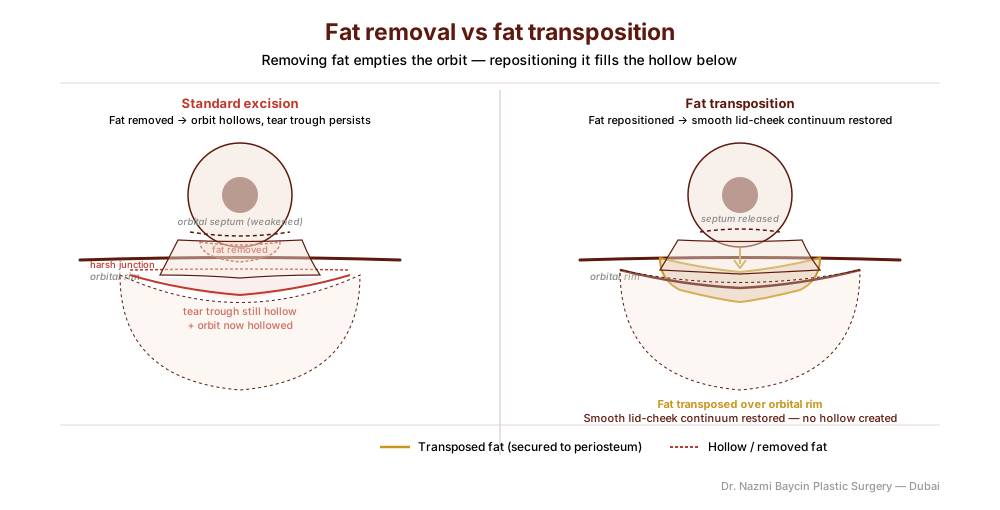
The lower-lid fat transposition technique — the herniated fat is repositioned over the orbital rim to fill the tear trough rather than removed, restoring a smooth lid-cheek transition — by Dr. Nazmi Baycin, Dubai.
Vectoral support and canthal reinforcement
The vector of support in lower-lid surgery is paramount, because a purely vertical lift is unnatural and prone to relapse. My focus is a supero-lateral vector that mimics the natural anti-gravitational pull of youth, and for patients with even mild lid laxity I integrate a canthopexy or canthoplasty — tightening and resuspending the lateral canthal tendon to its anatomical insertion point on the inner orbital rim.
This single step fortifies the lid, protects the cornea, and maintains the eye’s distinctive almond shape; it is the cornerstone of safety and longevity in my approach. When a heavy or descended brow contributes to the tired look, the two are often planned together — to learn more about how the upper third of the face is addressed, visit brow lift surgery in Dubai.
Micro-vascular reverence and imperceptible closure
The periorbital skin is the thinnest in the body, with a fragile, intricate vascular network, so my dissection is conducted with micro-instruments that respect every minute vessel, and closure is performed with sutures finer than a human hair, placed in a layered fashion to distribute tension perfectly. This attention to micro-surgical detail minimizes postoperative swelling, accelerates healing, and produces scars that mature into lines virtually indistinguishable from a natural crease.
The dual-zone technique: tailored upper and lower lid harmony
I never apply a universal template; each surgery is a custom plan based on a detailed topographic analysis of your orbital anatomy.
- For the upper lid, the goal is a crisp, well-defined crease while preserving the essential volume of the orbit: I place the incision precisely within the natural crease line, extend it only as far as necessary to address lateral hooding, and treat the medial fat pad judiciously, since over-removal creates an angry, skeletal appearance.
- For the lower lid, I almost exclusively use the subciliary approach for fat access, transposing or conservatively sculpting the herniated fat, and where skin needs refinement I perform a pinch removal of skin alone — the absolute minimum to eliminate redundancy without pulling on the lid margin.
This combination of subciliary fat work with minimal skin management is my gold standard for a refreshed, untightened, natural lower-lid contour. To learn more about how each procedure is planned around your individual eyelid anatomy, visit eyelid surgery in Dubai.
The candidacy dialogue: aligning vision with anatomical reality
An exceptional outcome begins with an exceptional consultation, and I seek patients looking not just for change but for intelligent, lasting restoration. On the upper lid, ideal candidates present with true excess skin (dermatochalasis) obscuring the lid fold, pseudo-herniation of fat, or heavy lateral hooding; on the lower lid, with festoons, tear-trough deformities, and mild to moderate fat herniation.
I am equally dedicated to guiding away those for whom surgery is inappropriate — individuals with severe, treatment-resistant dry-eye syndrome, unrealistic expectations, or those whose main concern is dynamic crow’s feet, which is better addressed with neuromodulators. Where the tired look comes as much from mid-face descent as from the lid itself, the eye may be best rejuvenated as part of a broader plan — to learn more about repositioning the mid-facial tissues, visit facelift surgery in Dubai.
One further distinction is worth understanding: repositioning volume is not the same as adding it. Fat transposition redistributes the orbital fat you already have, which is why it suits patients whose fat has herniated forward but not vanished. Where true deflation has hollowed the orbit beyond what redistribution can fill, I supplement the plan with structural micro-fat grafting from a donor site — the combined philosophy I describe in my article on the triad approach to eye rejuvenation. Choosing correctly between the two — or combining them — is part of the topographic analysis at consultation.
The recovery journey: a process of graceful unveiling
Recovery from this refined technique is typically swift and comfortable: initial swelling and mild bruising resolve substantially within the first 7 to 10 days, supported by a tailored regimen of cooling, head elevation, and ocular lubricants, and most patients feel confident returning to social and professional engagements within two weeks.
The true result reveals itself gradually over the ensuing months as the last swelling subsides and the transposed fat integrates permanently — not just the absence of puffiness, but the emergence of a smooth, rejuvenated orbital complex that harmonizes with the whole face. Because the plan is individually mapped to your anatomy, no two operations in my practice follow the same drawing. This restorative philosophy runs through all of my facial plastic surgery work in Dubai.
FAQs about periorbital rejuvenation and restoration in Dubai
-
What is the tear trough, and why does eyelid surgery often make it worse?
The tear trough is the shadowed groove running from the inner corner of the eye downward along the nose-cheek junction. It forms when the fat pad below the lower lid descends and thins, creating a valley between lid and cheek. Standard lower blepharoplasty that simply removes the herniated fat above this hollow makes things worse — it empties the orbital fat without filling the depression below, leaving both the orbit and the tear trough looking hollowed.
-
What is fat transposition, and why is it better than fat removal?
Instead of discarding the herniated orbital fat, I release it from the orbital septum and reposition it downward over the orbital rim to fill the tear-trough depression, securing it to the periosteum. This uses your own existing fat — no donor site, no grafting — to restore the smooth convexity that should exist between lower lid and cheek. The result is a continuous, light-reflecting surface rather than the harsh shadow line of an emptied orbit.
-
What is a canthopexy, and why is it done during lower blepharoplasty?
Canthopexy uses a permanent suture to re-suspend the lateral canthal tendon to its anatomical insertion point on the inner orbital rim. Even mild lower-lid laxity — which is common and often unrecognized — predisposes the lid to complications including scleral show, outward turning, or a rounded outer corner after surgery. By assessing laxity preoperatively with the snap-back test and integrating canthopexy when needed, I reduce these risks at source rather than managing them afterward.
-
Will I still have expression in my eyes after surgery?
Yes — and this is the specific goal of the approach. The hollowed, operated look comes from aggressive fat removal that strips the orbital volume and over-tightens the skin. By preserving volume with fat transposition rather than excising it, and working with micro-instruments that spare the delicate periorbital tissues, the result is a rested gaze that retains the depth, warmth, and expressiveness of your natural eyes.
-
What is the difference between upper and lower blepharoplasty recovery?
Upper-lid recovery is generally faster — bruising and swelling resolve within seven to ten days and most patients feel comfortable socially within two weeks. Lower-lid recovery takes slightly longer to show its final result, particularly when fat transposition is involved, because the repositioned fat needs several months to integrate and the lid-cheek transition continues to soften over time. The true final result is typically visible at three to six months.
-
How is this different from dermal filler for the tear trough?
Filler adds foreign material into a dynamic, mobile area with a complex vascular network. In the tear trough specifically, filler carries real risks — the Tyndall effect (bluish discoloration), irregular lumpiness, vascular occlusion, and progressive migration into neighboring compartments over time. Fat transposition uses your own living tissue, positioned surgically in the correct anatomical plane, integrating permanently without the risks of foreign material in a high-risk zone. For patients who are surgical candidates, it is the more reliable and lasting solution.


GET APPOINTMENT
Get ready to look and feel best… You deserve…
