

Key takeaways: precision over force
- The athletic chest problem is usually a firm fibrous gland, not excess fat.
- Liposuction alone cannot remove the dense disc beneath the areola.
- Ultrasound mapping guides the plan before any incision is made.
- A thin protective layer under the nipple is preserved to prevent a saucer depression.
- Periareolar, tension-free closure keeps the scar discreet for stage and camera.
- Phased return to training protects the contour as it heals onto the muscle.
The pattern is well recognized in the surgical literature. A study of gynecomastia related to anabolic steroid use in bodybuilders found that the most reliable correction combines liposuction with direct surgical excision, and that recurrence is linked to hormonally active subareolar tissue left behind. That single observation captures the crux of this operation: the fibrous gland must be removed thoroughly, not merely suctioned around, or the puffiness simply returns.
Why the bodybuilder’s anatomy demands a different strategy
The surgical landscape in Dubai changes completely when operating on a lean, muscular chest. The issue is rarely excess fat; it is a firm, disc-like plaque of glandular tissue adhered firmly beneath the areola, often resistant and fibrous as a result of long-standing hormonal activity. In athletes, that hormonal history frequently includes anabolic steroid or prohormone use, which raises the ratio of estrogen to androgen and drives a denser, more organized gland than the softer tissue seen in ordinary gynecomastia.
Standard liposuction cannulas cannot remove this plaque. Attempting to force them through it only risks a crater deformity — a depression over the pectoral muscle that becomes glaringly obvious the moment the muscle is flexed, which for a bodybuilder is precisely when the chest is on display. This is why my first principle is accurate diagnosis, and why palpation alone is not enough.
I use diagnostic ultrasound to map the gland’s size, density, and borders before planning anything, distinguishing true fibrous gland from fat and defining exactly how much tissue must be addressed. The importance of separating glandular from fatty tissue before surgery is something I discuss in depth in my article on why ultrasound assessment matters before gynecomastia surgery.
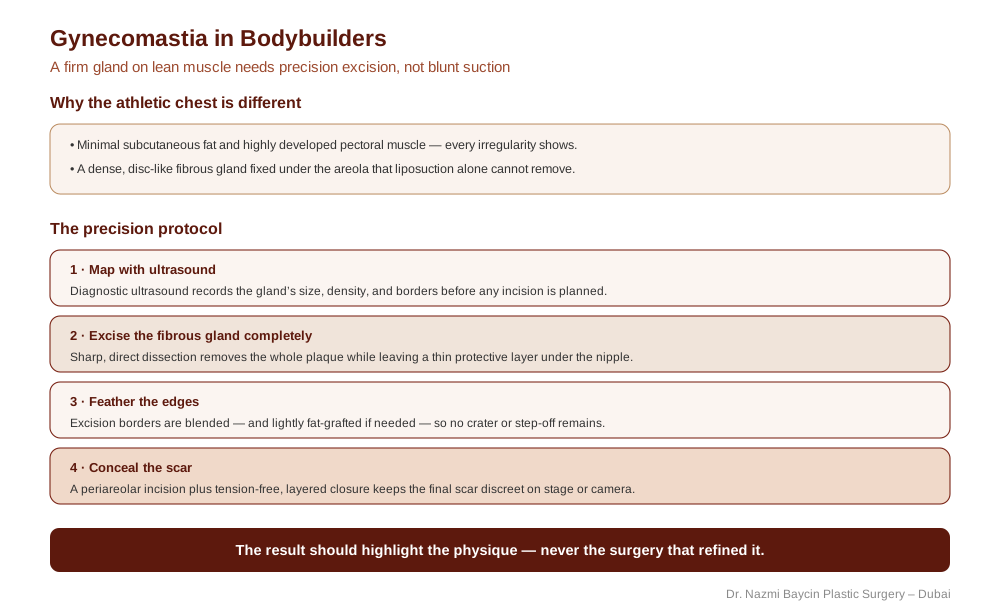
Why gynecomastia in bodybuilders needs precise gland excision and discreet scar placement rather than liposuction alone — by Dr. Nazmi Baycin, Dubai.
How the athletic approach differs from standard correction
It helps to see the contrast directly. The table below sets out how the bodybuilder’s presentation and its treatment differ from a typical gynecomastia case.
| Aspect | Typical Case | Bodybuilder / Athlete |
|---|---|---|
| Dominant tissue | Mixed fat and gland | Dense, fibrous gland; minimal fat |
| Main technique | Liposuction with some excision | Meticulous direct excision, limited liposuction |
| Biggest risk | Residual fullness | Crater deformity visible on flexing |
| Scar priority | Important | Critical — stage and camera exposure |
The cornerstone of my operation in Dubai is the complete, meticulous excision of the fibrous gland — a task of precision, not force. I almost always use a periareolar incision, a discreet cut along the lower border of the areola where the pigmentation changes, which in skilled hands heals to become nearly imperceptible.
Working with fine instruments under direct vision, I separate the gland from the overlying skin and the underlying pectoral fascia, removing the entire glandular plaque while deliberately preserving a thin, protective layer of tissue directly under the nipple. That small margin is what prevents the saucer-like depression that betrays an over-aggressive excision.
Finally, the edges of the excision are feathered to blend seamlessly with the surrounding chest, and where a contour irregularity would otherwise remain — particularly in revision cases — I use minimal, precise fat grafting from a remote site to guarantee a smooth transition. This balance of thorough removal and careful contouring mirrors the philosophy in my article on the dual-technique approach of excision and contouring, and it is central to how I perform gynecomastia surgery in Dubai.
The critical priority of scar concealment
For a bodybuilder, a visible scar can undo the entire benefit of the operation, so scar management is proactive rather than reactive. Placement comes first: the periareolar incision is the gold standard for concealment because it hides the scar at the natural color boundary of the areola. Closure matters just as much — I use a multi-layered technique with dissolving sutures deep within the tissue to eliminate tension at the skin surface, since surface tension is the primary driver of scar widening.
After surgery, a strict, evidence-based scar-care protocol supports optimal healing and minimizes visibility over the following months. The same tension-first logic underpins good scar outcomes across body contouring, a principle I explore in my article on why technique matters more than skin type in scar quality. Taken together, this attention ensures the final result highlights the physique rather than the surgery.
Managing asymmetry and achieving true harmony
A perfectly symmetrical chest is rare in nature, and even rarer in athletes with dominant-side development from years of training. My goal is therefore not mathematical symmetry but visual harmony in every pose — relaxed, flexed, and viewed from multiple angles. In practice this often means excising slightly different volumes of gland from each side to compensate for underlying muscular asymmetry, so that the chest looks balanced when it is actually being used rather than only when standing still.
That judgment cannot be reduced to a formula; it comes from experience and a close reading of each athlete’s build. It is the same demand for three-dimensional, dynamic balance that governs the most difficult corrections, including the crater and asymmetry problems I address in my article on correcting crater deformities and chest asymmetry.
The realistic path back to training
Healing cannot be rushed, and for an athlete in Dubai the return to training has to be staged deliberately to protect the result. In the first three weeks I ask for absolute rest from any chest, shoulder, or back activation, with a compression garment worn consistently to control swelling and support the healing plane. Between weeks four and six, lower-body and cardiovascular training can be reintroduced gradually, but with no direct pectoral work. From around week seven, upper-body training resumes in a carefully staged way, beginning with light weights and avoiding maximum contractions until the tissues are robust enough to tolerate them.
Adherence to this timeline is not optional: pushing too early risks complications such as hematoma and can disrupt the delicate way the refined chest contour heals onto the powerful pectoral muscle beneath it. Because every athlete’s anatomy, gland density, and training demands are different, both the surgical plan and its cost are best worked out at a consultation tailored to the individual.
The goal is a natural, powerful contour
Gynecomastia in a bodybuilder is not merely a cosmetic concern; it is a structural anomaly sitting on a canvas of hard-earned muscle, and correcting it well requires a surgeon who thinks like an architect and operates with restraint. From ultrasound mapping to feather-edge excision and strategic scar placement, the entire methodology is built for one outcome: a chest that looks inherently strong, naturally masculine, and as though the condition were never there.
That is the standard an athlete should expect from a leading plastic surgeon in Dubai — a plan shaped around the individual physique rather than a generic template. For any athlete troubled by this issue, a consultation focused on analyzing the specific anatomy is the right place to begin.
FAQs about gynecomastia surgery for bodybuilders in Dubai
-
Why is gynecomastia surgery different for bodybuilders?
Because the anatomy is different. Bodybuilders typically have minimal subcutaneous fat, highly developed pectoral muscle, and a dense, fibrous glandular disc under the areola rather than the softer mixed tissue seen in ordinary gynecomastia. On such a lean, muscular chest there is nowhere for an irregularity to hide, so precision matters more than usual. The firm gland cannot be removed by liposuction alone and requires meticulous direct excision, while the scar must be concealed to a standard suitable for stage or camera. A generic approach risks residual puffiness, crater deformities, or a visible scar.
-
Why can’t liposuction alone fix it?
The core problem in an athlete’s chest is a firm, disc-like plaque of fibrous glandular tissue fixed beneath the areola, not soft fat. Liposuction cannulas are designed to remove fat and simply cannot clear dense, organized gland. Forcing them through it does not eliminate the plaque and risks creating a crater — a depression over the muscle that becomes obvious when the chest is flexed. Effective correction requires sharp, direct excision of the gland under vision, sometimes combined with limited liposuction to blend the edges. That is why accurate diagnosis of gland versus fat, ideally with ultrasound, guides the whole plan.
-
Will the surgery leave a visible scar?
Scar concealment is one of the highest priorities in this operation. The incision is placed periareolarly, along the lower border of the areola where the color naturally changes, so it blends into that boundary. A multi-layered, tension-free closure with deep dissolving sutures removes tension from the skin surface, which is the main cause of scar widening, and a strict scar-care protocol afterward optimizes healing. In skilled hands the final scar typically becomes very difficult to see. For competitive athletes who appear on stage or in photographs, this attention to placement and closure is treated as non-negotiable.
-
What is a crater deformity and how is it avoided?
A crater deformity is a saucer-like depression over the pectoral muscle caused by removing too much tissue directly under the nipple, and it becomes especially visible when the muscle is flexed. It is one of the most common reasons athletes seek revision surgery. It is avoided by deliberately preserving a thin, protective layer of tissue beneath the nipple during excision, and by feathering the edges of the excision so they blend into the surrounding chest. Where a slight irregularity remains, a small amount of precise fat grafting can restore a smooth contour. Careful, measured excision — not maximal removal — is the key.
-
When can I return to training and lifting?
The return is staged to protect the result. For the first three weeks, complete rest from chest, shoulder, and back activation is essential, with a compression garment worn consistently. Between weeks four and six, lower-body and cardio work can resume gradually, but with no direct pectoral training. From around week seven, upper-body work restarts carefully with light weights, avoiding maximum contractions until the tissues are strong enough. Rushing this timeline risks complications such as hematoma and can disrupt how the contour heals onto the muscle. The exact schedule is tailored to the individual and the extent of surgery.
-
Will the gynecomastia come back after surgery?
Once the glandular tissue is completely excised, that tissue does not regrow, so a thorough excision gives a durable result. The main reason gynecomastia recurs is incomplete removal — hormonally active gland left behind under the areola can persist or enlarge. This is precisely why the technique focuses on removing the entire fibrous plaque while preserving only a thin protective layer. Ongoing hormonal influences, including anabolic steroid or prohormone use, can also stimulate any residual tissue, so maintaining a stable hormonal status supports the longevity of the result. A complete primary excision remains the best protection against recurrence.
-
Can asymmetry between the two sides be corrected?
Yes, and in athletes it usually must be addressed deliberately. Dominant-side muscular development from training frequently means the two sides are not identical, so the goal is visual harmony in every pose rather than mathematical symmetry. In practice this often involves excising slightly different volumes of gland from each side to balance the chest when it is relaxed, flexed, and seen from different angles. This is a matter of experienced surgical judgment rather than a fixed measurement, and it is assessed individually at consultation so the chest looks balanced in real, dynamic use rather than only at rest.


GET APPOINTMENT
Get ready to look and feel best… You deserve…
