

Key takeaways: revision is reconstruction, not a redo
- Most revision cases stem from surgery that was too aggressive in removal, ignoring 3D topography.
- The crater deformity is the signature complication of over-resection — and it is correctable.
- Correction relies on scar release first, then layered autologous fat grafting.
- Asymmetry is corrected with differential fat grafting — perceptual balance, not math.
- Severe cases need a staged plan (two sessions), because fat-graft survival is variable.
- Timelines are measured in months and stages, not weeks and a single operation.
Why gynecomastia surgery results go wrong — and what it leaves behind
Most revision cases I assess in Dubai are not surgical accidents. They are the result of an approach that was too aggressive in one direction — removal — and insufficiently attentive to the three-dimensional topography of the chest that must remain after the gland is gone. Understanding what was done wrong is the first step toward planning what must be done differently. How that error is avoided in the first place — by preserving a peripheral gland buffer rather than clearing the subareolar pad entirely — I set out in my article on the three pillars that prevent the crater deformity.
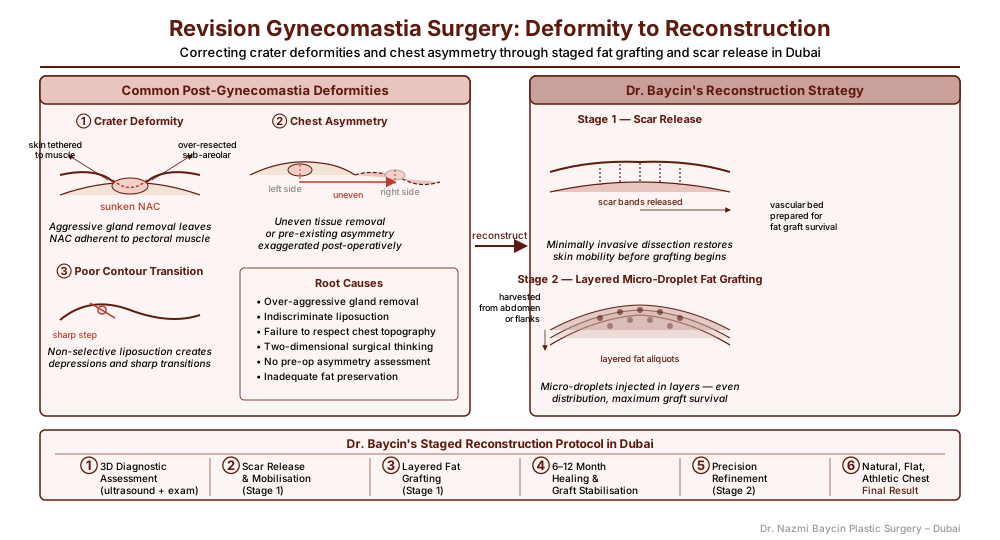
Left: the three most common post-gynecomastia deformities — crater deformity from over-resection, asymmetry from uneven removal, and poor contour transitions. Right: the staged reconstruction — scar release restores skin mobility, layered micro-droplet fat grafting rebuilds natural convexity, and differential grafting corrects asymmetry — by Dr. Nazmi Baycin, Dubai.
The crater deformity — the most common and most correctable outcome
The crater deformity — sometimes called the “saucer chest” — is the signature complication of over-resective gynecomastia surgery. It occurs when a surgeon removes both glandular tissue and fat aggressively from directly beneath the areola, leaving the nipple-areola complex without the soft tissue support that holds it in its natural position. The complex becomes adherent to the underlying pectoral muscle, and the result is a sunken, concave depression beneath the nipple that deepens visibly when the pectoral muscle contracts or the arms are raised. It is a tell-tale sign of two-dimensional surgical thinking — measuring success only by what was removed, not by what must remain to create a natural convex contour. The good news is that it is correctable: precise scar release to free the tethered skin, followed by layered autologous fat grafting to restore the volume that was taken.
Chest asymmetry — when uneven removal creates stark imbalance
No chest is perfectly symmetrical. But surgical error can transform a minor, natural difference in projection or nipple position into a stark, unnatural disparity visible in any light — typically from uneven tissue removal between the two sides, a failure to account for pre-existing asymmetry before resection, or lateralized liposuction that removes more fat from one side. Correcting this requires differential fat grafting: placing more volume on the deficient side, precisely calibrated to the specific volumetric difference. The art lies in the assessment — measuring not just how much is missing, but where, and what shape must be created to achieve harmony from all angles.
Poor contour and transition — the consequence of non-selective technique
Between the sternum and the shoulder, the normal male chest follows a gentle convexity — a smooth curve over the pectoral muscle that flows without interruption. Non-selective liposuction, performed without attention to the transitions between zones, can create sharp depressions, visible edges, or the characteristic “stuck-on” appearance of the areola sitting proud against a surrounding depression. These irregularities are often visible only in certain lighting or body positions, which makes them particularly distressing — unpredictable and inconsistent.
Diagnosing the problem before planning the correction
Every revision case begins not with a surgical plan but with a diagnostic one. I assess the chest in three dimensions — not just its current appearance but the anatomy underlying it and the specific failure that created the current state. I evaluate skin quality and adherence (how tightly the skin is scarred to the muscle, and whether it is tethered at specific points or globally); I map volume deficits precisely (where tissue is missing, in what quantity, and in what shape replacement tissue must be placed); I assess scar tissue planes using ultrasound imaging, which in a revision chest is routine rather than selective; and I evaluate the underlying pectoral muscle — the canvas on which everything else is built. This diagnostic rigor is what allows a staged plan to be constructed rather than improvised. For the clinical context and grading system that underpin this work, my overview of gynecomastia surgery in Dubai provides the foundation.
The reconstruction strategy: staged fat grafting and scar release
My reconstruction strategy rests on a single governing principle: the body must be given the conditions it needs to accept and sustain the correction before the correction is made. Attempting to graft fat into a field of dense, avascular scar tissue is the most common reason revision fat grafting fails. The sequence is not incidental — it is the work. The use of fat grafting to correct contour deformity after gynecomastia surgery is recognized in the literature: a 2025 series of 24 men found intraoperative contour irregularities in 37.5% of cases and corrected each with a median 8 cc of autologous fat; at a mean 12.4 months both the grafted and non-grafted patients reported high satisfaction, with no significant difference between them. That series grafted during the primary operation rather than as a later revision — men who had already undergone gynecomastia surgery were excluded from it, and in twenty of its twenty-four cases the tissue removed was fat rather than gland — so it supports the principle rather than the timing.
Step 1 — Scar release and mobilization: creating a receptive environment
Before a single milliliter of fat is placed, I create the biological environment in which that fat can survive. Through precise, minimally invasive dissection — fine instruments through small access points — I release the scar bands that tether the skin to the pectoral muscle. This restores skin mobility: the physical movement of the skin over the chest wall that is a prerequisite for both natural appearance and graft survival. It also re-establishes vascular supply to the recipient tissue, because fat grafts survive through revascularization. Dense, fibrous scar has poor blood supply; released, mobile, vascularized tissue has the supply needed to nurture the graft.
Step 2 — Layered micro-droplet fat grafting: sculpting natural convexity
Fat is harvested from a donor site — typically the abdomen or flanks — using gentle, low-pressure suction that preserves the integrity of the fat cells, then meticulously processed to leave only viable, intact adipocytes. I inject this fat in tiny, layered aliquots — micro-droplets placed at multiple depths within the prepared recipient bed. This maximizes contact between each droplet and the surrounding vascular tissue (the mechanism through which droplets revascularize and survive), and it allows me to sculpt convexity gradually rather than injecting a bolus that settles unpredictably. The principles of donor-site harvesting I apply in liposuction surgery in Dubai are directly relevant to obtaining high-quality graft material.
Step 3 — Differential grafting for asymmetry: achieving visual balance
Asymmetry correction is an exercise in calibrated precision. Using the same layered micro-droplet technique, I perform differential fat grafting — deliberately placing greater volume on the deficient side — to achieve visual harmony. The target is not mathematical symmetry but perceptual balance, which requires intraoperative assessment under different lighting conditions and body positions. Where over-resection has left thin or loose skin, the structural fat grafting also provides internal support, and patients frequently observe improvement in skin quality over the months that follow.
Why a staged approach produces the best outcome
For severe deformities, I recommend a staged plan without hesitation. The first stage addresses the foundational work — scar release, preparation of the recipient bed, and the primary fat grafting that rebuilds the general contour. After six to twelve months of healing, the grafted fat has stabilized, the scar tissue has matured, and the final topography has become legible; a second stage then allows for precise refinement and touch-up grafting.
This is not a concession to imperfection but the correct approach to a biological process that cannot be fully controlled in one session. Fat-graft survival is variable, and the amount retained cannot be known until healing is complete. A staged approach accounts for this honestly. It is a mark of surgical discipline, not limitation.
Primary versus revision gynecomastia surgery: what changes
| Feature | Primary Gynecomastia Surgery | Revision Gynecomastia Surgery |
|---|---|---|
| Goal | Remove glandular tissue and fat | Correct deformity from prior removal |
| Primary technique | Liposuction + gland excision | Scar release + fat grafting |
| Fat removal | Yes | No — fat is added |
| Surgical stages | Usually single session | Staged (2 sessions typical for severe cases) |
| Operative complexity | Moderate | High |
| Recovery time | 2–4 weeks | 4–6 weeks per stage |
| Outcome timeline | 3–6 months | 6–18 months (full staged result) |
| Risk of crater deformity | Present if over-resective | Addressed — not created |
Who is a candidate for revision gynecomastia surgery in Dubai?
The patients who benefit most share a clearly defined profile. They have undergone primary gynecomastia surgery — liposuction alone, glandular excision, or a combination — and are dissatisfied with the result due to one or more of the deformities described above. They have allowed adequate time for healing: I assess patients no earlier than twelve months post-operatively, as some apparent irregularities resolve with time and full scar maturation. They are at a stable weight, non-smokers, and medically fit for surgery under general anesthesia. They carry realistic expectations — not necessarily a “perfect” chest, but a dramatically improved one that allows them to dress, exercise, and present themselves without the physical and psychological burden of a visibly irregular result. And they are prepared for a staged process: the commitment to multiple procedures and a long timeline is a prerequisite, not an option.
Recovery and timeline after revision gynecomastia surgery
Recovery is longer than from primary surgery, reflecting the more extensive work. After Stage 1 — scar release and primary fat grafting — most patients return to desk work within two weeks and resume light activity within four weeks, with compression garments worn continuously for six weeks to support the grafted tissue. Swelling is more pronounced than in primary surgery and resolves over three to four months; the grafted fat stabilizes over six months, the point at which a meaningful assessment of the Stage 1 result becomes possible. If a Stage 2 refinement is indicated, it is typically planned between six and twelve months post-operatively. For context on recovery timelines across procedures and how staged planning works in practice, see my overview of body contouring surgery in Dubai.
- Week 1–2: Rest, compression garment continuous, swelling peaked.
- Week 3–4: Light daily activity; desk work resumable.
- Week 6: Compression garment discontinued; light exercise cleared.
- Month 3–4: Swelling resolved; early contour readable.
- Month 6: Stage 1 fat graft stabilized; Stage 2 assessment if indicated.
- Month 6–12: Stage 2 refinement (if needed) planned and performed.
- Month 12–18: Final settled result; fat integration complete.
Because every reconstruction is individual, its plan — including cost — is mapped and discussed transparently at the diagnostic consultation. This reconstructive philosophy runs through all of my plastic surgery work in Dubai.
FAQs about crater deformity after gynecomastia surgery in Dubai
-
What is a crater deformity after gynecomastia surgery and can it be corrected?
A crater deformity is a sunken, concave depression beneath the nipple-areola complex caused by over-resection of subareolar gland and fat during the primary surgery. The nipple becomes tethered to the underlying pectoral muscle and the chest appears hollow where tissue should be. It is correctable through a two-step process: scar release to free the tethered skin and restore mobility, followed by layered micro-droplet autologous fat grafting to rebuild the natural convexity. I perform this reconstruction in Dubai as a staged procedure.
-
How long after my primary gynecomastia surgery should I wait before having revision surgery?
A minimum of twelve months is required. This allows full scar maturation, complete resolution of swelling, and a stable final result from the primary surgery to be assessed. Some apparent irregularities — particularly those related to swelling or early scar contraction — resolve on their own within this period. Assessing and operating before the primary result has fully declared itself risks planning the correction for a problem that no longer exists, or missing one that has not yet become apparent.
-
How many surgeries will I need to correct my gynecomastia result?
For most moderate deformities, one well-planned revision session addresses the primary correction, with a possible second refinement session six to twelve months later. For severe crater deformities or significant asymmetry, a staged approach of two sessions is standard — the first rebuilding the foundation, the second refining the final contour. I outline the expected number of stages at the diagnostic consultation once the anatomy has been assessed.
-
Will fat grafting for gynecomastia revision look natural?
Yes — when performed with layered micro-droplet technique into a properly prepared recipient bed, autologous fat grafting produces results that are indistinguishable from natural tissue. The grafted fat integrates with the surrounding tissue over six months, matching the texture, warmth, and movement of the native chest. The key prerequisites are adequate scar release before grafting and patience during the settling period — the final contour cannot be assessed until approximately six months post-operatively.
-
Can chest asymmetry after gynecomastia surgery be corrected?
Yes. Asymmetry correction uses differential fat grafting — placing a calibrated volume on the deficient side to achieve visual balance. The target is perceptual harmony, not mathematical symmetry. I assess asymmetry under multiple lighting conditions and body positions during both the diagnostic consultation and intraoperatively, to ensure the correction reads as natural rather than constructed.
-
Is revision gynecomastia surgery available for men who had surgery abroad?
Yes. I regularly assess and correct results from primary surgery performed elsewhere — in Dubai, across the UAE, and internationally. The anatomical problem is the same regardless of where the primary surgery was performed, and the reconstruction approach is determined by the current anatomy, not the history of how it was created.


GET APPOINTMENT
Get ready to look and feel best… You deserve…
