

Key takeaways: three pillars build a natural male chest
- A natural result rests on three technical pillars: precise gland management, artistic liposculpting, and strategic scar placement.
- The crater deformity comes from aggressive total gland removal beneath the areola — a hollow the skin sinks into.
- Subtotal resection preserves a thin gland buffer beneath the areola that keeps the chest’s convex slope.
- Liposculpting should reveal muscular landmarks, not just debulk volume.
- Access at the areolar border with tension-free closure keeps scars nearly invisible.
- The three pillars are balanced differently for each patient’s glandular, fatty, or mixed anatomy.
With extensive experience in male contouring, I approach gynecomastia correction not as a removal procedure but as a sculpting one. True success rests on the three pillars, and neglecting any one of them can produce a result that betrays the surgery. This article explains all three — and why they must work together.
Why gynecomastia surgery is sculpting, not just removal
The fundamental misconception about gynecomastia surgery — held by patients and, unfortunately, some surgeons — is that it is simple subtraction: remove the gland, remove the fat, and the chest is corrected. In reality, the male chest is a three-dimensional aesthetic structure with a specific masculine architecture: a gentle convex slope, a defined pectoral border, a smooth transition to the abdomen, and a natural infra-areolar contour. Surgery that ignores this architecture in favor of pure removal does not produce a masculine chest. It produces a flat, hollowed, or irregular one.
Gynecomastia itself — the enlargement of male breast tissue — is reviewed in a StatPearls clinical reference, which sets out its many causes, from hormonal change and obesity to steroid use, medications, hypogonadism and liver or kidney failure, and notes that most cases are idiopathic. Management runs from treating any underlying condition to surgery where it is needed. So I think of the procedure as chest sculpting rather than gland removal. Every decision — how much gland to excise, how much to preserve, where to contour, how to blend the transitions — serves the final three-dimensional form. The three pillars keep those decisions aligned toward a natural result.
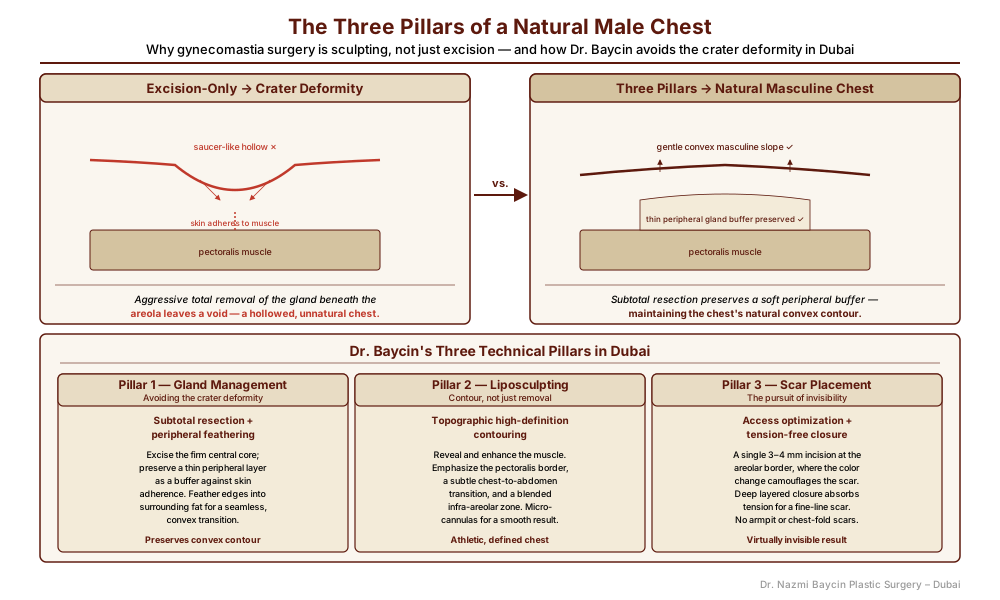
The crater deformity from excision-only surgery (a hollowed, concave chest with skin adhered to muscle) contrasted with the natural convex masculine result from subtotal resection preserving a peripheral gland buffer — and the three technical pillars: precise gland management, artistic liposculpting, and strategic scar placement — by Dr. Nazmi Baycin, Dubai.
Pillar one: precise gland management
The enlarged glandular tissue is the core problem in gynecomastia, and how it is managed decides whether the chest looks natural or operated. The fundamental error many surgeons make is complete, aggressive removal of the gland directly beneath the areola. That ignores the natural anatomy of the male chest, which has a gentle convexity, not a concave depression. Rip out this central pad of tissue and you leave a void; the skin adheres to the underlying muscle and a saucer-like indentation forms.
This crater deformity is especially visible in lean, muscular patients, where little surrounding fat can disguise it, and it is among the hardest complications to correct afterwards — though it is correctable, as I set out in my article on repairing a crater deformity after previous surgery. My technique is guided instead by subtotal gland resection with peripheral feathering. I never remove the entire gland. I excise the bulk of the firm glandular core while deliberately preserving a thin, soft layer of glandular tissue beneath the nipple-areola complex. That retained layer acts as a natural buffer: it maintains the chest’s gentle convex slope, protects the blood supply to the nipple-areola complex, and stops the skin adhering to the muscle beneath. The transition is then feathered into the surrounding fat so that no abrupt edge remains.
The result keeps its masculine convex contour while the firm, projecting gland that defined the condition is gone. This is the difference between removal and sculpting. How that excision is actually carried out, step by step in the operation, I set out separately in my article on the dual-technique approach: excision and contouring.
Pillar two: artistic liposculpting
Gland excision alone almost always leaves a disappointing, unfinished result, because fat surrounds and overlays the gland and adds much of the rounded appearance. Liposuction is therefore essential — but it must be applied with an artist’s eye, not a carpenter’s. Using it merely to debulk volume produces an irregular, lumpy contour that fails to define the natural landmarks of the male chest.
I apply high-definition liposculpture principles even in standard gynecomastia cases, focused on topographic contouring: removing fat strategically to reveal the underlying muscular anatomy rather than just reducing volume. The same layered-contouring philosophy governs my approach to VASER liposuction technique in Dubai, where the surgeon’s artistry, not the machine, defines the result. Specifically, I emphasize the pectoralis major border, create a subtle transition from chest to abdomen, and sculpt the infra-areolar area to blend seamlessly with the treated gland zone.
The goal is a chest that looks naturally athletic and defined, not merely flat — the cannulas, planes and sequence that achieve it belong to the operative account rather than to this one. That dedication to contour separates a basic reduction from a transformative sculpting procedure, and it draws on the same artistic principles as my abdominal etching and definition work in Dubai.
Pillar three: strategic scar placement
Scars are a necessary part of surgery, but they should not be its legacy. A visible, hypertrophic, or poorly positioned scar can distress a patient as much as the original gynecomastia did. The classic error is placing the access incision in a visible location, or making it unnecessarily large. My strategy centers on access optimization: one small incision, sited where the natural color transition at the areolar border camouflages it, doing the work that lesser planning spreads across several. In standard cases there is no need for scars in the armpit or the chest folds at all.
The visibility of any scar depends largely on the tension across it during healing. So at closure I layer the deep tissues to absorb that tension, letting the skin edges meet without strain — the key to a fine-line scar that heals nearly invisibly. I then give every patient a personalized, evidence-based scar management protocol to refine healing further. The result is defined by the new chest contour, not by reminders of how it was achieved.
These three pillars are the principles that govern the operation. The operation itself — the access, the excision, the feathering of the fat, and the closure, in the order they are performed — I describe in my article on the dual-technique approach to gynecomastia surgery.
Excision-only vs. the three-pillar approach: a comparison
| Factor | Three-Pillar Approach (Dr. Baycin) | Excision-Only Approach |
|---|---|---|
| Gland removal | Subtotal — central core only | Aggressive total removal |
| Subareolar buffer | Preserved for natural convexity | Removed — leaves a void |
| Chest contour | Gentle masculine convex slope | Hollowed, concave crater |
| Skin-to-muscle adherence | Prevented by preserved buffer | Common — saucer deformity |
| Fat / liposculpting | Topographic contouring of landmarks | Often ignored or crude debulking |
| Pectoral definition | Revealed and enhanced | Flat or irregular |
| Incision | Fewest, smallest, areolar-border | Often larger or poorly placed |
| Scar visibility | Camouflaged, fine-line | Risk of visible, hypertrophic scar |
| Result in lean/muscular men | Natural and athletic | Crater especially visible |
| Risk of revision | Minimized | Elevated |
How the three pillars are balanced for each patient
The pillars are constants; their proportions are not. A patient with significant skin laxity may need an approach that incorporates skin excision, so Pillar Three carries more of the work. A muscular patient with dense, fibrous glands needs the utmost precision in Pillar One, because there is little surrounding fat to disguise a crater. A predominantly fatty chest shifts the emphasis onto Pillar Two, where the result is made almost entirely by contouring.
What sets those proportions is the diagnosis: whether the enlargement is predominantly glandular, predominantly fatty, or mixed, and how much skin excess accompanies it. That classification, and how I make it, I set out in my article on the three types of gynecomastia and the surgery each one needs. It is why two gynecomastia patients may receive meaningfully different operations, and why a standardized procedure produces inconsistent results.
Why experience in male aesthetics is non-negotiable
The male chest has distinct aesthetic ideals — angular and defined, flat where it should be flat and gently convex where it should be convex — that differ fundamentally from female chest aesthetics. Sculpting it well takes a surgeon who genuinely understands those masculine ideals and the technical steps to achieve them.
My practice is dedicated to the subtleties of male contouring, and I deliberately avoid the common pitfalls that feminize the chest or produce an obviously operated result. For men in Dubai considering this life-changing procedure, the choice of surgeon is the single most critical factor.
The difference between a natural masculine chest and a crater deformity is not the equipment or the setting — it is the surgeon’s understanding of male chest architecture and command of all three pillars. Because every chest is individual, the plan and its cost are discussed transparently at consultation. This pillar-based philosophy runs through all of my plastic surgery practice in Dubai.
FAQs about three pillars gynecomastia surgery in Dubai
-
What is the crater deformity in gynecomastia surgery?
The crater deformity is a hollowed, concave, saucer-like depression in the chest that results from aggressively removing the entire glandular pad directly beneath the areola. Because the male chest naturally has a gentle convex slope rather than a flat or concave one, removing all the central tissue leaves a void, and the skin adheres to the underlying muscle — creating a visible indentation that is especially obvious in lean, muscular men. I prevent it by preserving a thin layer of gland beneath the areola as a buffer, maintaining the chest’s natural convexity.
-
Will gynecomastia surgery leave visible scars?
With the right technique, scars are minimal and very well concealed. Access is planned at the border of the areola, where the natural color transition camouflages it, and in standard cases there is no need for additional armpit or chest-fold scars. What governs visibility most is tension: tension-free closure, achieved by layering the deep tissues to absorb strain, produces a fine-line scar, and a personalized scar management protocol optimizes healing further. The exact incision, and how the gland work and the liposculpting are performed through it, I describe in my dual-technique article.
-
Is gynecomastia surgery permanent?
Yes, gynecomastia surgery is generally permanent. Once the glandular tissue is surgically removed, it does not grow back, and the fat cells removed through liposculpting are also permanently gone. The result is stable long-term, provided there is no significant new hormonal driver — such as starting anabolic steroids, certain medications, or a substantial weight gain — that could cause new tissue to develop. For a stable, healthy patient, a well-executed three-pillar procedure delivers a lasting, natural correction.
-
Is my gynecomastia glandular or fatty — and does it matter?
It matters a great deal, because it determines the surgical plan. Glandular gynecomastia involves firm, dense tissue concentrated beneath the areola that must be precisely excised (Pillar One). Fatty gynecomastia (sometimes called pseudogynecomastia) responds primarily to liposculpting (Pillar Two). Most men have a mixture of both, in varying proportions, often with some skin laxity. I classify the type during a physical examination and tailor the balance of the three pillars accordingly — which is why a standardized operation produces inconsistent results.
-
Will I have a flat chest or a natural-looking one?
The goal of my approach is a natural, masculine chest — not simply a flat one. A purely flat result, achieved by aggressive removal, often looks operated and can produce the crater deformity. The three-pillar method instead preserves the chest’s gentle convex slope, reveals the pectoral border and natural landmarks through liposculpting, and blends all transitions seamlessly. The result is an athletic, defined, masculine contour that looks natural rather than surgically flattened.
-
Can gynecomastia come back after surgery?
Properly removed glandular tissue does not regenerate, so true recurrence is uncommon. However, new gynecomastia can develop if a significant new hormonal cause arises after surgery — most commonly anabolic steroid use, certain medications, or a large weight gain that adds fatty tissue to the chest. This is why I assess for reversible underlying causes before surgery and why maintaining a stable weight and avoiding steroids protects the long-term result.
-
How is gynecomastia surgery different for muscular or lean patients?
Lean and muscular patients require especially precise gland management, because they have little surrounding fat to disguise any irregularity — making the crater deformity far more visible if too much gland is removed. For these patients, Pillar One (subtotal resection with a preserved subareolar buffer) is critical, and the liposculpting in Pillar Two focuses on revealing and complementing the existing muscular definition rather than reducing volume. My topographic contouring approach is particularly suited to athletic patients seeking a defined, natural chest.


GET APPOINTMENT
Get ready to look and feel best… You deserve…
