

Key takeaways: tissue elasticity as the foundation
- Tissue elasticity — not the implant — is the most critical variable in augmentation planning.
- Firm, resilient tissue risks excessive tension; lax tissue risks descent and bottoming-out.
- Implant profile and base width are matched to your chest footprint, not to a target cup size.
- For lax tissue, form-stable cohesive gel plus pocket reinforcement counteract gravity.
- Incision choice follows tissue quality — the inframammary approach gives the most control for structural work.
- Sound biomechanical planning is what protects against malposition, rippling, and revision.
The biomechanical imperative: a detailed analysis of tissue types
Understanding your tissue’s mechanical character is the first and most crucial step, and my evaluation moves far beyond a visual appraisal into a dynamic, hands-on assessment that predicts how your tissues will behave under the new, permanent load of an implant. This is not merely a stylistic preference: a 2013 paper applying the mechanics of materials to the augmented breast frames stretch-related problems — bottoming-out, breakdown of the inframammary fold, tissue atrophy, and distortion such as visible implant edges and traction rippling — as the behaviour of a material deforming under a constant load. It is a theoretical framework drawn from its authors’ experience rather than an outcome study, and it is offered here as the reasoning behind the assessment rather than as evidence of any particular rate. The table below summarizes how my strategy diverges for the two broad tissue profiles.
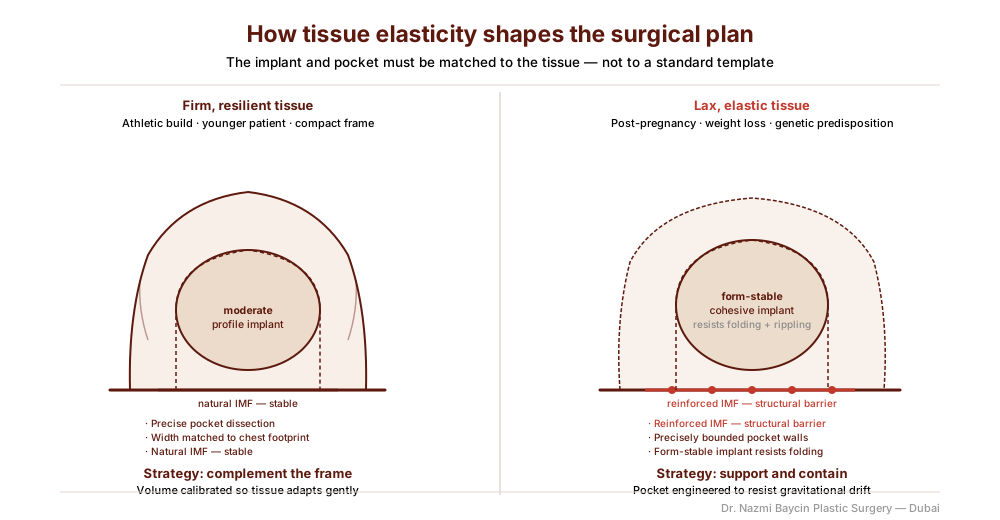
How tissue elasticity guides implant choice, pocket design, and incision strategy — firm tissue avoids over-tension, lax tissue needs structural support — by Dr. Nazmi Baycin, Dubai.
The patient with firm, resilient tissue
This profile is often seen in younger patients or those with a compact, athletic build, where the tissue has excellent innate tone and resistance. The primary surgical challenge is avoiding excessive tension: an implant too large or too wide for this taut canvas can produce an unnaturally rounded appearance, visible implant edges, or animation deformity where the implant distorts sharply with pectoral movement — a problem governed by how the implant sits relative to the muscle, which I explore in the dual-plane breast augmentation.
For this anatomy I typically advocate moderate-profile implants with a base width meticulously matched to your natural chest footprint, selecting a volume that complements your frame without overwhelming the tissue’s capacity to stretch gently and adapt. The pocket dissection must be exacting, because tight tissues offer less room for error.
The patient with lax or more elastic tissue
This scenario is common after pregnancy, breastfeeding, or substantial weight loss, or simply through genetic predisposition, where the breast envelope has lost some of its collagenous support and behaves like a stretched canvas. The concerns shift from managing tension to providing structural support and preventing future descent, since gravity will otherwise exploit the laxity and lead to implant migration and loss of upper-pole fullness.
Here the implant choice and surgical technique must work in concert: I often recommend more cohesive, form-stable gel implants for their resistance to folding and deformation, which minimizes rippling, and the pocket design becomes an act of internal engineering — not merely a space, but a supported structure with precise internal landmarks and reinforcement sutures at the new inframammary fold to establish a durable barrier against downward drift. Where laxity is accompanied by genuine sagging, the plan may extend beyond an implant alone; to learn more about combining support with volume, visit breast lift surgery in Dubai.
| Consideration | Firm, resilient tissue | Lax or elastic tissue |
|---|---|---|
| Typical profile | Younger or athletic; excellent innate tone | After pregnancy, breastfeeding, or weight loss |
| Primary risk | Excessive tension; visible edges, animation | Descent, migration, loss of upper-pole fullness, bottoming-out |
| Implant choice | Moderate-profile, base width matched to the chest footprint | More cohesive, form-stable gel to resist folding and rippling |
| Pocket strategy | Exacting dissection; little room for error | Internal engineering with inframammary-fold reinforcement |
The incision strategy: a conduit shaped by biology
Where the scar goes, what each route crosses, and what each one costs you is a subject in its own right, and I set the three approaches side by side in my article on where the scar goes, and what it records. What belongs here is narrower: how tissue quality narrows that choice before preference enters it.
Where the plan calls for complex internal work — reinforcing the fold, shaping precise medial and lateral boundaries, positioning an anatomical implant exactly — the inframammary route gives the most direct access to carry it out, and lax tissue is precisely the situation that demands that work. Where elasticity is good and balanced and the goal is straightforward augmentation without internal reshaping, the transaxillary route suits, and it is the approach my practice is built on; the full account is on my breast augmentation surgery in Dubai page. And very elastic tissue is the one finding that argues actively against a periareolar incision, since a stretched envelope and a larger areola together raise the potential for areolar stretching and scar widening.
Engineering the implant pocket: the architecture of durability
The creation of the implant pocket is where surgery transitions from planning to permanent form, and it is especially critical with elastic tissue, where the pocket must be designed not just to house but to actively support and secure the implant against gravitational and biological forces.
My technique uses a layered, anatomical approach that respects the natural tissue planes and preserves vital structures; for patients with laxity I meticulously reinforce the new inframammary fold and carefully shape the medial and lateral boundaries so the implant remains centered on the chest wall, preventing lateral displacement or symmastia. Keeping the implant precisely where it was placed over the long term is the focus of my article on implant pocket control in breast augmentation.
Some patients ask about alternative, minimally invasive systems that avoid detailed pocket work; while such technologies have their place, they often cannot reliably reinforce the inframammary fold or sculpt the pocket dimensions needed to secure an anatomical implant in an elastic envelope, so for a result built to last in a dynamic body the precision of traditional surgical technique remains the gold standard.
The integral preoperative assessment: beyond the physical exam
My assessment integrates objective data with seasoned clinical judgment. I use the pinch test to measure skin and soft-tissue thickness at the upper pole; I assess lower-pole stretch to judge the pliability and length of the tissue below the nipple; I evaluate the existing breast footprint and parenchymal coverage to determine how much natural tissue exists to veil the implant; and I note the chest-wall architecture, including any rib-cage asymmetries that will influence implant behavior.
This comprehensive profile lets me model the anticipated behavior of your tissues, transforming the surgery from an art into a predictable science of beautiful form. Because each plan is built individually from this assessment, the surgical design is drawn around your measurements rather than a template. This physiologically sound philosophy runs through all of my cosmetic surgery work in Dubai.
The harmony of form and function
Ultimately, a masterful breast augmentation achieves a silent harmony in which the implant feels and behaves as an integral part of your own form. This is only possible when the surgeon approaches the procedure as a biomechanist and an artist, viewing tissue elasticity not as an obstacle but as the essential guide. Every decision — from implant selection to the final suture — is filtered through the lens of your tissue’s unique character, and this commitment to deeply personalized, physiologically sound planning is what delivers not just enhanced volume, but balanced proportions, natural contours, and a result engineered to stand the test of time. Just as important as making these decisions well is avoiding the errors that undo them, which I catalogue in technical mistakes in breast augmentation and how to avoid them.
FAQs about tissue elasticity and breast augmentation in Dubai
-
What is tissue elasticity, and why does it matter for breast augmentation?
Tissue elasticity is your skin and soft tissue’s ability to stretch under load and recoil — its resistance to deformation over time. In breast augmentation, the implant applies a permanent, continuous force to this living system. If the tissue is firm and resilient, it can contain and conceal the implant naturally. If it is lax or overstretched, the same force will cause the implant to migrate downward over months and years unless the surgical plan specifically counteracts this. Elasticity is the canvas — every other decision follows from understanding it.
-
How does my surgeon assess my tissue elasticity?
Through a hands-on physical assessment during consultation — not just a visual appraisal. The pinch test measures skin and soft tissue thickness at the upper pole. Lower pole stretch evaluates how freely the tissue below the nipple moves and lengthens under gentle traction. I also assess the existing breast footprint, parenchymal coverage, and chest wall architecture. Together these measurements build a biomechanical profile that predicts how your tissues will behave under the permanent load of an implant, so the plan can be designed accordingly.
-
What is bottoming out and how is it prevented?
Bottoming out is when the implant gradually descends below the natural inframammary fold, causing the nipple to appear too high and the lower pole to look overfull. It happens when the implant’s weight exploits lax tissue without any structural resistance to stop the drift. Prevention requires two things: choosing an implant whose volume the tissue can support without being overstretched, and engineering the pocket with reinforcement sutures at the inframammary fold to create a durable barrier against downward migration. Neither step alone is sufficient.
-
Does this mean patients with lax tissue can’t get the result they want?
Not at all — lax tissue is a different engineering challenge, not a disqualification. It means the surgical plan needs to work harder structurally: using a more form-stable, cohesive implant that resists folding and rippling, and building internal pocket support to manage the gravitational forces. When planned correctly, patients with post-pregnancy or post-weight-loss tissue achieve excellent, lasting results. The risk comes from applying a standard plan to a non-standard canvas.
-
Why does incision choice depend on tissue quality?
Because the amount of internal work the pocket needs is set by the tissue, and different incisions give different degrees of access to do it. For patients with lax tissue requiring complex internal pocket engineering — reinforcing the inframammary fold, shaping precise medial and lateral pocket boundaries — the inframammary incision provides the most direct access for those structural refinements. The transaxillary approach suits patients with balanced tissue seeking augmentation without a scar on the breast. And very elastic tissue argues against a periareolar incision, because a stretched envelope raises the potential for areolar stretching and scar widening.
-
How long does a properly planned augmentation last?
A result that is biomechanically sound — meaning the implant volume is correctly matched to tissue capacity, the pocket is precisely engineered, and the inframammary fold is structurally reinforced where needed — should remain stable and natural-looking for well over a decade. Revision surgery most commonly becomes necessary when these tissue-based decisions were not made correctly at the outset: the wrong volume for the tissue, an inadequately supported pocket, or an implant chosen for appearance rather than compatibility with the patient’s mechanics.


GET APPOINTMENT
Get ready to look and feel best… You deserve…
