

Key takeaways: technique, not anatomy, drives the result
- Most disappointing results come from avoidable technical errors, not the patient’s anatomy.
- The CC chase — sizing by cup alone — ignores the tissue that must carry the implant.
- The pocket plane and inframammary fold determine whether the breast looks natural at rest and in motion.
- An over-dissected pocket lets the implant drift; a snug, controlled one keeps it stable.
- Natural results require correcting asymmetry, not just adding equal implants.
- Sound technique is linked in outcome data to complication and reoperation rates.
These points are not a matter of opinion. A single-surgeon retrospective review of 1,539 consecutive primary augmentations over fifteen years collected implant characteristics, incision type and pocket location for every case, and concluded that both implant-related and technique-related factors may influence complications and reoperations. It is an association within one practice rather than proof of cause, but it is evidence that the decisions below genuinely shape results.
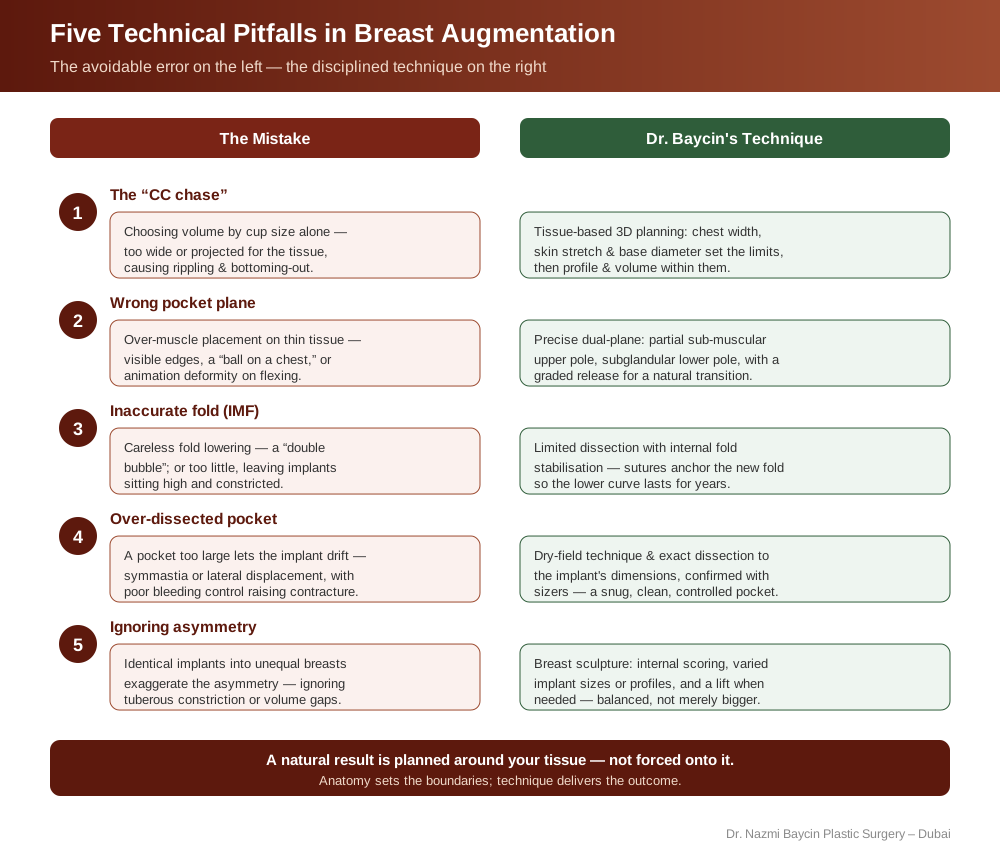
The five technical pitfalls in breast augmentation — the CC chase, wrong pocket plane, inaccurate fold, over-dissected pocket, and ignored asymmetry — each paired with the disciplined technique that avoids it, from tissue-based planning to comprehensive breast sculpture — by Dr. Nazmi Baycin, Dubai.
Poor implant selection based on volume alone: the CC chase
One of the most common errors I see is selecting an implant on desired cup size or a fixation on cubic centimeters. This CC chase ignores the patient’s most important limiting factor: their own tissue — the very property that should drive implant selection, which I examine in how tissue elasticity shapes implant selection. An implant too wide for the chest wall drifts laterally into an unnatural side-heavy appearance, while one with too much projection for thin tissue produces visible rippling, palpability, and accelerated bottoming-out. It also helps to understand the limits of specific techniques.
The Mia Femtech method, for example, prioritizes minimal dissection and uses a strict maximum implant size of around 195cc — an advantage for tissue preservation, but a real constraint for patients wanting a more substantial increase in volume or projection. Its own three-year study of 100 patients describes a procedure built around one specific implant delivered through a set of proprietary single-use instruments. That trade-off makes the wider point: no single technique is perfect for everyone.
In my practice, implant selection is a three-dimensional puzzle. I take detailed measurements of chest width, nipple position, skin stretch, and breast base diameter, and those objective parameters define the allowable implant dimensions. Only within those anatomical boundaries do we then discuss profile and volume. I stay proficient across all methods — from dual-plane to composite augmentation — so I can recommend what suits your framework rather than forcing your goals into the limits of one approach.
Incorrect pocket placement and dynamic deformities
Creating the pocket where the implant sits is where surgical skill is paramount. A mistake I frequently correct is subglandular (over-the-muscle) placement in patients with insufficient upper-pole tissue, which leaves visible implant edges, rippling, and an artificial look on the chest. Conversely, a submuscular pocket that is not properly released can produce animation deformity, where the implant shifts unnaturally as the chest muscle flexes.
My standard for a natural result is the dual-plane technique, refined over many years, in which the upper implant sits beneath the muscle and the lower implant against the gland. How the degree of release is judged, and why it changes the result, is set out in full in that article. Avoiding a one-size-fits-all pocket is a cornerstone of a result that looks natural both at rest and in motion.
Inaccurate inframammary fold positioning
The inframammary fold is the foundation of the breast. Lowering it carelessly to accommodate a tall implant is a serious error that produces a double bubble, where the native fold persists above the new, surgically lowered one. Failing to lower it enough does the opposite, leaving the implant sitting too high in a constricted shape. I treat the fold with strategic reverence. When lowering it is necessary, I use precise, limited dissection and always add internal fold stabilization — typically permanent sutures securing the lower capsule or dermis to the chest wall at the planned position. This step, which many surgeons omit, builds a robust anatomical foundation that prevents the implant descending over time and keeps the lower curvature defined for decades.
Over-dissection and failure to control the pocket
The pocket must be a snug, exact home for the device, and maintaining that control over the years is the subject of my article on controlling the implant pocket for long-term stability. A cavity that is too large lets the implant drift, leading to symmastia — implants meeting in the middle — or lateral displacement. This often pairs with poor bleeding control, which invites hematomas and excessive scarring in the form of capsular contracture.
My surgery is defined by dry-field discipline and precision. I use electrocautery for bloodless dissection, controlling every small vessel, and I dissect only to the exact dimensions the selected implant requires. Creating a controlled, clean space minimizes trauma, reduces complication rates, and is a major reason my patients tend to have smoother, more predictable recoveries.
Ignoring asymmetry and focusing only on implants
A major oversight is augmenting a naturally asymmetric framework without corrective maneuvers. No woman is perfectly symmetrical, and placing identical implants into different breasts often exaggerates the difference. The common failures are not addressing tuberous constriction, significant volume differences, or nipple-position disparities. I view every augmentation as a breast sculpture. It is standard practice for me to use adjunctive techniques — internal scoring of constricted tissue, varying implant sizes or profiles, or combining a lift — to achieve harmony. This holistic view is what separates a satisfactory outcome from an exceptional one, and the same structural philosophy runs through my breast augmentation in Dubai.
The mistake vs. the technique at a glance
The table below distils the five pitfalls and the disciplined technique that prevents each.
| Technical Area | Common Mistake | Dr. Baycin’s Technique |
|---|---|---|
| Implant selection | Sizing by cup / CC alone | Tissue-based 3D measurement first |
| Pocket plane | Over-muscle on thin tissue | Precise, graded dual-plane release |
| Inframammary fold | Careless or inadequate lowering | Limited dissection + internal stabilization |
| Pocket dimensions | Over-dissection; implant drifts | Exact pocket design after implant placement |
| Bleeding control | Poor hemostasis | Dry-field electrocautery discipline |
| Asymmetry | Identical implants both sides | Scoring, varied implants, lift if needed |
| Result at rest | Visible edges, artificial contour | Smooth upper-pole transition |
| Result in motion | Animation deformity | Stable, natural movement |
| Longevity | Bottoming-out, descent | Fold stability for lasting shape |
Choosing a surgeon who masters the details
Your result depends entirely on a surgeon’s ability to anticipate and navigate these complexities. I encourage you to study before-and-after galleries with a critical eye: is the fold well-defined, does the upper pole transition smoothly, do the breasts sit in harmony with the body?
In my Dubai clinic we discuss these technical aspects openly, because an informed patient is a confident one. It is the same standard I bring to corrective work when a previous augmentation has not held. If you want a result founded on anatomical precision rather than hope, the plan should be built to avoid exactly these pitfalls. Because every patient’s anatomy is different, the surgical plan and its cost are discussed transparently at consultation, and this precision-first philosophy shapes all of my aesthetic plastic surgery in Dubai.
FAQs about breast augmentation technical mistakes in Dubai
-
Why shouldn’t I choose my breast implant by cup size alone?
Choosing by cup size or a target number of CCs — the CC chase — ignores your most important limiting factor: your own tissue. An implant too wide for your chest wall drifts to the side and looks unnatural, and one with too much projection for thin tissue causes rippling, palpability, and early bottoming-out. I instead measure chest width, nipple position, skin stretch, and breast base diameter first; those parameters define the range of safe implant dimensions, and profile and volume are chosen within them for a proportionate, lasting result.
-
What is a double bubble and how is it avoided?
A double bubble occurs when the inframammary fold is lowered carelessly and the original fold persists as a visible crease above the new one. Avoiding it depends on how the fold is handled: I use precise, limited dissection and always add internal fold stabilization — usually permanent sutures securing the lower capsule or dermis to the chest wall at the planned fold position. This creates a stable foundation that holds the fold where it was designed to be and preserves the lower curvature over time.
-
What causes implants to drift, sit too wide, or meet in the middle?
These problems usually trace back to an over-dissected pocket. If the cavity is larger than the implant needs, the device can drift — producing lateral displacement or symmastia, where the implants meet in the middle. Poor bleeding control compounds it by raising the risk of hematoma and capsular contracture. I dissect only to the exact dimensions the chosen implant requires, confirm the boundaries with sizers, and use a meticulous dry-field technique, so the pocket is a snug, clean, stable home for the implant.
-
What is animation deformity?
Animation deformity is unnatural movement or distortion of the breast when the chest muscle flexes, seen with submuscular implants when the muscle’s lower attachments have not been properly released. Because the muscle still pulls across the implant, the breast shifts or flattens with certain movements. My graded release addresses this by controlling exactly how the muscle interacts with the implant, so the result stays stable and natural during activity, not just at rest.
-
Can breast augmentation correct natural asymmetry?
Yes, and it should. No one is perfectly symmetrical, and placing identical implants into two different breasts often exaggerates the difference rather than hiding it. I treat each augmentation as a breast sculpture, using techniques such as internal scoring of constricted tissue, different implant sizes or profiles for each side, or a lift where needed, to bring the breasts into balance. The goal is not simply bigger breasts, but better, more harmonious ones.
-
How does good technique affect complication and revision rates?
Technique is one of the things outcome data examine. A large single-surgeon series looked at implant characteristics, incision type and pocket location together, and concluded that both implant-related and technique-related factors may influence complications and reoperations. In other words, the decisions made during planning and surgery are among the variables that shape how stable and complication-free a result is over time. This is why I emphasize tissue-based planning, exact pocket creation, fold stabilization, and meticulous hemostasis: each step is aimed at reducing the risk of the very problems that lead to revision surgery.


GET APPOINTMENT
Get ready to look and feel best… You deserve…
