

I frequently consult slim, fit patients in Dubai who are perplexed by a persistent double chin that defies their disciplined lifestyle. Their frustration is understandable: they have minimal body fat, yet this isolated fullness remains. In most of these cases the problem is rarely excess fat at all — it is inherited anatomy. A genetic double chin is a structural puzzle of bone, muscle, and skin relationships, and approaching it with liposuction alone is like trying to fix a building’s foundation by repainting the walls. For the slim individual seeking a lasting solution, success lies in correcting the underlying architecture, not simply removing tissue.
Key takeaways: the answer is in your anatomy, not your weight
- A genetic double chin in a slim person is usually structural, not fatty.
- The real culprits are a retrusive chin, obtuse neck angle, lax platysma, and low hyoid.
- Liposuction alone disappoints and can even over-hollow a thin neck.
- Diagnosis works through four pillars: skeleton, muscle, fat, and skin.
- Chin augmentation is often the key move, acting as a support for the neck skin.
- The goal is a natural, elegant contour, never a skeletonized or over-sharpened neck.
My whole strategy is rooted in anatomical diagnosis rather than a single default technique. Once the true cause is identified, the correction becomes precise and durable, and it looks natural on a slim frame.
Why liposuction alone disappoints in slim patients
The fundamental error I correct in Dubai is mistaking a structural issue for a fatty one. In slim patients the fat layer above the platysma is often negligible, so aggressive liposuction risks adhesions, visible banding, and an unnatural, over-hollowed appearance. More importantly, it leaves the real causes untouched.
A retrusive chin, or microgenia, is one. When the chin is set back it provides no anterior support for the neck skin, which creates the illusion of fullness. An obtuse cervicomental angle — the angle between the neck and the chin — is another; a wide, poorly defined angle is genetic and cannot be changed by removing fat.
Platysma muscle laxity is a third: even in a slim neck this thin muscle sheet can be genetically loose or separated, allowing tissues to descend. And a low hyoid bone position is the fourth, because this small neck bone sets the deepest point of the contour, so a low hyoid produces a permanently shadowed, full appearance.
This is why patients so often tell me, “I don’t have fat there, but it still looks heavy” — and they are usually right. The published literature agrees that isolated liposuction is not a complete answer: a 2012 review comparing submental liposuction with formal cervicoplasty concluded that liposuction alone does not address all the anatomic components producing submental fullness, and that a comprehensive approach including muscle correction is superior. If you have been told liposuction is your only option, it is worth understanding my broader philosophy on double chin correction in Dubai, which is built around this structural view.
My diagnostic protocol: the four pillars of contour
I assess every patient in Dubai through a structural lens, evaluating four pillars in turn. The table below summarizes what each one examines and why it matters.
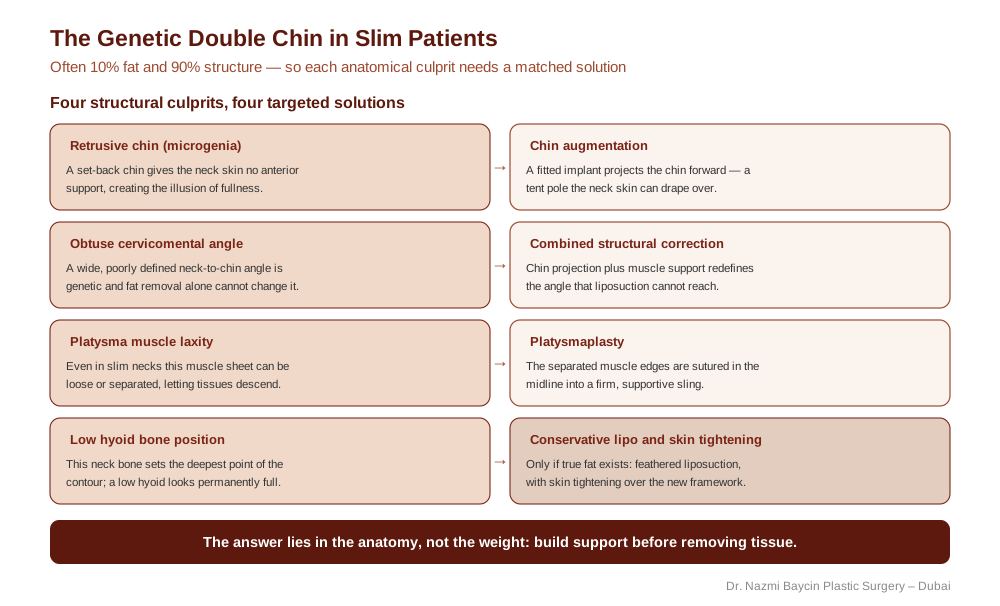
The four structural causes of a genetic double chin and the surgical strategy matched to each, by Dr. Nazmi Baycin, Dubai.
This comprehensive analysis usually reveals a striking ratio: the problem is often ten percent fat and ninety percent structure. Understanding that split is what makes a durable correction possible, because it tells me which tools the case actually needs. The cervicomental angle and the behavior of the overlying soft-tissue envelope are central to that judgment, which I detail in my article on advanced evaluation of the chin-neck angle. The same principle explains why some double chins return after liposuction, a subject I examine in my article on the role of muscle and skin support in double chin recurrence.
| Pillar | What I Assess | Why It Matters |
|---|---|---|
| Skeletal support | Chin projection relative to the lips and neck, on lateral profile | A weak, set-back chin is a common and correctable cause of fullness |
| Muscular integrity | The platysma at rest and during animation, for banding and laxity | A loose or separated muscle lets the neck contour descend |
| Fat distribution | Whether true submental fat exists, and in which layer | Determines if any liposuction is warranted, and how conservative |
| Skin quality | Skin elasticity and its adherence to the deeper layers | Guides whether skin tightening is needed over the new framework |
Surgical strategies: building support, not just removing tissue
My surgical plan in Dubai is tailored to the anatomical deficits I find, drawn from a personalized toolbox rather than a fixed routine.
For a retrusive chin, chin augmentation is often the single most transformative step. A custom-fitted implant projects the chin forward, immediately redefining the jawline and giving the neck skin something to drape over, which dramatically improves the cervicomental angle. This structural role of the chin — as the keystone of the lower face — is something I explore in my article on the structural philosophy of chin augmentation.
If the platysma is lax, I perform a precise platysmaplasty. Through a small incision under the chin, I suture the separated muscle edges together in the midline, creating a strong, supportive sling that holds the neck contour firmly in place.
Liposuction enters the plan only when true fat is present, and then it is deliberately conservative — feathering the edges to avoid depressions and working in synergy with the structural corrections rather than in place of them. For patients with mild skin laxity, a skin-tightening technology such as J-Plasma can be used concurrently to enhance skin contraction over the newly sculpted framework. Because the chin, jawline, and neck function as one unit, planning them together matters, which is why I think in terms of the neck, chin, and jawline continuum rather than isolated fixes.
Realistic expectations and natural results
My goal is never an artificially sharp, “carved” neck that looks out of place on a slim frame. The result must be a natural, elegant enhancement of the patient’s own anatomy, because over-aggressive treatment leads to a skeletonized, prematurely aged look.
I prioritize a smooth, strong transition from chin to neck that looks impeccable both at rest and during conversation. That measured, artistic restraint is what makes results balanced and enduring rather than obvious.
The answer lies in your anatomy, not your weight
A genetic double chin in a slim individual is a clear message from your anatomy: the solution is structural support, not subtraction. By fortifying the chin, supporting the muscles, and only then addressing any minimal fat, the neck contour finally comes into harmony with a fit physique.
Because every neck and jawline is different, the precise plan is best defined at a consultation with a full anatomical assessment — the standard you should expect from a leading cosmetic surgeon in Dubai. If you are tired of explanations that don’t match your reflection, that assessment is where we map your blueprint and build the definitive solution.
FAQs about genetic double chin in slim patients in Dubai
-
Why do I have a double chin if I am slim?
In slim, fit people a persistent double chin is usually structural rather than fatty. The fat layer under the chin may be negligible, yet the neck still looks full because of inherited anatomy: a set-back (retrusive) chin that fails to support the neck skin, a naturally wide angle between the neck and chin, a lax or separated platysma muscle, or a low position of the hyoid bone. Any of these can create the appearance of heaviness with little or no excess fat. That is why the assessment focuses on bone, muscle, and skin relationships rather than assuming fat is the problem.
-
Why won’t liposuction fix my double chin?
Because liposuction only removes fat, and in a slim neck there is often very little fat to remove. If the real cause is a retrusive chin, a wide neck angle, a lax muscle, or a low hyoid, taking away the small amount of fat present will not change the underlying shape and can even leave the neck looking over-hollowed, with adhesions or banding. The published evidence supports this: comparisons of submental liposuction with formal neck surgery conclude that liposuction alone does not address all the anatomic components of submental fullness, and that adding muscle correction gives a superior, more comprehensive result.
-
How do you diagnose the real cause?
I assess four pillars. First, skeletal support: I measure chin projection relative to the lips and neck on a lateral profile, since a weak chin is a common and correctable cause. Second, muscular integrity: I examine the platysma at rest and during animation for banding and laxity. Third, fat distribution: careful palpation or ultrasound shows whether any true fat exists and in which layer. Fourth, skin quality: I evaluate the skin’s elasticity and how well it adheres to the deeper tissues. Together these reveal the true balance of the problem, which in slim patients is frequently around ten percent fat and ninety percent structure.
-
How does a chin implant help a double chin?
When the chin is set back, the neck skin has nothing to drape over, so the area looks full and the angle between chin and neck is blunted. Placing a custom-fitted chin implant projects the chin forward, which acts almost like a support that lets the neck skin stretch over a stronger framework. This immediately sharpens the jawline and improves the cervicomental angle, often making the single biggest difference in a genetic double chin. It is frequently combined with muscle tightening for the best result, and the implant is chosen and shaped to suit your specific facial proportions.
-
What is platysmaplasty, and will I need it?
The platysma is a thin sheet of muscle across the front of the neck. In many people its two halves are separated or lax, which lets the neck tissues sag and blunts the contour even when there is little fat. Platysmaplasty tightens it: through a small incision under the chin, I suture the muscle edges back together in the midline to form a firm, supportive sling that holds the neck shape. Whether you need it depends on what the assessment shows about your muscle; in structural double chins it is often combined with chin augmentation to support the contour from both the bone and the muscle.
-
Will my results look natural or over-done?
The aim is always a natural, elegant contour, never an artificially sharp or skeletonized neck. Over-aggressive treatment, especially over-removal of tissue, can leave a slim face looking hollowed and prematurely aged, which is the opposite of the goal. By building support with the chin and muscle first, and only conservatively addressing any true fat, the neck is refined without being stripped. I plan for a smooth, strong transition from chin to neck that looks natural both at rest and while you are talking and moving, so the improvement is noticeable but not obvious.
-
Am I a good candidate for a structural approach?
Good candidates are slim, healthy people whose double chin has persisted despite a stable weight and good fitness, and who want a lasting rather than superficial correction. The ideal way to know is an in-person assessment that maps your chin projection, muscle tone, fat distribution, and skin quality, because these determine which combination of chin augmentation, muscle tightening, conservative liposuction, or skin tightening is right for you. If your reflection has never matched your lifestyle, it usually means the cause is structural, which is exactly what this tailored, architecture-first approach is designed to correct.


GET APPOINTMENT
Get ready to look and feel best… You deserve…
