

Key takeaways: restoring the over-corrected face
- Over-correction is a distinct clinical entity, not a matter of taste — the result of violated anatomical principles.
- The revision surgeon’s first task is an anatomical audit: identifying what is deficient, not just what is in excess.
- Correction follows three pillars: release, restore, and re-support.
- Volume loss is the hallmark — structural fat grafting rebuilds what over-resection removed.
- The over-resected nose needs framework reconstruction with cartilage grafts for form and airway.
- Timing matters: traumatized tissue often needs 12–18 months to soften before major revision, frequently staged.
Deconstructing the dysfunction: anatomical principles violated
Over-correction is a systematic failure that typically stems from several technical and philosophical missteps.
- The first is the pursuit of tension over structure — relying on skin tightening as the primary vector of lift, rather than repositioning the deeper SMAS and fat compartments, which produces the characteristic “wind tunnel” look with flattened cheeks and distorted hairlines.
- The second is the era of over-resection: aggressive removal of buccal fat pads, periorbital fat, and subcutaneous tissue during procedures such as a facelift in Dubai, creating a skeletonized, aged appearance rather than youthful fullness.
- The third is disregard for ethnic and individual anatomy — imposing a one-size-fits-all template, such as over-narrowing a nasal base or over-elevating a brow, erasing identity and creating disharmony.
- And the fourth is violation of the support framework: in rhinoplasty, excessive removal of the dorsal and caudal septal L-strut leads to mid-vault collapse and internal-valve incompetence.
The revision surgeon’s first task is a precise anatomical audit, identifying not just what is in excess, but more critically, what is deficient.
Reading the damaged landscape: how I plan a revision
The anatomical audit is a discipline in itself, and I never skip a step of it. I begin with standardized photographs and video in animation — smiling, speaking, closing the eyes gently and forcefully — because an over-corrected face often reveals its true restrictions only in movement. Palpation comes next. Scar plates, tethered planes, and areas where skin has fused to deeper structures can be felt long before they are seen, and mapping them determines where release will be needed and which tissue planes remain safe to travel.
When the nose is involved, I add an internal examination of the septum and valves to establish how much structural cartilage remains and where the airway narrows. Prior operative records, when they exist, are read line by line. The result of this audit is a written map of the face: what is excessive, what is deficient, what is displaced, and what is simply scarred. Only then do the three pillars — release, restore, re-support — get assigned to a sequence and a timeline.
Strategic pillars of reconstruction: release, restore, and re-support
Correction is not a reversal but a complex rebuilding process, and my strategy rests on three pillars, summarized in the infographic and table below.
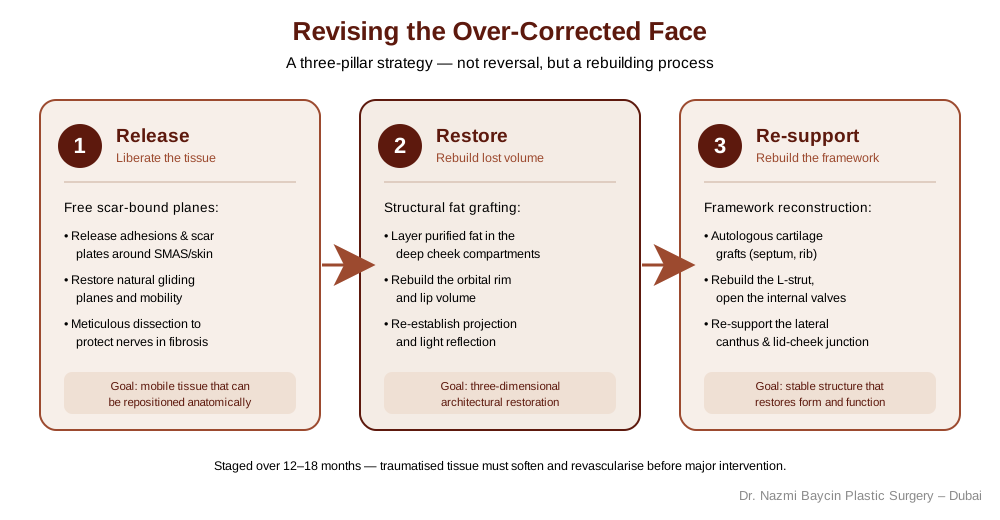
The three-pillar revision strategy — release, restore, and re-support — staged over 12 to 18 months, by Dr. Nazmi Baycin, Dubai.
Strategic release and soft-tissue liberation
The first operative step is often the careful release of scar-induced adhesions and malpositioned soft tissue. In a secondary facelift this means meticulous dissection to free the SMAS and skin from underlying scar plates so they can be repositioned anatomically — a painstaking process, undertaken to avoid nerve injury within the fibrotic landscape, whose goal is to restore natural gliding planes and mobility. A 2021 narrative review of revision facelift and neck lift in Seminars in Plastic Surgery frames the same difficulty, describing secondary face and neck lifts as more complex than primary ones by the nature of the operation, and turning on a comprehensive preoperative assessment of the deformities the first procedure left behind. It surveys technique rather than comparing approaches or reporting outcomes, so it maps the problem rather than measuring a solution.
Volume restoration as structural foundation
Volume loss is the hallmark of the over-corrected face, so I employ structural fat grafting with a sculptor’s intent. Using micro-cannulas, I layer purified autologous fat in precise amounts to rebuild the deep medial and lateral fat compartments of the cheeks, the pre-periosteal plane of the orbits, and the lips. This is not simple filling; it is three-dimensional architectural restoration — placing living tissue to re-establish youthful projection and light reflection, with the fat distributed to ensure high graft survival and a low risk of contour irregularity.
Re-supporting the nasal framework
The over-resected nose presents a profound challenge, because correction requires a functional and aesthetic rhinoplasty in Dubai that addresses both the visible deformity and the compromised airway. My approach harvests strong, straight autologous cartilage (septum or rib) as graft material, reconstructs the L-strut with batten grafts to support the mid-vault and open the internal valves, and uses precise tip grafts to restore projection and definition without excessive narrowing. Where silicone or Gore-Tex implants have failed or caused infection, diced cartilage wrapped in fascia (the DC-F technique) can recreate a smooth, natural dorsal line.
| Pillar | What it does | Key techniques |
|---|---|---|
| Release | Liberates scar-bound soft tissue and restores mobility | Dissection of scar plates around SMAS and skin; nerve-protective technique |
| Restore | Rebuilds lost volume as a structural foundation | Layered structural fat grafting to cheeks, orbital rim, and lips |
| Re-support | Rebuilds the structural framework | Cartilage grafts (septum, rib); L-strut and canthal re-support |
Periocular harmony: correcting the hollowed gaze
The over-corrected eye area, with its hollowed upper lids and retracted lower lids, conveys exhaustion and fear, and revision requires a dual approach. For the upper lid, I carefully release any overly tightened levator aponeurosis or septum and add judicious fat grafting to the retro-orbicularis oculi fat (ROOF) pad to restore supraorbital fullness.
For the lower lid and midface continuum, the key is addressing the lid-cheek junction: I often combine a canthoplasty to re-support the lateral canthus with a midface lift and precise fat grafting, blending the transition seamlessly to eliminate the harsh, demarcated look.
The lip that cannot close: restoring perioral balance
Among the stigmata of over-correction, the incompetent lip is one of the most distressing, because it is functional as well as visible. An upper lip shortened too aggressively by a lip lift, or hollowed by over-resection around the mouth, may no longer seal comfortably at rest — patients describe dryness, difficulty with certain sounds, and the constant awareness of an open mouth.
Restoration here follows the same three pillars in miniature. I release the perioral scar bands that tether the lip upward, then rebuild the deflated substance of the lip and the surrounding perioral fat with structural micro-grafting, restoring the natural roll of the vermilion and the gentle downward drape that allows effortless closure. The goal is never a larger lip; it is a competent, mobile one that moves naturally in speech and expression. When the lip regains its function, its appearance almost always follows.
The critical role of timing and staged procedures
Patience is a non-negotiable revision tool. Tissues traumatized by prior surgery require extended time — often 12 to 18 months — for maximal softening and revascularization before major intervention. Complex reconstructions are also frequently planned as staged procedures: stage one may focus on structural framework restoration (rib rhinoplasty, major fat grafting), while stage two, after complete healing and graft integration, addresses finer refinements such as skin redraping and minor contour adjustments.
This disciplined timeline is essential for stable, natural results. Because every over-corrected face is a uniquely damaged landscape, no two revision plans are alike — each one is built upward from the anatomical audit during a thorough consultation. This restorative philosophy is central to my wider work as a plastic surgeon in Dubai.
FAQs about revision and over-correction surgery in Dubai
-
How do I know if my face is over-corrected or just healing?
Healing produces temporary tightness, swelling, and asymmetry that gradually soften. Over-correction is persistent: brows that remain arched at full rest after six months, cheeks that look flat rather than full, lower lids that show a visible white band below the iris, or a nose that feels collapsed rather than refined. If these findings do not soften with time and instead become more obvious as swelling resolves, they are structural, not transitional.
-
Can fat grafting alone fix an over-corrected face, or is surgery always necessary?
Fat grafting alone addresses a specific subset of problems — volume loss and contour hollowing. It will not release a brow that has been anchored too high by scar plates, restore a retracted lower lid, or rebuild a collapsed nasal valve. In many patients, structural fat grafting is an essential component of revision, but it works best when combined with the targeted tissue release that restores the mobility fat needs to sit properly. The two are often staged rather than combined.
-
Why must I wait 12 to 18 months before revision surgery?
Operated tissue continues maturing for over a year — scars soften, vascular supply improves, and tissues regain some of their natural gliding mobility. Operating too early means working through maximum scar formation, which increases the risk of nerve injury, introduces new fibrosis into the dissection, and makes it nearly impossible to judge how much correction is actually needed versus how much is temporary stiffness. Patience is genuinely a surgical tool in revision planning.
-
My revision rhinoplasty has left me with breathing problems as well as a cosmetic problem. Can both be corrected at once?
Yes, and they almost always should be addressed simultaneously. The structural causes of airway compromise — a collapsed mid-vault, narrowed internal valves, a weakened L-strut — are the same findings that create the visible aesthetic deformity. Rebuilding the dorsal cartilage framework with rib or septal cartilage grafts addresses both in one operation, since the support that opens the airway is the same support that restores the nasal profile.
-
Is it possible to fully reverse severe over-correction?
Complete reversal is rarely achievable, and I consider it important to be honest about this from the first consultation. What is achievable — and consistently so, with staged, planned reconstruction — is a result that is dramatically more natural, functionally sound, and free of the most distressing stigmata. The goal of revision surgery is a face that no longer reads as surgically altered, not a return to the original untouched state. That is a meaningful, life-changing distinction for most patients.
-
What should I bring to a revision consultation?
As much documentation of your surgical history as you can gather. Operative reports are the most valuable — they tell me exactly what was removed, repositioned, or implanted, and in which plane. Photographs of your face before the first surgery and at intervals during healing are nearly as important, because they let me separate what was lost from what was merely displaced. Details of any implants or grafts, prior imaging, and a timeline of each procedure complete the picture. The more accurately I can reconstruct the history, the more precisely I can plan the reconstruction.


GET APPOINTMENT
Get ready to look and feel best… You deserve…
