

Key takeaways: contour is sculpted, not just excised
- The over-tightened look comes from uniform linear tension along the whole inner arm.
- Selective tension — concentrated near the axilla, released toward the elbow — preserves the natural curve.
- A lazy-S resection following the arm’s grooves beats a simple straight ellipse.
- Liposuction should be conservative and integrated — feathered, not aggressive.
- A layered closure lets the fascial system bear the tension, so the scar heals as a fine line.
- Technique is matched to anatomy — full lift, short-scar lift, or a combination.
The complication profile of brachioplasty is well documented. A 2022 meta-analysis pooling 29 observational studies and 1,578 patients put aberrant scarring at the top of the list, at 9.9%, followed by ptosis or recurrence at 7.79% and wound dehiscence at 6.81%. That review estimated how often these outcomes occur; it did not compare tension strategies or closure techniques against one another, and its authors note the absence of large clinical trials in this field. Reading those figures alongside what I see in revision consultations is what has shaped my own priorities, and my philosophy in Dubai is built around avoiding those pitfalls from the first incision.
The pitfall of linear tension: why simple excision fails
The classic mistake in brachioplasty is treating the arm as a two-dimensional surface. The surgeon makes a linear incision from armpit to elbow, pulls the skin tight, and excises the excess. That applies uniform, high tension along the entire inner arm. The result is predictable: a scar prone to widening and hypertrophy, a flattening of the soft natural curve of the inner arm, and a tell-tale guitar-string tightness on extension. The arm may look acceptable at rest but strained and artificial in motion. The approach ignores the topographic anatomy of the arm, which has contours, depressions, and a need for differential resection.
My philosophy is grounded instead in selective tension. The greatest skin looseness usually sits in the proximal third of the arm, near the axilla, so the tension of closure should be concentrated there. Moving distally toward the elbow, the tension is progressively released to allow a gentle, natural drape. This calls for a resection pattern that is not a simple ellipse but more of a lazy-S following the arm’s natural grooves — the first and most critical step in avoiding the over-pulled look.
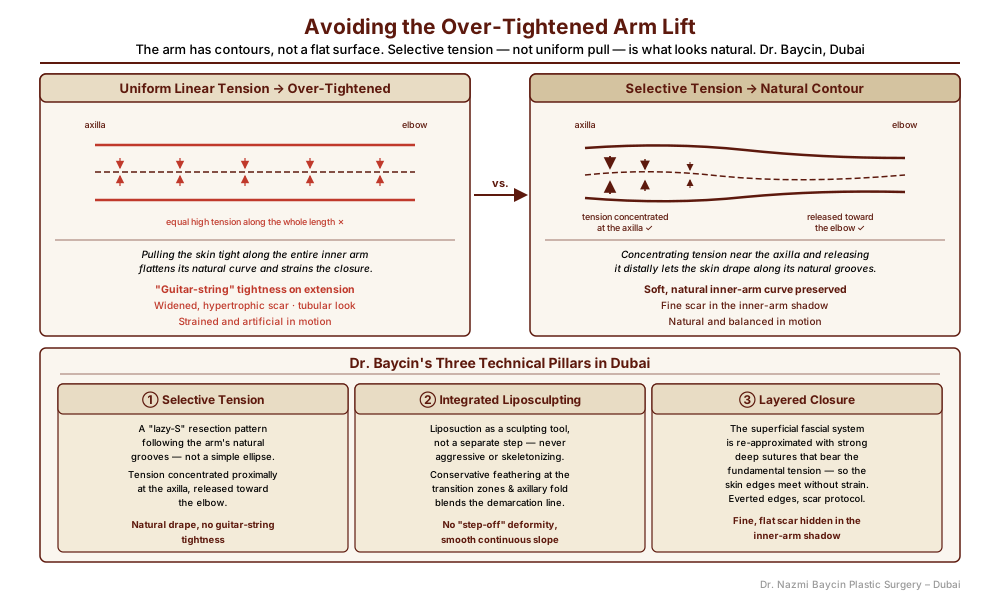
Natural contour versus the over-tightened look — selective tension concentrated at the axilla with a lazy-S resection and layered fascial closure preserves the soft inner-arm curve and hides the scar, while uniform linear tension flattens the arm into a tense, tubular shape with a widened scar — by Dr. Nazmi Baycin, Dubai.
Addressing the subdermal fat and soft-tissue framework
Skin is only the outer layer. The underlying subdermal fat and superficial fascial system determine the final shape. A common technical error is to perform liposuction aggressively or indiscriminately during brachioplasty, which leads to depressions, irregularities, and a skeletonized appearance that no amount of skin tightening can fix.
In my technique, liposuction is not a separate step but a sculpting tool integrated into the lift. I focus on conservative, artistic feathering of the fat at the periphery of the excision zone — particularly at the superior and inferior edges of the wound and along the posterior arm. That blends the transition zones and creates a smooth, continuous slope from the tightened area to the surrounding tissue. I pay particular attention to the axillary fold and the posterior arm near the triceps; failing to contour these junctional areas leaves a visible demarcation, a step-off deformity that announces the surgery.
Natural contour versus the over-tightened look
The table below sets the two approaches side by side — the same anatomy handled with selective tension versus uniform linear tension.
| Factor | Natural Contour (Dr. Baycin) | Over-Tightened (Linear Tension) |
|---|---|---|
| Tension approach | Selective — concentrated at axilla | Uniform — high along whole arm |
| Resection pattern | Lazy-S following natural grooves | Simple straight ellipse |
| Inner-arm curve | Soft, natural curve preserved | Flattened, tubular |
| On extension | Natural and balanced | Guitar-string tightness |
| Liposuction | Conservative, integrated feathering | Aggressive or indiscriminate |
| Transition zones | Blended, smooth slope | Visible step-off demarcation |
| Scar | Fine, flat, hidden in inner-arm shadow | Widened, hypertrophic |
| Closure | Layered, fascial system bears tension | Skin bears tension |
| In motion | Natural | Strained, artificial |
Scar placement and management: the invisible art
No account of brachioplasty is complete without the scar. The ideal scar is fine, flat, and strategically hidden. Placing it in a highly visible midline position is a less common mistake now, but poor scar outcomes persist through excessive wound tension and inadequate closure. My strategy is twofold.
- First, through the selective-tension planning above, I close the wound with minimal tension.
- Second, I use a layered, meticulous closure: I re-approximate the superficial fascial system — a deep tissue layer — with strong, dissolvable sutures so that layer bears the fundamental tension, letting the skin edges meet without strain.
The skin is then closed with deep dermal and fine superficial sutures, often everting the edges for optimal healing. Every patient receives a proven, multi-stage scar management protocol to support the work. The goal is a fine line that settles into the shadow of the inner arm, virtually invisible in most positions.
Personalized assessment and harmony
Perhaps the biggest error is applying a standardized technique to every patient. A 60-year-old with significant laxity after massive weight loss has entirely different needs from a 40-year-old with moderate laxity and good skin elasticity. The former may need a full traditional brachioplasty; the latter might be an ideal candidate for a limited-incision technique — a mini or short-scar brachioplasty — confined to the axillary area.
During consultation I perform a dynamic assessment, pinching and manipulating the skin to simulate the postoperative result. I evaluate skin quality, fat distribution, and where the laxity is greatest, which lets me recommend the precise technique — full lift, short-scar lift, or a combination with liposuction — that addresses your concerns without over-treating or creating an unnatural silhouette. The aim is always arms in harmonious proportion with your shoulders, chest, and back — the standard I hold for every arm lift in Dubai. For a full picture of how this is planned, see my overview of arm lift surgery in Dubai.
Choosing a surgeon skilled in contour, not just cutting
Your result is a permanent reflection of your surgeon’s aesthetic eye and technical skill. When reviewing before-and-after galleries, look beyond the mere absence of loose skin. Assess the overall contour: does the arm have a soft, natural curve, does the scar appear well-settled, does the result look balanced? I believe in empowering patients with this knowledge, and I discuss these technical goals openly.
If you want an arm lift that enhances your natural form — a toned, confident silhouette without the tell-tale signs of surgery — the plan should meticulously avoid the common technical mistakes and focus on the art of natural contour. Because every arm is individual, the plan and its cost are discussed transparently at consultation, and this contour-first philosophy runs through all of my cosmetic surgery in Dubai.
FAQs about arm lift surgery results in Dubai
-
Will an arm lift make my arms look too tight or unnatural?
Not when the procedure is performed with selective tension. The over-tightened, guitar-string look comes from applying uniform high tension along the entire inner arm, which flattens its natural curve. I instead concentrate tension near the axilla (where the looseness is greatest) and progressively release it toward the elbow, allowing the skin to drape along the arm’s natural grooves. The result is a soft, natural contour that looks balanced both at rest and in motion — not a tense, tubular arm.
-
How visible will my arm lift scar be?
With proper technique, the scar is fine, flat, and hidden in the shadow of the inner arm, becoming virtually invisible in most positions. The two keys are minimal wound tension (achieved through selective-tension planning) and a layered closure in which the deep superficial fascial system bears the tension, so the skin edges meet without strain. I also provide a multi-stage scar management protocol. A scar under constant tension widens and thickens; a scar closed without tension heals as a fine line.
-
Why is the tension of an arm lift concentrated near the armpit instead of spread along the whole arm?
Because the excess skin is not distributed evenly. The greatest looseness almost always sits in the proximal third of the arm, near the axilla, while the skin toward the elbow is comparatively less redundant. If I applied uniform tension along the entire inner arm to close the wound, I would over-tighten the lower arm just to correct the upper — flattening the natural curve and producing the guitar-string look on extension. Instead I concentrate the pull where the laxity actually is, at the axilla, and progressively release it toward the elbow so the skin drapes naturally. This tension gradient is the single most important factor in avoiding an over-pulled result.
-
What is a lazy-S resection pattern, and why is it better than a straight ellipse?
A lazy-S is a gently curved resection that follows the arm’s natural grooves rather than a simple straight-line ellipse running from armpit to elbow. A straight ellipse treats the arm as a flat, two-dimensional surface and tends to place the scar under even tension along its whole length, which encourages widening. The curved pattern lets me remove the excess along the arm’s true topography, keep the scar tucked into the shadow of the inner arm, and vary the tension so it concentrates where the laxity is greatest. The result is a finer scar and a contour that looks natural in motion, not only at rest.
-
Why do some arm lifts look over-done or tubular?
The over-done, tubular look results from two errors: applying uniform tension along the entire arm (which flattens the natural curve), and over-aggressive liposuction (which skeletonizes the arm and creates depressions). I avoid both through selective tension that preserves the inner-arm curve and conservative, integrated liposculpting that feathers the transition zones. The aim is a natural, athletic contour in proportion with the shoulders and chest — never an arm that looks thinned and tightened in isolation.
-
What causes a visible step-off or demarcation after an arm lift, and how is it prevented?
A step-off is an abrupt ledge between the tightened area and the surrounding untreated tissue — a tell-tale sign that the transition zones were ignored. It usually happens when liposuction is done aggressively in one spot, or when the edges of the excision are not blended into the neighboring fat. I prevent it by treating liposuction as an integrated sculpting step rather than a separate one: I feather the fat conservatively at the superior and inferior edges of the wound and along the posterior arm near the triceps, creating a smooth, continuous slope instead of a sharp border. Blending these junctional areas is what keeps the result looking natural rather than operated.
-
How long do arm lift results last, and is the procedure permanent?
Arm lift results are long-lasting and essentially permanent, as the excised skin does not return. The contour is stable provided your weight remains stable — significant weight gain or loss after surgery can affect the result by stretching or deflating the tissues. Maintaining a stable weight, along with good skin care, protects the natural contour I create. The fine scar continues to mature and fade over the first year to eighteen months following the procedure.


GET APPOINTMENT
Get ready to look and feel best… You deserve…
