

Achieving massive weight loss is a monumental life victory, yet it often leaves a complex anatomical legacy: extensive, inelastic skin that drapes from the upper arm onto the lateral chest wall. In my practice, I frequently meet patients who were told a standard arm lift would suffice, only to find it addresses just part of the problem. When laxity extends beyond the arm into the axilla and the lateral torso, a more comprehensive solution is required, and this is a common reason patients seek an extended arm lift in Dubai. The extended arm lift is not merely a longer incision; it is a different operation, designed to treat the upper body as one continuous aesthetic unit rather than a series of isolated regions.
Key takeaways: treating the upper body as one unit
- Massive weight loss leaves a continuous envelope of loose skin, not an isolated arm problem.
- The laxity forms a triad: inner-arm hang, axillary descent, and lateral-chest roll.
- A standard brachioplasty stops at the arm and leaves the lateral chest untreated.
- That untreated pull is a downward force that widens scars and invites recurrence.
- Layered suspension offloads tension from the skin, protecting scar quality.
- Lymphatic and nerve preservation in the axilla guards against chronic swelling.
My goal for the massive weight loss patient in Dubai is a smooth, stable contour that restores comfort, confidence, and a natural silhouette. That means planning around the interconnected anatomy of the whole upper body, not just the visible portion of the arm that first prompts the consultation.
Why anatomy demands an extended approach after massive weight loss
Following significant weight reduction, the skin’s supportive architecture — its collagen and elastin fibers — is permanently altered. The tissue does not simply sag; it becomes a redundant, immobile envelope that no longer retracts.
In the upper body, this produces a triad of deformities: hanging skin on the inner arm, descent of the axillary fold, and laxity that spreads over the lateral ribs toward the back. These three components are continuous with one another, which is exactly why they cannot be treated in isolation.
A traditional brachioplasty incision, confined to the arm, leaves the lateral chest component untreated. That unresolved laxity then acts as a powerful downward force, frequently leading to poor scar healing, scar widening, and recurrent sagging of the arm itself. The excess crossing the axilla behaves as a direct extension of the posterior axillary fold, and correcting the arm alone simply leaves the adjacent tissue to pull against the repair.
My planning therefore begins by recognizing this interconnected anatomy — because treating one part in isolation sets the stage for a disappointing result. The observation is not new. A 2008 account of the L-brachioplasty by the surgeon who devised it opens from exactly this premise — that after massive weight loss the arm deformity extends through the axilla and on to the chest — and describes excising the whole of it as one continuous unit. It reports more than fifty patients treated since 2002 with inconspicuous scars and only minor complications, alongside eight scar revisions, two of them Z-plasties for contracture. That is an uncontrolled series from the technique’s own originator rather than a comparative trial, but the anatomical premise it starts from is the one I see in the clinic.
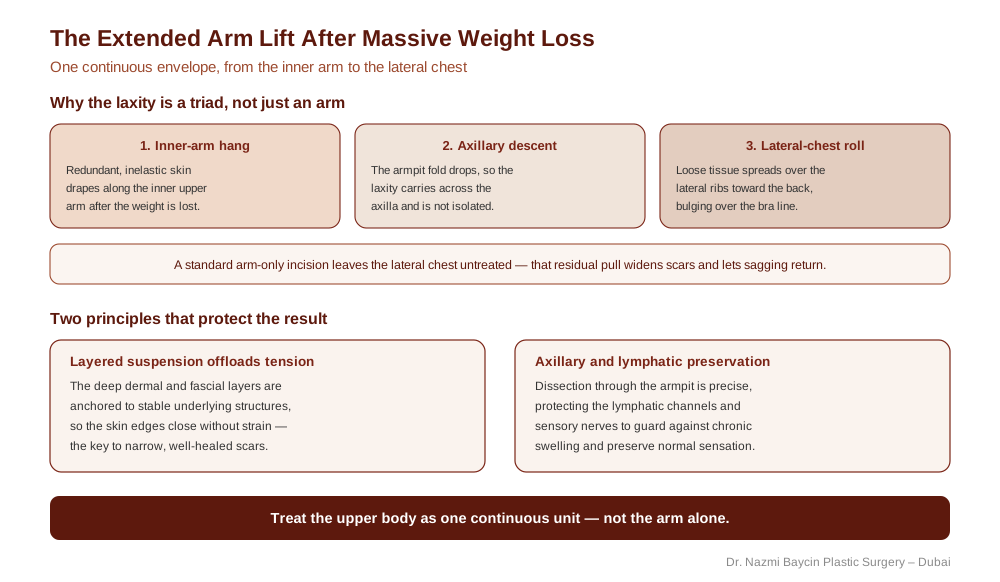
Why the extended arm lift treats the inner arm, axilla, and lateral chest as one continuous unit — by Dr. Nazmi Baycin, Dubai.
Standard versus extended: what actually differs
The distinction is not about incision length alone; it is about which anatomy the operation is designed to reach. The table below sets out how the standard and extended approaches compare across the components that matter most after massive weight loss.
| Feature | Standard Brachioplasty | Extended Arm Lift |
|---|---|---|
| Area treated | Inner upper arm only | Inner arm, axilla, and lateral chest as one |
| Lateral chest roll | Left untreated | Excised for a continuous arm-to-torso line |
| Tension on the closure | Higher, from the adjacent untreated pull | Offloaded by deep layered suspension |
| Scar behavior | More prone to widening and recurrence | Positioned and supported to heal narrow |
| Best suited to | Isolated arm laxity | The massive weight loss upper-body envelope |
My surgical technique: a strategic, continuous excision
The cornerstone of my approach to the extended arm lift in Dubai is a strategically placed incision that follows a continuous path from the inner arm, through the armpit, and along the lateral chest wall. This lets me remove the entire affected skin envelope in one seamless segment rather than in disconnected pieces.
The first critical step is precision marking. With the patient standing, I map the incision along the innermost aspect of the arm and extend it posteriorly along the bra line, placing the final scar where it is concealed by the natural shadow of the arm and the line of undergarments or swimwear.
The second is tension management through layered suspension. The greatest challenge is the profound downward pull of heavy tissues, so I anchor the deep dermal and fascial layers to stable underlying structures. This offloads tension from the skin edges — the single most important factor in preventing wide, hypertrophic scars and in helping the lift withstand gravity over time.
The third is axillary and lymphatic preservation. The armpit is a zone of vital structures, so dissection there must be exceptionally precise to protect the major lymphatic channels and sensory nerves. Preserving lymphatic function is paramount to preventing chronic postoperative swelling, or lymphedema, a risk that is higher in this patient population. Patients who want to understand the foundation this builds on can explore my approach to arm lift surgery in Dubai, and the way I protect a natural, un-tightened contour is the focus of my article on the art of natural contour in arm lift surgery.
The critical focus on lateral chest laxity and scars
Many patients in Dubai initially focus on their arms, but the improvement in lateral chest contour is equally transformative. By excising the excess skin that bulges over the bra strap and ribs, I create a smooth, continuous line from the arm to the torso.
This does more than refine the side and back profile. It also eliminates skin-on-skin irritation and improves how clothing fits — functional gains that matter as much as the aesthetic ones.
The trade-off is a longer scar, but its strategic placement makes it highly concealable. I dedicate significant effort to a meticulous, multi-layered closure and provide a comprehensive scar-care protocol to optimize healing. A well-healed, discreet scar is always preferable to a shorter one left under tension. Because tension is what ultimately determines scar width, the same biomechanical thinking applies elsewhere on the body — a relationship I explore in my article on why tension vectors drive scar widening.
Comprehensive care for the massive weight loss patient
Candidacy for this procedure requires more than excess skin. I make sure my patients are at a stable weight for at least six to twelve months, are nutritionally optimized to support healing, and hold realistic expectations about both the result and the scar.
Recovery is more involved than for a minor procedure. I have patients wear specialized compression garments for several weeks and guide them through a graduated return to activity to protect the delicate repair while it matures.
Dubai’s climate calls for specific guidance on hygiene and sun protection to maintain ideal healing conditions, particularly for a long scar. Careful adherence to these measures meaningfully reduces the risk of complications such as lymphatic leakage, chronic swelling, or restricted arm movement. For patients whose weight loss has affected multiple regions, the arm is usually one stage within a larger plan — I set out how those stages are sequenced safely in my article on post-bariatric body contouring for the massive weight loss patient, and the way sustained medical weight loss is reshaping this population is something I discuss in my article on body contouring after GLP-1 weight loss.
Restoring form and function with respect for anatomy
The extended arm lift honors the specific anatomical reality of the massive weight loss patient. It moves beyond simple skin removal to reconstruct the upper body’s natural contours by addressing the root cause of the deformity: the continuous sheet of inelastic tissue.
My methodology is built on respect for that anatomy — tension-reducing techniques and strategic scar placement that deliver a result as functional as it is aesthetic, freeing patients from physical discomfort and restoring a silhouette that reflects their achievement. Because each envelope of excess is different, both the surgical plan and its scope are best defined at a consultation, which is the right setting to assess candidacy and build a personalized plan. That individualized, anatomy-first standard is what anyone should expect from an experienced plastic surgeon in Dubai.
FAQs about the extended arm lift in Dubai
-
What is the difference between a standard and an extended arm lift?
A standard brachioplasty treats laxity confined to the inner upper arm, with the incision limited to the arm itself. An extended arm lift treats the arm, the axilla, and the lateral chest as one continuous unit, because after massive weight loss the loose skin does not stop at the arm — it carries across the armpit and spreads over the lateral ribs. The extended operation removes that whole envelope through a single continuous excision. It is not just a longer incision; it is a different operation designed to reach anatomy a standard arm lift leaves behind.
-
Why does massive weight loss require this extended approach?
After significant weight loss, the skin’s collagen and elastin framework is permanently altered, so the tissue no longer retracts and instead forms a redundant, immobile envelope. In the upper body this creates a triad: inner-arm hang, descent of the axillary fold, and a roll of laxity over the lateral chest. Because these three components are continuous with one another, treating only the arm leaves the adjacent tissue to pull against the repair. That residual downward force is a common cause of scar widening and recurrent arm sagging, which is why the extended approach addresses the whole envelope at once.
-
Will the scar be very noticeable?
The scar is longer than in a standard arm lift, but it is planned to be highly concealable. I map the incision along the innermost aspect of the arm and extend it posteriorly along the bra line, so the final scar sits in the natural shadow of the arm and along the line of undergarments or swimwear. Just as important, a deep layered suspension offloads tension from the skin edges, which is the single most important factor in helping a scar heal narrow rather than widening. A well-positioned, well-supported long scar is preferable to a shorter one left under tension.
-
What is done to protect against lymphedema?
The armpit contains major lymphatic channels and sensory nerves, and preserving them is a central priority of the operation. My dissection through the axilla is deliberately precise to protect those lymphatic pathways, because disrupting them raises the risk of chronic postoperative swelling, or lymphedema, which is already higher in the massive weight loss population. Protecting the sensory nerves at the same time helps preserve normal sensation in the arm. This careful axillary technique, combined with compression and a graduated activity plan afterward, is how the risk of persistent swelling is minimized.
-
Am I a good candidate for an extended arm lift?
Good candidacy requires more than excess skin. I look for a weight that has been stable for at least six to twelve months, good nutritional status to support healing, and realistic expectations about both the result and the scar. The ideal candidate has the full upper-body pattern — arm, axilla, and lateral chest laxity — rather than isolated arm looseness, which a standard arm lift may address. General health and the ability to follow the recovery protocol also matter, since this is a more involved operation. The most reliable way to confirm candidacy is a consultation where your specific anatomy is assessed.
-
How does the layered suspension protect the result?
The heavy tissues of the massive weight loss upper body exert a strong, continuous downward pull, and if that pull is borne by the skin closure, the scar tends to widen and the lift tends to relapse. Layered suspension addresses this by anchoring the deep dermal and fascial layers to stable underlying structures, so the load is carried internally rather than by the skin edges. This offloads tension from the closure, which is the key to narrow, well-healed scars and to a correction that withstands gravity over time. It is the technical heart of why the extended approach holds up.
-
What is recovery like after an extended arm lift?
Recovery is more involved than for a minor procedure because the operation is more extensive. Patients wear specialized compression garments for several weeks and follow a graduated return to activity so the repair can mature without strain. Some swelling and tightness are expected early on, and the long scar needs consistent care. In Dubai’s climate I give specific guidance on hygiene and sun protection to support healing. Following these measures closely reduces the risk of complications such as lymphatic leakage, chronic swelling, or restricted arm movement, and helps the final contour settle smoothly.


GET APPOINTMENT
Get ready to look and feel best… You deserve…
