

Revision rhinoplasty is among the most demanding challenges in nasal surgery. It operates not on virgin anatomy but on a landscape altered by previous intervention, scar tissue, and often compromised structural integrity. When a patient comes to me in Dubai for secondary surgery, they usually carry a dual burden: an anatomical concern and an eroded trust in the surgical process. The work, therefore, is twofold — a technical mission to reconstruct a functional, harmonious nose, and a commitment to restore the patient’s confidence. This is not simply another operation; it is a calculated restoration that demands the precision of an architect and the insight of someone who must understand what was built before in order to build correctly again.
Key takeaways: revision is reconstruction
- Revision rhinoplasty works on scarred, altered anatomy, not predictable virgin tissue.
- The common failures are an over-resected dorsum, under-supported tip, and obstructed airway.
- My approach follows a triad: support first, then symmetry, then surface.
- Structure is rebuilt before refinement — aesthetics cannot sit on an unstable frame.
- Grafts follow a hierarchy: septal, then auricular, then autologous rib.
- Irradiated and alloplastic materials are avoided in scarred, poorly vascularized beds.
Every revision I plan begins from that principle of restoration rather than reinvention. The nose has to be understood as it is now — its scarring, its deficiencies, its distortions — before a single corrective move is made.
The altered anatomy: scar, deficiency, and distortion
A primary rhinoplasty operates on predictable, layered anatomy. A revision I perform in Dubai confronts a unique and often unpredictable terrain, and the failures I most frequently reconstruct fall into three patterns.
The over-resected dorsum is a scooped, collapsed bridge left by excessive cartilage and bone removal, which often compromises the mid-vault and internal valve. The under-supported tip is pinched, asymmetric, or collapsed because the lower lateral cartilages were weakened or misapplied. The obstructed airway follows from internal valve collapse, septal deviation, or scar-tissue synechiae that turn breathing into a conscious effort.
Dense scar tissue, or fibrosis, is the defining variable across all of these. It distorts the tissue planes, masks the true anatomy, and compromises the blood supply. My first dissection is therefore a diagnostic exploration — a careful mapping of the altered territory before any reconstruction begins. This is exactly why choosing a surgeon for a revision means verifying specific expertise in reconstructive, not merely aesthetic, nasal surgery.
The reconstructive triad: support, symmetry, and surface
I approach every revision in Dubai with a three-tiered blueprint, working from deep to superficial: support first, then symmetry, then surface.
Structural rebuilding is the non-negotiable foundation, because aesthetic refinement is impossible without a stable frame. A weakened septum is reinforced with carefully sculpted spreader grafts or PDS plates to restore dorsal support and internal valve patency. A weakened tip is projected and defined with a shield graft carved from septal or rib cartilage, and alar rim grafts are placed to correct pinching and support the external valve. In severely compromised cases where septal cartilage is exhausted, autologous rib cartilage becomes the material of choice, strong enough to fabricate an entirely new structural framework. This kind of tissue-based rebuilding is the subject of my article on rebuilding the nasal framework with autologous tissue.
Aesthetic reintegration comes only once structural integrity is assured. Here the goal is a nose that belongs to the face, so I avoid radical change in favor of subtle refinements — softening an overly scooped radix, smoothing dorsal irregularities, recreating a natural supratip break. The emphasis is on natural shadows and gentle transitions, because an over-narrowed, over-lighted nose draws attention to itself while a successfully revised one recedes into facial balance. This philosophy of restoring both look and breathing is something I explore in my article on restoring form and function in secondary rhinoplasty.
Surface preservation protects viability. Because the blood supply is already compromised in revision cases, I use delicate, sharp dissection to preserve the vital mucosal lining and subcutaneous tissue, which supports healing and minimizes the contracture that can distort the final shape. The value of protecting the lining and airway is a theme I develop in my article on subperichondrial dissection for an uncompromised airway.
Graft selection and engineering
The choice of graft material is one of the most consequential decisions in a revision, and I follow a clear hierarchy. Septal cartilage is the ideal first choice when enough good-quality material remains. Auricular (ear) cartilage is excellent for delicate tip grafts and rim support, thanks to its natural curvature. Autologous rib cartilage is the material for major reconstruction, providing the strength to build new dorsal lines and major support struts.
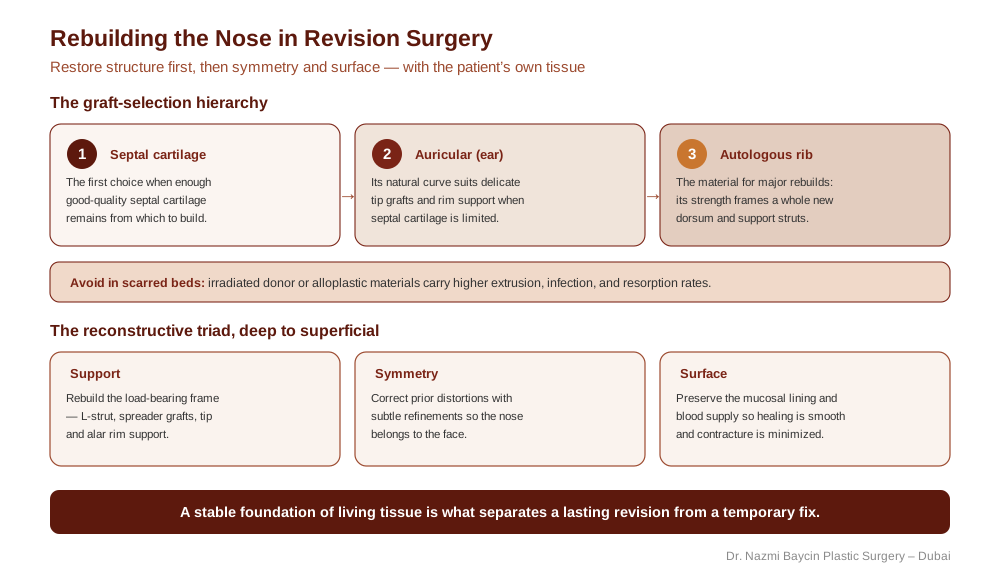
The graft-selection hierarchy and the support-symmetry-surface triad in revision rhinoplasty, by Dr. Nazmi Baycin, Dubai.
The published evidence supports the material but counsels caution about the technique. Autologous costal cartilage is widely regarded as the graft of choice where major reconstruction is needed, and a retrospective review of 108 rib-graft rhinoplasties takes that view as its starting point — but its own finding is a sobering one, reporting a relatively high complication rate and relatively poor aesthetic results, with 19 of the 108 patients dissatisfied. I read that as a verdict on execution rather than on the material: rib is unforgiving of imprecise carving and fixation, which is exactly why I reserve it for cases that genuinely need it and plan the harvest and shaping in detail. The work I co-authored reinforces the case for the patient’s own tissue: in our study on bone chips and diced cartilage for the nasal dorsum, 59 of the 67 cases were reconstructions of noses over-resected in previous surgery, rebuilt with the patient’s own bone and cartilage and holding up over seven years of follow-up experience. My broader approach to rhinoplasty in Dubai is grounded in that same commitment to living tissue.
The error I most often correct is the use of irradiated donor cartilage or alloplastic materials in complex revisions. In scarred, poorly vascularized beds these carry a higher rate of extrusion, infection, and resorption, which is why my philosophy mandates the patient’s own living tissue whenever major structural work is required. The table below summarizes the hierarchy.
| Graft Material | Best Role | When It Is Chosen |
|---|---|---|
| Septal cartilage | Versatile structural and tip grafts | First choice when enough good-quality septum remains |
| Auricular (ear) cartilage | Delicate tip grafts and alar rim support | When septal cartilage is limited; its curve suits the tip |
| Autologous rib cartilage | Major dorsal reconstruction and support struts | When septum is exhausted and major rebuilding is needed |
| Irradiated or alloplastic | Generally avoided in revision | Higher extrusion, infection, and resorption in scarred beds |
Candidacy and realistic horizons
The ideal revision candidate I meet in Dubai understands that this is a restorative rather than a creative journey. That means realistic expectations focused on improvement rather than perfection, the emotional patience for a longer and more nuanced recovery, and tissue that — while scarred — retains viable vascularity.
I am forthright that swelling resolves more slowly after a revision, and that the final definition can take twelve to eighteen months to emerge fully. That timeline is a biological reality, not a surgical shortcoming, and setting it as an honest expectation is part of rebuilding trust. The structural correction of a specific deformity, such as a collapsed or drooping tip, is a good example of how lasting support outperforms quick fixes — a topic I cover in my article on the structural correction of the drooping nasal tip.
A discipline within a discipline
Revision rhinoplasty demands a surrender to anatomical truth, a mastery of reconstructive principles, and the artistic sensibility to visualize harmony beneath layers of scar and distortion. It is, in a real sense, a discipline within a discipline.
The destination is a nose that breathes freely, balances gracefully, and finally feels like the patient’s own — which is the whole purpose of the work. Because every revision is anatomically unique, the plan is best defined after a comprehensive, imaging-assisted assessment at consultation, the standard you should expect from a board-certified plastic surgeon in Dubai.
FAQs about revision rhinoplasty in Dubai
-
Why is revision rhinoplasty harder than a first rhinoplasty?
A first rhinoplasty works on predictable, layered anatomy. A revision operates on tissue already altered by previous surgery, where scar tissue distorts the natural planes, masks the true anatomy, and compromises the blood supply. Structural support is often weakened or missing, and cartilage that would normally be available for grafting may already have been used or removed. This means the surgeon has to diagnose the altered anatomy carefully, rebuild the structure, and do so while protecting a more fragile blood supply. It is a fundamentally reconstructive operation, which is why specific revision experience matters so much.
-
What are the most common problems you correct in revision?
Three patterns come up most often. The first is an over-resected dorsum — a scooped or collapsed bridge from too much cartilage and bone being removed, which can also affect the mid-vault and breathing. The second is an under-supported tip that looks pinched, asymmetric, or collapsed because the tip cartilages were weakened or misapplied. The third is an obstructed airway from internal valve collapse, septal deviation, or scar-tissue bands. Often these coexist, and dense scar tissue underlies all of them, which is why the first step is always a careful diagnostic assessment of what is actually there.
-
What graft material do you use, and why does it matter?
I follow a hierarchy. Septal cartilage is the first choice when enough good-quality tissue remains. Ear (auricular) cartilage is excellent for delicate tip and rim grafts because of its natural curve. For major reconstruction, when septal cartilage is exhausted, autologous rib cartilage provides the strength to rebuild the dorsum and support struts. I avoid irradiated donor cartilage and synthetic (alloplastic) materials in complex revisions, because in scarred, poorly vascularized tissue they carry a higher risk of extrusion, infection, and resorption. Using the patient’s own living tissue gives the most durable and biologically sound result.
-
Will revision rhinoplasty fix my breathing as well as the appearance?
Very often, yes, because function and form are addressed together. Many revision patients have both an aesthetic concern and a breathing problem, and the two frequently share a cause — for example, an over-resected dorsum or collapsed internal valve that affects both the profile and the airway. Reinforcing the structure with spreader grafts, restoring valve patency, and correcting septal deviation can meaningfully improve breathing while the external shape is refined. My planning treats the airway as an integral part of the reconstruction rather than an afterthought, so that the nose both looks balanced and functions well.
-
How long does recovery take compared with a primary rhinoplasty?
Recovery after a revision is generally slower and more gradual than after a first rhinoplasty. Swelling resolves more slowly because the tissue has been operated on before and the blood supply is more delicate, and if rib cartilage is used there is a second, chest, site to heal as well. The early healing follows the usual pattern of splint removal and settling over the first weeks, but the final, subtle definition can take twelve to eighteen months to emerge fully. This is a biological reality rather than a sign of a problem, and I set it as an honest expectation from the outset.
-
Am I a good candidate for revision rhinoplasty?
Good candidates have realistic expectations focused on improvement rather than perfection, the patience for a longer and more nuanced recovery, and tissue that — although scarred — still has viable blood supply. It also helps to be in good general health and to be far enough out from the previous surgery for the tissues to have settled. Because every revision is anatomically unique, the only reliable way to confirm candidacy is a thorough, imaging-assisted assessment that maps the existing structure, the available graft material, and the specific deformities to be corrected. That assessment is what turns a complex problem into a concrete surgical plan.
-
Why do you emphasize using my own tissue?
Because in a scarred, previously operated nose, the patient’s own living cartilage integrates and heals far more predictably than irradiated donor or synthetic materials. In poorly vascularized beds, those alternatives carry a higher rate of extrusion, infection, and resorption over time, which can lead to yet another revision. Autologous grafts — septal, ear, or rib — become living, incorporated structure that provides durable support. This is consistent with both my clinical philosophy and the published evidence, including the work I co-authored on reconstructing over-resected noses with the patient’s own bone and cartilage. Durability and biological safety are the priorities in any major reconstruction.


GET APPOINTMENT
Get ready to look and feel best… You deserve…
