

Key takeaways: reconstruction, not refinement
- Secondary rhinoplasty navigates scar tissue, compromised structures, and depleted materials.
- Form and function are inseparable — the framework that shapes the nose holds the airway open.
- The primary tool is the autologous cartilage graft (septal, ear, or rib).
- The new framework must resist the contractile forces of scar tissue during healing.
- A minimum of 12 months from the prior surgery is required before revision.
- The full, settled result takes 12 to 18 months as grafts integrate and tissue redrapes.
Why form and function cannot be separated
A nose over-resected during a primary rhinoplasty often suffers paired deficits. A pinched tip is not just an aesthetic concern; it typically indicates collapsed internal nasal valves that obstruct airflow. A scooped dorsal profile can weaken the mid-vault, producing both an unnatural shadow and a compromised airway. My planning always starts with diagnosing these structural failings, because restoration of form follows restoration of function: the supportive framework that gives the nose its graceful shape is the very same framework that holds the airways open.
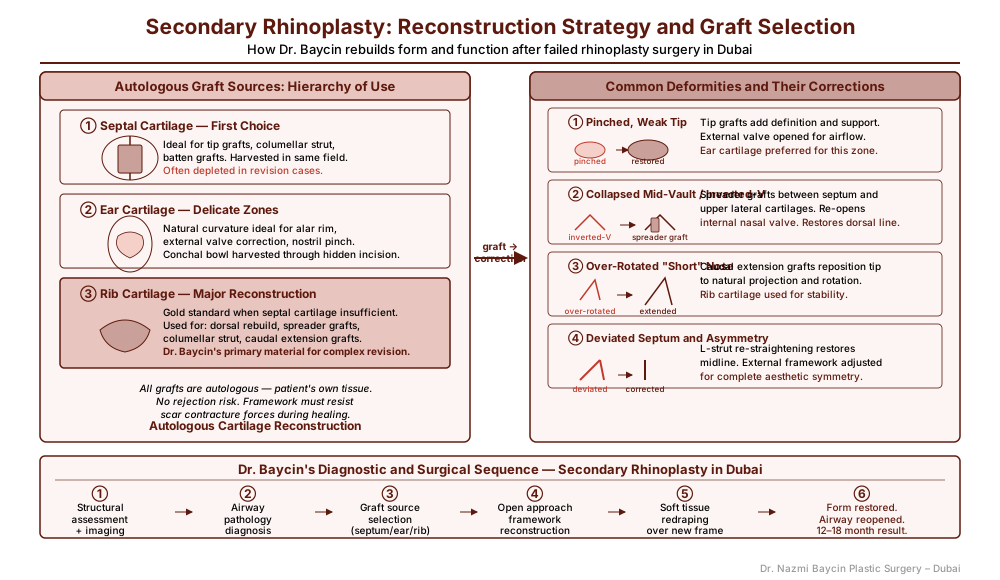
Secondary rhinoplasty restores form and function together — the autologous cartilage framework that rebuilds a natural dorsal line, tip, and mid-vault is the same structure that re-opens the internal and external nasal valves — by Dr. Nazmi Baycin, Dubai.
Assessment: determining what can be restored
The first crucial step is a comprehensive, honest assessment. Using detailed examination and computerized imaging, I evaluate three critical areas. Structural viability: what essential cartilage remains, and is the septum strong enough to support reconstruction, or do we need to plan for rib cartilage grafts? Soft tissue environment: how have the skin and underlying tissue been affected by previous surgery, since scarring limits elasticity and blood supply and influences strategy? And airway pathology: precisely where is the blockage — the septum, the valves, or the turbinates? This diagnostic phase lets me create a realistic surgical blueprint and discuss the art of the possible, setting achievable goals for meaningful improvement in both appearance and breathing.
The core of reconstruction: strategic autologous grafting
The primary tool in secondary rhinoplasty is the cartilage graft. Because the nose’s original cartilage is often weakened or missing, sturdy new material must be imported, and my gold standard is the patient’s own tissue (autologous grafts), which integrates perfectly and carries no risk of rejection. Septal cartilage is used where enough strong septum remains, ear cartilage for delicate areas such as the alar rim, and rib cartilage where major reconstruction is required.
How that material is selected, carved and fixed, graft by graft, is a technical subject in its own right, which I set out in my companion article on rebuilding the nasal framework with autologous tissue; the reasoning behind the graft hierarchy itself, and why irradiated and synthetic materials are avoided in a scarred bed, is set out in my article on advanced techniques for revision rhinoplasty. The principle of using the patient’s own bone and cartilage to rebuild the dorsum is one I have described in the surgical literature; the 2004 paper I co-authored on an anatomically adopted bone-and-diced-cartilage graft for the nasal dorsum sets out one such approach.
Correcting common primary deficits
My revision practice systematically addresses the deficits most frequently left by primary surgery; a descriptive prospective study of 150 secondary rhinoplasty patients catalogues how common these aesthetic and functional complaints are. The pinched, weak tip is corrected by placing precisely sculpted tip grafts that add definition and support, opening the external valves for better airflow. The collapsed mid-vault and inverted-V deformity are repaired with spreader grafts placed between the septum and upper lateral cartilages, restoring a smooth dorsal line and, critically, re-opening the internal nasal valve — the most common site of post-surgical obstruction.
The over-rotated short nose is addressed with caudal extension grafts that reposition the tip to a natural, balanced projection. And a deviated septum or residual asymmetry requires meticulous re-straightening of the septal L-strut, often with complementary adjustments to the external framework for total symmetry.
Primary versus secondary rhinoplasty: what changes
The table below contrasts the two, making clear why revision is a reconstructive rather than a refining procedure.
| Feature | Primary Rhinoplasty | Secondary Rhinoplasty |
|---|---|---|
| Anatomy encountered | Pristine, predictable | Scarred, altered, depleted |
| Tissue planes | Clear and defined | Distorted by scar tissue |
| Cartilage availability | Full native framework | Partially or fully depleted |
| Graft source typically used | Septal cartilage | Rib and/or ear cartilage |
| Primary goal | Refinement and reduction | Reconstruction and restoration |
| Airway complexity | Variable | High — frequently obstructed |
| Operative time | 2–3 hours | 4–6 hours |
| Minimum wait time | N/A | 12 months from prior surgery |
| Recovery to final result | 6–12 months | 12–18 months |
Why experience with Dubai’s diverse community matters
The patients I see in Dubai come from a vast array of ethnic backgrounds, each with distinct nasal anatomy and aesthetic ideals. A secondary procedure on a Middle Eastern, South Asian, or East Asian nose requires specific understanding. The goal is never to impose a generic Western ideal, but to restore a nose that fits your face — respecting your ethnic identity while correcting the functional and aesthetic disharmony caused by the prior surgery. This dual mission defines my approach to cosmetic nose surgery in Dubai.
Recovery and realistic timeline
Healing from secondary rhinoplasty requires patience. Initial swelling and bruising may be more pronounced due to dissection through scar tissue. While most visible recovery occurs in the first few weeks, the final refinement of shape and the full return of nasal breathing can take twelve to eighteen months — the time needed for deep swelling to resolve, grafts to fully integrate, and the soft tissue envelope to relax and redrape over the new framework. I guide patients through every stage with clear expectations, and because each reconstruction is individual, its plan and cost are discussed transparently at consultation. This restorative philosophy runs through all of my facial cosmetic surgery work in Dubai.
FAQs about nose restoration with secondary rhinoplasty in Dubai
-
How long do I need to wait after my primary rhinoplasty before having secondary rhinoplasty in Dubai?
A minimum of twelve months from the primary procedure is required before I will assess or plan a secondary rhinoplasty. This allows complete resolution of swelling, full maturation of scar tissue, and the cartilaginous framework to reach its settled position. Operating before twelve months means planning a correction for a nose that is still changing — producing results that will shift as the primary healing continues.
-
Which of my two problems does revision surgery address first, the look or the breathing?
Neither is addressed first, because they are the same problem approached from two sides. The framework that gives the nose its shape is the framework that holds the airway open, so a spreader graft that restores a smooth dorsal line is the same graft that re-opens the internal nasal valve, and a tip graft that restores definition is the same graft that supports the external valve. In practice this means I do not ask patients to choose between an aesthetic operation and a functional one. I diagnose the structural failing that is producing both complaints and correct it once.
-
Can secondary rhinoplasty fix my breathing as well as the appearance of my nose?
Yes — and my approach requires that both goals are addressed simultaneously. The same structural framework that creates the aesthetic result is the framework that holds the airway open. Correcting a collapsed mid-vault with spreader grafts simultaneously re-opens the internal nasal valve. Correcting a pinched tip with tip grafts simultaneously supports the external nasal valve. Form and function are addressed as the interdependent systems they are.
-
Will revision rhinoplasty in Dubai leave additional scars?
Secondary rhinoplasty is performed using the open approach in the majority of cases — a small incision across the columella (the skin bridge between the nostrils) that heals to a virtually invisible scar in most patients. If rib cartilage is harvested, a small additional scar on the chest wall in the natural skin crease below the breast or along a rib margin is required. I discuss scar placement and management at consultation.
-
How long does it take to see the final result of secondary rhinoplasty?
Twelve to eighteen months for the full, settled result. Grafts integrate progressively over this period. The soft tissue envelope, which has been altered by previous surgery and scar tissue, redrapes over the new framework over time. Early contours are visible at three to six months. The result continues to refine through twelve months and, in cases of significant reconstruction, through eighteen months. I set these expectations clearly at consultation.
-
Can patients who had rhinoplasty abroad have revision surgery in Dubai?
Yes — and this represents a significant proportion of the patients I assess for secondary rhinoplasty. The anatomical problem is the same regardless of where the primary surgery was performed. I request any available operative notes or imaging from the prior procedure but conduct a comprehensive new diagnostic assessment regardless — because the current anatomy, not the surgical history, determines the reconstruction plan.


GET APPOINTMENT
Get ready to look and feel best… You deserve…
