

Key takeaways: preservation rhinoplasty
- Preservation rhinoplasty maintains the nose’s natural framework rather than removing and rebuilding it.
- The technique works within the subperichondrial plane — a nearly bloodless space that protects the cartilage’s support and blood supply.
- Instead of cutting out a dorsal hump, push-down and let-down techniques lower the dorsum en bloc, keeping the internal nasal valve open.
- The approach is airway-first: it protects breathing where traditional hump removal often compromises it.
- Reduced tissue trauma means less swelling and a more comfortable recovery, with the splint removed at about one week.
- Results age gracefully and remain stable over decades, and the technique is especially valuable for revising over-resected noses.
The technical keystone: mastering the subperichondrial plane
The magic — and the mastery — of this approach lies in a specific surgical plane: the subperichondrial space. This is a potential anatomic space between the cartilage and its protective covering (perichondrium). Navigating this plane is the cornerstone of true preservation rhinoplasty. Why does this plane matter so much?
- Bloodless precision: this plane is essentially avascular. Dissecting here means almost no bleeding, providing a crystal-clear surgical field that allows for millimeter-perfect modifications without visual obstruction.
- Preservation of vital support: the perichondrium is the life-support system of the cartilage. By keeping it intact and attached to the dorsal structure at the keystone area, I maintain the nose’s intrinsic strength and drastically reduce the risk of long-term collapse or deformity.
- Reduced trauma, accelerated healing: traditional dissection through soft tissue causes significant swelling and prolonged recovery. The subperichondrial approach is minimally traumatic, leading to less post-operative edema and a faster, more comfortable recovery for my patients.
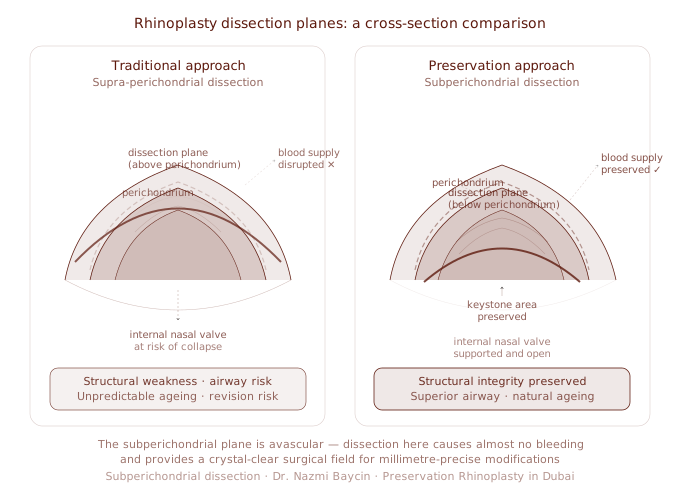
Subperichondrial versus supra-perichondrial dissection planes in rhinoplasty — by Dr. Nazmi Baycin, Dubai.
The common alternative is a supra-perichondrial dissection. This is a more traumatic, bloody dissection that violates the cartilage’s blood supply and destabilizes the dorsal framework. It is a primary reason for unpredictable healing and structural weakness. My dedication to this technical nuance ensures that every rhinoplasty in Dubai I perform starts from the most anatomically respectful position possible.
Airway first: how preservation protects your breath
Most patients focus on shape, but a nose must breathe. Traditional hump removal often involves resecting the critical middle vault cartilage (the upper lateral cartilages), which can collapse the internal nasal valve — the narrowest part of the airway. This is a frequent cause of post-rhinoplasty breathing difficulties.
The preservation philosophy inherently protects the airway. Instead of removing the dorsal hump, I often use a push-down or let-down technique. This lowers the entire dorsal complex en bloc, maintaining the natural relationship between the septum and upper lateral cartilages. The internal valve remains open and supported. When refinement requires modification, I use micro-thin spreader grafts, inserted via the subperichondrial tunnel, to reinforce the valve without adding bulk. This is airway-integrated aesthetic surgery — a non-negotiable standard.
To learn more about how I address breathing obstruction alongside cosmetic refinement, visit my septoplasty in Dubai page.
Preservation versus traditional rhinoplasty at a glance
| Factor | Preservation rhinoplasty | Traditional (resective) rhinoplasty |
|---|---|---|
| Core philosophy | Preserve and reposition the natural framework | Remove cartilage and bone to rebuild |
| Dissection plane | Subperichondrial — nearly bloodless, protects blood supply | Supra-perichondrial — more bleeding, disrupts vascularity |
| Dorsal hump | Lowered en bloc (push-down / let-down) | Resected, often opening the middle vault |
| Internal nasal valve | Kept intact and supported | At risk of collapse |
| Long-term aging | Stable, ages gracefully | Can droop, twist, or contract unpredictably |
| Recovery / swelling | Less edema, faster recovery | More swelling, longer recovery |
Contrasting outcomes: the high toll of destructive techniques
The legacy of a rhinoplasty is judged over decades. Destructive, over-resective techniques leave a telltale trail of problems I am often asked to correct:
- The over-resected look: an exaggerated scooped dorsum, a pinched supra-tip, and an over-rotated tip. The nose looks operated on and lacks structural harmony.
- Nasal collapse: weakened cartilage from aggressive resection and loss of perichondrial support can lead to mid-vault collapse and inverted-V deformity, severely impacting breathing.
- Unpredictable aging: a nose stripped of its natural support structures may droop, twist, or contract unpredictably over time, leading to patient distress and complex revision needs.
My preservation technique is designed to prevent these issues by default. The nose heals strong, ages gracefully, and remains functionally robust. This is the definitive advantage for a patient seeking lifelong satisfaction. Where a nose has already been over-resected and needs rebuilding rather than preserving, that is a different operation with its own graft hierarchy and sequence, which I set out in my article on advanced techniques for revision rhinoplasty.
Evidence in the plane: the science of subperichondrial dissection
This methodology is grounded in anatomic research. A retrospective single-surgeon series of 228 consecutive patients undergoing complete subperichondrial dissection reported that working in this deeper plane — while repairing the preserved scroll and Pitanguy ligaments to stabilize the internal valve and tip — resulted in relatively limited edema and more rapid recovery when compared with the same authors’ earlier experience with the sub-SMAS approach, and made repeat elevation easier and less traumatic in revision cases.
The broader literature is more cautious than it is often reported to be. A systematic review of the state of the evidence for preservation rhinoplasty found that the published studies do consistently report positive outcomes, but that most are low-level evidence without validated patient-reported measures, and that few high-level comparative studies yet support the theoretical advantages of preservation over structural rhinoplasty; its authors call for prospective comparative trials. I state that plainly because it is the honest position: what I observe in my own practice — a more comfortable recovery and a more stable framework over time — is consistent with the published series rather than proven superior by comparative trial.
Who is a candidate for preservation rhinoplasty in Dubai?
Preservation rhinoplasty is appropriate for a broad range of patients, but it is particularly well-suited to those concerned not only with aesthetics but with the long-term functional health of their nose. In my Dubai practice, ideal candidates share several characteristics:
- They are seeking reduction of a dorsal hump, nasal refinement, or tip reshaping — the three areas where preservation techniques deliver their clearest advantage over traditional methods.
- They want results that age gracefully over decades, not a result that depends on scar tissue and weakened cartilage to hold its shape.
- They have concerns about breathing — either pre-existing nasal airway compromise or a desire to avoid the breathing difficulties that frequently follow traditional rhinoplasty.
- They are in good general health, are non-smokers, and have realistic expectations about the limits and timeline of surgical refinement.
- They understand that final results emerge gradually — swelling resolves in layers, with the most meaningful refinement visible between six and twelve months post-operatively.
Preservation principles also have a place in patients who have previously undergone traditional rhinoplasty and are now experiencing breathing difficulties or structural weakness, where the subperichondrial plane gives cleaner access to a scarred framework. Whether such a nose is best served by preserving what remains or by rebuilding it with grafts is a judgement made case by case, and I set out the reconstructive side of that decision separately.
The demands of the technique: skill over speed
Preservation rhinoplasty requires advanced surgical skill, increased operative time, and intricate planning. This is not a 60-minute procedure; it is a meticulous, often multi-hour architectural endeavor that demands absolute precision and profound anatomic knowledge. The reward is a reduced risk of revision, a superior airway, and a result that looks inherently natural — the reasons I hold every nasal surgery I perform to this exacting standard rather than to the clock.
FAQs about preservation rhinoplasty in Dubai
-
What is preservation rhinoplasty?
Preservation rhinoplasty is a surgical philosophy that prioritizes maintaining the nose’s natural structural framework rather than removing and rebuilding it. Instead of resecting cartilage and bone to sculpt a new shape, I work within a precise anatomic plane — the subperichondrial space — to reposition, refine, and reinforce what is already there. The result is a nose that looks naturally refined, breathes optimally, and ages predictably over time.
-
What is the difference between preservation rhinoplasty and traditional rhinoplasty?
Traditional rhinoplasty is largely subtractive — cartilage and bone are removed to change the nose’s shape. This can produce good results in skilled hands, but it also risks structural weakness, breathing compromise, and an operated appearance over time. Preservation rhinoplasty avoids this by maintaining the dorsal support structures and using techniques like push-down and let-down to lower a hump without removing it. Research supports better preservation of the dorsal support ligaments and less post-operative swelling with the preservation approach; the long-term comparative advantage over traditional technique is supported by consistent clinical series rather than by high-level comparative trials, which are still limited.
-
Is preservation rhinoplasty better for breathing?
Yes, for most patients. Traditional hump removal often disrupts the internal nasal valve — the narrowest, most functionally critical part of the airway — leading to post-operative breathing difficulties that can persist for life. The preservation approach maintains the natural relationship between the septum and upper lateral cartilages, keeping the valve open and supported. When refinement is needed, I use micro-thin spreader grafts placed through the subperichondrial tunnel to reinforce the valve without adding visible bulk.
-
Who is a good candidate for preservation rhinoplasty in Dubai?
The best candidates are patients seeking dorsal hump reduction, nasal refinement, or tip reshaping who want results that look natural, breathe well, and remain stable over decades. Preservation principles can also help a patient who previously had traditional rhinoplasty and is now experiencing breathing difficulty or structural weakness, provided enough of the original framework survives to work with. Good overall health and non-smoking status are required.
-
How long does recovery take after preservation rhinoplasty?
Because the subperichondrial approach causes significantly less tissue trauma than traditional rhinoplasty, most patients experience noticeably less swelling and a more comfortable recovery. The nasal splint is typically removed at one week. Socially presentable swelling resolves within two to three weeks for most patients. However, the nose continues to refine for up to twelve months — the final result emerges gradually, with the most meaningful definition visible between six and twelve months.
-
Can preservation rhinoplasty fix a previous rhinoplasty that went wrong?
Sometimes, and the answer turns on how much of the original framework has survived. Where enough structure remains, preservation principles apply well to a nose that has already been operated on: the subperichondrial plane gives cleaner access to a scarred framework than supra-perichondrial dissection does, which helps in restoring support and airway function. Where the nose has been heavily over-resected, the problem is no longer one of preserving but of rebuilding, and that is a different operation with its own graft hierarchy and sequence — I set it out in my article on rebuilding an over-resected nose with cartilage grafts.
-
Does preservation rhinoplasty leave visible scars?
In most cases there is no visible external scar. Preservation rhinoplasty can frequently be performed through a closed (endonasal) approach, with all incisions hidden inside the nose. Where an open approach is needed, the only external incision is a tiny one across the columella (the strip of skin between the nostrils), which typically heals to become virtually undetectable.
The distinction: a surgeon as anatomist and artist
Choosing a surgeon for preservation rhinoplasty requires a specialist, not a generalist. It requires a surgeon who is as much an anatomist as an artist. In my operating room, the subperichondrial plane is not just a technique — it is a philosophy made manifest. It allows me to deliver refinement without sacrifice, elegance without compromise. The result is a nose that looks and feels like it was always meant to be: balanced, beautiful, and breathing perfectly.
Preservation rhinoplasty via the subperichondrial plane represents a mature understanding that our role is not to conquer nature, but to collaborate with it. For those who seek this gold standard in nasal surgery, I welcome you to discover my comprehensive surgical philosophy as a premier plastic surgeon in Dubai.


GET APPOINTMENT
Get ready to look and feel best… You deserve…
