

Key takeaways: structural correction of the drooping tip
- A drooping tip is a cartilage-support problem, not a skin problem — so it needs structural, not superficial, correction.
- The tip behaves as a tripod of cartilage; when one leg weakens, the tip descends.
- Filler, or so-called liquid rhinoplasty, adds weight to a failing structure and can worsen droop and carry vascular risk.
- Correction is additive and supportive — rebuilding with the patient’s own cartilage, not aggressive removal.
- The columellar strut, tip graft, and alar rim grafts form the core rebuilding sequence.
- The smiling (dynamic) tip is addressed by modifying the depressor septi muscle so the result holds during expression.
The anatomical pillars: why tips descend
The nasal tip is not a static structure; it is a dynamic tripod of cartilage. Its stability and rotation depend on the strength, orientation, and interplay of the medial and lateral crura of the lower lateral cartilages, and ptosis occurs when these supports are inadequate or have collapsed.
The primary anatomical causes are weak or under-projected lower lateral cartilages (the core elements lack the strength to hold position against gravity and the opposing pull of the skin); an over-developed or downward-angled septum that literally pushes the tip complex downward; poor skin and soft-tissue quality, where thick, heavy nasal skin loads the delicate framework; and age-related descent, as ligamentous supports weaken and cartilage thins over decades.
A fundamental error is treating all drooping tips with the same technique — often aggressive cartilage removal from the septum (a hump reduction) or excessive suture tightening. This can further destabilize the tip, leading to a pinched, over-rotated, or collapsed appearance that struggles to breathe properly.
Correction must be additive and supportive, not merely reductive. Because the causes differ from patient to patient, the technique must be matched to the specific failure: a published treatment algorithm for the drooping nose (Sajjadian & Guyuron) reflects exactly this principle — diagnosing which support has failed and selecting the corresponding maneuver rather than applying one technique to every nose.
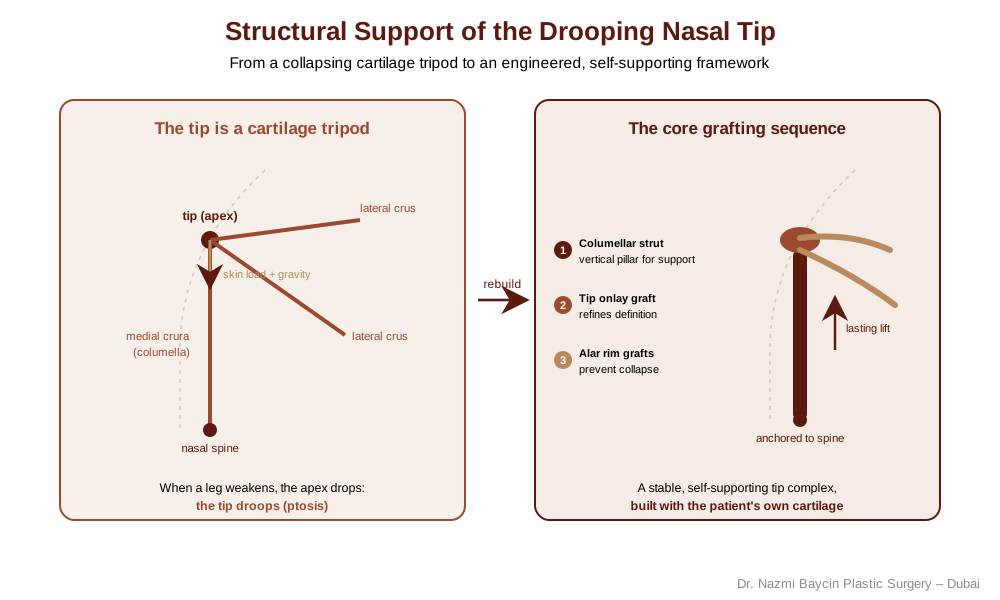
The tip as a cartilage tripod that droops when a support fails (left), rebuilt with a columellar strut, tip graft, and alar rim grafts into a stable, self-supporting framework (right) — by Dr. Nazmi Baycin, Dubai.
The fallacy of filler and temporary fixes
The non-surgical liquid rhinoplasty for a drooping tip is a physiologically flawed concept. Injecting hyaluronic acid filler along the columella or into the tip to provide push or support adds dead weight to an already failing structure. It creates a temporary visual lift while introducing three real problems: increased long-term drooping (the filler stretches the skin envelope and ligaments further), vascular risk (filler in this critical vascular zone carries a high risk of occlusion, potentially leading to skin necrosis), and distorted anatomy (it obscures the true landmarks, making any future surgical correction more complex and less predictable). Surgery must reverse the anatomical cause, not mask it with volume — I diagnose which specific supports have failed and rebuild them using the patient’s own cartilage for permanent, integrated strength.
The surgical rebuilding process: grafting for permanence
My technique moves beyond simple suture repositioning to a philosophy of structural grafting, with the goal of a stable, self-supporting tip complex. Often the starting point is the septum: I conservatively reduce any excessive dorsal length (the saddle area) and may reorient the caudal septum to a more favorable, supportive position. I then typically harvest strong, straight septal cartilage as building material — or, if unavailable, auricular (ear) or rib cartilage — and carve it into specific, functional grafts. Why that order matters most in a nose that has been operated on before, where the septum may already have been harvested, I set out in my article on the graft-selection hierarchy in revision rhinoplasty. The table below summarizes the core grafting sequence.
| Graft | What it does | Why it matters |
|---|---|---|
| Columellar strut graft | A strong cartilage strut placed between the medial crura and anchored firmly to the nasal spine | The foundational step — a vertical pillar giving independent support and projection, freeing the tip from downward pull |
| Tip graft | Precise onlay grafts of crushed or shaped cartilage over the tip | Refines definition and contour, creating elegant highlights without over-projecting |
| Alar rim grafts | Thin strips of cartilage placed along the nostril margins | Support the lateral crura, prevent post-operative collapse or pinching, and keep a smooth, open airway |
This layered, architectural approach builds a tip that is strong, defined, and resilient. For patients seeking this level of definitive correction, exploring structural rhinoplasty in Dubai is essential to understanding the commitment to permanent, anatomical solutions.
When the dorsum also needs support: dorsal grafting
In particular cases, restoring tip support alone cannot fully resolve the problem — when the bridge itself is low, over-resected from previous surgery, or irregular, a weak dorsum will continue to undermine the balance of the tip. In these situations a dorsal graft can also be considered, rebuilding height and smoothing contour so the reconstructed tip sits in proper harmony with the profile.
This is an area I have studied and published on directly: our work on bone chips and diced cartilage as an anatomically adopted graft for the nasal dorsum describes using the patient’s own bone and cartilage to reconstruct and smooth the dorsum durably — reconstructing the bony side of the nose with bone and the cartilaginous side with cartilage. Matching the graft to the anatomy in this way gives a natural, lasting dorsal contour that complements the rebuilt tip.
The critical nuance: managing the smiling tip
A unique challenge is correcting dynamic ptosis — the tip that droops significantly when smiling due to the pull of the depressor septi nasi muscle. A surgery that only addresses static appearance will fail here. My technique includes a selective release or modification of this muscle, allowing the newly reinforced tip structure to remain stable during animation, ensuring a natural look in both repose and expression.
What recovery looks like after structural tip correction
Because this is a rebuild rather than a simple reduction, I set expectations honestly from the first consultation. A lightweight external splint supports the new framework for about a week, and most visible swelling and bruising settle within ten to fourteen days, at which point many patients feel comfortable returning to work and social life. Numbness and firmness at the tip are normal early on and soften gradually.
The tip’s final refinement is a slower story than the bridge: because the tip carries the thickest overlying skin, the last degree of definition emerges over many months as deep swelling resolves. What does not change is the support — the reconstructed cartilage framework holds its position from the first day, so the elevation and projection you see settling in are permanent rather than fading over the years.
The philosophical goal: creating a self-sustaining structure
The endpoint of this process is a nasal tip that stands on its own. It should not rely on scar tissue or hope for support; it should be engineered from the first day of surgery to bear the loads of a lifetime. The result is a nose that appears elegantly defined, functions impeccably, and remains unchanged by time or expression — a testament to the principle that, in expert hands, the most sophisticated aesthetics are always built upon the bedrock of sound anatomical science. To discuss your own anatomy, I welcome you to consult with me as a leading cosmetic surgeon in Dubai.
FAQs about drooping nasal tip correction in Dubai
-
What actually causes a drooping nasal tip?
A drooping tip is usually a problem of cartilage support, not skin. The tip works like a tripod of cartilage, and it descends when those supports are weak, under-projected, or stretched — whether from naturally soft cartilage, a long or downward-angled septum, thick heavy skin loading the framework, or age-related weakening of the ligaments. Because the cause varies from person to person, accurate diagnosis is what guides the right correction.
-
Can filler fix a drooping tip instead of surgery?
Filler can create a brief visual lift, but it doesn’t fix the underlying problem and often makes it worse. Adding volume places extra weight on an already failing structure, which can increase drooping over time by stretching the skin and ligaments. There is also a real vascular risk in this area, and filler can obscure the anatomy, making later surgery more complex. Lasting correction has to rebuild the support, not mask it.
-
What is a columellar strut, and why is it important?
A columellar strut is a strong piece of the patient’s own cartilage placed between the medial crura and anchored to the nasal spine. It acts as a vertical pillar that gives the tip independent support and projection, freeing it from the downward pull that caused the droop. It’s the foundational step of the structural rebuild, on top of which tip and rim grafts refine the final shape.
-
Where does the cartilage for the grafts come from?
Whenever possible I use the patient’s own septal cartilage, which is strong and straight and ideal for building support. If septal cartilage isn’t available or sufficient, I use ear (auricular) or rib cartilage instead. Using your own tissue means the grafts integrate permanently and avoid the risks associated with synthetic implants.
-
Why does my tip droop more when I smile, and can that be corrected?
Smiling activates a small muscle called the depressor septi nasi, which pulls the tip downward during expression — so a tip that looks fine at rest can droop noticeably when you smile. Correcting this dynamic droop requires selectively releasing or modifying that muscle, so the reinforced tip stays stable during animation and looks natural in both repose and expression. A repair that only addresses the static tip will not solve this.
-
Is the dorsum (bridge) ever treated at the same time?
Sometimes, yes. When the bridge is low, irregular, or over-resected from previous surgery, supporting the tip alone won’t fully balance the profile, so a dorsal graft may be added to rebuild height and smooth the contour. Matching the graft material to the anatomy — bone for the bony vault, cartilage for the cartilaginous portion — gives a natural, durable result that complements the rebuilt tip.


GET APPOINTMENT
Get ready to look and feel best… You deserve…
