

Back contouring in Dubai is one of the most sophisticated challenges in body sculpting. Unlike the abdomen, the dorsal region is a complex landscape of dense, fibrous fat compartments, tightly tethered by connective-tissue septa and overlaid by relatively inelastic skin. Patients often struggle with stubborn dorsal rolls and bra-line bulges that resist diet and exercise. The common, fundamental error is treating this area with standard liposuction that merely skims surface volume and ignores the underlying architectural problem — which leads to temporary improvement, surface irregularities, and rapid recurrence.
Key takeaways: the back is layered architecture
- The back has dense fibrous fat and inelastic skin, so it behaves nothing like the abdomen.
- Standard single-layer liposuction leaves rolls, irregularities, and recurrence.
- The technique is tri-planar: deep debulking, intermediate septal work, superficial finishing.
- Fat supplies the volume; the fascia decides where the roll forms, so both have to be addressed.
- J-Plasma skin tightening helps the inelastic back skin redrape smoothly.
- Poor technique produces a washboard back, dimpling, or persistent rolls.
My philosophy for back contouring in Dubai is one of structural engineering. Successful back contouring means the strategic, layer-by-layer release and reduction of these defined fat compartments, so the dorsal topography is rebuilt as a smooth, muscular, naturally athletic surface rather than simply emptied of fat.
Why the back defies simple fat removal
The dorsal region is not a uniform fat depot; it is an organized series of functional compartments. The challenge concentrates in the bra-line zone, where several anatomical factors converge at once.
The first is the superficial fascial system. The fat is compartmentalized by fibrous bands that bridge every level of the dorsal subcutaneous tissue, anchoring the skin to the deep fascia, and their density is not uniform. A dissection study of twelve fresh cadavers in Plastic and Reconstructive Surgery mapped this directly: the system is dense and resists deformation over the scapular and lumbar triangle regions, and markedly looser and more deformable below the scapula — a regional pattern its authors found consistent with where back contour deformities actually appear. Rolls form as increasing fat volume expands against those fixed adherences, with gravity determining which way the bulge falls. The fat supplies the volume and the fascia decides the shape, which is why removing volume without regard to the regional architecture leaves the roll roughly where it was.
The second is a multi-layered fat architecture. Superficial, intermediate, and deep layers each contribute differently to the contour — the deep layer provides bulk, while the intermediate layer, bound by septa, creates the visible ridges.
The third is the inelastic skin envelope. Dorsal skin has limited contractile ability, so removing fat without addressing the septal tethering and skin quality reliably produces loose, draping skin afterward. Because the character of the fat itself shapes the plan, I also assess tissue type carefully, a point I explore in my article on how fibrous versus soft fat changes technique.
The strategic sequence: layered deconstruction
My technique for back liposuction in Dubai is a deliberate, sequenced deconstruction of the dorsal architecture, working from deep to superficial so each layer prepares the one above it.
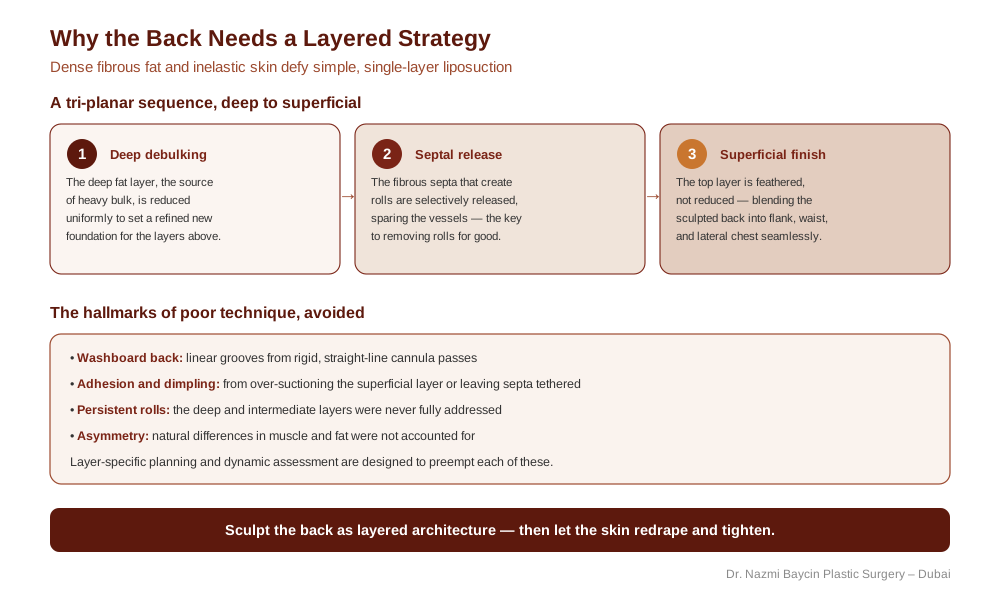
The tri-planar approach to back and bra-line liposuction, and the poor-technique pitfalls it is designed to avoid, by Dr. Nazmi Baycin, Dubai.
Phase one is deep-compartment debulking. The heavy, thick appearance comes from volume in the deep fat layer, which I reduce uniformly with specialized cannulas. The aim is not to create a cavity but to establish a refined new foundational volume onto which the upper layers can redrape.
Phase two — the critical maneuver — is intermediate septal work, and the operative word is selective. The retinaculum cutis is not one uniform tissue but a mixed network of loose interlobular fascia and stiff functional fascia, so the aim is to work through the weaker interlobular planes with fine cannulas and VASER energy, where appropriate, while sparing the dense functional fascia and the subdermal vascular network. That is what allows the once-segmented fat to redistribute as a smooth, continuous layer. The distinction matters because the zones where the fascia is densest are also the zones where over-treatment produces the worst contour deformities — the same anatomy that shapes the roll will punish an indiscriminate approach to it.
Phase three is superficial refinement, treated with deliberate conservatism. Here the goal is feathering and blending, not volume reduction, because over-aggression in this plane causes rippling, adhesions, and uneven shadows. The focus is on seamless transitions from the sculpted back to the flank, waist, and lateral chest. The table below summarizes how the three planes differ.
| Layer | Goal | Risk If Done Wrong |
|---|---|---|
| Deep fat compartment | Uniform debulking to set a refined foundation | Over-hollowing that leaves an unnatural cavity |
| Intermediate (septal) layer | Selective work through the weaker planes that shape the roll | Persistent rolls if under-treated; contour deformity if dense zones are over-released |
| Superficial layer | Feathering and blending into adjacent zones | Rippling, adhesions, and uneven shadows |
The bra-line: precision sculpting of a dynamic unit
The bra-line is not one problem but three, and each sub-unit needs its own solution — which is precisely what the regional variation in fascial density would predict.
The upper dorsal roll is often a mix of fat and hypertrophied trapezius muscle, so sculpting here has to respect the muscle border to avoid an unnatural, over-suctioned depression. The mid-scapular fold sits over one of the densest zones of the dorsal fascial system, so treatment focuses on measured work in the weaker planes rather than aggressive fat removal.
The axillary fold and tail of Spence is the zone that most influences how clothing and swimwear fit; contouring here must be exquisitely precise to avoid a concave deformity or disruption of the lymphatic channels near the axilla. Each zone is mapped and treated as an independent subunit, then harmonized into one continuous, natural curve running from the neck to the waist.
Integrating J-Plasma for definitive skin draping
Because back skin has such limited elastic recoil, fat removal alone in Dubai may not be enough for optimal draping. Patients with meaningful skin laxity benefit from pairing structural liposuction with energy-based skin tightening. There is early published support for pairing the two: a series of 14 consecutive back-contouring cases in Aesthetic Surgery Journal Open Forum treated back rolls as a combination of excess fat and skin redundancy, using ultrasound-assisted liposuction with helium-activated radiofrequency tightening in place of an excisional upper body lift, and reported elimination of the rolls in all fourteen with satisfaction maintained at twelve months. It is a small single-practice series, rated level four evidence by the journal, with outcomes judged visually rather than by any validated measure and no comparison group — so I treat it as encouraging rather than settled.
In appropriate candidates, I integrate J-Plasma (Renuvion) subdermal tightening. After the structural liposuction, plasma energy is applied to the underside of the skin, causing immediate collagen contraction and stimulating long-term neocollagenesis.
This is not a substitute for proper fat-layer management but a powerful adjunct, and it is especially valuable in the upper back and bra-line, where skin quality varies most. It lets me achieve a tighter, smoother envelope that conforms to the newly sculpted contour. I discuss when this pairing genuinely earns its place in my article on when J-Plasma prevents secondary skin laxity.
Avoiding the pitfalls of poor technique
I regularly revise backs that show the tell-tale signs of an anatomically naive approach, and each one traces back to a specific error.
The “washboard” back — linear, parallel grooves — comes from rigid, straight-line cannula passes that ignore the natural contours. Adhesion and dimpling are focal depressions caused by over-suctioning the superficial layer or working carelessly through a dense fascial zone. Persistent rolls mean the deep and intermediate layers were incompletely treated, leaving the structural cause in place. And asymmetry follows when natural anatomical differences in muscle development and fat distribution are not accounted for.
My methodology is grounded in layer-specific planning and dynamic assessment precisely to preempt these avoidable complications. The same energy-based finishing that smooths the contour also depends on managing healing well, which I cover in my article on preventing and managing post-liposuction fibrosis. The broader tissue-selective approach that makes this precision possible is something I set out in my article on high-definition VASER liposuction without contour deformities.
The surgeon’s mandate: sculptor of the silhouette
Contouring the back is an exercise in negative-space sculpture. The goal is to reveal the harmonious underlying form of the latissimus dorsi, trapezius, and thoracic spine by removing what obscures it — which calls for an artistic eye for proportion, a scientific understanding of the fascial planes, and a disciplined hand.
The result should be a back that looks strong, sleek, and naturally defined, whether viewed from behind in a gown or from the side in a tailored shirt. Choosing the right surgeon means finding a portfolio that consistently shows smooth, seamless dorsal contours — the standard you should expect from a cosmetic surgery clinic in Dubai — and the review of your comprehensive liposuction options in Dubai is best done at a consultation, with a detailed topographic analysis of your own dorsal anatomy.
FAQs about back and bra-line liposuction in Dubai
-
Why is back liposuction more difficult than other areas?
The back is anatomically unlike areas such as the abdomen. Its fat is dense and fibrous, compartmentalized by a fascial network that anchors the skin to the deep fascia, and that network is tight over some regions and loose over others. It is also arranged in distinct superficial, intermediate, and deep layers that each affect the contour differently, and the overlying skin has limited elasticity. Standard liposuction that only removes surface volume ignores this architecture, which is why it tends to leave irregularities and rolls that quickly return. Treating the back well requires a layered, region-specific strategy rather than simple fat removal.
-
What causes bra-line rolls, and can liposuction remove them permanently?
Both the fat and the fascia beneath it matter, and the fascia is the part most often missed. Cadaver mapping of the back has shown that a fibrous network anchors the skin to the deep fascia and that its density varies by region, being tight over the scapula and lower back and much looser below the scapula. Rolls form where increasing fat volume expands against those fixed anchors, with gravity setting the direction the bulge falls. That is why suctioning volume alone often disappoints: the architecture that gave the roll its shape is still there. I treat the intermediate layer according to its regional density, working through the weaker planes and sparing the dense ones, so the fat redistributes as a continuous layer. With stable weight that correction holds well, though I would not promise anyone that a body contour is permanent.
-
What is the tri-planar technique?
It is a sequenced approach that treats the back’s three fat layers in order, from deep to superficial. First, the deep layer is uniformly debulked to establish a refined foundation. Second, the intermediate layer is addressed selectively — the step that most affects whether the roll returns — working through the weaker fascial planes while protecting the denser ones and the subdermal blood supply. Third, the superficial layer is treated conservatively, feathering and blending rather than reducing volume, to create seamless transitions into the flank, waist, and lateral chest. Working in this order gives the skin a stable, smooth base to contract onto and helps prevent surface irregularities.
-
Do I need skin tightening as well as liposuction?
It depends on your skin quality. Back skin has limited elastic recoil, so if you have meaningful laxity, removing fat alone may leave the skin loose rather than smoothly redraped. In those cases, I integrate J-Plasma (Renuvion) subdermal tightening after the structural liposuction: plasma energy applied under the skin causes immediate collagen contraction and stimulates longer-term collagen renewal. This is an adjunct, not a replacement for proper fat-layer work, and it is most valuable in the upper back and bra-line where skin quality varies. Whether you need it is determined by assessing your skin at consultation.
-
What are the signs of poorly performed back liposuction?
There are a few tell-tale signs. A “washboard” back shows linear, parallel grooves from rigid, straight-line cannula passes. Adhesions and dimpling appear as focal depressions from over-suctioning the superficial layer or working carelessly through a dense fascial zone. Persistent rolls mean the deep and intermediate layers were incompletely treated, leaving the structural cause in place. Asymmetry results from not accounting for natural differences in muscle and fat. These are the problems I most often revise, and they are avoidable with layer-specific planning and careful, dynamic assessment during surgery rather than a one-pass approach.
-
What is recovery like after back and bra-line liposuction?
You will wear a compression garment to support the tissues and help the skin conform to the new contour, and light activity is encouraged early while strenuous exercise is reintroduced gradually. Swelling and firmness are normal at first and resolve over weeks to months as the contour refines. Because the back skin needs to redrape onto a smaller, smoother foundation, following the aftercare plan closely matters, and any energy-based tightening used during surgery supports that process. I provide a personalized recovery plan and monitor healing so that the final contour settles smoothly.
-
Am I a good candidate?
Good candidates are people bothered by stubborn dorsal rolls or bra-line bulges that persist despite diet and exercise, and who are in good general health with a stable weight. Reasonable skin quality helps, though laxity can be addressed by adding skin tightening. Realistic expectations matter: the aim is a smoother, more athletic dorsal contour that improves how clothing fits, not an unnatural flatness. Because the right plan depends on your specific fat distribution, skin, and anatomy, a topographic assessment at consultation is the most reliable way to confirm whether the procedure suits you.


GET APPOINTMENT
Get ready to look and feel best… You deserve…
