

A flat male chest after gynecomastia surgery depends far more on surgical judgement than on liposuction alone. Men in Dubai expect masculine contours without irregularities or residual puffiness, yet the most common causes of a disappointing result are consistent: misdiagnosis between glandular and fatty tissue, incomplete gland excision, and poor contouring that leaves step-offs or indentations. When the surgery is done with an accurate diagnosis, complete removal of the excess tissue, and controlled skin redraping, the chest looks firm, smooth, and naturally athletic. When any one of those elements is skipped, the puffiness or projection tends to persist — and it is almost always a matter of surgical shortcuts rather than the limits of the patient’s body.
Key takeaways: judgement over technology
- A flat chest depends on diagnosis and technique, not the liposuction device.
- Gland mistaken for fat is the commonest error — firm gland does not respond to suction.
- Incomplete excision leaves residual puffiness under the areola.
- Poor contouring creates step-offs and indentations that look operated.
- Over-suction without vascular preservation causes skin wrinkling and uneven redraping.
- The fix is a diagnosis-led protocol: identify the tissue, excise completely, contour, and respect the skin.
The published literature points the same way. A 2015 systematic review of seventeen studies on gynecomastia treatment concluded that traditional surgical excision of glandular tissue combined with liposuction provides the most consistent results and a low rate of complications — which is precisely why relying on suction alone so often falls short when true gland is present. Its authors were candid that none of the included studies were randomised and that the overall quality of the evidence was very low, so this is the settled consensus of accumulated surgical experience rather than the verdict of a controlled trial. Getting the diagnosis and the combination right is what separates a flat chest from a puffy one.
Why a flat result needs more than liposuction
Gynecomastia surgery is often misunderstood as simple fat removal, yet a genuinely flat, smooth chest requires precise identification of the tissue type — glandular versus fatty — followed by controlled excision and contour refinement. Anything less tends to leave persistent projection, asymmetry, or unnatural hollowing that undermines gym results and swimwear confidence.
Liposuction alone fails when firm glandular tissue is mistaken for fat, leaving puffy nipples and incomplete flattening that becomes obvious within months. Real expertise lies in customizing the approach: VASER or power-assisted liposuction for fatty pseudogynecomastia, direct excision for true glandular cases, and combined techniques for the mixed presentations that are so common. The technology assists the judgement; it never replaces it.
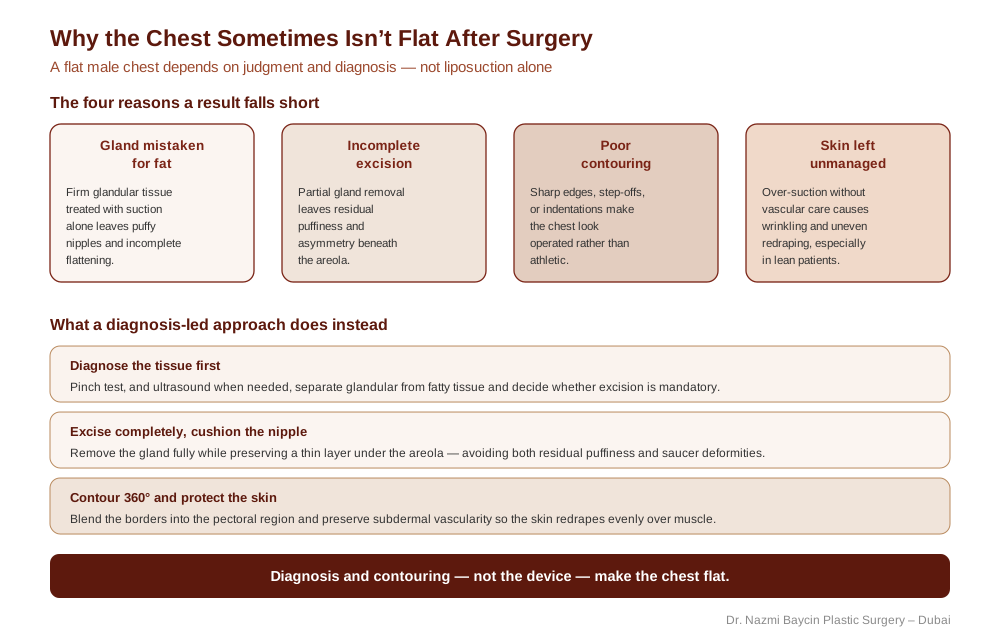
Why a chest sometimes isn’t flat after gynecomastia surgery — four common causes and the diagnosis-led approach that corrects each of them — by Dr. Nazmi Baycin, Dubai.
Gland vs fat: the most common diagnostic error
The first critical step is distinguishing glandular from fatty tissue, because fatty gynecomastia responds well to liposuction while true glandular hypertrophy does not. Mistaking firm gland for fat and treating it with suction alone predictably produces persistent chest projection, puffy nipples, and the need for revision.
During evaluation I assess tissue density by pinch test — and ultrasound when it adds clarity — along with nipple projection, skin elasticity, chest symmetry, and any relevant endocrine factors. That assessment is what determines whether excision is mandatory alongside liposuction. This diagnostic distinction is important enough that I have written separately on why ultrasound assessment matters before gynecomastia surgery in Dubai, since getting this step right prevents the majority of flat-chest failures.
The table below summarises how each tissue finding maps to the right technique.
| Tissue Finding | Correct Technique | What Happens If It’s Missed |
|---|---|---|
| Fatty (pseudogynecomastia) | Liposuction (VASER or power-assisted) | Good result — provided the tissue really is fatty |
| True glandular | Direct excision plus liposuction for blending | Suction alone leaves puffy nipples and projection |
| Mixed presentation | Combined excision and contouring | Partial treatment leaves residual puffiness or asymmetry |
| Reduced skin elasticity | Adjunct skin management or excision | Wrinkling and uneven redraping, especially in lean patients |
Incomplete excision leaves residual puffiness
Partial gland removal is another frequent error, often done out of a fear of creating nipple depression, but it leaves residual puffiness, asymmetry, and dissatisfaction. A flat chest is simply impossible if abnormal glandular tissue persists beneath the areola. My approach achieves complete excision while deliberately preserving a thin supportive layer directly under the nipple for a natural contour, combined with peripheral contouring to blend the transitions smoothly. That balance reflects experience rather than aggressive over-removal, which risks the saucer or crater deformities seen in so many revision cases. Correcting those over-resection deformities is itself a distinct challenge; I discuss it in detail in my piece on revision gynecomastia surgery for crater deformities in Dubai.
Contouring creates the masculine shape
Tissue removal alone does not produce a masculine chest — meticulous contouring does, blending the treated areas seamlessly into the untreated pectoral regions. Poor contouring creates sharp edges, indentations, or step-offs that make the chest look operated rather than athletic. After gland excision and liposuction, I sculpt the surrounding fat layers to establish smooth gradients across the pectoralis, the anterior chest wall, and the lateral borders. This 360-degree refinement prevents the isolated-correction appearance and ensures the chest integrates naturally with the deltoids, arms, and torso. The interplay of complete excision and careful contouring is the heart of the technique, something I explore further in my article on the dual-technique approach of excision and contouring in Dubai.
Skin retraction and preventing irregularities
How the skin behaves after surgery depends on age, elasticity, the volume of tissue removed, and the precision of the technique. Excessive fat suction without vascular preservation leads to wrinkling, uneven redraping, or visible skin excess, especially in leaner patients. I maintain subdermal vascularity through controlled VASER settings and limited cannula passes, which allows even retraction over the contoured muscle.
In cases of reduced elasticity, preoperative planning includes adjunct skin management or excision, so the surface heals smoothly rather than rippling the way it does after inadequate technique. Matching the skin strategy to the skin’s actual quality is what prevents late irregularities.
Reading the skin correctly before the operation, rather than hoping it will retract afterwards, is the standard of care you should expect from an experienced cosmetic surgeon in Dubai.
Scar placement
Visible scars undermine even excellent contouring, so incisions must be small, placed at the areolar border, or hidden in natural creases to give adequate access without aesthetic compromise. Precise access allows full gland removal through minimal ports, healing to near-invisibility within a year. Recovery then hinges on compression: properly fitted garments worn as directed reduce swelling, support retraction, and minimize irregularities, whereas inadequate use or early discontinuation can compromise even flawless surgery and prolong puffiness.
My protocol phases the return to activity — desk work within a few days and the gym at around four to six weeks — with follow-ups to ensure the compression is doing its job. This complete philosophy, from diagnosis through contouring, is what underpins my approach to gynecomastia surgery in Dubai, where the goal is a firm, natural chest rather than a merely smaller one.
FAQs about flat-chest results in gynecomastia surgery in Dubai
-
Why is my chest still puffy after gynecomastia surgery?
The most common reason is that firm glandular tissue was mistaken for fat and treated with liposuction alone, which cannot remove gland. Suction reduces fatty volume, but true glandular tissue has to be excised directly, so if it is left behind the nipple area stays puffy and projected. Incomplete gland removal — sometimes done out of caution about nipple depression — produces the same result. A proper assessment of whether the tissue is glandular or fatty, followed by complete excision when needed, is what prevents persistent puffiness.
-
Why does liposuction alone often fail to flatten the chest?
Liposuction is excellent for fatty pseudogynecomastia, but it does not remove firm glandular tissue. When the enlargement is glandular or mixed, suction alone leaves residual projection and puffy nipples that become obvious within months. The published surgical experience points consistently to combining excision of the gland with liposuction as the approach that gives the most reliable, flat result, although the studies behind that conclusion are observational rather than randomised. The device — whether VASER or power-assisted — assists the work, but it cannot substitute for the judgement to identify the tissue correctly and excise gland where it is present.
-
What is the difference between glandular and fatty gynecomastia?
Fatty gynecomastia (pseudogynecomastia) is excess fatty tissue, which responds well to liposuction, whereas true glandular gynecomastia is firm breast tissue that must be surgically excised. Many men have a mixed presentation with both. The distinction matters enormously, because treating firm gland as if it were fat is the single most common cause of an incomplete, puffy result. Assessment by pinch test, and ultrasound where it adds clarity, along with an evaluation of nipple projection and skin quality, determines which type is present and whether excision is required.
-
What causes a crater or saucer deformity, and can it be fixed?
A crater or saucer deformity results from over-aggressive removal of tissue directly beneath the nipple, leaving a visible depression instead of a smooth contour. It is the opposite error to incomplete excision, and it is why a thin supportive layer should be preserved under the areola. These deformities can be corrected, but revision is more complex than a primary procedure — it involves restoring contour, often with careful fat grafting and contouring, to rebuild a natural surface. Avoiding the deformity in the first place, through balanced excision, is always preferable.
-
Will there be visible scars?
Scars are kept small and discreet, placed at the areolar border or hidden in natural creases, which provides adequate access while keeping them inconspicuous. Full gland removal can be achieved through these minimal, well-placed incisions, and they typically heal to near-invisibility within about a year. Poor scar planning, by contrast, can leave noticeable marks that distract from an otherwise good contour. The aim is to give the surgeon enough access to do a complete job while ensuring the healed incisions do not undermine the aesthetic result.
-
Why is a compression garment so important afterwards?
Compression garments reduce swelling, support the skin as it retracts onto the newly contoured chest, and help minimize irregularities. Worn properly and for the recommended duration, they are a genuine part of the result, not an optional extra — inadequate or early-discontinued use can prolong puffiness and compromise even technically excellent surgery. The garment supports the healing tissues while they settle into their new shape. Following the compression protocol closely is one of the most important things a patient can do to protect the outcome.
-
How soon can I return to the gym?
Most patients return to desk work within a few days, with the gym generally resumed at around four to six weeks, phased in gradually rather than all at once. Returning to strenuous chest exercise too early risks swelling, bleeding, or strain on the healing tissues, which can affect the final contour. The exact timing is confirmed at follow-up based on how you are healing. A staged return, combined with diligent use of the compression garment, protects the flat, firm result the surgery is designed to achieve.


GET APPOINTMENT
Get ready to look and feel best… You deserve…
