

Key takeaways: foundation before refinement
- In most cases the lower body lift comes first — it re-sets the body’s structural foundation.
- A lower body lift generates upward tension that shifts the inframammary fold and breast position.
- Lifting the breasts first risks over-elevation, scar stress, and shape distortion once the torso is later tightened.
- A 4–6 month healing interval between stages is biologically necessary, not arbitrary.
- A stable weight for at least 12 months is required before any contouring stage begins.
- Specific functional exceptions (pain, severe ptosis with mild lower-body laxity) can reverse the order.
My philosophy is rooted in viewing the body as an integrated structural unit, where a change in one region creates a ripple effect across others. Performing a breast lift on an unstable torso is like building a beautiful upper floor on a shifting foundation. This is a decision I map carefully for every post-weight-loss patient in Dubai. The optimal sequence for staged post-weight-loss contouring is well described in the surgical literature; a 2008 overview of body contouring in the massive-weight-loss patient states the order plainly — lower body contouring first, followed six months later by breast, lateral chest and arm procedures, with thighplasty last — on the reasoning that each stage changes the adjacent regions that follow it.
Why foundation precedes refinement
Massive weight loss leaves behind a skeletonized frame draped in loose, inelastic skin. The goal of body contouring is to redrape this skin envelope tightly over your new frame — but the forces of tension are global. A lower body lift circumferentially tightens the torso from the abdomen around to the lower back and buttocks, creating a powerful upward lift on the trunk.
This shift changes the very anchor points and skin tension that a breast lift depends upon. If I perform a mastopexy first and then subsequently tighten the lower torso, I risk over-elevation of the breasts (the upward pull can make a previously well-positioned breast sit too high on the chest wall), altered scar tension (the carefully placed breast-lift scars can be stretched by the new tension vectors), and shape distortion (the inframammary fold — the crease under the breast — can be subtly shifted, altering the breast’s foundational footprint). By prioritizing the lower body lift, I first establish the body’s new ground zero. Once that foundation has healed and stabilized over several months, I can plan and execute a breast lift with precise, predictable, and lasting results.
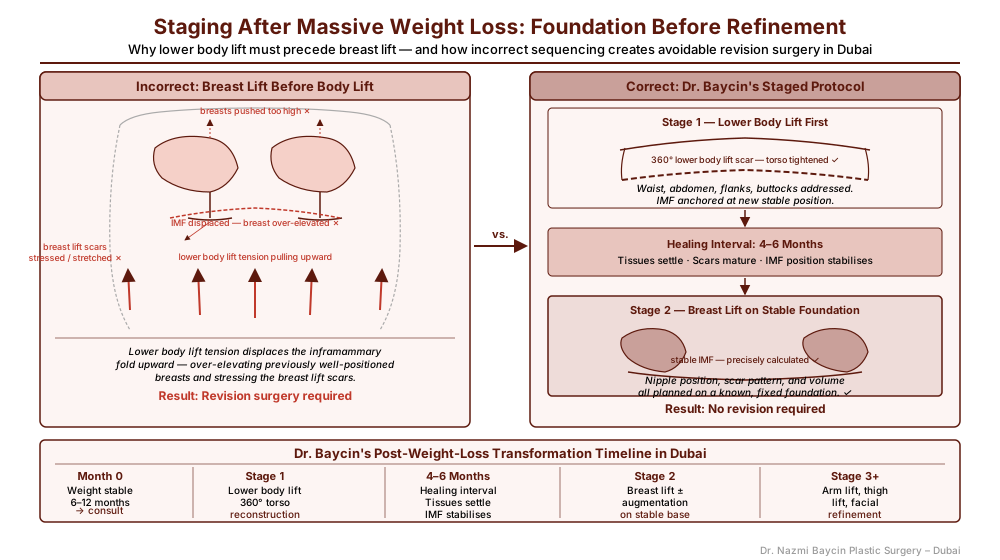
Sequencing after massive weight loss — the lower body lift is performed first, its upward tension re-setting the inframammary fold and trunk foundation; after a four to six month interval the breast lift is designed on that now-stable base, avoiding the over-elevation and scar stress seen when the breast is lifted first — by Dr. Nazmi Baycin, Dubai.
My staged protocol: the lower body lift as the first act
For the vast majority of my post-weight-loss patients, the journey begins with the lower body lift. This is not merely an extended tummy tuck; it is a 360° reconstruction of the lower torso addressing the abdomen, flanks, lower back, and buttocks, often with a lateral thigh component.
By removing the heavy, descending apron of skin and reinforcing the core, I restore structural integrity (repair of abdominal muscle diastasis and fascial tightening improves core strength and posture), establish the final tension vectors (the skin envelope is re-draped and secured under its final, permanent tension), and define the waist and trunk proportion (creating the stable silhouette on which upper-body aesthetics are designed). Patients seeking to understand this foundational procedure can explore my approach to body lift surgery in Dubai.
Lower body lift first versus breast lift first
The table below sets out why establishing the lower-body foundation first protects the accuracy and durability of the breast result.
| Factor | Lower Body Lift First ✓ | Breast Lift First ✗ |
|---|---|---|
| IMF position at breast surgery | Stable and fixed | Will shift after subsequent lower body lift |
| Breast position accuracy | Precisely calculable | At risk of over-elevation post-body-lift |
| Breast lift scar tension | Placed under minimal tension | Stressed by subsequent lower body lift |
| Shape durability | Designed for long-term stability | May require revision after body lift |
| Nipple height planning | Based on stable anatomy | Based on anatomy that will change |
| Risk of requiring revision | Minimized | Higher — shape distortion likely |
| Recommended by Dr. Baycin | ✓ Standard protocol | Only in specific functional exceptions |
| Supported by clinical literature | ✓ | ✗ |
The exceptional cases: when a breast lift may come first
While the standard sequence is lower-torso first, my approach is always personalized, and there are specific, less common scenarios where I may recommend addressing the breasts earlier. A severe functional burden — where breast hypertrophy and ptosis cause chronic pain, deep shoulder grooving, or recurrent skin infections — can make addressing the breasts a quality-of-life priority.
Mild lower body laxity, where weight loss has left significant breast ptosis but only moderate lower-body skin excess, means the tension ripple effect is less pronounced. And occasionally a staged patient preference — an urgent professional or personal need for breast contour — shifts the order.
Even in these cases, planning is everything: I design the breast lift with the future lower body lift in mind, using techniques and scar placements that can accommodate future shifts in tension. For patients in this category, exploring breast lift surgery in Dubai begins with a conversation about the long-term, comprehensive plan.
The crucial interval: why healing time between surgeries is non-negotiable
Patience is a critical component of success, so I mandate a minimum interval of four to six months between the lower body lift and the breast lift. This period is not arbitrary; it is biologically necessary. During this time the tissues fully settle — the dramatic swelling from the major lower-body procedure resolves, revealing your true new contour; the scars begin maturation, softening and relaxing into their final position so I can assess their influence on adjacent areas; and you regain strength, your body recovering fully and preparing for the next stage with resilience. Rushing this interval risks operating on unstable, still-healing tissues, which compromises the precision and outcome of the breast lift.
The final stage: upper-body harmony on a stable foundation
Once your torso is stable, planning the breast lift becomes an exercise in refined artistry. With a fixed inframammary fold and known skin tension, I can precisely calculate the new nipple position for ideal lifelong proportion and choose the optimal surgical pattern (lollipop versus anchor) with confidence.
Where significant volume has been lost, I also determine whether volume restoration — through autologous tissue rearrangement or an implant — will give the best shape. The result is a breast contour perfectly balanced with your new waist and torso, designed to last for decades without distortion. Because each stage is individual, its plan and cost are mapped transparently and phased across the program at consultation. This staged, foundation-first philosophy runs through all of my plastic surgery work in Dubai.
FAQs about lower body lift vs. breast lift sequencing after massive weight loss in Dubai
-
Should I have a lower body lift or breast lift first after massive weight loss?
In the vast majority of cases, I perform the lower body lift first. The circumferential tightening of the lower body lift generates upward tension through the torso that can displace the inframammary fold — the anatomical foundation of the breast — upward. If a breast lift has already been performed, this displacement over-elevates the breast and stresses the breast-lift scars, frequently requiring revision. By establishing the lower-body foundation first and allowing four to six months for the tissues to stabilize, I can plan and execute the breast lift on a fixed, predictable anatomical base.
-
Can I have a lower body lift and breast lift at the same time?
In most post-weight-loss cases, I do not advise combining these two major procedures in a single session. The operative time of each is significant — four to six hours or more for the lower body lift, two to four hours for a post-weight-loss mastopexy — and combining them creates excessive anesthesia duration with proportionally higher complication risk. More importantly, performing both at once eliminates the healing interval that lets the lower body lift’s tension changes stabilize before I plan the breast lift. I stage these procedures as two dedicated sessions four to six months apart.
-
How long do I need to wait between lower body lift and breast lift surgery in Dubai?
I require a minimum of four to six months. This interval lets the dramatic swelling from the lower body lift fully resolve, reveals the true new contour and the stable position of the inframammary fold, and allows the scars to mature and relax into their final position. If I operate before this interval is complete, I am planning the breast lift on anatomy that is still actively changing — producing results that shift as the healing continues.
-
How long after massive weight loss should I wait before starting body contouring surgery?
I require a minimum of twelve months of stable weight before I plan any body contouring stage. This ensures the anatomy I am planning for is the final anatomy — not one that will keep changing as weight loss continues. For patients who have lost weight through bariatric surgery, I measure this twelve-month minimum from when the weight plateau was reached, not from the date of the bariatric procedure itself.
-
What is included in a lower body lift after massive weight loss?
When I perform a lower body lift after massive weight loss, it is a 360° circumferential procedure addressing the entire lower trunk: the anterior abdomen (including diastasis recti repair), the flanks, the lateral and posterior lower back, and typically the upper buttocks. The incision runs completely around the body, usually in the bikini-line zone. I aim for a tighter, flatter anterior abdomen, a defined waistline, improved flank and hip contour, and a lifted buttock position. This is a significantly more extensive procedure than a standard tummy tuck and requires four to six hours of operative time.
-
Will I need an implant with my breast lift after weight loss?
Many patients who have experienced significant breast volume loss after massive weight loss benefit from combining a breast lift with volume restoration — either through autologous tissue rearrangement (auto-augmentation) or through an implant. I make this decision at the Stage 2 consultation, once the lower body lift has healed and I can accurately assess the stable breast anatomy — when the breast’s true volume needs are apparent on a settled, post-lift torso.


GET APPOINTMENT
Get ready to look and feel best… You deserve…
