

Key takeaways: function protects beauty
- Good blepharoplasty does not cause dry eye — but poor planning can unmask it.
- The tear film depends on a complete blink and a well-positioned lower lid.
- At-risk patients can be identified before surgery through careful screening.
- Conservative resection preserves the muscle that drives a full, protective blink.
- Canthal support (canthopexy/canthoplasty) protects the tear pump and prevents exposure.
- Early dryness is usually transient, resolving as swelling settles over four to six weeks.
The ophthalmic literature makes the same case. A 2020 review of cosmetic blepharoplasty and dry eye disease sets out the mechanisms by which the operation can cause or worsen dry eye, and concludes that the incidence of postoperative dry eye can be reduced when appropriate clinical interventions are made preoperatively, intraoperatively, and postoperatively. It is a narrative review rather than a pooled analysis, so it frames the problem rather than quantifying how much of it is avoidable — but that three-phase structure mirrors exactly how I approach every eyelid case, because a good outcome is engineered long before and long after the operation itself, not just during it.
Why eyelid surgery and the tear film are linked
To understand the risk, it helps to understand how the eye stays comfortable in the first place. The tear film is a thin, three-layered coating spread across the eye with every blink: an oily outer layer from the meibomian glands in the lid margins that slows evaporation, a watery middle layer from the lacrimal glands, and a mucous inner layer that helps everything adhere. Two things keep that film healthy — a complete, forceful blink that resurfaces the eye, and a lower lid that sits snugly against the globe to hold tears in their reservoir and pump them toward the drainage system.
Eyelid surgery touches precisely these structures. If too much skin or muscle is removed, the blink weakens or the lids no longer close fully, so the film dries out between blinks. If the lower lid loses tone or is pulled downward, the tear reservoir is disrupted and the eye is more exposed to the air. Seen this way, dry eye after blepharoplasty is not a mysterious complication but a predictable consequence of specific, avoidable technical errors — which is exactly why it can be designed out of the procedure.
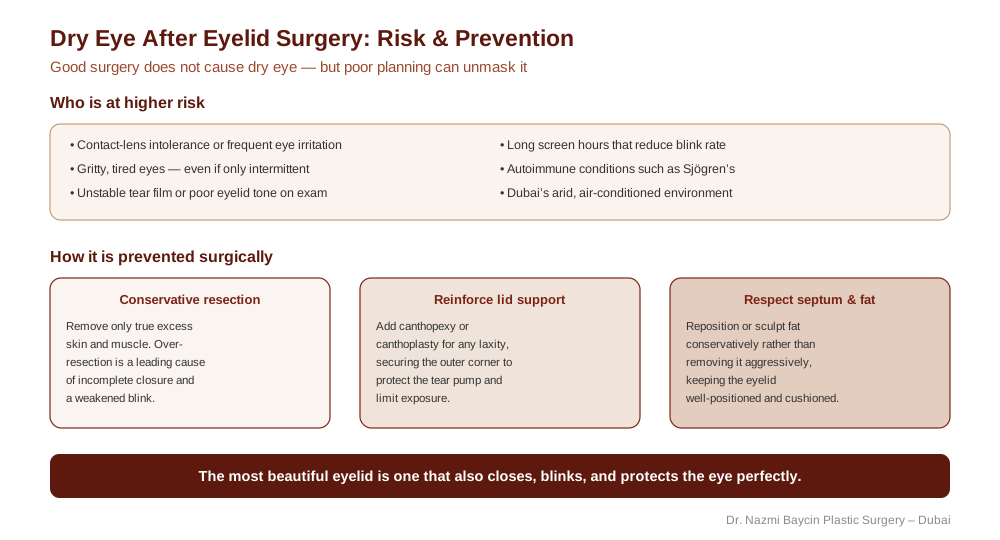
Who is at risk for dry eye after eyelid surgery, and the three surgical principles that prevent it — by Dr. Nazmi Baycin, Dubai.
The preoperative assessment: identifying the at-risk patient
The journey to a safe outcome in Dubai begins with a meticulous preoperative evaluation, because the single most effective way to prevent postoperative dry eye is to know who is vulnerable before any incision is made. I systematically screen for the factors that predispose a patient to dry eye symptoms after surgery, and I ask about them specifically rather than waiting for a patient to volunteer them. The table below summarizes what I look for and why each matters.
| Risk Factor | Why It Matters |
|---|---|
| Contact-lens intolerance or frequent irritation | Signals an already-marginal tear film with little reserve |
| Prolonged screen time | Reduces blink rate and completeness, worsening evaporation |
| Gritty or tired eyes, even intermittently | Suggests subclinical dry eye that surgery could tip over |
| Autoimmune conditions (e.g. Sjögren syndrome) | Directly reduces tear production and ocular surface stability |
| Unstable tear film or poor eyelid tone on exam | Predicts weaker closure and a higher exposure risk after surgery |
In this climate, almost every patient carries some degree of evaporative stress, so this assessment is not a formality. It lets me stratify risk, optimize the ocular surface beforehand where needed — for example by treating meibomian gland dysfunction or starting a lubrication regimen weeks before surgery — and tailor the operation itself to the individual.
For a genuinely high-risk patient, that might mean choosing a more conservative resection, adding lower-lid support that I might otherwise not need, or, occasionally, advising against a purely cosmetic lower-lid procedure altogether. Honest risk assessment sometimes means recommending less surgery, not more, and that judgment is central to how I counsel every eyelid patient.
The anatomy of a safe surgery: technical principles that protect function
My surgical technique in Dubai is deliberately designed to preserve and support the eyelid’s dynamic function, and it rests on three principles I apply without exception.
- The first is conservative skin and muscle resection: the goal is to remove only the true excess, because over-resection of skin or of the underlying orbicularis oculi muscle is a primary cause of lagophthalmos, or incomplete eyelid closure. The orbicularis is the muscle that powers the blink, so I measure carefully and preserve its integrity to maintain a strong, complete blink rather than chasing a dramatic but unsafe reduction.
- The second principle is reinforcing eyelid support. The position and tone of the lower eyelid are paramount, and for any patient with even mild laxity I integrate a lateral canthopexy or canthoplasty, securing the outer corner of the eyelid to the orbital rim. This prevents the downward pull or rounding that would otherwise disrupt the tear pump mechanism and increase ocular exposure. It is the same canthal-support logic I describe in my article on preventing lower-eyelid retraction through canthal support.
- The third principle is respecting the orbital septum and fat: the orbital fat pads act as a protective cushion, so I reposition or conservatively sculpt herniated fat rather than removing it aggressively, which helps maintain a healthy eyelid position. Preserving and re-draping the orbicularis rather than excising it is a theme I return to in detail in my piece on orbicularis suspension techniques in lower blepharoplasty.
Together, these decisions separate a procedure that merely removes tissue from one that rejuvenates while safeguarding comfort — and the same function-first mindset guides how I approach eyelid surgery in Dubai as a whole.
Why surgical approach and sequencing matter
The choice of surgical approach also influences dry eye risk: transconjunctival techniques, which leave the orbicularis muscle undisturbed, tend to carry a lower dry eye burden than skin-muscle flap approaches that divide it. Where a patient’s anatomy allows, favoring the gentler approach is one more way to protect the blink.
Sequencing matters too. The upper face works as a system: a brow that sits too low can masquerade as excess upper-lid skin, and removing that skin instead of addressing the brow can compromise closure. Getting the diagnosis and the order of operations right is essential, which is why I plan the eyes within the context of the whole upper face, drawing on the principles in my article on the triad technique for natural eye rejuvenation. This functional focus is equally critical when a brow lift is involved, because altering the upper facial dynamics can subtly change how completely the eyelids close, and a plan that ignores that interaction can create exposure where none existed before.
Adapting postoperative care to the environment
The local climate in Dubai is a significant variable in my postoperative protocol, because dry, dusty air and constant air conditioning challenge tear film stability at precisely the moment the eye is most vulnerable. My aftercare instructions are therefore specific rather than generic.
I prescribe a structured regimen of preservative-free artificial tears, often with an ointment for nighttime use during the early healing phase, to keep the surface protected while the blink recovers. I advise patients to use humidifiers at home and in the office and to consciously increase their blink frequency, especially when using digital devices, since screen work is one of the most common everyday causes of incomplete blinking. And I emphasize strict sun protection with wrap-around sunglasses outdoors, to shield the eyes from wind and ultraviolet light during the vulnerable healing period.
These measures are not incidental comfort advice; they are an active part of preventing a transient dryness from becoming an entrenched problem, and patients who follow them closely recover more smoothly.
Temporary discomfort versus a lasting complication
I make sure every patient understands the difference between normal recovery and a true complication, because that distinction prevents a great deal of unnecessary anxiety. It is entirely normal to experience some transient dryness or irritation in the early weeks, driven by temporary swelling, a briefly altered blink reflex, and healing tissues.
This typically settles within the first four to six weeks as the swelling subsides and normal function returns. What is not normal is dryness that persists or worsens beyond that window; that is uncommon and usually points to an underlying issue — unrecognized pre-existing dry eye, over-resection, or inadequate lid support — that warrants prompt evaluation rather than simply waiting it out.
Clear communication about this timeline, set out honestly before surgery, means patients know what to expect, recognize reassuring signs, and understand exactly when to raise a concern. Because each patient’s ocular surface, anatomy, and risk profile are different, both the surgical plan and its cost are best worked out at a consultation focused as much on the health of the eye as on the aesthetics of the result.
Excellence is measured in comfort as well as contour
Eyelid rejuvenation is an alliance between aesthetic artistry and physiological science, and it fails if it delivers one without the other. My commitment is to results that let patients look refreshed and feel completely comfortable — in their skin and in their eyes. By identifying at-risk patients, employing precise, function-preserving techniques, and providing aftercare targeted to this specific environment, I treat dry eye as a preventable concern rather than an accepted trade-off.
That is the standard anyone should expect from a board-certified plastic surgeon in Dubai: an approach that protects the way your eyes work just as carefully as it refines the way they look. For anyone considering this procedure, a consultation focused on the health of the ocular surface as much as the beauty of the result is the right place to begin.
FAQs about dry eye after eyelid surgery in Dubai
-
Does eyelid surgery cause dry eye?
A well-planned, well-executed blepharoplasty does not cause dry eye disease, but it can unmask or worsen a pre-existing tendency if the surgery does not respect the ocular surface. Dry eye after eyelid surgery usually traces back to specific, avoidable factors — over-resection of skin or muscle that weakens the blink, or loss of lower-lid support that increases exposure. When the muscle is preserved, the lid is properly supported, and at-risk patients are identified in advance, the risk is low and any early dryness is typically temporary. In other words, it is far more a question of planning and technique than of the operation itself.
-
Who is most at risk of dry eye after blepharoplasty?
The highest-risk patients are those who already have a marginal tear film. That includes people with contact-lens intolerance or frequent eye irritation, those who spend long hours on screens (which reduces blink rate), and anyone with gritty or tired eyes even intermittently. Autoimmune conditions such as Sjögren’s syndrome directly reduce tear production, and clinical signs of an unstable tear film or poor eyelid tone raise the risk further. Living in an arid, air-conditioned environment adds evaporative stress on top of all of these. Identifying these factors before surgery is exactly why a thorough preoperative assessment matters so much.
-
How is dry eye prevented during surgery?
Prevention rests on three surgical principles. First, conservative resection — removing only the true excess skin and muscle, so the orbicularis muscle that powers a complete blink is preserved. Second, reinforcing lower-lid support with a canthopexy or canthoplasty in any patient with laxity, which secures the outer corner of the lid, protects the tear pump, and prevents downward pull or rounding. Third, respecting the orbital septum and fat by repositioning or conservatively sculpting it rather than removing it aggressively, which keeps the eyelid well-positioned. Choosing a gentler surgical approach where anatomy allows adds a further margin of safety.
-
How long does dry eye last after eyelid surgery?
For most patients, any dryness or irritation is transient and settles within the first four to six weeks. Early on, temporary swelling, a briefly altered blink reflex, and healing tissues can leave the eyes feeling gritty or watery, but this improves steadily as the swelling resolves and normal function returns. Persistent or worsening symptoms beyond that window are uncommon and usually indicate an underlying issue — such as unrecognized pre-existing dry eye or inadequate lid support — that should be evaluated rather than simply waited out. Knowing this timeline in advance helps patients tell reassuring signs from ones worth reporting.
-
Can I still have eyelid surgery if I already have dry eyes?
Often yes, but it requires careful assessment and planning. Having some dry eye does not automatically rule out surgery; it means the ocular surface should be optimized beforehand and the operation tailored to protect it. That might involve treating meibomian gland dysfunction, starting a lubrication regimen weeks ahead, choosing a more conservative resection, or adding lower-lid support. In some cases, particularly with significant dry eye, I may advise against a purely cosmetic lower-lid procedure or recommend a more limited operation. The point of the preoperative assessment is precisely to make that judgment safely and individually, rather than applying a blanket rule.
-
Does the type of eyelid surgery affect dry eye risk?
It can. Approaches that leave the orbicularis muscle undisturbed, such as transconjunctival lower blepharoplasty, tend to carry a lower dry eye burden than skin-muscle flap techniques that divide the muscle. Where a patient’s anatomy allows the gentler approach, it offers an added margin of safety for the blink. The extent of skin and fat removal matters too — conservative, function-preserving surgery consistently protects the ocular surface better than aggressive tissue removal. This is why the surgical plan is individualized: the right approach depends on the anatomy, the goals, and the patient’s baseline dry eye risk rather than a single default technique.
-
What can I do to reduce dry eye risk after surgery?
The most important step is to follow the tailored aftercare plan closely. That usually means using preservative-free artificial tears on the prescribed schedule, applying a nighttime ointment during early healing, and protecting the eyes with wrap-around sunglasses outdoors. Using a humidifier at home and at work counters the drying effect of air conditioning, and consciously blinking more fully during screen work helps resurface the tear film. Attending your follow-up appointments matters too, so any early signs can be addressed promptly. Combined with good surgical technique and honest preoperative screening, these habits keep dry eye a temporary, manageable phase rather than a lasting problem.


GET APPOINTMENT
Get ready to look and feel best… You deserve…
