

No two breasts are born twins. In nature, perfect symmetry is the exception, not the rule — and in my Dubai practice, the patients who come to me seeking balance are not chasing an impossible ideal, but a quiet correction to an asymmetry that has shaped how they see themselves for years.
I do not approach breast asymmetry as a single operation with a single answer. I approach it as two separate sculptures asked to resolve into one harmonious form. Each breast carries its own history in its tissue, its own elasticity, its own relationship to the chest wall beneath it — and each, therefore, demands its own surgical decision.
This is the discipline at the center of my Dubai practice: not forcing both sides toward an artificial match, but listening to what each breast individually requires, so that the result reads not as “corrected,” but simply as natural.
What is breast asymmetry, and when should it be corrected?
Breast asymmetry refers to a visible difference between the two breasts in size, shape, or position. It can be present from puberty or develop later due to pregnancy, weight change, ageing, or prior surgery.
Correction becomes worth considering when the difference causes physical discomfort, makes clothing or swimwear difficult to fit, or affects self-confidence. There is no medical requirement to treat asymmetry — the decision is personal, and the right outcome is comfort and balance, not exact symmetry.
Am I a candidate for breast asymmetry correction?
You may be a good candidate for breast asymmetry correction if:
- Your breasts are fully developed (typically from age 18)
- You are in good general health and a non-smoker, or willing to stop smoking before and after surgery
- You have a noticeable difference in breast size, shape, or nipple position
- You are not currently pregnant or breastfeeding, and have completed your family planning or are not planning a pregnancy in the near future
- You have realistic expectations about achieving balance rather than perfect symmetry, since no two breasts are ever identical
When you consult with me at my Dubai clinic, I begin with a full medical history review, a physical examination, and detailed measurements and photography to confirm candidacy and plan the right combination of techniques for your anatomy.
The diagnostic process: decoding the layers of asymmetry
True correction starts with a detailed assessment that goes beyond comparing cup sizes. In my practice, I classify asymmetry into distinct categories, since each requires a different surgical answer.
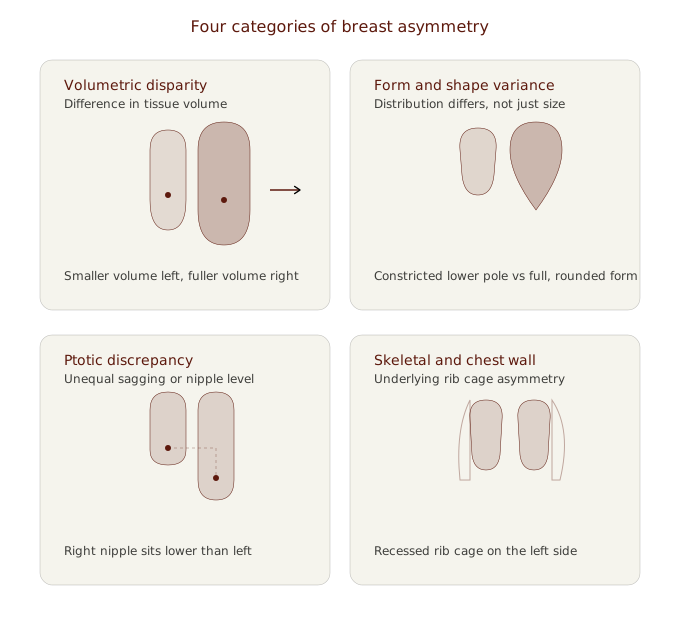
Volumetric disparity
A difference in the amount of glandular and fatty tissue between the two breasts. This is the most common form of asymmetry and the most straightforward to correct with augmentation or reduction.
Form and shape variance
A difference in how breast tissue is distributed — for example, a constricted lower pole on one side and fullness on the other. This often requires reshaping rather than simply adding or removing volume.
Ptotic discrepancy (uneven sagging)
An unequal degree of sagging or nipple position between the two breasts. This is corrected with a tailored lift, planned separately for each side.
Skeletal and chest wall influence
Underlying asymmetry in the chest wall or rib cage can affect how breasts appear, even when breast tissue itself is similar. Soft tissue surgery cannot fully correct skeletal asymmetry, but careful implant selection can visually balance it.
A common mistake in less detailed evaluations is focusing on volume alone. This can leave other forms of asymmetry uncorrected or even make them more visible. My consultation process is built to catch all four categories before any surgical plan is finalized.
Surgical techniques for correcting breast asymmetry
Correcting asymmetry typically means applying different techniques to each breast, with the explicit goal of meeting in the middle rather than copying one side exactly.
Augmentation and reduction as complementary techniques
When one breast is smaller, I bring it into balance using an implant matched not just to size, but to chest width and the existing breast footprint. To learn more about how implants are selected and placed, visit my breast augmentation in Dubai page. In tuberous breast deformity, this can require a releasing incision and scoring technique to expand a constricted base before the implant is placed. To learn more about this specific condition, visit my tuberous breast correction in Dubai page.
For the larger breast, reduction is not simply about removing tissue. I reshape the larger breast to match the expected final shape of the augmented side, not its current shape. This often calls for different surgical techniques on each breast within the same operation. To learn more about this technique on its own, visit my breast reduction in Dubai page.
The role of a breast lift (mastopexy) in asymmetry correction
When the degree of sagging differs between breasts, I plan a tailored lift for each side individually. Incision pattern, nipple repositioning, and the amount of skin removed are calculated separately for each breast, so that both nipples end up level and naturally placed — regardless of where they started. To learn more about this procedure, visit my breast lift (mastopexy) in Dubai page.
Combined approach: the gold standard for complex cases
Most significant asymmetries need an integrated plan combining more than one technique. A typical example: one breast receives a reduction with a lift, while the other receives an augmentation with a different implant placement and a smaller lift. This level of customization is the standard I apply for every breast asymmetry correction I perform in Dubai.
Technical considerations beyond volume
Chest wall asymmetry
For a subtly raised or recessed rib cage, I may use a slightly larger implant on the recessed side. This projects the breast forward and visually levels the chest contour.
Inframammary fold correction
When the fold beneath one or both breasts sits at different heights, internal suturing repositions it to create a matching foundation for both breasts.
Areola size and pigmentation differences
Differences in areola diameter or color are corrected through concentric areolar reduction or, for color matching, fractional laser treatment.
How much does breast asymmetry correction cost in Dubai?
In my Dubai practice, the cost of breast asymmetry correction typically ranges from AED 20,000 to AED 60,000. The exact price depends on which combination of techniques is required — augmentation alone is at the lower end, while combined augmentation, reduction, and lift procedures are at the higher end. Implant type and hospital fees also affect the final cost. I provide a personalised quote after your consultation and physical assessment.
What does recovery look like after breast asymmetry correction?
Recovery depends on which combination of techniques I used. Most of my patients in Dubai take 5 to 7 days off work and avoid strenuous activity for 2 to 3 weeks. Swelling and bruising are most noticeable in the first 1 to 2 weeks. Because each breast may have had a different procedure, healing can progress at a slightly different pace on each side — this is expected and resolves as both breasts settle. Final results, including symmetry, are typically visible at 3 to 6 months once all swelling has resolved.
Why choose me for breast asymmetry correction in Dubai
Asymmetry correction is, in my view, the truest test of a surgeon’s eye. Augmentation alone rewards a steady hand. Asymmetry correction rewards judgement — the ability to look at two unequal breasts and see not what is wrong with each, but what they could become together.
I have built my practice in Dubai around this conviction: that surgical mastery is not measured by how closely a result follows a textbook technique, but by how invisibly it disappears into the patient’s own anatomy. Over more than 25 years and thousands of breast procedures, I have come to trust this principle more than any single method — because no two patients, and no two breasts, ever ask the same question of the surgeon.
This philosophy is not sentiment; it is supported by evidence. A 2019 study published in Aesthetic Plastic Surgery on long-term outcomes found that treating each breast according to its own anatomy — rather than mirroring one side onto the other — produced the highest patient satisfaction and the most durable results. It is the same approach I bring to every consultation, performed exclusively in JCI-accredited hospitals in Dubai, under the standard of care I would expect for my own family.
Harmony as the highest form of beauty
Correcting breast asymmetry is, in the end, an act of restoration rather than alteration. It does not impose a new form on the body. It uncovers the balance that was always meant to be there, hidden beneath an inequality of tissue, time, or chance.
What I offer is not a guarantee of perfect symmetry — no surgeon can promise that, and no honest one should. What I offer is a silhouette that moves naturally, clothing that fits with ease, and the quiet confidence of finally feeling at home in one’s own body.
If breast asymmetry is something you would like to address, I invite you to a consultation at my Dubai clinic, where we will look closely at your anatomy and shape a plan built for you alone. To understand the philosophical framework behind such personalized, restorative work, I welcome you to explore the principles that guide my practice as a leading cosmetic surgeon in Dubai.
FAQs About breast asymmetry correction in Dubai
-
Is it normal to have asymmetrical breasts?
Yes. Most women have some natural difference between their breasts in size, shape, or position. It becomes a candidate for correction only when the difference causes physical discomfort or affects confidence.
-
What causes breast asymmetry?
Breast asymmetry can be present from puberty, or develop later due to pregnancy, breastfeeding, significant weight change, ageing, or a previous breast surgery. Chest wall or rib cage differences can also contribute.
-
Can breast asymmetry be fixed with just an implant?
Sometimes, if the only difference is volume. However, many cases involve a combination of shape, position, and chest wall differences that require augmentation combined with a lift or reduction on one or both sides.
-
Will my breasts be perfectly identical after surgery?
No two breasts are ever perfectly identical, even after surgery. The goal of asymmetry correction is a natural, balanced appearance rather than exact symmetry.
-
How long does breast asymmetry correction surgery take?
Surgery time depends on the combination of techniques used. A single-technique procedure on one side may take 1 to 2 hours, while combined augmentation, reduction, and lift procedures can take 2 to 4 hours.
-
Is breast asymmetry correction painful?
Most patients describe moderate discomfort for the first few days, managed with prescribed pain medication. Discomfort typically decreases significantly within the first week.
-
Can asymmetry return after correction surgery?
Significant weight changes, pregnancy, or natural ageing can affect results over time, the same as with any breast surgery. Following post-operative guidance and maintaining a stable weight helps preserve results long-term.


GET APPOINTMENT
Get ready to look and feel best… You deserve…
