

Key takeaways: why sequence matters
- The face ages as an integrated unit — skin, fat, muscle, and bone change interdependently.
- Operating on one area without anticipating its effect on another is the root cause of results that look operated.
- The optimal sequence runs top-to-bottom, deep-to-superficial: brow → upper eyelid → lower eyelid/midface → facelift.
- Lifting the brow first reduces apparent upper-eyelid excess, preventing over-resection.
- Repositioning the midface supports the lower eyelid, so standalone lower blepharoplasty is rarely needed.
- The facelift comes last, re-draping preserved tissue onto a fully restored foundation.
This article is about the order, not about the operations themselves. How a facelift is performed — which plane the dissection runs in, and what that buys in longevity — belongs to the pages that treat it directly. What is settled here is which step comes first, and why that ordering decides whether the result reads as rested or as operated.
The anatomical conversations: why sequence matters
The face ages as an integrated unit, but not at the same rate — skin, fat, muscle, and bone undergo interdependent changes, and a critical mistake is operating on one area without anticipating its effect on another. Consider the brow-and-eyelid dialogue: elevating a sagging brow naturally reduces excess upper-eyelid skin, so performing an upper eyelid surgery in Dubai before addressing a low brow can lead to over-resection — and once the brow is later lifted, the patient can be left with a hollow, over-exposed, or even incompletely closing eyelid.
The midface-and-lower-eyelid junction behaves similarly: as the midface descends it deepens the nasolabial fold and creates a heavy, tired lower lid, so a facelift that repositions the midface upward automatically supports the lower eyelid and improves the tear trough, whereas isolating the lower eyelid without that support risks a distorted, pulled look. Finally, the whole skin-and-soft-tissue envelope matters: a facelift re-drapes the foundational tissues, so performing skin-excisional procedures first wastes tissue that could have produced a smoother, more integrated final result.
My planning therefore always starts with a global assessment of the primary vectors of aging — brow, midface, or neck — and designs a sequence where each step builds upon the next.
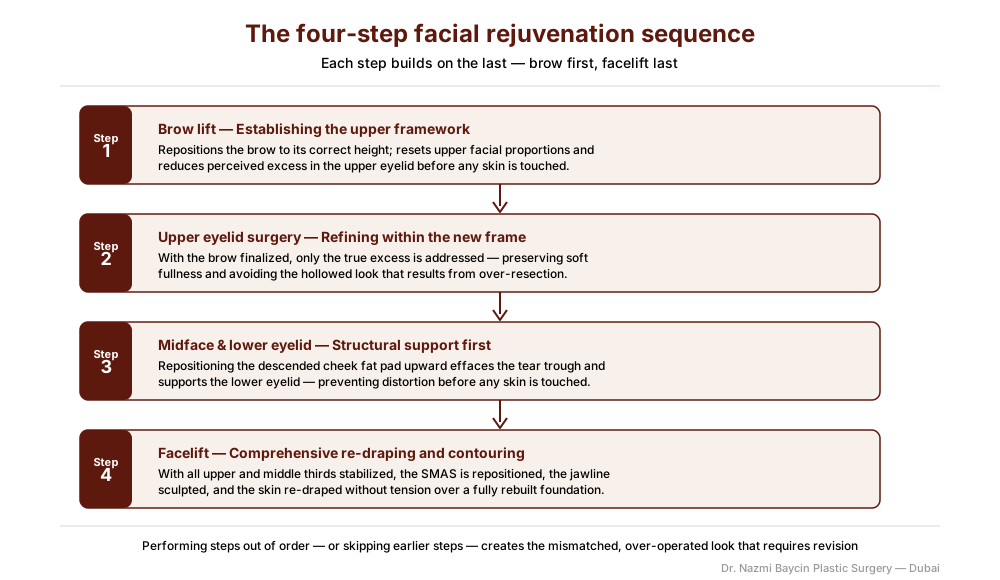
The strategic sequence for facial harmony: brow, upper eyelid, lower eyelid and midface, then facelift — each step establishing the framework for the next — by Dr. Nazmi Baycin, Dubai.
The strategic sequence: a stepwise surgical blueprint
The optimal sequence follows a logical, top-to-bottom, deep-to-superficial flow to ensure stability and naturalness.
- Step 1 is the brow lift, the foundational first step when indicated: by repositioning the brow to a graceful, natural height, it resets the entire upper facial aesthetic — reducing perceived excess in the upper eyelids, opening the orbital aperture for a more alert expression, and softening horizontal forehead lines — creating the stable upper benchmark from which all other proportions are balanced.
- Step 2 is the upper eyelid surgery: with the brow position finalized, the true amount of skin, muscle, and fat can be precisely assessed to create a crisp, open crease that harmonizes with the newly elevated brow, avoiding the hollowed or skeletonized upper eye.
- Step 3 is the lower eyelid and midface, the most technically nuanced step: rather than a standalone lower blepharoplasty, the descended malar fat pad is lifted and secured through advanced facelift techniques, which naturally effaces the tear trough, supports the lower eyelid, and restores cheek volume — only then is the lower-eyelid skin gently refined if needed.
- Step 4 is the comprehensive facelift in Dubai, addressing the lower two-thirds of the face and neck: with the upper and middle thirds already restored, the deep tissues of the lower face are repositioned, the jawline and submental region are sculpted, and the skin is re-draped without tension using the excess preserved by every step before it. How that repositioning is performed is the subject of the facelift itself; what the sequence contributes is that it happens last.
| Step | Procedure | What it establishes | Why this order |
|---|---|---|---|
| 1 | Brow lift | Resets brow height; the stable upper benchmark | Reduces apparent upper-eyelid excess before the eyelid is touched |
| 2 | Upper eyelid surgery | Crisp crease harmonized with the new brow | True skin excess can only be judged once the brow is fixed |
| 3 | Lower eyelid & midface | Malar fat lifted; tear trough effaced; lid supported | Structural support must precede any lower-lid skin refinement |
| 4 | Facelift | SMAS repositioned; jawline sculpted; skin re-draped | Final re-draping uses tissue preserved by not excising earlier |
The principle behind the plan
This philosophy of balance is not merely personal preference; the principle that a face is read as a set of proportions rather than as a collection of separate features is well established in the anatomical literature. A 2025 morphometric study of 100 young adults measured forty parameters across the face, eyes, nose and lips in order to build regression equations for individualized aesthetic planning, and takes as its starting premise that beauty cannot be explained by any single element, because harmony and symmetry rest on proportion. That premise is the paper’s framing rather than its finding, and its volunteers averaged twenty-one years of age, so it describes how a face is composed rather than how an aging one should be restored. The surgical inference — that proportion is precisely what sequencing exists to protect — is mine.
I consistently see patients seeking revision after poorly sequenced procedures, and the tell-tale signs are unmistakable — an over-operated upper eyelid beneath a low brow; a hollow, pulled lower eyelid disconnected from an untreated, descended cheek; or a tight lower face that contrasts with tired, aged eyes. These are not failures of individual techniques but failures of holistic planning: each procedure was technically completed yet anatomically isolated.
How I decide which vector of aging leads the plan
Before a single incision is planned, I study the face at rest and in motion to identify which vector of descent is doing the most damage to the overall balance. In one patient the dominant problem is a heavy, low brow that crowds the eyes and makes the whole upper face look tired; in another it is a deflated, descended midface that drags the lower lids down and deepens the folds around the mouth; in a third it is the neck and jawline that have lost definition while the eyes remain relatively fresh. Identifying that lead vector determines where the sequence starts and how much of the face needs to be addressed to keep it balanced.
Treating a secondary problem while ignoring the dominant one is what produces the disjointed, partially rejuvenated look — a smooth neck under tired eyes, or bright eyes above a heavy jaw. The art is not in performing every step, but in choosing which steps a particular face genuinely needs, and then ordering them so each one sets up the next rather than undermining it.
Why the order protects tissue
There is a second reason the order matters, and it is closer to arithmetic than to aesthetics. Every step that repositions a structure changes how much skin is genuinely redundant above and around it. Lift a brow, and the upper lid turns out to have less excess than it appeared to have. Reposition a midface, and the lower lid needs less refinement than it seemed to need. Restore the lower face, and skin that looked surplus at the outset is exactly the skin required to re-drape without tension.
So skin excised early is not simply skin removed early — it is skin removed from a calculation that had not yet been completed. Working top-to-bottom and deep-to-superficial keeps that calculation in the right order: each layer is set before the layer whose measurement depends on it, and the final re-draping is done against a face that has finished moving. What that final step involves — the plane of dissection, how the deep tissues are secured, and how long the result holds — is a question about the operation rather than about the sequence, and it is answered on my page on how the facelift itself is performed in Dubai.
The goal: invisible artistry
The highest compliment I receive is not that the surgery looks good, but that the patient looks wonderfully rested. The aim of strategic sequencing is to make the intervention itself undetectable: a face that moves naturally, expresses emotion freely, and possesses a coherence that feels inherent rather than constructed — the restoration of a person’s essential vitality, not the imposition of a new shape. Because the plan is tailored to your unique aging pattern and may combine several procedures in one setting or a planned staged sequence, the surgical blueprint is always individualized to your anatomy — designed around your features rather than a fixed formula.
FAQs about facial harmony and surgical sequencing in Dubai
-
Why does the order of facial procedures matter so much?
Because each area of the face influences the others. Lifting a descended brow automatically reduces apparent excess in the upper eyelid. Repositioning the cheek fat pad upward supports the lower eyelid and improves the tear trough. If you perform procedures in the wrong order, or in isolation, you either waste tissue, over-resect, or create a result where one area looks operated while another remains aged.
-
Can all four procedures be done in a single operation, or does it have to be staged?
In many cases, all four can be performed safely in a single surgical session, which is my preferred approach when anatomy and health allow. Combining procedures minimizes total recovery time and ensures each step immediately builds on the previous one while the tissue is still in a defined, unaltered state. Staging is reserved for patients whose health profile, anatomy, or extent of correction makes a single long operation inadvisable.
-
What happens if I’ve already had one procedure — can the sequence still be followed?
Yes, though the planning becomes more nuanced. Prior surgery creates altered tissue planes, scar adhesions, and sometimes depleted skin that must be accounted for. In these cases, I perform a thorough assessment of what was done, what was changed, and what margin remains before designing the sequence going forward.
-
Why do you rarely perform a standalone lower blepharoplasty?
Because isolated lower eyelid surgery without first addressing the descended midface removes a symptom without treating the cause. The apparent lower eyelid excess is largely the result of the cheek fat pad descending and creating a hollow at the lid-cheek junction. When the midface is repositioned first, this hollow effaces and the lower eyelid is naturally supported — eliminating the need for aggressive skin excision that risks retraction and an unnatural, pulled look.
-
What does a poorly sequenced result look like, and can it be corrected?
The signs are recognizable: an over-operated upper eyelid beneath a low, unlifted brow; a hollow, retracted lower eyelid disconnected from a heavy, untreated cheek; or a tight, smooth lower face that contrasts sharply with tired, aged eyes. These are the classic revision presentations. Correction is possible but significantly more complex than doing it right the first time, since tissue has been altered, adhesions have formed, and the available margin for re-operation has been reduced.
-
How long is recovery when several procedures are combined in one operation?
Combining procedures doesn’t multiply the recovery. Because it’s a single anesthetic and one healing period, downtime is broadly similar to a facelift alone rather than the sum of each procedure done separately. Most visible swelling and bruising settle over the first two to three weeks, and the eyes generally recover faster than the lower face and neck. I give every patient a specific timeline based on exactly which steps were performed, and the deeper tissue repositioning continues to refine quietly over the following months.


GET APPOINTMENT
Get ready to look and feel best… You deserve…
