

Key takeaways: why male surgery is different
- Male surgery is not female surgery on a male body — the anatomy, aging, and goals differ.
- Masculine features are structural: sloping brow with prominent ridges, higher radix, straight dorsum, squarer jaw, broader chin, thicker skin.
- Men age with deeper creases, heavier jowls, and hooding rather than fine lines.
- The male nose keeps a straight/strong dorsum and minimal tip rotation — the opposite of many feminine goals.
- The male chest needs direct excision of dense glandular tissue, not liposuction alone.
- The guiding philosophy is enhance, do not change — restraint, because small over-corrections read as feminized or unnatural.
The anatomy of masculinity
To treat a male patient successfully, one must first understand what makes a face or body read as masculine — and these are not arbitrary cultural preferences, but features rooted in skeletal and soft-tissue structure. The male face has a more sloping forehead with prominent supraorbital ridges, a squarer jawline with a defined gonial angle, and a broader, more projecting chin. The skin is thicker, contains more collagen, and carries hair follicles that must be respected. The nose has a higher radix, a straighter dorsum, and a less rotated tip. These are the very architecture of masculine beauty, and every surgical choice has to work with them.
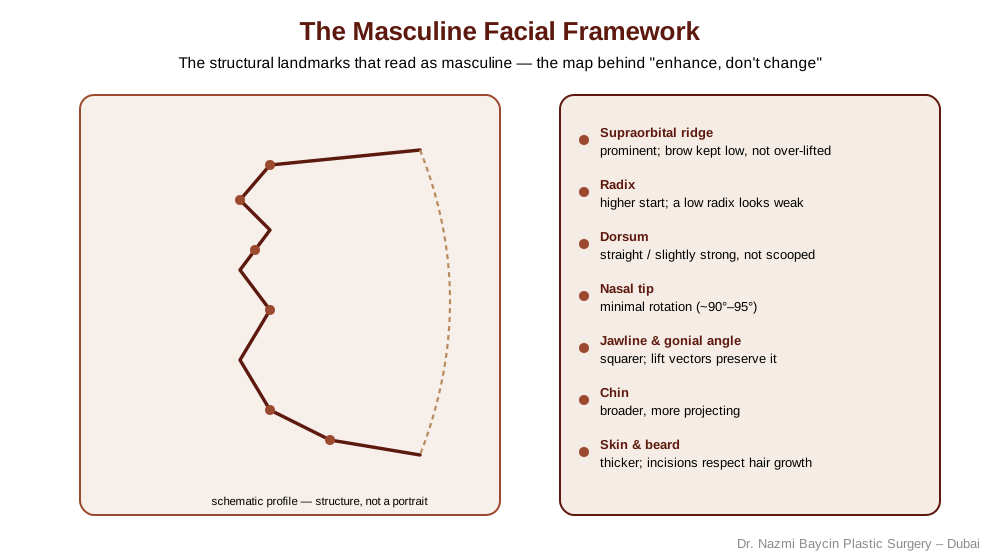
The structural landmarks that read as masculine — the map behind the philosophy of enhance, do not change — by Dr. Nazmi Baycin, Dubai.
This article is about that map, and about what it changes. It is not an account of the operations themselves: beard distribution governs where a male facelift incision goes, the lift vectors are chosen to keep the jawline square rather than to produce a soft oval, and the lateral brow is left where it is, because raising it is what reads as surprised or feminized. What changes for a man is the plan. The dissection, the candidacy and the recovery are the operation’s own subject, and I set them out on my page on facelift surgery in Dubai. The table below summarizes how several common male procedures diverge from their female counterparts.
| Area | Male-specific priority | What is deliberately avoided |
|---|---|---|
| Facelift | Vectors that preserve a strong jawline; incisions respecting beard growth | Soft, oval contour; over-lifted lateral brow |
| Eyelids (blepharoplasty) | Preserve natural masculine hooding; reduce only functional excess | Over-resection that creates a hollow, feminized look |
| Rhinoplasty | Straight/strong dorsum; minimal tip rotation (~90–95°); higher radix | Scooped dorsum; over-rotated, delicate tip; low radix |
| Chest (gynecomastia) | Direct excision of dense glandular tissue for a flat contour | Liposuction alone; concave “crater” deformity |
| Body contouring | Flank and abdominal sculpting toward a V-shaped taper | Generic fat reduction without masculine shaping |
The aging male face: a different timeline
Men age differently: collagen and elastin loss is more gradual, but when it shows, it appears as deeper creases, heavier jowls, and more pronounced nasolabial folds rather than the fine lines that trouble women. The brows descend into a hooded, tired appearance, the lower lids develop bags and laxity, and the jawline softens as jowls form, often with neck banding and submental fullness — changes that can make a man look older, angrier, or more fatigued than he feels.
This is where a male blepharoplasty parts company with a female one. The masculine eye is meant to be hooded, and over-resecting upper-eyelid skin produces exactly the hollow, feminized upper lid that men later come to me to have corrected. So the male-specific judgement is not how to lift the lid but how little to take: enough to relieve the tired look or the visual obstruction, and no more. How that operation is performed, and who is a candidate for it, belongs to my page on eyelid surgery. The judgement is what belongs here, and it is refreshment rather than transformation.
The male nose: strength and harmony
Rhinoplasty is perhaps where the difference between masculine and feminine approaches is most pronounced. Where a female nose often benefits from a slightly scooped dorsum, a rotated tip, and soft contours, the male nose requires the opposite: a straight or slightly strong dorsal line, minimal tip rotation (usually 90 to 95 degrees), broader nasal bones, and a tip refined without being made delicate.
I also pay close attention to the nasofrontal angle and radix, because a low radix that looks elegant on a female patient can make a male nose appear weak and under-projected. Those are questions about the patient rather than about the operation. Graft choice, osteotomies and the approach itself are questions about the operation, and they are answered on my page on rhinoplasty in Dubai. Managed carefully, these relationships create a nose that strengthens the whole face in harmony with a strong jaw and brow, without drawing attention to itself as “surgical.”
The male chest: beyond gynecomastia
For many men the chest is the primary concern, and it is not a smaller version of a female breast problem. Gynecomastia — enlargement of male breast tissue — is mixed tissue: a fatty portion, which liposuction removes, and a dense fibrous glandular component, which it does not. That composition, rather than any surgical preference of mine, is the reason a flat masculine contour usually requires the gland to be excised directly rather than suctioned. It is also the reason so many men are told the wrong thing about their chest — that it is fat, and that fat can simply be removed.
Everything past that point is the operation rather than the anatomy: how the gland is resected, how the fold beneath the chest is preserved, how a concave result is avoided, who is a candidate, and what an athletic patient can expect afterwards. I set all of it out on my page on gynecomastia surgery in Dubai. What belongs here is the anatomical fact a man should carry into the consultation, so that he can tell a considered plan from a quick one.
Body contouring for men
Male body contouring is not female liposuction applied to a male torso. Men and women store fat differently and the aesthetic goals diverge: men tend to accumulate fat in the abdomen, flanks (love handles), and chest, and the ideal male physique is a V-shaped torso — broad shoulders tapering to a narrow waist.
For a man, then, this is a shaping operation rather than a volume operation. Removing the same quantity of fat without regard to that taper produces a smaller man rather than a better-proportioned one, which is the single most common way a male result disappoints. The technique, the candidacy and the honest limits belong to the procedures themselves — liposuction, and abdominal etching in Dubai, which reveals the segmentation of the rectus abdominis a man has already built rather than building it for him.
The philosophy of masculine enhancement
My philosophy for male patients reduces to a single phrase: enhance, do not change. The goal is never to make a man look like someone else, but like the best possible version of himself — and that requires restraint and knowing when to stop. In male surgery, less is almost always more: a millimeter of over-resection in the brow, a degree of over-rotation in the tip, a gram of over-excision in the chest can produce results that read as unnatural or feminized. The patient may not be able to articulate what is wrong, but he will feel that something is off.
The value of a male-tailored approach is also reflected in the wider evidence on how men engage with aesthetic surgery: a survey of 411 men on their preferences and barriers found that concerns such as recovery time, perceived complication risk, and fear of an obvious “operated” look weigh heavily on male patients, and concluded that practices benefit from offering male-tailored procedures and communication rather than defaulting to a female-oriented model.
Recovery and choosing the right surgeon
Recovery follows the same physiological principles as for women, but the psychological experience can differ: men often have less schedule flexibility, may be anxious about time away from work, and can be less comfortable asking for help early on. I give clear, realistic timelines — most facial procedures allow a return to desk work within about two weeks, while chest or abdominal procedures restrict gym activity for four to six weeks — and I emphasize patience, since swelling resolves gradually and the final result can take six months to a year to emerge. Above all, your face and body are expressions of your identity, and they deserve a surgeon who understands the nuances of masculine structure and the importance of preserving your essential self — the philosophy I bring as a plastic surgeon in Dubai.
FAQs about male plastic surgery in Dubai
-
Is male plastic surgery really different from female surgery?
Yes, fundamentally. Men have different skeletal structure, thicker skin with beard hair, different aging patterns, and different aesthetic goals. A technique that flatters a female face — such as a scooped nasal dorsum or a highly lifted brow — can look feminized on a man. The approach has to be planned around masculine anatomy rather than adapted from a female template.
-
How do you keep a result looking masculine and natural?
By respecting the structural features that read as masculine — a strong jawline, prominent brow ridge, straight nasal dorsum, broader chin — and by exercising restraint. In male surgery, small over-corrections are what create an unnatural or feminized look, so the guiding principle is to enhance rather than change, reducing excess without erasing the features that make the face read as male.
-
Why can’t gynecomastia be treated with liposuction alone?
Because the male breast is mixed tissue. Liposuction removes the fatty portion, but the firm, fibrous glandular component usually has to be excised directly before the chest reads as flat and masculine. That is an anatomical fact rather than a surgical preference, and it is the most useful thing for a man to understand before a consultation. How the excision is planned and performed is set out on my gynecomastia surgery page.
-
What makes male rhinoplasty different?
The male nose generally calls for a straight or slightly strong dorsal line, minimal tip rotation of roughly 90 to 95 degrees, and a higher radix, whereas many feminine goals involve a softer, scooped profile with more rotation. A low radix or an over-rotated tip can make a man’s nose look weak or feminized, so the aim is a nose that strengthens the face in harmony with the jaw and brow.
-
What is abdominal etching, and who is it for?
It is a refinement rather than a shortcut. Etching reveals the muscular definition a man has already built; it does not build it, and it is not a treatment for excess weight. That is why it suits fit patients and disappoints everyone else. The technique itself, and who is a candidate for it, is covered on my abdominal etching page.
-
What should men expect during recovery?
For most facial procedures, a return to desk work is realistic within about two weeks, while chest or abdominal procedures typically restrict gym activity for four to six weeks to protect healing tissues. Swelling resolves gradually and the final result can take six months to a year, so patience matters — especially for goal-oriented patients who want to see the outcome quickly.


GET APPOINTMENT
Get ready to look and feel best… You deserve…
