

Key takeaways: enhancement versus erasure
- Aesthetic identity is a mosaic of genetics, ethnicity, and lived experience — not a set of flaws to standardize.
- The danger is the pursuit of a generic, homogenized ideal, often fueled by social-media trends.
- Wanting to become someone else (a celebrity photo) signals psychological misalignment, not an anatomical need.
- The first duty of the surgeon is to protect psychological integrity — sometimes the right act is a referral, not surgery.
- Preservation is a technical discipline: conservative resection, volume restoration, ethnic and gender competence.
- Over-correction is a failure to respect identity — it replaces the person with the signature of the surgery.
Identity as a biological and psychological mosaic
A person’s aesthetic identity is a unique convergence of genetic inheritance, ethnic heritage, lived experience, and personal narrative. It lives in the specific arch of a brow inherited from a parent, the width of the nasal base that signals ancestry, or the subtle asymmetries born from a lifetime of expression.
These are not flaws to be standardized, but the signature of a life. A common and dangerous tendency in aesthetic surgery is the pursuit of a generic ideal — a homogenized, geographically ambiguous look often fueled by social-media trends. My philosophy is one of aesthetic preservation: to work with these inherent features rather than against them. In a primary rhinoplasty, for example, the aim is not to give every patient the same narrow, upturned nose. It is to refine the structure — resolving a hump, improving breathing, refining the tip — while meticulously preserving its fundamental character and ethnic congruence, so the result is a nose that belongs unequivocally to that person’s face, as if it had always been that way.
The spectrum from enhancement to erasure
The same operation can sit anywhere along a spectrum, from preserving identity to dissolving it, and what decides the position is restraint. The contrast below captures the difference at its two poles.
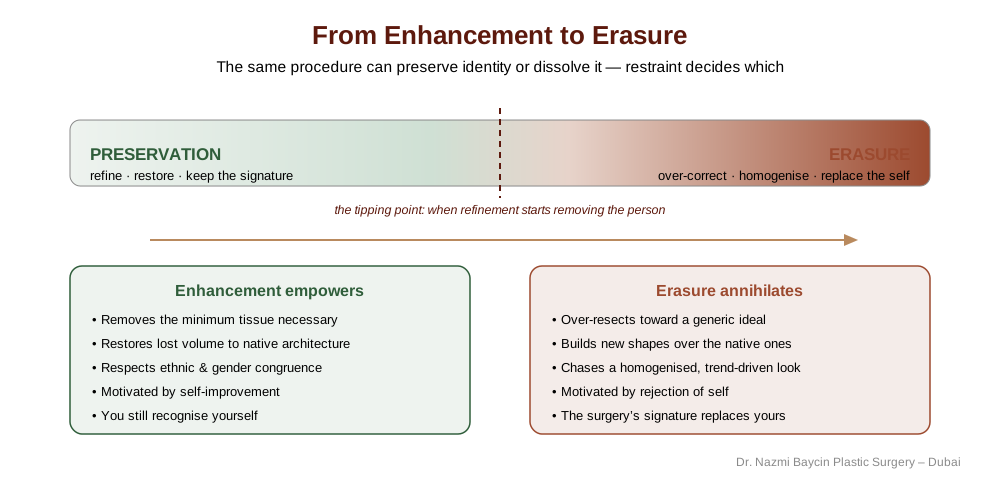
The same procedure can preserve identity or dissolve it — restraint is what keeps a result on the enhancement side of the line — by Dr. Nazmi Baycin, Dubai.
| Dimension | Enhancement (empowers) | Erasure (annihilates) |
|---|---|---|
| Tissue handling | Removes the minimum necessary | Over-resects toward a generic ideal |
| Use of volume | Restores lost volume to native architecture | Builds new shapes over the native ones |
| Aesthetic reference | Ethnic and gender congruence preserved | Homogenized, trend-driven look |
| Underlying motive | Self-improvement | Rejection of self |
| Result in the mirror | You still recognize yourself | The surgery’s signature replaces yours |
The psychological pitfall: operating on external phantoms
The most clear-cut cases of potential identity erasure often stem from psychological misalignment, not anatomical necessity. When a patient brings a photo of a celebrity and asks to become that person, they are not seeking enhancement but transformation into someone else — a desire that is often a mask for deeper self-esteem issues no scalpel can fix. This is not a rare edge case.
A 2017 multicenter prospective study of 597 patients at facial-plastic and oculoplastic clinics found that 13.1% of those presenting for cosmetic surgery screened positive for body dysmorphic disorder, against 6.7% of those presenting for reconstructive surgery — roughly double the rate, with an odds ratio of 2.10. Surgeons clinically suspected the condition in only 4.0% of the patients they assessed, well below the 9.7% who screened positive overall. That gap is precisely why a deliberate ethical protocol matters. My protocol involves discerning the source of the request: is it a desire for self-improvement, or a rejection of self? I have declined procedures when the motivation was rooted in erasing a feature tied to family or ethnicity, or in conforming to a partner’s coercive ideal, because to operate in such scenarios is to become an instrument of self-alienation.
The true therapeutic act is sometimes a referral for counseling, not a surgical plan. The surgeon’s first duty is to protect the patient’s psychological integrity, which is the core of their identity.
The technical execution: preservation through precision
The philosophy of preservation must be embedded in surgical technique, and it demands a different set of skills than wholesale alteration. It requires ultra-conservative resection — removing the absolute minimum of tissue necessary to achieve the goal, whether in a blepharoplasty or a labiaplasty. It requires strategic augmentation — using implants or fat grafting not to create new shapes, but to restore lost volume and support to the patient’s native architecture. And it requires ethnic and gender competence — a deep understanding of the anatomical norms and aesthetic canons specific to different ethnicities and genders, so results look authentic.
The technical mistake of over-correction — an over-resected lip, an eye that appears too hollow, a facelift that creates a mask-like stare — is ultimately a failure to respect identity, replacing the patient’s unique humanity with the glaring signature of the surgery itself. My technique is defined by restraint, ensuring the outcome is a balanced, natural-looking result that whispers rather than shouts.
The dialogue of consent: co-creating, not imposing
Preserving identity is a collaborative process that begins with a consultation which is a dialogue, not a sales pitch. I spend significant time understanding not just what the patient wants to change, but who they feel they are and wish to become, and I use imaging technology not to promise a fantasy but to facilitate a realistic conversation about possibilities.
Together we discuss what must be preserved as inviolable and agree on parameters, which transforms the patient from a passive recipient into a co-author of their outcome — so their informed consent is not just for a procedure, but for a specific, identity-conscious artistic vision. This shared understanding is the strongest safeguard against a result that feels like a betrayal of self. Because this depth of consultation and customization defines the work, it is treated as an unhurried, essential part of the process rather than a formality.
The surgeon as a guardian of self
The ultimate measure of success in aesthetic surgery is not the dramatic before-and-after, but the patient’s ability to look in the mirror and recognize themselves — to see a refreshed, more confident version of the person they have always been. Enhancement empowers; erasure annihilates. The surgeon’s highest calling is to wield their skill as a tool for empowerment, guided by the wisdom to know the difference — a practice of profound respect requiring the heart of a philosopher, the eye of an artist, and the unwavering ethics of a physician. This conviction underpins all of my plastic and reconstructive surgery work in Dubai, where preservation is treated as the ultimate form of enhancement.
FAQs about identity-preserving aesthetic surgery in Dubai
-
What is the difference between enhancement and erasure in cosmetic surgery?
Enhancement refines what is already there — it removes the minimum tissue necessary, restores lost volume to your native architecture, and respects your ethnic and gender features, so you still recognize yourself afterward. Erasure over-corrects toward a generic ideal, building new shapes over your natural ones and chasing a homogenized look, until the result reflects the surgery rather than the person. The same operation can fall on either side of that line — restraint is what keeps it on the enhancement side.
-
Why would a surgeon decline an operation a patient actively wants?
Because the first duty of a surgeon is to the wellbeing of the patient, not to the request. When the motivation is to erase a feature tied to family or ethnicity, to satisfy a coercive ideal held by a partner, or to become someone else entirely, operating can deepen distress rather than relieve it. In those situations the more honest and ethical act is to say no, and sometimes to suggest counseling — surgery cannot resolve a difficulty that is psychological in origin rather than anatomical.
-
What is body dysmorphic disorder, and why does it matter here?
Body dysmorphic disorder (BDD) is a preoccupation with a perceived flaw in appearance that is minor or not visible to others, causing significant distress. It matters because it is notably more common among people seeking cosmetic surgery than in the general population, and it is easy to miss — studies show surgeons suspect it far less often than screening detects it. People with BDD typically do not feel better after surgery, because the distress is not really about the feature being operated on, which is why careful, honest assessment before surgery is so important.
-
Can I bring a photo of a celebrity to my consultation?
A photo can be a useful communication tool to show a shape or proportion you admire — for instance, a nasal profile or a brow position. The concern arises when the goal is to become that person rather than to refine your own features. A good consultation will translate what you like about the image into what is achievable and harmonious for your own face, rather than trying to transplant the anatomy of another person onto yours. The aim is a result that looks like the best version of you, not a copy of someone else.
-
How do you preserve ethnic identity during surgery?
By treating ethnic features as part of the aesthetic goal, not obstacles to it. In rhinoplasty, for example, that means resolving a specific concern — a hump, a breathing problem, a bulbous tip — while preserving the fundamental character and proportions that signal your heritage, so the nose still belongs to your face. It requires ethnic and gender competence: an understanding of the anatomical norms and aesthetic canons of different backgrounds, and conservative technique that refines rather than standardizes.
-
Does a natural-looking result mean a subtle or small change?
Not necessarily. Natural refers to how believable and integrated the result looks, not how large the change is. A well-planned procedure can make a meaningful difference while still looking as though you were simply born that way, because it works with your existing architecture and proportions. What makes a result look artificial is usually over-correction or a shape imposed from outside — not the amount of change itself. The goal is a result that harmonizes with the rest of your face or body, whatever its magnitude.


GET APPOINTMENT
Get ready to look and feel best… You deserve…
