

Key takeaways: dog-ears are engineered out, not healed away
- A dog-ear is a geometry problem — a straight-line excision on a curved body leaves unequal skin edges.
- Straight incisions also concentrate tension at the lateral poles, worsening scars over time.
- Prevention starts with a dynamic standing assessment and a curvilinear excision design.
- A progressive tension suture closure distributes force evenly and eliminates dead space.
- Waistline irregularities are prevented by treating integrated flank sculpting as standard, not optional.
- Preventing the deformity is far simpler than revising it once it has healed.
In my Dubai practice, I approach every abdominoplasty as a problem in three-dimensional engineering, not two-dimensional cutting. My goal is not simply to remove what is excess and close what remains — it is to design a result that is smooth, continuous, and harmonious from every angle: from the front, from the side, and from the back. Achieving that requires a specific sequence of planning steps, a specific surgical technique, and an integrated approach to waistline sculpting that most patients never hear discussed at consultation.
What causes dog-ear deformities after tummy tuck surgery?
Before discussing prevention, it is worth understanding precisely what a dog-ear is and why it forms. The anatomy of the problem is simple — but its solution requires understanding it clearly. The table below contrasts a standard linear approach with the prevention-focused approach I apply to every case.
| Feature | Standard / Linear Approach | Dr. Baycin’s Prevention-Focused Approach |
|---|---|---|
| Incision design | Straight line | Curvilinear — follows body geometry |
| Preoperative marking | Basic midline marking | Dynamic 3D standing assessment |
| Lateral end management | Unplanned — dog-ear risk | Designed into curvilinear extension |
| Closure technique | Simple layered closure | Progressive tension suture technique |
| Dead space elimination | Drains only | Progressive tension sutures + drains |
| Flank contouring | Optional / not included | Integrated — standard component |
| Dog-ear risk | Moderate to high | Engineered out of the procedure |
| Scar tension | Present at lateral ends | Eliminated by deep tension sutures |
| Waistline result | Front-focused only | Continuous front-to-back silhouette |
| Revision rate for dog-ears | Higher | Significantly reduced |
Why a straight-line incision creates the problem
A dog-ear is a cone-shaped bunching of excess skin and subcutaneous fat that forms at the lateral ends of a surgical incision when the wound is closed. Its cause is geometrically straightforward: when a straight incision is used to remove an ellipse of tissue from a curved body surface, and the wound is then closed, the skin edges do not meet at equal lengths. The skin on the superior flap at each lateral end is longer than the skin on the inferior flap. When sutured together, this length discrepancy has nowhere to go except upward into a fold — the dog-ear.
The longer the straight incision and the flatter its course, the more pronounced the discrepancy, and the more pronounced the resulting deformity. A straight-line incision is also a tension-concentration problem: closure forces converge at the lateral poles, placing these points under the highest tension in the wound. High tension there promotes scar widening, hypertrophy, and the progressive stretching that turns a minor dog-ear at surgery into a more pronounced one at six months.
Why waistline irregularities are a three-dimensional failure
Waistline irregularities — the boxy shape, the contour dip, the unnatural step between the tightened midline abdomen and the untreated flank — arise from a related but distinct failure: treating the abdomen as a flat panel rather than a three-dimensional torso. The abdomen is bounded laterally by the flanks and hips, which carry their own fat compartments, their own skin laxity patterns, and their own contributions to the overall silhouette.
A tummy tuck that addresses only the central panel — tightening the midline without contouring the transition zones — creates a result that reads as local rather than holistic. The tightened center contrasts with the unaddressed sides, creating the appearance of an operation visible from every angle except the front.
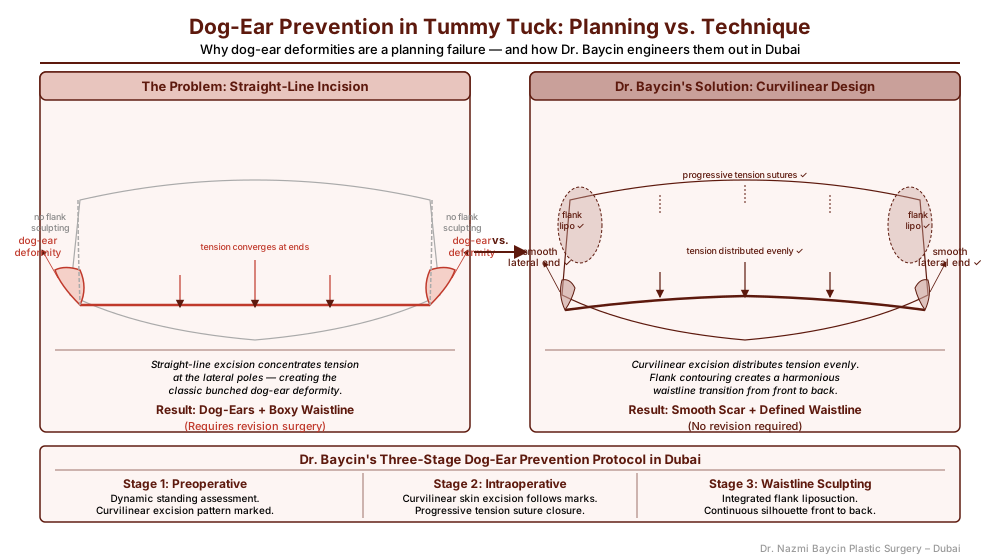
Left: a straight-line incision concentrating tension at the lateral poles — producing the classic dog-ear bunching and a boxy, uncontoured waistline. Right: curvilinear excision following the body’s natural geometry, progressive tension sutures distributing closure force evenly, and integrated flank liposuction creating a continuous silhouette — no dog-ear, defined waistline — by Dr. Nazmi Baycin, Dubai.
Prevention stage 1 — the preoperative marking protocol
Dog-ear prevention begins not in the operating room, but in the consultation room — with the patient standing, the body in its natural position, and the surgeon reading the three-dimensional distribution of skin, fat, and laxity across the entire torso.
Dynamic standing assessment: reading the body in three dimensions
I perform a comprehensive standing assessment before marking a single line. I examine the distribution of skin laxity — not only in the central abdomen, but across the flanks, hips, and lower back — to understand how the tissue will behave when the midline is tightened and the lateral excess is placed under tension. I assess the degree of flank fullness that will create a contour irregularity if left unaddressed, and I observe the natural curves of the body and the specific geometry of the lateral hip and waist transition, because the incision must account for these curves, not ignore them.
What I observe standing, I plan standing — because the result the patient will live in is a standing result.
Designing the curvilinear excision pattern
The marking that follows is not a single straight line but a carefully designed curvilinear excision pattern. The incision is drawn to sweep gently upward at its lateral ends — extending slightly higher and further toward the hips than a standard straight-line mark — following the body’s natural curves rather than crossing them.
This extension serves two purposes: it anticipates the skin excess that emerges laterally when the midline is closed and tightened, incorporating it within the excision zone rather than leaving it to bunch at the ends; and it ensures the wound edges will be of equal length at closure, eliminating the geometric discrepancy that produces the dog-ear.
Changing the line and angle of the incision in this way has been tested directly. A 2017 open-label randomized trial in 70 abdominoplasty patients compared the classic high-lateral-tension technique against a method built on exactly that modification, and found the resulting scar significantly shorter — a mean of 41.7 cm against 53.7 cm. Its authors describe the method as newly introduced and call for longer follow-up, so it establishes a measured advantage in scar length rather than a settled standard. For how this fits within the full scope of the operation, my overview of tummy tuck surgery in Dubai explains the procedure from assessment through recovery.
Prevention stage 2 — curvilinear excision and progressive tension closure
The preoperative marking creates the blueprint. The intraoperative technique executes it — and execution matters as much as design.
Why the excision shape determines the scar outcome
The curvilinear excision pattern I have marked is followed precisely intraoperatively. This discipline is non-negotiable: any deviation toward a simpler straight-line shortcut reintroduces the geometric problem the design was intended to eliminate. The sweeping, curved excision removes skin and fat in a pattern that matches the body’s surface geometry — producing wound edges matched in length that can be brought together without lateral excess.
A common observation among my patients in Dubai is that their scar, despite technically being longer than some alternatives, is less visible and heals more completely than shorter straight-line scars — because it lies under no tension, which is the single most important determinant of scar quality. The correct length for that curved excision is itself set by the tissue, which is why I explain how skin elasticity dictates incision length and closure strategy.
The progressive tension suture technique
Wound closure is where the prevention of dog-ears is either secured or lost. I use a multi-layered progressive tension suture technique. Deep permanent sutures are placed between the abdominal flap and Scarpa’s fascia at regular intervals across the entire wound length — distributing the closure force evenly across a broad area rather than allowing it to concentrate at the wound ends. These sutures do the structural work of closure: the skin itself is approximated under minimal or no tension, because the deep sutures have already borne the load.
The result is a wound that closes smoothly from end to end without the lateral bunching that signals an impending dog-ear. Simultaneously, the progressive tension eliminates dead space beneath the flap — reducing the risk of seroma, the most common post-operative complication of abdominoplasty — making this technique prevention on two fronts at once. For patients considering the high-definition approach, my article on high-definition tummy tuck in Dubai explains how liposculpting integrates with tension-controlled closure.
Prevention stage 3 — integrated waistline sculpting
The third stage of prevention addresses the waistline irregularities that arise not from the incision itself, but from the untreated lateral territory that surrounds it. A smooth scar with a boxy flank is still an incomplete result. I treat integrated liposuction of the flank fat compartments not as an optional add-on, but as an essential component of a complete abdominal contouring result. Using precise, conservative suction, I sculpt the transition zone between the tightened anterior abdomen and the lateral flank and hip — creating a gradual, natural curve that flows continuously from front to side to back.
The specific zones are determined by the preoperative assessment: where fullness creates a contour discontinuity, it is reduced; where the natural waistline curve has been obscured by fat, it is restored. The result reads as a continuous, harmonious silhouette rather than a locally improved front panel surrounded by unaddressed sides. My overview of liposuction surgery in Dubai describes the precise fat-sculpting techniques I apply in this integrated approach.
When dog-ears still occur: minor revision
Despite meticulous planning, a small number of patients present with residual lateral fullness or minor dog-ears in the weeks following surgery — typically because the degree of lateral skin laxity was difficult to fully anticipate pre-operatively, or because early swelling obscured the lateral contour during planning. In these cases, revision is straightforward: a small, well-placed lateral excision under local anesthesia, performed at three to six months once swelling has fully resolved and the scar has stabilized.
This minor revision is categorically different from the major corrective surgery required when significant dog-ears result from inadequate primary planning — which involves dissecting through scar tissue, addressing structural tension problems in a field that has already healed, and accepting compromised skin elasticity and blood supply. That contrast is precisely why engineering the result correctly from the outset is always the superior strategy.
How to choose a surgeon who prevents rather than corrects
The questions a patient asks at a tummy tuck consultation in Dubai reveal, quickly, whether the surgeon is thinking in two dimensions or three. A surgeon who discusses only the central incision, the belly-button repositioning, and the muscle repair — without mentioning the lateral excision design, the progressive tension closure, or the integrated flank contouring — is describing a procedure that addresses the front of the body and leaves the sides to chance.
The questions worth asking: How do you prevent dog-ears? What closure technique do you use to distribute tension? Do you include flank contouring in your standard abdominoplasty, or is it an add-on? What is your approach to the lateral excision pattern?
A surgeon who can answer these specifically and confidently — not generically — is one who has confronted these problems technically, not merely aesthetically. That is the standard I hold myself to for every tummy tuck I perform in Dubai, and it runs through all of my plastic surgery practice in Dubai. Because every abdomen is individual, the plan and its cost are mapped transparently at consultation.
FAQs about dog-ear deformity after tummy tuck in Dubai
-
What exactly is a dog-ear deformity after tummy tuck surgery?
A dog-ear is a cone-shaped bunching of excess skin and subcutaneous fat at the lateral ends of a tummy tuck incision. It forms when a straight-line excision creates unequal skin edge lengths at closure — the geometric discrepancy has nowhere to go except upward into a fold. Dog-ears are not a healing complication; they are a direct consequence of inadequate surgical planning and excision design. I prevent them through curvilinear excision that eliminates the geometric discrepancy before closure begins.
-
Can dog-ears after tummy tuck surgery go away on their own?
Minor post-operative swelling at the lateral ends of the wound — which can initially resemble a dog-ear — typically resolves within three months. True dog-ear deformities, where there is genuine excess skin and tissue, do not resolve spontaneously. They require surgical correction: a small lateral excision, usually performed under local anesthesia at three to six months once swelling has resolved and the scar has stabilized. Prevention through correct surgical design is always preferable to correction after the fact.
-
Why does a straight-line tummy tuck incision cause dog-ears?
When an ellipse of skin is excised along a straight line from a curved body surface, the skin edges that remain are unequal in length — the superior edge is longer than the inferior edge at each lateral end. When these edges are sutured together, the excess length bunches into a cone: the dog-ear. A curvilinear excision, designed to follow the body’s natural curves, produces equal-length edges at closure and eliminates this geometric problem entirely.
-
What is the progressive tension suture technique and why does it prevent dog-ears?
Progressive tension sutures are deep permanent sutures placed between the abdominal flap and the underlying fascia at regular intervals across the entire wound. They distribute the closure force evenly across a broad area, removing tension from the skin edges and the lateral wound ends — where tension concentration produces dog-ears. The skin is approximated under minimal tension because the deep sutures have already borne the load. This technique simultaneously eliminates dead space, reducing seroma risk — making it prevention on two fronts.
-
Is flank liposuction included in a tummy tuck in Dubai with Dr. Baycin?
Yes — integrated flank liposuction is a standard component of my abdominoplasty approach in Dubai, not an optional add-on. It sculpts the transition zone between the tightened anterior abdomen and the lateral flank and hip, creating a continuous, harmonious silhouette rather than a locally improved front panel surrounded by unaddressed sides. Waistline irregularities arise specifically when this integration is omitted — they are prevented by including it from the outset.
-
How do I know if my surgeon’s tummy tuck approach will prevent dog-ears?
Ask specifically: How do you design the lateral excision to prevent dog-ears? What closure technique do you use to distribute tension? Do you include flank contouring as a standard component? A surgeon who can answer these questions with specific technical detail — describing curvilinear design, progressive tension sutures, and integrated flank sculpting — is a surgeon who has addressed these problems technically. A surgeon who answers generically, or who does not raise these topics unprompted, may be planning a simplified approach that carries higher risk.


GET APPOINTMENT
Get ready to look and feel best… You deserve…
