

Key takeaways: protecting sensation during tightening
- The vagina is richly innervated, not numb — tightening reshapes a sensory organ, so nerve preservation is central.
- Nerves are found throughout the vaginal walls, so every dissection and suture carries some risk to sensation.
- The lower third (introitus) is the most vulnerable zone during surgery — over-tightening it produces pain.
- A posterior-focused approach avoids the anterior clitoral complex and is anatomically safer.
- A graduated taper — mild at the introitus, most at the mid-vagina — preserves the natural sensory gradient and avoids pain.
- Outcomes depend on technique, not the operation itself: preserved sensation predicts the highest satisfaction.
The erogenous vagina is a neuroanatomical reality
A common misconception is that the vagina is numb or insensitive. This is false — it is richly innervated with both sensory and autonomic nerve fibers, and tactile stimulation of the vaginal walls can lead to orgasm. How that innervation is distributed is still disputed — some histological work reports more nerve fibers distally than proximally, while the study below found no such gradient — and either way the lower third lies directly in the surgical field.
Mapping the nerve distribution matters: a prospective study of 21 patients examining 110 biopsy specimens found that vaginal nerves are located regularly throughout the anterior and posterior walls — proximally, distally, and including the apex and cervix — with no single location of consistently higher density. In other words, the entire vagina has the potential for sensation, so every dissection, suture, and tissue resection carries a risk of nerve injury. That is why my planning begins with a detailed neuroanatomical map before any incision.
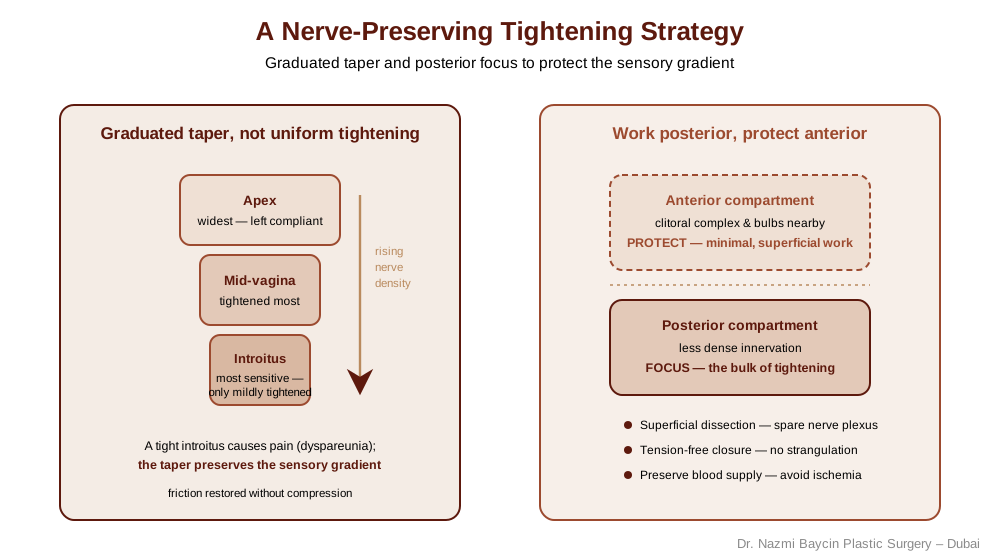
A graduated taper preserves the sensory gradient (introitus kept compliant, mid-vagina tightened most), while tightening is focused on the posterior compartment to protect the anterior clitoral complex — by Dr. Nazmi Baycin, Dubai.
The clitoral complex is not the only erogenous structure
The clitoris is famously sensitive, but the clitoral complex extends internally as well — the clitoral bulbs and body lie just beneath the anterior vaginal wall. Aggressive anterior dissection or deep plication sutures can compress or damage these internal structures; in patients who lost the ability to experience vaginal orgasm after surgery elsewhere, deep anterior sutures disrupting the clitoral neurovascular bundle are a recurring theme.
The posterior approach is safer. A 2025 single-team series of 57 sexually active women, mean age 36.5, undergoing posterior vaginal tightening — deliberately avoiding anteriorly located structures such as the clitoral complex — found every domain of the Female Sexual Function Index improved, although the pain domain was the one improvement that did not reach statistical significance. Two thirds of the patients, 68.5%, were satisfied or very satisfied.
That series is also worth reading for what it reports about pain, because pain is the risk this article is about: 38.5% described dyspareunia at first intercourse and 8.8% still had it at six months, and every dissatisfied patient in the cohort was one of those with pain at six months. It is a single-arm series with no comparison group, and a quarter of the patients had an anterior cervical ring repair added, so it establishes that a posterior-focused approach performs well rather than proving it outperforms the alternative.
The authors concluded that sexual function in women with vaginal laxity can be improved when the vulvovaginal erogenous complex is not disrupted, which mirrors my own clinical experience: working primarily from the posterior compartment achieves excellent tightening without compromising sensation.
The lower third requires special respect
The distal vagina — the lowest three to four centimeters — is the zone where friction during intercourse is most acute, and the zone where over-tightening reliably produces pain. It is also where many surgeons place their tightest sutures, which is a mistake. My tightening emphasizes the mid-vagina more than the lower third, keeping the introitus compliant. A tight introitus causes dyspareunia, which paradoxically reduces sexual satisfaction even if the deeper canal feels tighter. The goal is a graduated taper — wider at the apex, moderately tightened in the mid-vagina, and only mildly tightened near the introitus — which preserves the natural sensory gradient.
How surgical trauma damages innervation — and how it’s avoided
Every incision causes some degree of nerve injury; the real question is whether the nerves can regenerate and whether the remaining innervation is sufficient for normal function. There are three main risks, each with a corresponding safeguard.
| Risk to innervation | What happens | How it is minimized |
|---|---|---|
| Direct nerve transection | Excising mucosa or plicating fascia can cut small nerve fibers running through the tissue | Minimize the volume of resected tissue; avoid deep, wide excisions that remove nerve trunks |
| Compression or entrapment | Sutures placed too tightly strangulate nerve fibers; chronic pressure causes loss of function | Interrupted sutures with just enough tension to approximate tissue, never to strangulate |
| Ischemia | Aggressive dissection damaging the submucosal vascular plexus deprives nerves of oxygen | Keep dissection superficial; preserve the vascular supply; avoid large flaps |
The evidence on sexual function after tightening
The literature counsels humility rather than blanket promises. A systematic review of 11 studies on vaginal tightening surgery and female sexual function found that although most studies suggested tightening improves sexual function, methodological limitations — the absence of precise laxity measurements and inconsistency in surgical techniques — made firm conclusions difficult. One finding was consistent, however: patients who retained normal sensation reported the highest satisfaction, while those who experienced new-onset dyspareunia or reduced lubrication were the least satisfied.
The lesson is clear — the operation is not automatically beneficial; the outcome depends entirely on technique. A poorly planned procedure can reduce sensation and cause pain; a well-planned one restores friction without destroying nerves. The difference is surgical philosophy.
The nerve-preserving protocol
In practice, protecting the erogenous zones comes down to a consistent protocol. It begins with preoperative mapping — asking each patient to describe her own sensation pattern and any area of already-diminished sensation — which guides the surgical plan. The vast majority of tightening is then performed from the posterior vaginal wall, which has less dense innervation and is anatomically safer for plication. Dissection stays superficial: a thin mucosal flap is elevated and the underlying fascia plicated without resecting large volumes, preserving the submucosal nerve plexus. When anterior tightening is necessary, the smallest possible sutures are placed superficially, never plicating the anterior wall near the clitoral bulbs.
Finally, all incisions are closed with fine, absorbable sutures placed just tightly enough to approximate edges — no strangulation, no compression. This protocol adds time to the surgery, but the result is a patient who feels better, not worse, after healing. The step-by-step surgical detail lives on my page vaginal tightening procedure in Dubai.
Recovery and the return of sensation
Because the technique deliberately avoids deep resection and tight closure, the early recovery is usually gentler than patients fear. Discomfort is typically modest and controlled with simple measures, and I ask patients to avoid intercourse and strenuous activity for roughly six weeks so the plication and the delicate mucosal repair can consolidate without tension on the sutures.
Sensation deserves its own explanation, because it does not return on a single timeline. Some tissues are simply swollen at first, and normal feeling re-emerges as that swelling settles over the first weeks. Where small nerve fibers were unavoidably disturbed, they regenerate slowly, so the fullest picture of sensation is best judged at three to six months rather than immediately.
In my experience, when the posterior-focused, superficial protocol is followed, patients describe restored friction and preserved erogenous feeling together — which is the entire point of operating this way.
Function before tightness
A narrow vagina is of little value if it cannot feel. Rather than chasing arbitrary tightness at the expense of sensation, the aim is to restore normal vaginal caliber while preserving every erogenous nerve fiber possible — friction without pain, tightness without compression. This sensation-first discipline is the counterpart to how functional repair and aesthetic refinement come together in the complete procedure. This is a niche, sensation-first way of thinking about an operation that is too often reduced to a single measurement, and it reflects the broader philosophy behind my work as a plastic surgeon in Dubai.
FAQs about nerve-preserving vaginoplasty in Dubai
-
Does vaginal tightening reduce sensation?
It can, if the technique disregards the nerves — but it doesn’t have to. The vagina is richly innervated throughout, so a poorly planned procedure that places deep or tight sutures in the wrong areas can reduce sensation or cause pain. A nerve-preserving approach that works superficially, focuses on the posterior wall, and avoids the anterior clitoral structures aims to restore friction while protecting the erogenous zones.
-
Why is a posterior approach considered safer?
The internal clitoral structures — the bulbs and body — lie just beneath the anterior vaginal wall, so deep anterior work risks compressing or damaging that neurovascular bundle. The posterior wall has less dense innervation and is anatomically safer for the plication that creates tightening. Published work on posterior-focused tightening that deliberately avoids anterior structures reported improved sexual-function scores, with about two thirds of patients satisfied or very satisfied.
-
What is a graduated taper, and why does it matter?
Instead of tightening the whole canal uniformly, a graduated taper leaves the apex widest, tightens the mid-vagina the most, and only mildly tightens the introitus. This matters because the introitus (the lower third) is where friction is most acute, and over-tightening it causes painful intercourse (dyspareunia) that reduces satisfaction even when the deeper canal feels tighter. The taper preserves the body’s natural sensory gradient.
-
How can nerve damage happen during surgery, and how is it avoided?
There are three main risks: cutting small nerve fibers during tissue removal, strangulating nerves with over-tight sutures, and starving nerves of blood through aggressive dissection. Each is minimized by a specific safeguard — resecting as little tissue as possible, using interrupted sutures with only enough tension to approximate edges, and keeping dissection superficial to preserve the blood supply.
-
Will I definitely have better sexual function afterwards?
Not automatically — and any surgeon who promises that is overstating the evidence. A systematic review found that outcomes depend heavily on technique: the patients most likely to be satisfied are those who retain normal sensation, while those who develop pain or reduced lubrication are the least satisfied. This is precisely why the technique, not the operation label, is what matters.
-
How do you plan the surgery around my anatomy?
Planning starts before any incision with a sensation map — I ask you to describe where you feel most, and whether any area already feels diminished. That information, combined with a physical assessment, shapes a plan tailored to your anatomy and sensation goals rather than a one-size-fits-all tightening. Because everyone’s anatomy differs, the plan and approach are individualized.


GET APPOINTMENT
Get ready to look and feel best… You deserve…
