

Key takeaways: function before form
- Panniculectomy is reconstructive surgery, not a cosmetic tummy tuck.
- Its purpose is functional relief — resolving rashes, hygiene problems, and restricted movement.
- Unlike abdominoplasty, muscle repair is usually not performed, to limit operative risk.
- A progressive-tension closure obliterates dead space and lowers the risk of seroma.
- Weight stability and nutritional readiness are non-negotiable before surgery.
- Success is measured in regained function and dignity, not waistline inches.
The safety-first emphasis reflects what the evidence shows about this population. A retrospective review of 706 post-bariatric panniculectomy patients over ten years recorded an overall complication rate of 56 percent, almost all of it local wound morbidity — wound dehiscence in 24 percent, surgical site infection in 22 percent, and seroma in 18 percent — with 12 percent of patients returning to the operating room. Its authors identified higher BMI, an anesthetic risk class above 2, and the use of a fleur-de-lis rather than a low transverse incision as the modifiable factors driving that risk. Those numbers are precisely why careful patient selection and a low-tension closure matter so much — the technique and the timing are what keep this major operation safe.
Panniculectomy vs. abdominoplasty: a matter of intent
Understanding this distinction is critical for both patient alignment and surgical planning. Both procedures remove lower abdominal tissue, but their purposes diverge, as the table below makes clear.
| Feature | Panniculectomy (Reconstructive) | Abdominoplasty (Aesthetic) |
|---|---|---|
| Primary goal | Relief from a functional burden | Comprehensive abdominal restoration |
| Tissue removed | Overhanging pannus of skin and fat | Excess skin, then reshaping |
| Muscle repair (plication) | Usually not performed | Diastasis recti routinely repaired |
| Contouring & liposuction | Not the priority | Trunk contoured for a refined silhouette |
| Umbilicus | Often removed with the specimen | Precisely repositioned |
Put simply, the patient who needs a panniculectomy needs relief, while the patient who needs an abdominoplasty needs restoration. Muscle repair is typically omitted in a panniculectomy because the priority is minimizing operative time and complexity in patients who often carry higher perioperative risk after massive weight loss.
Misjudging which operation a patient needs leads to inappropriate surgery, so this diagnostic clarity is the first obligation of the reconstructive surgeon in Dubai. It is the same principle I apply across post-bariatric body contouring for the massive-weight-loss patient in Dubai, where matching the procedure to the patient’s anatomy and health profile matters more than any single technique.
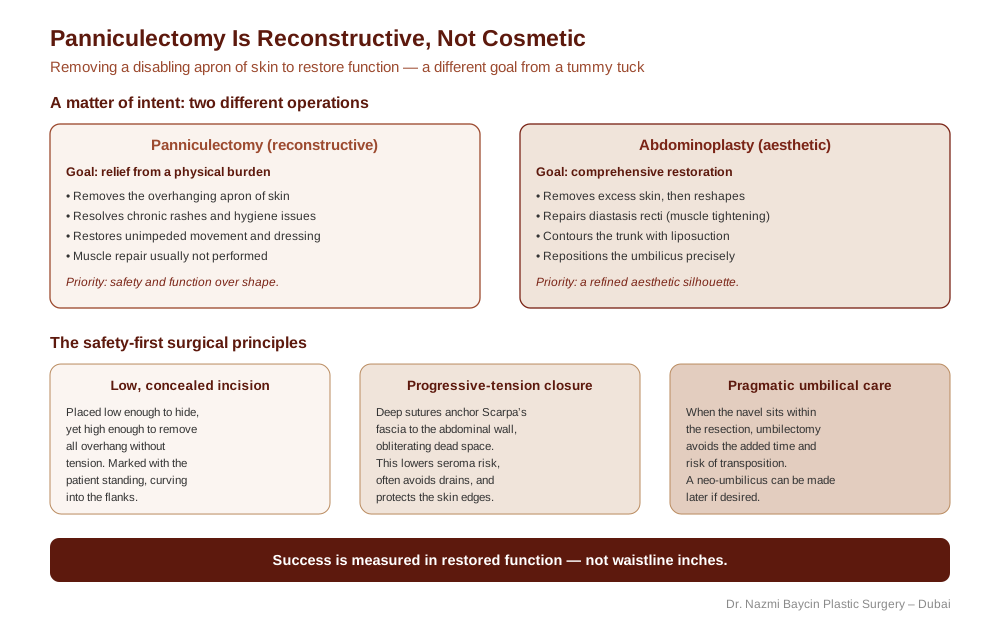
Panniculectomy is reconstructive surgery with a different intent from abdominoplasty — its safety-first principles prioritize function over aesthetic shape — by Dr. Nazmi Baycin, Dubai.
Planning for safety and durable function
The technical challenge of a panniculectomy lies in its scale — we are often removing a kilogram or more of tissue from an area with a compromised blood supply, so every decision is governed by reconstructive safety. The incision must sit low enough to be concealed by underwear, yet give enough exposure to remove all the overhanging tissue without excessive tension at closure.
A common error is placing the incision too high to shorten the scar, which leaves residual overhang at the pubic area; I mark the superior line of resection with the patient standing, so the closed contour is genuinely flat. The pannus itself lies in a vascular watershed, which is why I use a progressive-tension suturing technique: deep, absorbable sutures secure the superficial (Scarpa’s) fascia of the advanced flap to the underlying abdominal wall. This obliterates dead space, often removes the need for drains, and substantially reduces the risk of seroma, which affected 18 percent of patients in the series above, while distributing tension across a broad deep layer to protect the skin edges.
How far the incision extends and how the closure is tensioned both depend on the quality of the tissue, a relationship I explore in more depth in my article on how tissue elasticity determines incision length and closure strategy in abdominoplasty.
Umbilical management: a functional decision
In a true panniculectomy, the navel often lies within the zone of resection. Rather than attempting a complex transposition — which adds time and risk in these frequently higher-risk patients — I typically perform an umbilectomy: the stalk is ligated and the umbilicus removed with the specimen. A new neo-umbilicus can be created in a secondary stage if the patient wishes, but the primary goal remains functional relief.
This pragmatic approach reflects a safety-first mindset, and it stands in deliberate contrast to the detailed umbilical artistry that defines a cosmetic abdominoplasty. My complete approach to the abdomen, from purely functional resection through to aesthetic refinement, is described on my page for tummy tuck and abdominoplasty in Dubai, which sits at the aesthetic end of the same spectrum.
Avoiding common technical pitfalls
The complications I am called to correct stem from predictable errors. Inadequate resection — failing to extend the excision far enough laterally — leaves residual rolls at the hip, the classic dog-ear deformity; my excision follows a gentle curved line into the flanks to prevent it. Closing under excessive tension all but guarantees wide, hypertrophic scars or even wound breakdown, which is why the progressive-tension technique reduces the surface closure to a simple edge approximation. And neglecting the superficial fascial system leaves an unnatural, bulging contour, so I re-approximate that layer meticulously for a smooth transition.
Avoiding lateral dog-ears in particular is a recurring theme in body-contouring surgery, and I discuss it in detail in my piece on preventing dog-ear deformities and waistline irregularities in tummy tuck surgery.
Candidacy and timing: a non-negotiable framework
The ideal candidate has achieved weight stability — a minimum of twelve months at a stable weight — with a BMI ideally below 35 for optimal wound healing, any nutritional deficiencies common after bariatric surgery resolved, realistic expectations focused on functional improvement, and a commitment to lifelong weight maintenance. Operating before weight has stabilized, or on a nutritionally compromised patient, invites serious complications.
My preoperative workup in Dubai is therefore rigorous and often involves collaboration with a bariatrician or nutritionist. That multidisciplinary caution is central to how I practice, because in this population the discipline of patient selection is as important as anything done in the operating room.
Recovery: a phased return to freedom
Recovery here is measured in regained function. In the first week or two, the sensation of weight being lifted is immediate, and the focus is on wound care, gentle walking, and support from compression garments. Between weeks three and six, patients gradually return to daily activities — and the simple joys of being able to see one’s feet, tie shoes without a struggle, and wear ordinary clothing begin to return.
From around three months, as the scars mature, the full functional benefit is realized: freedom from rashes, unhindered movement, and the psychological lift of an external form that finally matches an internal accomplishment. Because every case is different, both the surgical plan and its cost are best worked out at a consultation, tailored to your anatomy, health profile, and goals.
That kind of careful, safety-led reconstruction is what you should expect from a plastic surgery clinic in Dubai that treats this operation as the major reconstructive undertaking it is. A successful panniculectomy does not create a sculpted abdomen; it creates a functional one, removing an obstacle and granting the physical autonomy the weight loss deserved.
FAQs about panniculectomy in Dubai
-
What is the difference between a panniculectomy and a tummy tuck?
A panniculectomy is reconstructive surgery that removes the overhanging apron of skin and fat (the pannus) to relieve functional problems such as rashes, poor hygiene, and restricted movement. A tummy tuck, or abdominoplasty, is an aesthetic operation that removes excess skin and then reshapes the abdomen, repairing the separated muscles, contouring with liposuction, and repositioning the navel. In short, a panniculectomy prioritizes function and safety, while an abdominoplasty prioritizes the refined silhouette. Which one is appropriate depends entirely on the patient’s anatomy, goals, and health profile.
-
Is panniculectomy considered cosmetic or reconstructive surgery?
Panniculectomy is fundamentally reconstructive. Its purpose is to resolve a genuine physical deficit — a hanging pannus that obstructs mobility, causes chronic skin inflammation, and interferes with hygiene and daily life — rather than to sculpt an aesthetic shape. The surgical priorities reflect this: safe, extensive removal of the burdensome tissue and a robust, low-tension closure take precedence over contouring. That reconstructive intent also shapes decisions such as usually omitting muscle repair, to keep the operation as safe as possible for patients who may carry higher perioperative risk after massive weight loss.
-
Who is a good candidate for panniculectomy?
The ideal candidate has reached a stable weight — generally at least twelve months of stability — with a BMI ideally below 35 to support wound healing, and has resolved any nutritional deficiencies that commonly follow bariatric surgery. Realistic expectations focused on functional improvement, along with a commitment to maintaining the weight loss, are equally important. Operating too early, before the weight has stabilized, or on a nutritionally compromised patient significantly raises the risk of complications, so a thorough preoperative assessment — sometimes alongside a bariatrician or nutritionist — is an essential part of the process.
-
Why is muscle repair often not done in a panniculectomy?
Muscle repair, or plication, tightens the separated abdominal muscles and is a routine part of a cosmetic abdominoplasty. In a panniculectomy it is frequently omitted deliberately, because the goal is functional relief and the priority is to minimize operative time and complexity in patients who may have higher perioperative risk after massive weight loss. Adding muscle repair lengthens and complicates the surgery, so when the aim is simply to relieve the burden of the pannus safely, it is often left out. If comprehensive muscle tightening is a goal, that is the territory of a full abdominoplasty instead.
-
What happens to the belly button?
In a true panniculectomy the navel frequently sits within the tissue being removed. Rather than performing a complex transposition to preserve it — which adds operative time and risk in these often higher-risk patients — an umbilectomy is commonly done, meaning the umbilical stalk is ligated and the navel removed along with the specimen. If the patient later wishes, a new belly button (a neo-umbilicus) can be created as a secondary, smaller procedure. The primary operation stays focused on safe, functional relief, with umbilical reconstruction treated as an optional later refinement.
-
How is the risk of seroma and wound problems reduced?
The pannus lies in an area of borderline blood supply, so wound complications are the main risk. A progressive-tension closure is central to reducing them: deep absorbable sutures anchor the superficial (Scarpa’s) fascia of the flap to the abdominal wall, obliterating the dead space where fluid would otherwise collect. This lowers the risk of seroma, often removes the need for drains, and spreads tension across a strong deep layer so the skin edges are protected. Careful patient selection — stable weight, good nutrition, and a reasonable BMI — further reduces the overall complication risk.
-
What does recovery involve?
Recovery is experienced as a gradual return of function. The first week or two center on wound care, gentle walking, and wearing a compression garment for support, with the relief of the lifted weight felt almost immediately. Over weeks three to six, everyday activities resume, and ordinary tasks that the pannus made difficult become possible again. By around three months, as scars mature, the full benefit is realized — freedom from rashes, easier movement, and a real psychological lift. The exact pace varies by individual and is guided by follow-up, but the trajectory is consistently one of steadily regained freedom.


GET APPOINTMENT
Get ready to look and feel best… You deserve…
