

Key takeaways: the vector, not the height
- Over-elevation is usually a wrong-direction error, not simply lifting too far.
- A pure vertical vector pulls the whole brow up equally, creating a high, startled-looking arch.
- The medial brow barely moves with aging; the mobile lateral brow is what descends.
- The correct oblique posterolateral vector selectively lifts the lateral tail and restores the natural sweep.
- The brow must be assessed with the frontalis muscle fully at rest, not in its compensatory position.
- Brow and upper eyelid are one aesthetic unit — planning one in isolation is a cardinal error.
The anatomy of expression: why vectors are everything
To correct or avoid over-elevation, one must move beyond two-dimensional thinking, because the brow complex is a three-dimensional structure with fixed points of adhesion. It is anchored laterally by the temporal fusion line and the orbital ligamentous system. Aging then causes a differential descent in which the mobile lateral brow falls more than the stable medial brow, so a proper lift must selectively address that lateral descent rather than pulling the whole brow up equally. This is not merely stylistic.
A 2010 measurement study of 50 subjects redefining the eyebrow peak position found the deep temporal fusion line to be the most precise indicator of the brow peak among the landmarks examined, and concluded that the endoscopic incision and fixation points — the very things that set the vector — may be best defined along it. Chronic, unconscious frontalis contraction is a patient’s attempt to compensate for lateral brow heaviness. A surgeon who lifts to the level achieved by that muscular effort is making a critical error: we must lift to the position of muscular repose, not to the strained position of compensation.
Finally, the retro-orbicularis oculi fat (ROOF) pad descends and atrophies with age. The right vector repositions this volume, while the wrong one either leaves a hollowed supraorbital rim or over-elevates into an unnatural fullness. Understanding this transforms the lift from a skin-tightening exercise into a structural repositioning of composite tissue.
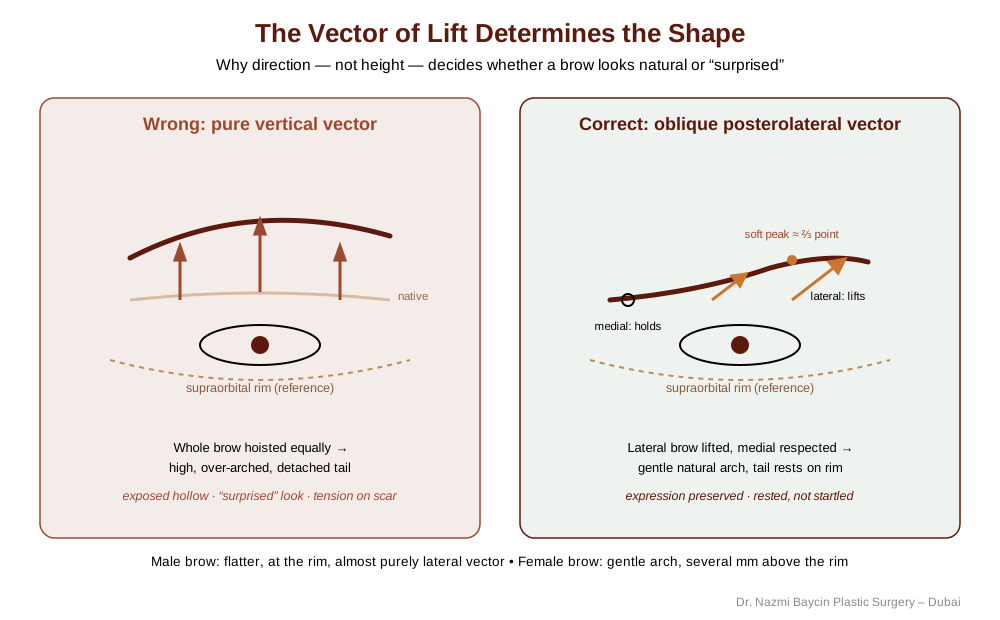
Vector, not height, determines the result: a pure vertical pull over-elevates the brow into a startled look, while an oblique posterolateral vector lifts the lateral tail and preserves natural expression — by Dr. Nazmi Baycin, Dubai.
The fallacy of the vertical vector and the endoscopic amplification error
The most common technical misadventure is the application of a purely vertical lifting force, which treats the brow as a unified curtain. In reality the medial brow has limited mobility due to dense fascial adhesions, so a vertical pull predominantly elevates the more mobile lateral brow. This creates a “J-shaped” or “surprised” contour that obliterates the natural, gently peaked female brow or the flat, strong male brow — and it places excessive tension on the temporal incision, leading to scar widening and a palpable ridge.
Indeed, a 2016 review of the ideal eyebrow shape and position records over-elevation as the most common surgical mistake in brow lifting, and notes that a medially placed peak in particular produces the undesired “surprised” appearance. The endoscopic brow lift, while minimally invasive, is a potent vector amplifier. Its power lies in deep subperiosteal release and strong fixation, so if the fixation points are placed with a vertical orientation the result is an exaggerated, permanent lateral sweep — the error is locked in.
My endoscopic technique instead emphasizes oblique, posterolateral vectors, placing fixation sutures not just to hold height but to recreate the natural sweep of the youthful brow, so the lateral tail rests softly on the orbital rim. To learn more about how this is performed with anatomical intelligence, visit endoscopic brow lift surgery in Dubai.
Gender, ethnicity, and the customized vector
There is no universal ideal brow — the surgical vector must be adapted to the patient’s inherent architecture, as summarized below.
| Feature | Male brow | Female brow |
|---|---|---|
| Ideal height | At or just above the supraorbital rim | Several millimeters above the rim |
| Shape | Flatter, stronger, horizontal | Gentle arch peaking at the medial two-thirds / lateral third junction |
| Vector | Minimal, almost purely lateral | Oblique — lateral more than medial |
| Cardinal error | Any arch feminizes the whole upper face | Too much arch looks sharp or “cartoonish” |
Beyond gender, skeletal projection, orbital shape, and soft-tissue thickness vary widely between individuals and ethnicities, so a one-vector-fits-all approach is technically indefensible. My planning involves detailed analysis of pre-existing photographs and dynamic assessment to determine each patient’s personalized vector of youthful positioning.
The inseparable unit: brow position and eyelid harmony
An over-elevated brow creates a cascade of disharmony across the periorbital region, which is why planning a brow lift in isolation is a cardinal sin. Lifting the brow too high exposes the superior orbital rim and the retroseptal hollow, creating a skeletonized, aged appearance that contradicts the goal of rejuvenation. Because the brow skin and upper eyelid skin are continuous, an upward pull on the brow can also raise the natural supratarsal crease into a deep, high fold that looks artificial and can contribute to eyelid retraction.
My solution is synergy: brow lifting is almost always considered in concert with upper blepharoplasty, staged within the same operation. First the brow is repositioned to its natural height, then the upper eyelid skin is excised based on that new position, so skin removal does not contribute to brow descent and the lift does not create excess upper-lid skin. To learn more about the eyelid half of this equation, visit eyelid surgery in Dubai, and to learn more about how the whole periorbital frame is rejuvenated together, visit periorbital rejuvenation in Dubai.
Corrective strategies: the complex art of revision
Revision of the over-elevated brow is a profound surgical challenge, often more difficult than the primary procedure. It requires meticulous dissection to free all prior fixation points and scar tissue. In some cases it also calls for precise fat grafting or soft-tissue adjustment to add weight and contour to an overly elevated area, and re-anchoring the brow complex in a more anatomically sound position, often with more robust fixation to overcome prior scar contracture.
The goal is not always to lower the brow dramatically, but to re-establish a natural slope and contour. Prevention, through impeccable primary planning, is vastly superior to correction. This is precisely why I devote so much of the consultation to analysis before any incision is contemplated. A vector that is planned correctly the first time spares the patient the far harder task of undoing a result that has already healed into place. Because each plan is built individually from your own anatomy, its details and expectations are set out clearly during a thorough consultation. This commitment to anatomical fidelity runs through all of my facial plastic surgery work in Dubai.
FAQs about vector analysis of brow lift surgery in Dubai
-
What does lift vector mean, and why does it matter so much?
The vector is the direction in which the brow tissue is repositioned — not just how high, but at what angle. A vertical vector pulls everything straight up, like hoisting a curtain. An oblique posterolateral vector pulls upward and backward at an angle that selectively elevates the mobile lateral brow while leaving the denser, less mobile medial brow largely undisturbed. The vector determines the final shape of the brow — not just its height. Getting the direction wrong while achieving the right height still produces an unnatural result.
-
Why does the medial brow barely move during a proper brow lift?
Because the medial brow is anchored by dense fascial adhesions to the underlying bone. It does not descend much with aging for the same reason — those attachments hold it in place. The lateral brow, by contrast, is more mobile and descends progressively with age. This differential descent is what creates the characteristic tired, hooded look. A correct brow lift addresses this asymmetric aging pattern by selectively elevating the lateral tail while respecting the relative stability of the medial brow.
-
How do you assess the correct brow position before surgery?
I evaluate the brow in full muscular repose — meaning with the frontalis muscle completely relaxed. Many patients have spent years unconsciously recruiting the frontalis to compensate for lateral brow heaviness. If I plan the lift to match the position achieved by that muscular effort, I am lifting to a strained, compensatory height rather than a natural, restful one. I also study photographs of the patient from their younger years to identify their native brow shape, position, and relationship to the orbital rim — this is the anatomical blueprint that guides the operative plan.
-
How do male and female brow lifts differ technically?
Male brows ideally sit at or just above the supraorbital rim, are flat rather than arched, and convey strength through their horizontal line. The vector for men is minimal and almost purely lateral — the goal is to clear visual field obstruction without feminizing the upper face or creating any arch. Female brows have a gentle peak at the junction of the medial two-thirds and lateral third, sit slightly above the rim, and the vector must be oblique to restore this specific peak without overdoing the arch. A feminine vector applied to a male patient feminizes the entire upper face — a technically irreversible mistake.
-
Can an over-elevated brow be corrected surgically?
Yes, but revision is significantly more complex than the primary procedure. It involves releasing all prior fixation points and scar contracture, which may have anchored the brow in a position above its natural level. In some cases, soft tissue or fat grafting is used to add weight and contour to an over-elevated area. Re-fixation must then be performed in a more anatomically correct vector, often requiring more robust anchoring to hold the new position against the pull of existing scar tissue. Prevention through impeccable primary planning is vastly preferable.
-
Should a brow lift always be combined with eyelid surgery?
Not always — but the relationship between brow position and upper eyelid appearance must always be assessed together, even when only one is treated. The brow and upper lid are part of a continuous aesthetic unit. An uncorrected brow descent contributes to upper lid heaviness; treating the lid without the brow leaves the root cause unaddressed and often produces an unsatisfying result. Equally, a brow lift that alters the brow height changes how much upper eyelid skin appears — so any eyelid skin excision must be planned after the brow is repositioned, not before.


GET APPOINTMENT
Get ready to look and feel best… You deserve…
