

Key takeaways: muscle, not just mucosa
- Post-childbirth laxity is a muscular and fascial problem, not a mucosal one.
- Mucosal trimming alone narrows the lining but leaves the muscular separation untouched.
- That is why trim-only results tend to fade rather than hold.
- True repair reaches four layers: perineal body, levator ani, bulbospongiosus, then mucosa.
- The levator ani plication is the step that restores durable tone and sensation.
- Mucosal refinement is conservative and last — over-excision scars and reduces sensation.
The three layers of vaginal anatomy — and why only one is usually treated
To understand why technique determines outcome, one must first understand what the vagina actually is as an anatomical structure with distinct, functional layers. Each layer has a different role, responds differently to childbirth, and requires a different surgical response.
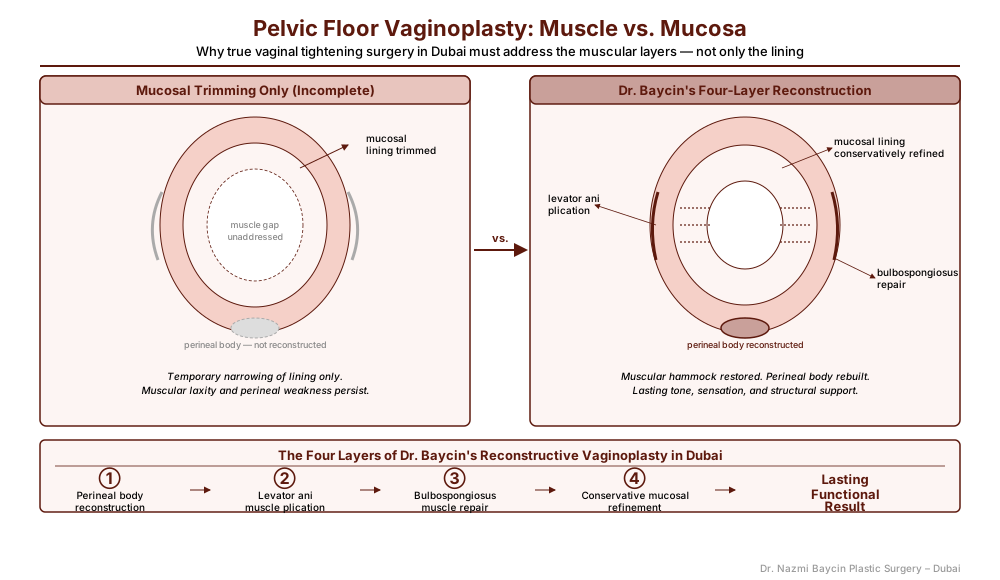
Left: mucosal trimming alone — the muscular separation and unrepaired perineal body persist. Right: a four-layer pelvic floor reconstruction — perineal body rebuilt, levator ani plicated, bulbospongiosus repaired, mucosal lining conservatively refined — by Dr. Nazmi Baycin, Dubai.
The mucosal lining: what it is and what it cannot do
The mucosal lining is the innermost epithelial layer — elastic, sensitive, and self-renewing. After childbirth or with age it can become redundant. Trimming it reduces the diameter of the vaginal lumen, and that is the entirety of what mucosal excision achieves. It does not restore muscle tone, rebuild support, or address the deeper separation that is the true origin of laxity in the overwhelming majority of post-partum patients.
The fibromuscular wall and pelvic floor: the structures that determine lasting tone
Beneath the mucosa lies the fibromuscular vaginal wall — smooth muscle and connective tissue that provides contractile tone. Beneath that lies the pelvic floor musculature: the levator ani group (principally the pubococcygeus muscles) and the bulbospongiosus muscles that flank the vaginal introitus. These are the structures traumatically stretched, thinned, and separated during vaginal childbirth. Their separation is what creates laxity, the reduction in friction, the loss of active muscular tone, and the feeling of heaviness that patients describe. A procedure that does not reach these layers does not address these symptoms.
Why mucosal trimming alone fails — and what it leaves behind
I regularly meet women some months to a year or two after surgery, their initial tightness already gone, wondering what went wrong. Nothing went wrong with the execution — the problem was the plan. When the levator ani muscles remain separated and the perineal body remains unrepaired, the muscular laxity that drove the patient to seek treatment continues unchecked. The trimmed mucosa cannot compensate for an absent muscular foundation; the tightened lining sits over an unsupported structure, and that structure reasserts itself with time.
The consequences are consistent: tightness that does not hold; scar tissue at the entrance that can reduce sensation rather than restoring it; no improvement in functional symptoms such as pelvic heaviness, because these originate from muscular and fascial deficit; and an experience that reads as surgical rather than restorative.
Distinguishing a muscular problem from a mucosal one is not something a patient can do alone, and it is not something a surgeon should assume. That separation is a diagnostic exercise in its own right, and I set out the assessment it requires in my article on how vaginal laxity is evaluated.
Mucosal trimming versus pelvic floor reconstruction
| Feature | Mucosal Trimming Only | Pelvic Floor Reconstruction |
|---|---|---|
| Addresses mucosal lining | ✓ | ✓ (conservatively) |
| Repairs levator ani muscles | ✗ | ✓ |
| Rebuilds perineal body | ✗ | ✓ |
| Repairs bulbospongiosus | ✗ | ✓ |
| Improves sensation | Limited | ✓ |
| Addresses pelvic heaviness / prolapse symptoms | ✗ | ✓ |
| Duration of results | Short-lived | Designed to hold |
| Suitable after a failed prior procedure | ✗ | ✓ |
What a layered reconstruction has to reach
A repair that answers this problem has to work at four levels rather than one: the perineal body at the opening, the levator ani sling around the canal, the bulbospongiosus muscles flanking the introitus, and only then the mucosal lining, refined conservatively over a foundation that has already been rebuilt. Each is a distinct structure with a distinct mode of failure, and none of them is reached by trimming the lining. Performed under magnification for precision and nerve preservation, this is a reconstruction rather than a cosmetic trim.
The sequence in which those layers are rebuilt, and why the order is not arbitrary, I set out in my article on the four-stage protocol behind a high-accuracy repair; my purpose here is the argument for reaching those layers at all, not the order of the steps. The perineal body deserves its own account, because it is the keystone the whole opening depends on and the step most often skipped — I cover it in my article on the perineal body as the keystone of the vaginal opening. For the full scope of candidacy, recovery, and surgical detail, visit my vaginal tightening surgery in Dubai page.
What results does pelvic floor vaginoplasty deliver?
The results of a correctly performed reconstruction differ from a mucosal-only procedure not merely in degree but in kind — they are structural and functional rather than superficial. The repaired muscular hammock provides active tone, not a passive narrowing; the rebuilt perineal body restores core support that patients describe as a broader sense of pelvic strength; and the bulbospongiosus repair restores the introital architecture that underlies sensation. Because the underlying cause of laxity has been addressed rather than masked, the repair is designed to hold in the absence of further childbirth. Patients regularly describe resolution of functional symptoms — the heaviness, the sense of reduced support — that they had accepted as an inevitable consequence of motherhood. What the published literature does not yet offer is long-term comparative follow-up between the two approaches, so the case for reconstruction rests on the anatomy and on what each technique actually repairs rather than on a durability figure.
Who is the right candidate?
The ideal candidate is a woman who has completed her family and is experiencing a subjective sense of laxity after vaginal delivery, reduced sensation during intimacy, functional symptoms of pelvic floor weakness, or dissatisfaction with a previous mucosal-only procedure. She should be at a stable weight, a non-smoker, and free of active gynecological conditions, with a minimum interval of one year from the last vaginal delivery. Candidacy is not self-assessed — it is determined by a diagnostic consultation, where a physical examination identifies whether laxity is primarily mucosal, muscular, or both, and calibrates the plan accordingly. Where both internal and external anatomy require attention, this is frequently planned alongside labiaplasty in Dubai, assessed and staged at consultation.
Recovery after pelvic floor vaginoplasty
Recovery is staged: weeks one to two involve rest, with discomfort managed by analgesics and no strenuous activity; by weeks three to four most patients return gradually to daily activities; by around week six a follow-up assessment typically clears the patient for a return to intimacy; and by about month three full tissue integration is reached and muscular tone stabilizes. The structural results then persist long-term, and no compression garment is required. Because each reconstruction is individual, its plan and cost are discussed transparently at consultation. This reconstructive philosophy runs through all of my genital plastic surgery work in Dubai.
FAQs about pelvic floor vaginoplasty in Dubai
-
What is the difference between pelvic floor vaginoplasty and regular vaginal tightening?
Pelvic floor vaginoplasty reconstructs the muscular layers beneath the vaginal lining — specifically the levator ani muscles, the perineal body, and the bulbospongiosus muscles — rather than simply trimming the mucosal lining. This structural repair addresses the true cause of post-partum laxity, which is why the result holds where a surface tightening does not. I perform this reconstructive approach exclusively for patients seeking vaginal tightening surgery in Dubai.
-
Does pelvic floor vaginoplasty improve sensation?
Yes — but through anatomy, not artifice. The bulbospongiosus repair restores the introital architecture that is directly associated with pleasurable sensation. The levator ani plication recreates the muscular tone that generates natural friction and sensitivity. By addressing the muscular separation that disrupted these structures during childbirth, the procedure restores the neurovascular environment upon which sensation depends. Mucosal trimming alone cannot achieve this because it does not reach these structures.
-
How long do the results of functional vaginoplasty last?
When performed as a layered muscular reconstruction, the repair is designed to hold in the absence of further vaginal delivery. The levator ani plication uses permanent sutures in the muscle layer, and the perineal body reconstruction is similarly durable, while the mucosal closure uses dissolvable sutures because the lining only has to stay closed while it heals. Unlike mucosal trimming — which addresses a lining rather than a structure — the rebuilt muscular layers do not stretch back to their pre-operative state. I would be cautious of anyone quoting a precise number of years, because the published literature does not yet provide long-term comparative follow-up.
-
Can I have this procedure if a previous vaginoplasty gave me unsatisfactory results?
Yes, and this represents a significant proportion of the patients I assess in Dubai. Previous mucosal trimming does not preclude a subsequent pelvic floor reconstruction — it simply means the muscular layers were not addressed in the first procedure. I assess the extent of existing scarring and residual muscular separation at consultation and plan the reconstruction accordingly. In most cases, a full layered repair remains achievable even after prior surgery.
-
Will this procedure affect my ability to give birth in the future?
Pelvic floor vaginoplasty is recommended for women who have completed their families, because a subsequent vaginal delivery would stretch the repaired muscles. The procedure itself does not prevent future pregnancies or deliveries — it simply means that the structural repair would need to be reassessed and potentially repeated after any future vaginal birth. Women who have not yet completed their families are advised to delay the procedure.
-
How is candidacy for pelvic floor vaginoplasty assessed in Dubai?
Candidacy is determined through a dedicated diagnostic consultation — a specific physical examination through which I identify whether laxity originates from mucosal redundancy, muscular separation, perineal disruption, or a combination. This assessment directly dictates the surgical plan. There is no standard template. The procedure is calibrated to each patient’s individual anatomy, which is why the consultation is as important as the surgery itself.
-
What is the recovery time after pelvic floor vaginoplasty in Dubai?
Most patients return to desk work within one to two weeks. Return to intimacy is typically cleared at the six-week follow-up, once the muscular suture lines have reached initial integration. Full tissue stability — the point at which the repaired muscles are fully integrated and the final tone is established — occurs at approximately three months. Compression garments are not required. Post-operative discomfort is manageable with standard analgesics and resolves progressively over the first two weeks.


GET APPOINTMENT
Get ready to look and feel best… You deserve…
