

Table of content
- What are the key takeaways about high-accuracy vaginoplasty in Dubai?
- Which structures does the operation rebuild, and why those?
- What are the four stages of my high-accuracy vaginoplasty in Dubai?
- Which sutures do I use at each layer, and why?
- How does each stage protect your sensation?
- How does aesthetic refinement follow the functional repair in Dubai?
- What does the evidence say about tightening alone?
- Why must form and function be rebuilt together?
- Where can you read about each part of vaginoplasty in Dubai in more depth?
- FAQs about high-accuracy vaginoplasty in Dubai
- What does “high-accuracy” mean in vaginoplasty?
- Why do you rebuild the perineal body before the levator ani?
- How do you calibrate the tension of the muscle repair?
- Will I feel the sutures, or need them removed?
- Why is the mucosa trimmed last and closed without tension?
- When do you integrate a labiaplasty into the same operation?
- Can this repair fix urinary leakage?
- Get appointment
High-accuracy vaginoplasty is a vaginoplasty performed as a layered reconstruction in a fixed order, rebuilding the perineal body and the levator ani muscles at calibrated tension before the lining is refined, so that support is restored without sacrificing sensation.
This article covers the operation itself: the four stages in order, how I calibrate the tension and which sutures I use. For candidacy, anesthesia, recovery, risks and cost, see my page on vaginoplasty in Dubai; for why the muscle rather than the lining must be repaired, see muscle versus mucosa; for the nerve map behind the sensation-sparing steps, see preserving the erogenous zones.
What are the key takeaways about high-accuracy vaginoplasty in Dubai?
High-accuracy vaginoplasty is an architectural repair of the pelvic floor, carried out in four stages, with each layer secured before the next is touched.
- It is a reconstruction, not a simple tightening: the deep support is rebuilt, not just the lining.
- The order is fixed: access, perineal body, levator ani, then mucosa. Each stage depends on the one before it.
- The perineal body is rebuilt first, with strong, slowly absorbing sutures, because it anchors everything above it.
- The levator plication is calibrated: enough to restore support, never enough to cause pain.
- The mucosa is trimmed last and closed without tension, which protects healing and sensation.
- Nerve preservation runs through every stage: a repair that costs sensation is a functional failure.
- Aesthetic refinement, sometimes with a labiaplasty, follows the functional repair and never replaces it.
Which structures does the operation rebuild, and why those?
The operation rebuilds three things: the perineal body at the opening, the levator ani muscles that form the supporting platform, and the fascia and lining that give the canal its contour. I rebuild these because they are the structures that childbirth, trauma and age actually alter.
What goes wrong in each of them, and why the lining alone cannot carry a lasting result, is covered in my other articles:
- Why the muscular and fascial layers, rather than the lining, decide whether a result lasts: why lasting results must rebuild muscle, not just mucosa.
- Why the perineal body is the keystone of the opening and how childbirth damages it: the perineal body as the keystone of the vaginal opening.
- How the three levels of support fit together and why the failed level decides the plan: the three levels of vaginal support.
My purpose here is the operation itself: how I approach those layers, in what order, and with what calibration. My surgery in Dubai is a deliberate, anatomical dissection that identifies and repairs each component individually.
What are the four stages of my high-accuracy vaginoplasty in Dubai?
The four stages are access and assessment, perineal body reconstruction, levator ani plication, and mucosal refinement with a tension-free closure. The order never changes, because each stage creates the foundation the next one needs.
| Stage | What I do | What it restores | What goes wrong if it is skipped or rushed |
|---|---|---|---|
| 1. Access and assessment | A planned incision in the posterior wall exposes the deep structures under direct vision | The accuracy of everything that follows | Blind suturing misses the separated muscle edges and risks the nerves |
| 2. Perineal body reconstruction | The separated ends of the perineal muscles and the central tendon are brought together with strong, slowly absorbing sutures | The anchor of the opening; its height and position | The levator repair above it has nothing solid to rest on and loosens |
| 3. Levator ani plication | The medial edges of the muscles are brought to the midline with a series of sutures at calibrated tension | The muscular sling that sets the canal’s working caliber and strength | Too loose gives no support; too tight gives pain and a rigid opening |
| 4. Mucosal refinement and closure | True excess lining is trimmed conservatively and closed without tension over the new foundation | A smooth contour that heals cleanly and keeps its sensation | Over-trimming or a tight closure strains the healing edge and risks sensory nerves |
How to read this table: read it top to bottom, in operating order. The last column is the reason the order is fixed: each failure listed is the consequence of treating that stage as optional or interchangeable.
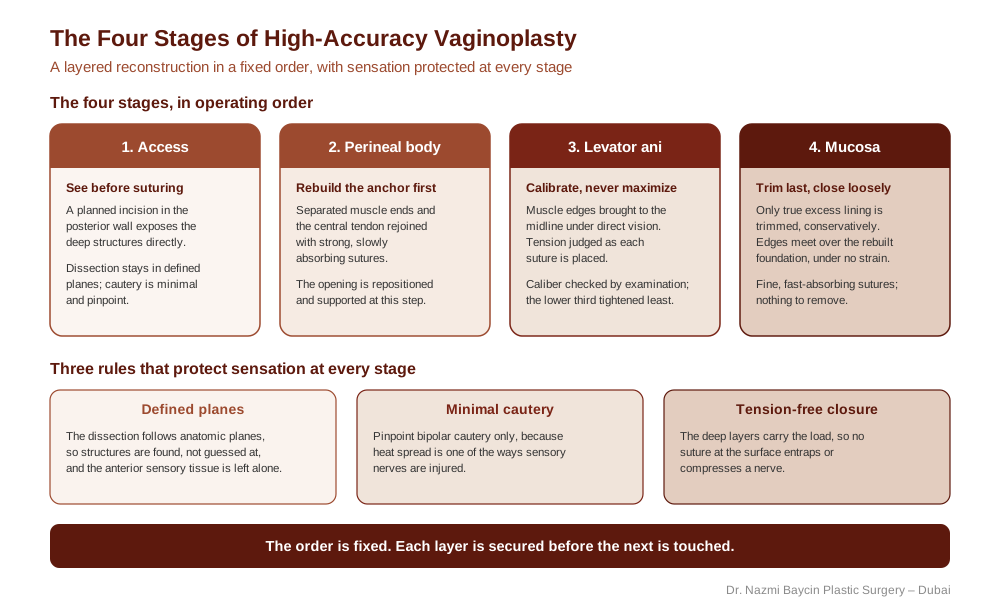
The four stages of high-accuracy vaginoplasty in operating order, access, perineal body, levator ani and mucosa, with the three rules that protect sensation at every stage and a fixed order in which each layer is secured before the next is touched, by Dr. Nazmi Baycin, Dubai.
How do I gain access without disturbing the sensory structures?
I gain access through a carefully planned incision in the posterior vaginal wall, which gives me direct visual and tactile access to the deep structures. That exposure is essential for accuracy, and it keeps the dissection away from the most sensitive anterior tissues.
Three rules govern this stage:
- The dissection stays in defined tissue planes, so the muscle edges are found rather than guessed at.
- Cautery is minimal and pinpoint, because heat spread is one of the ways sensory nerves are injured.
- Before any suture is placed, I identify the separated ends of the perineal muscles and the medial edges of the levator ani, so I know exactly what I am repairing.
Why the posterior approach protects sensation, and where the nerves actually run, is explained in my article on preserving the erogenous zones during vaginoplasty.
How do I rebuild the perineal body?
I rebuild the perineal body by bringing the separated ends of the perineal muscles and the central tendon back together with strong, slowly absorbing sutures, restoring its height and structural integrity. The sutures hold the repair for the months it takes firm scar tissue to form, and then they dissolve. This is the second stage, and it comes before the muscle plication for a reason: the perineal body is the pillar the levator repair rests on.
That step alone dramatically repositions and supports the vaginal opening. In practice I see two common faults in repairs done elsewhere:
- The perineal body was never rebuilt, so the opening still gapes even though the canal above it was narrowed.
- The sutures caught the skin and lining rather than the separated muscle ends themselves, so nothing held once the swelling settled.
What the perineal body is and why it matters so much is set out in my article on the perineal body as the keystone of the vaginal opening.
How do I plicate the levator ani and calibrate the tension?
I plicate the levator ani under direct vision, bringing the medial edges of the muscles back to the midline with a series of sutures, and I calibrate the tension as I go. The target is enough support to restore youthful tone, and never so much that the opening becomes rigid or painful.
Calibration is the heart of this stage, and it is judged, not measured on a scale. Three things guide it:
- How the muscle edges meet: they should come together without being dragged, so the repair is not under constant strain.
- The caliber at the end of the plication: I check the opening with my examining fingers before closing, to confirm it is supportive but compliant.
- The lower third: the opening itself is tightened least, with a graduated taper, because an over-tight introitus causes pain long after everything else has healed.
| Tension | What I find at the end of the plication | What you would feel afterward | My response during surgery |
|---|---|---|---|
| Too loose | Muscle edges still apart; the canal keeps its old caliber | Little change in support or tone | Add or reposition sutures until the edges meet |
| Calibrated | Edges meet in the midline without being dragged; the opening is supportive but compliant on examination | Restored support and tone, comfortable intercourse once healed | Proceed to the mucosa |
| Too tight | Edges pulled together under strain; a rigid, narrow opening | Pain, difficulty with intercourse, a repair that may tear | Release and re-place the sutures at lower tension |
How to read this table: the middle row is the only acceptable end point, and the other two describe what I correct before closing. The tension is set on the operating table, not left for healing to sort out.
How do I refine and close the mucosa?
Only once the deep support is secured do I address the lining. I trim any true excess conservatively and close it without tension over the newly reconstructed foundation.
Two points define this stage:
- Conservative trimming: the lining is not the source of support, so removing more of it adds nothing but strain on the closure.
- Tension-free closure: the deep layers already carry the load, so the mucosal edges simply meet. No suture here should entrap or compress a sensory nerve.
That layered, tension-free closure is paramount for healing and sensation. It is why my vaginoplasty patients in Dubai report not just improved tightness but better stability, control and sensation.
Which sutures do I use at each layer, and why?
I use absorbable sutures at every layer, but not the same ones: the deep layers get strong, slowly absorbing sutures that hold until scar tissue takes over, and the lining gets fine, fast-absorbing ones. The choice follows the job each layer does.
| Layer | Suture | Why | What you notice |
|---|---|---|---|
| Perineal body | Strong, slowly absorbing | The anchor must hold its height for the months it takes scar tissue to mature; the scar then carries it | Nothing; the sutures sit deep and are not felt |
| Levator ani plication | Strong, slowly absorbing, placed in series | The sling carries load with every cough and step, so the sutures must outlast the healing period before they go | Nothing once healed; early firmness settles over weeks |
| Mucosa | Absorbable, fine | The lining heals quickly and carries no load, so nothing needs to remain | Dissolve on their own; no removal visit |
How to read this table: the deeper the layer, the longer its suture must last before it dissolves. Nothing is left behind permanently; the repair is held by the sutures first and by your own scar tissue afterward.
How does each stage protect your sensation?
Each stage protects sensation by a specific rule: the access stays posterior and in defined planes, cautery is minimal, the plication is calibrated rather than maximal, and the closure carries no tension. A vaginoplasty that compromises sensation is a functional failure, however good it looks.
The structures I protect are the dorsal nerves to the clitoris and the sensory network of the vestibule. The detail of that discipline, the vaginal sensory map, the posterior-focused approach and the graduated taper that keeps the opening compliant, is the subject of my neuroanatomical approach to preserving erogenous sensation. The goal is to improve sexual function by restoring tone and support while safeguarding, and often improving, sensation. Function is never traded for form.
How does aesthetic refinement follow the functional repair in Dubai?
Aesthetic refinement comes after the functional repair, never instead of it, and its aim is a natural, symmetrical result that looks unoperated. Where it is indicated, it addresses the outside of the opening once the inside has been rebuilt.
Depending on your anatomy, that refinement may involve:
- Sculpting the labia majora and minora so they frame the opening harmoniously.
- Creating a smooth, youthful transition from the posterior fourchette to the perineal skin.
- Removing any residual redundancy or asymmetry at the opening.
When it is the right choice for you, this is also the stage at which I integrate a labiaplasty with the vaginoplasty. The two procedures complement each other well, restoring internal support and external form under one anesthetic with a single, coordinated recovery. Whether to combine them is a decision we make together at consultation, based on your anatomy and goals rather than a fixed template; the labiaplasty itself is described on my labiaplasty in Dubai page.
What does the evidence say about tightening alone?
The evidence says that vaginal laxity is a real, studied condition, and that tightening by itself has not been shown to improve sensation. I take that as a caution about what tightening alone achieves, not as an argument against repair.
A 2024 systematic review with meta-analysis of 38 studies of treatments for vaginal laxity assembled the published evidence across the range of approaches used to address it. Its findings deserve stating plainly:
- Most of the evidence concerns energy-based devices such as laser and radiofrequency, not layered surgical reconstruction.
- Sexual-function scores improved in the pooled observational studies, but that improvement did not hold in the randomized trials included in that analysis.
- The authors conclude that vaginal tightening did not improve sensation in women with vaginal laxity.
So the review establishes the condition without testing the operation I describe here. That is precisely why my aim is to treat the root cause structurally, at the level of the muscles and connective tissue that provide support, and to protect sensation at each stage rather than hope tightness will supply it.
Why must form and function be rebuilt together?
Because a tight result that does not function, or a functional repair that looks operated, is only half a result. At its best, vaginoplasty is a restorative surgery that honors the complexity of the female form.
Many women who consult me describe multifaceted concerns after several pregnancies and an active life, and a clear preference for a definitive surgical solution over temporary measures. What they value is an approach grounded in surgical anatomy rather than passing trends. A repair built on the perineal body and levator ani addresses the mechanical cause of laxity, which is why the result tends to be more functional and more durable than a superficial procedure.
The measure of the result is not how tight it feels at six weeks, but how naturally strong, sensate and balanced it remains over the long term. This anatomical philosophy runs through all of my genital plastic surgery practice in Dubai, and because every anatomy differs, we discuss your plan and its cost openly and confidentially at consultation.
Where can you read about each part of vaginoplasty in Dubai in more depth?
Each part of the subject has its own page: the procedure page covers candidacy, recovery, risks and cost, and the articles below each go deeper into one question.
- The procedure, candidacy, recovery, risks and cost: vaginoplasty in Dubai
- How laxity is assessed before anything is decided: how vaginal laxity is evaluated and the rejuvenation options
- The support system, level by level: the three levels of vaginal support
- Why the muscle, not the lining, must be repaired: muscle versus mucosa in vaginal tightening
- The keystone of the opening: the perineal body as the keystone of the vaginal opening
- Protecting sensation: preserving the erogenous zones during vaginoplasty
- Severely stretched tissue: vaginoplasty after multiple deliveries
FAQs about high-accuracy vaginoplasty in Dubai
-
What does “high-accuracy” mean in vaginoplasty?
It means the repair is carried out layer by layer, in a fixed order, under direct vision, with the tension of each layer judged on the operating table rather than left to chance. The perineal body is rebuilt first, the levator ani muscles are plicated second at calibrated tension, and only then is the lining trimmed conservatively and closed without tension. Each stage is secured before the next is touched. The accuracy lies in that discipline: the right structure, in the right order, at the right tension, with the sensory nerves protected throughout.
-
Why do you rebuild the perineal body before the levator ani?
Because the perineal body is the pillar the muscle repair rests on. Once its separated ends and central tendon are brought together with strong, slowly absorbing sutures, the opening is already repositioned and supported, and the levator ani plication above it has something solid to anchor to. If the order is reversed, or the perineal body is skipped, the muscle repair has no foundation and tends to loosen, and the opening can still gape even though the canal above was narrowed. Rebuilding the keystone first is what makes the rest of the repair hold.
-
How do you calibrate the tension of the muscle repair?
I judge it on the operating table, under direct vision, as I place each suture. The muscle edges should meet in the midline without being dragged together, so the repair is not under constant strain. At the end of the plication I check the caliber of the opening with my examining fingers to confirm it is supportive but compliant, and I tighten the lower third least, with a graduated taper, because an over-tight opening causes pain long after everything else has healed. If the edges are still apart I add sutures; if they are under strain I release and re-place them at lower tension.
-
Will I feel the sutures, or need them removed?
No to both. Every layer is closed with absorbable sutures, so nothing needs removing and nothing stays behind permanently. The deep sutures in the perineal body and the levator ani are strong and slow to dissolve, because those layers carry load with every cough and step and must be held until your own scar tissue has matured. They sit beneath the lining and are not felt once the tissues have healed. In the first weeks you may notice firmness along the repair, which settles as swelling resolves and the muscle adapts. The lining is closed with fine, fast-absorbing sutures that disappear on their own.
-
Why is the mucosa trimmed last and closed without tension?
Because the lining is not the source of support, and strain on it only harms healing. By the time I reach the mucosa, the perineal body and levator ani already carry the load, so the lining only has to cover the new foundation. I trim only true excess, conservatively, and bring the edges together so they meet without pulling. A closure under tension strains the healing edge, invites breakdown and can compress a sensory nerve; a tension-free one heals cleanly and keeps its sensation. Trimming more lining than necessary would add strain without adding support.
-
When do you integrate a labiaplasty into the same operation?
When your anatomy and goals call for refinement of the outer form as well as the inner support. The labiaplasty is performed at the aesthetic refinement stage, after the four functional stages are complete, so the outside is shaped around a rebuilt opening rather than the other way round. Combining them restores internal support and external form under one anesthetic with a single recovery. It is a decision we make together at consultation, based on what you have and what you want, never a fixed package.
-
Can this repair fix urinary leakage?
It may improve leakage that is linked to pelvic-floor weakness, because restoring the muscular support can help. True stress urinary incontinence, however, often has additional causes and frequently needs its own targeted treatment. For that reason I assess urinary symptoms carefully before surgery and set expectations honestly about what this repair can and cannot address. Where incontinence is a significant concern, we discuss it directly so that the overall plan accounts for it, rather than assuming the vaginoplasty alone will resolve it.


Book a private consultation with Dr. Baycin in Dubai
Get ready to look and feel best… You deserve…
